
PIONEERS IN SOCIOLOGY
One can't talk of Pioneers in Sociology without beginning with Auguste Comte, whose writings reached America, by the way, through the translation of a woman, Harriet Martineau, [although] he, as later Herbert Spencer and Lester Ward, was rather too dogmatic to measure up to what came to be called the sociological attitude.
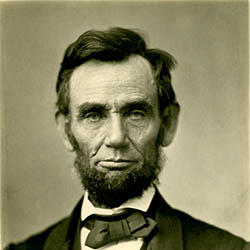
But one may be equally truthful in saying that the men responsible for the abolition of slavery in the British colonies as early as 1832 -- Lord [Shaftesbury] hotly defending children from exhausting labor in the Lancashire mills; Dr Chalmers studying the poor in his [Edinburgh] parish; Elizabeth Peabody insisting that the insane needed no mechanical restraint; the gifted Italian [Beccaria] inducing his government to abolish the death penalty; Abraham Lincoln studying the reaction of slave labor upon the character of the man with only his labor to sell; Arnold Toynbee rebelling against the theory of the economic man and substituting living, breathing creatures for an empty postulate; -- all of them employed the method which might be called sociological. They certainly challenged the traditional policy, and although they may have been hot with a sense of injustice or melting with compassion, they were still obliged to serve social processes in relation to results upon society.
Both scholars and philanthropists insisted that the traditional ways of interpreting human experience were often futile and set out to discover new and better ones. It was during the decade between 1880 and '90 that first courses in the social sciences were offered in various colleges and [page 2] universities, [although] Professor Sumner of Yale had given a series of lectures as early as 1876. The publication of Ward's second book in 1892, "Psychic Factors in Civilization," accelerated the process. I still recall the eager interest with which we discussed it that summer preceding the World's Fair when the spirit of enterprising youth descended upon the city and all things seemed possible!
The University of Chicago was the first to open a Department of Sociology, of which Dr. Albion W. Small was made head, in 1893, and in the very same month Graham Taylor was made professor of the department of Sociology in the Chicago Theological Seminary.
It is curious that in the history of its development in the United States, while a great deal is said about the students of economics, politics and history who gradually became conscious that their subjects did not include all of the field of human association and that social factors must be taken more largely into account, I have failed to find anywhere a stressing of the fact that these first three pioneers whom I have mentioned -- Sumner, Small and Taylor -- had all received a theological education, as had Francis Peabody, who gave the first course in social ↑ethics↓ science at Harvard -- ↑a course in↓ "Drainage, Drunkenness and Divorce," the gibing students used to call it.
But whether theologian, economist or historian, all of these early men were moved by a common unrest as to the unconvincing method of interpreting human life. They were vaguely conscious that "linear causation" is not the main connection of human events, in fact they even then suspected what was later [page 3] termed "vortex causation." It is a lovely phrase, if you take time to think of it -- "vortex causation."
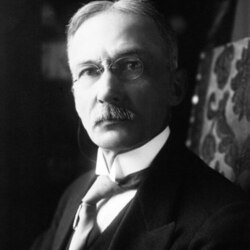
We are not at the moment concerned as to how the other theologians were able to make the crucial synthesis between the church's obligation to the individual soul and the conception of society as the result of an incessant action and reaction between the individuals within the group, and of groups upon each other; how they were able to accept an early definition of sociology as a technique for a scientific interpretation of human experience upon the basis of the group hypothesis in contrast with the individual hypothesis. How this synthesis was effected by Graham Taylor has happily been set down in his forthcoming book, of which I have been privileged to see the manuscript. He was a young clergyman in Hartford, Connecticut, preceding his call to teach in a ↑the↓ theological seminary there, and he says: "Our first home in Hartford, near the church, stood on the main street of the city, down from which side streets ran into the river wards that held three quarters of the city's poor and delinquent people within one quarter of its area. Our eight years' life and work there so identified us to the locality that the subsequent four years, during which we were connected with the seminary, extended our social contacts and acquaintanceships slowly in other parts of the city."
During those Hartford days he learned to know the vagrant and the criminal as well as the respectable poor, and it is in relation to the former that he writes: "These disclosures reinforced my religious conviction of the sanctity and worth of the individual so that it has never faded or been forgotten in the emphasis I later learned to place upon the group and the [page 4] aggregate of human beings. The person has never been to me a mere 'case' or specimen of a class or exhibit in any sociological laboratory." He had the unforgettable experience of seeing promising children neglected and destroyed, and he writes: "The nurture of child life and the protection and promotion of the welfare of childhood became both a primary and ultimate obligation." Education took on a social significance, and ↑when↓ he learned once for all that "education is a debt, culture an obligation, which can be honestly discharged only by turning back into the common life the best results of what others have made it possible for us to acquire and to be."
Graham Taylor himself ascribes his early interest in sociology not only to the scholars and practical men to whom I have referred but to such missionaries as Cyrus Hamlin in Turkey, introducing improved methods in agriculture; Jacob Chamberlain in his medical service in India; David [Livingstone's] intrepid portrayal of the evils in Africa. He was much influenced by the Indianapolis pastor McCulloch with his genealogical studies of the tribe of Ishmael; Stanley Hall's education studies; and, above all, by such men as Washington Gladden, David [Aiken] Reed in Springfield, professors ↑Peabody of Harvard and↓ Tucker of Andover, Richard T. Ely, Mark Baldwin, Josiah Royce ↑& John Graham Brooks.↓ These contemporaries were moving, as he was, towards a better methodology, toward the scientific spirit, which means "that a man is ready to let things be what they may be, whether or not he wants them to be that way. It means that he has conquered his desire to have the world justify his prejudices."
During Graham Taylor's teaching at Hartford (his chair ↑of Practical Theology↓ was entitled ↑included↓ "Homiletics, Liturgics, Pedagogy, Polity, Pastoral [page 5] Theology and Sociology!"), -- we find him desperately making out syllabi without precedent or source books and in general having all the troubles of the pioneer. A new science, working out its method, and technique ↑and↓ its very phraseology [illegible] as it goes, is not an easy undertaking.
I will say nothing of how he came to be summoned to the Theological Seminary in Chicago, but rather speak of what he found at this end of the journey when he moved from Hartford to Chicago in 1892.
The city was still nervous from the shock of the anarchist riot, and, under a suspicion that the situation had been met in a spirit of panic and had received little analysis or skilled treatment, the new Sunset Club was organized for discussion of the situation. Giant industries had been developed upon the shores of Lake Michigan without the restraint of industrial legislation, of collective bargaining, or even of adequate competition. Lusty industry had it all its own way in those days, and even the very first attempts to show up monopolies ↑as↓ founded [upon] preferential freight rates, was considered at the best impertinent and at the worst subversive of the established social order.
"[Muckraking]" had not yet become fashionable, and the "grey wolves" in the city council openly boasted of the amount they received from the granting of franchises and ostentatiously shared the loot with their poorest constituents. The red light district was ↑protected by the police, and↓ was a source of unending corruption to the entire force; the saloon was the acknowledged center of political activity. Even in such state institutions as Graham Taylor had learned to work with in Hartford, political patronage was openly dispensed ↑placed above the interests of the patients.↓ [page 6] The newspapers more and more measured events not as to their importance but as to their value as entertainment. Chicago, as other great cities, tended to dissolve almost as by a chemical process the customs and beliefs which were nurtured in rural and provincial society; nowhere ↑was this↓ so obvious as in foreign quarters of the city where landlords of the newly arrived immigrants, often ↑their↓ fellow countrymen, were concerned only with profit; the refuse was sporadically collected, if at all; the Belgian ↑wood↓ blocks which paved the ↑many↓ streets were so conveniently loosened by the rain each spring that they provided fuel for many a thrifty family for the rest of the year.
On the northern edge of this [widespread] city there had long stood a university, and in 1892 another was opened on its southern border. In the same ↑next↓ year was built a vision of beauty called the World's Columbian Exposition, which -- at least when dissolved by moonlight -- embodied the very spirit of Athens returned to earth; and at the same time on the Lake Front was erected the Art Institute under whose roof was held the first World's Congress of Religions. Perhaps the city itself that summer became dimly conscious that the arid wastes of human existence which it exhibited were not inevitable, and certainly men from all parts of the world bore testimony that a rising tide of religious fervor could not only make fertile such desert spots but was alone capable of carrying away the huge impedimenta which formed ↑such↓ inert barriers to human progress. William ↑T↓ Stead said something like that, in his book entitled "If Christ Came to Chicago," and I remember the high hope animating many of us when, at his instigation and perhaps castigation would be the better word -- the Civic Federation was started in a rousing meeting held [page 7] in Central Music Hall, with an organizing committee of five -- a clergyman, a saloon keeper, a business man, a trade unionist, and a women, -- appointed by Stead in a desperate attempt to find moral leadership! John Burns came a little later, full of enthusiasm for the new London County Council of which he was a member ↑and was↓ profoundly astonished by what he found in our City Council. When he hurt the feelings of Chicago by calling the city "a pocket edition of hell," he changed, in deference to ↑its↓ their boastfulness, saying that "hell was a pocket edition of Chicago," ↑and↓ the World's Greatest Newspaper really did like it better!
What should a man under these circumstances do, a man who was made head of a "department, the first of its kind in any seminary, Protestant, Jewish or Catholic, to be wholly devoted to the social interpretation and application of religion?"
It was laid upon him not only to bear a man's share of study into the stupid atrocities of contemporary life, its arid wastes, its meaningless labor, its needless suffering and its political corruption, but to make clear that if the church was going ↑hoped↓ to guide enlightened men in the complexities and contradictions of modern life, not only must the clergy receive an additional training, but the social compunctions of the laity, in their search for social righteousness, their desire for more order in the welter of human relationships, even their scruples and [self-distrust], must be formulated and utilized.
He must rally and unite the minority within the church itself who desired at the same time to express a personal compunction and to organize forms of socialized activity which would at least seem to lead toward social justice. Certainly [page 8] Beginning fifty years ago, there ↑certainly↓ has been discernible within the church a group demanding that new forms of [illegible] religious activity should express their yearning sense of justice and compassion. They have demanded this as insistently as the school men long ago -- perhaps at the least spiritual period in the church's history -- embodied their philosophy and theology into creeds and dogmas, or as the artists at another period expressed their absorbing thirst for beauty by building cathedrals and adorning sacred walls. This group never made the headway it promised in the days of Charles Kingsley and Maurice, or in the early adventures in altruism made by ardent high churchmen under the compulsion of the Oxford Movement. It was apparently not sufficiently "God driven," to use an Irish phrase, to send it out into the wilderness wherein to erect a new tabernacle, but it was nevertheless to the American prototypes of this group, attenuated [though] they were, both in numbers and zeal, that men like Graham ↑Dr↓ Taylor and other men in this faculty must come to rely.
How Graham Taylor to the measure of his ability met this difficult situation it is impossible to make clear in a short review, but I will ask you to recall with me his leadership of various groups and his constructive effort in many directions.
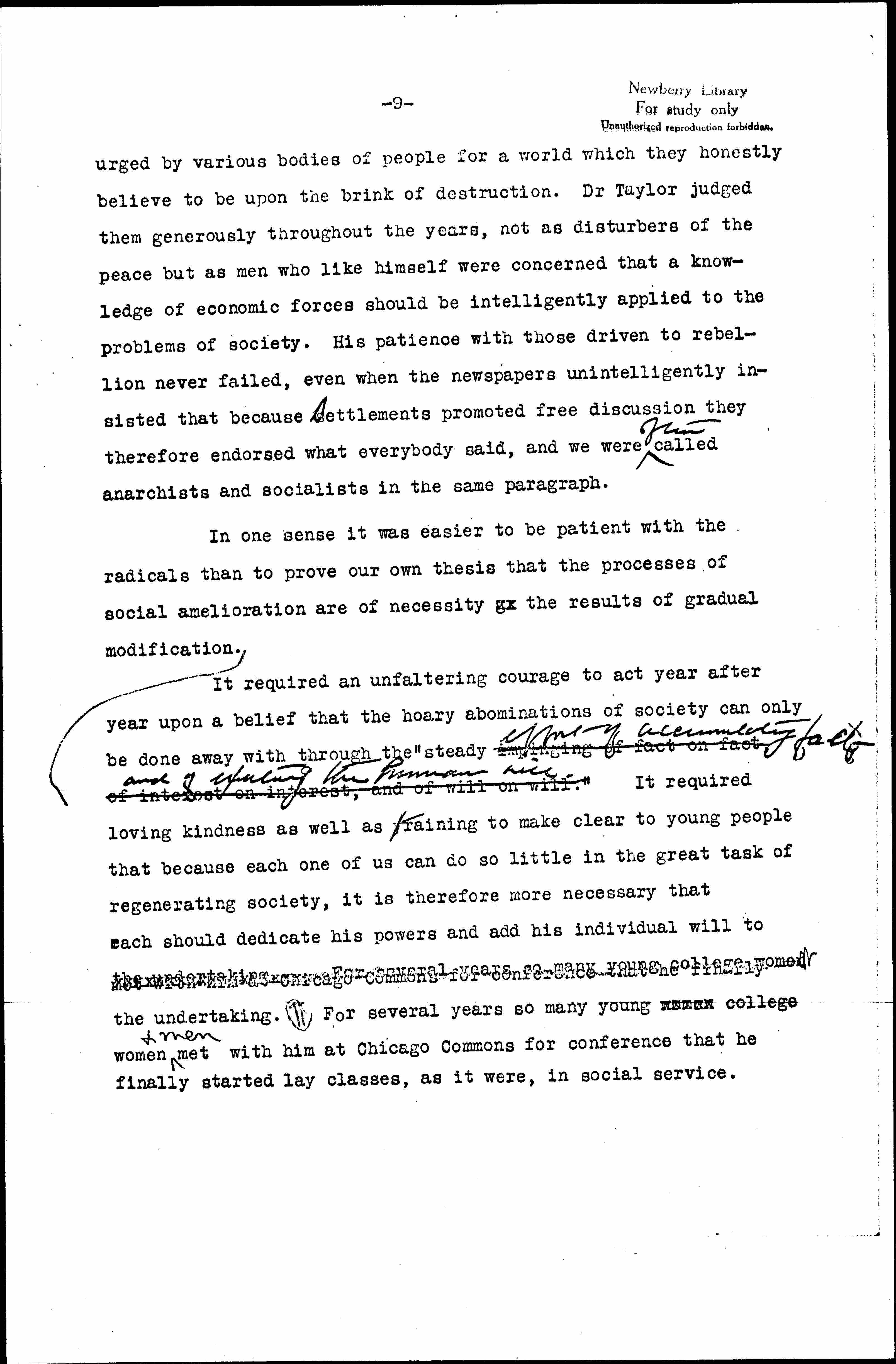
Very early he founded Chicago Commons, located in a river ward in a rambling old house that some of us still remember. It was not altogether easy for a man of his background, with a family of growing children, to take this step. One of the first things he did was to try to relieve "the suppressed desires" of the radicals in the city by giving them an opportunity to debate upon a free floor. No one can be ↑really↓ useful in the long and delicate task of social amelioration unless he knows the changes being [page 9] urged by various bodies of people for a world which they honestly believe to be upon the brink of destruction. Dr Taylor judged them generously throughout the years, not as disturbers of the peace but as men who like himself were concerned that a knowledge of economic forces should be intelligently applied to the problems of society. His patience with those driven to rebellion never failed, even when the newspapers unintelligently insisted that because Settlements promoted free discussion they therefore endorsed what everybody said, and we were ↑often↓ called anarchists and socialists in the same paragraph.
In one sense it was easier to be patient with the radicals than to prove our own thesis that the processes of social amelioration are of necessity [illegible] the results of gradual modification. It required an unfaltering courage to act year after year upon a belief that the hoary abominations of society can only be done away with through the impinging of fact on fact of interest on interest, and of will on will "steady ↑effort of accumulating facts and of exalting the human will.↓" It required loving kindness as well as training to make clear to young people that because each one of us can do so little in the great task of regenerating society, it is therefore more necessary that each should dedicate his powers and add his individual will to the undertaking. For several years so many young college women illegible] Chicago Commons for conference that he finally the undertaking.
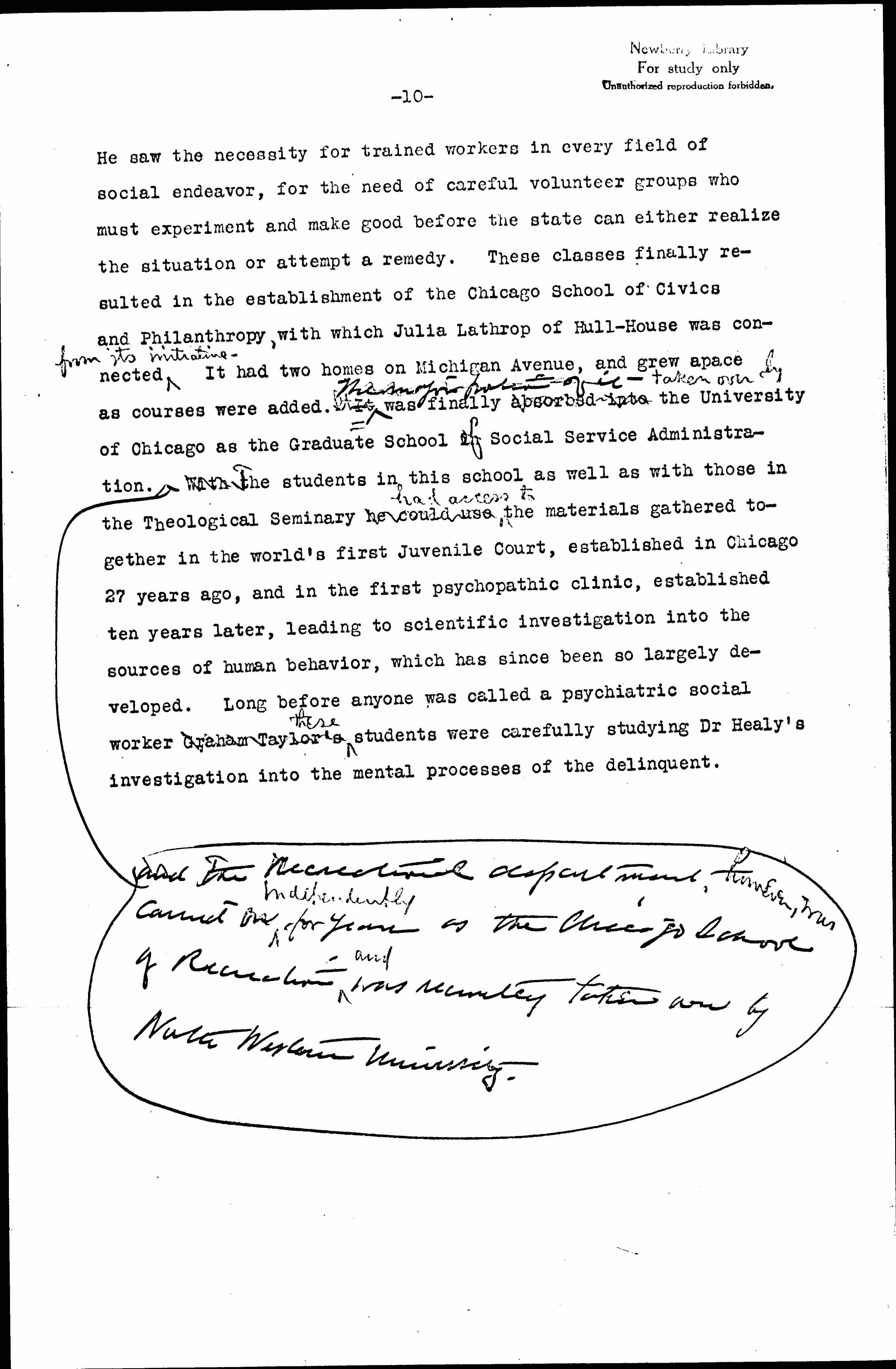
For several years so many young [illegible] college women ↑& men↓ met with him at Chicago Commons for conference that he finally started lay classes, as it were, in social service. [page 10] He saw the necessity for trained workers in every field of social endeavor, for the need of careful volunteer groups who must experiment and make good before the state can either realize the situation or attempt a remedy. These classes finally resulted in the establishment of the Chicago School of Civics and Philanthropy, with which Julia Lathrop of Hull-House was connected ↑from its initiative.↓ It had two homes on Michigan Avenue, and grew apace as courses were added. It ↑The major portion of it↓ was finally absorbed into ↑taken over by↓ the University of Chicago as the Graduate School of Social Service Administration. ↑and The recreational department, ↑however, was↓ carried on ↑independently↓ for years as the Chicago School of Recreation ↑and↓ was recently taken over by [Northwestern] University.↓ With The students in this school as well as with those in the Theological Seminary he could use ↑had access to↓ the materials gathered together in the world's first Juvenile Court, established in Chicago 27 years ago, and in the first psychopathic clinic, established ten years later, leading to scientific investigation into the sources of human behavior, which has since been so largely developed. Long before anyone was called a psychiatric social worker Graham Taylor ↑these↓ students were carefully studying Dr. Healy's investigation into the mental processes of the delinquent. [page 11]
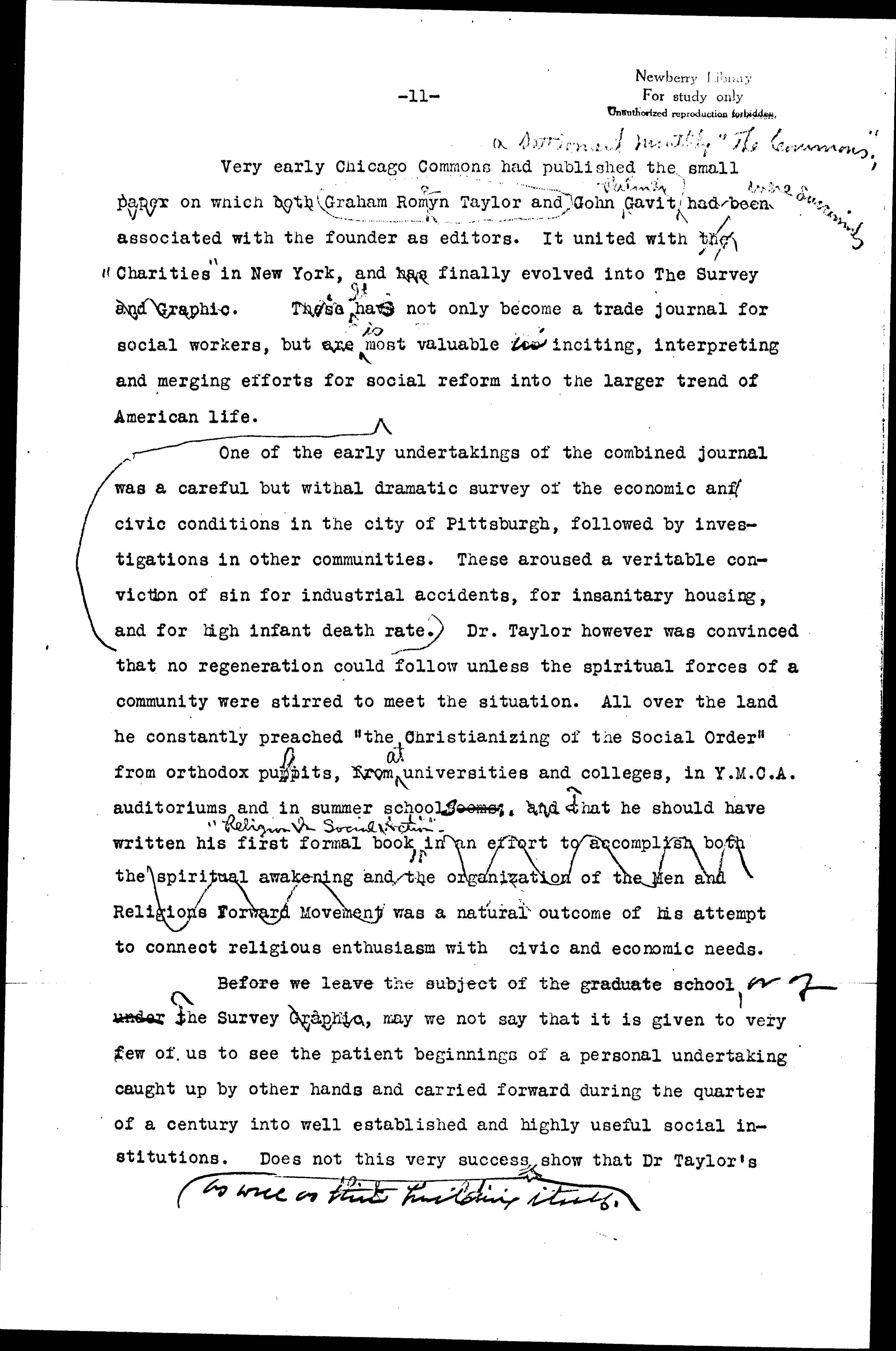
Very early Chicago Commons had published ↑a settlement monthly "The Commons,"↓ the small paper on which both Graham Romeyn Taylor and John ↑Palmer↓ Gavit had been ↑were successively↓ associated with the founder as editors. It united with the "Charities" in New York, and has finally evolved into The Survey and Graphic. These ↑It↓ has not only become a trade journal for social workers, but are ↑is↓ most valuable in inciting, interpreting and merging efforts for social reform into the larger trend of American life. One of the early undertakings of the combined journal was a careful but withal dramatic survey of the economic and civic conditions in the city of Pittsburgh, followed by investigations in other communities. These aroused a veritable conviction of sin for industrial accidents, for insanitary housing, and for high infant death-rate.
Dr. Taylor however was convinced that no regeneration could follow unless the spiritual forces of a community were stirred to meet the situation. All over the land he constantly preached "the Christianizing of the Social Order" from orthodox pulpits, from ↑at↓ universities and colleges, in Y.M.C.A. auditoriums and in summer schools. seems, and That he should have written his first formal book, ↑“Religion in Social Action"↓ in an effort to accomplish both the spiritual awakening and the organization of the Men and Religions Forward Movement was a natural outcome of his attempt to connect religious enthusiasm with civic and economic needs.
Before we leave the subject of the Graduate School, ↑or of↓ The Survey Graphic, may we not say that it is given to very few of us to see the patient beginnings of a personal undertaking caught up by other hands and carried forward during the quarter of a century into well established and highly useful social institutions. Does not this very success ↑as well as this building itself,↓ show that Dr Taylor's [page 12] social experiments, in the words of Prof. James, "were true," because "assimilated, validated, and verified in experience."
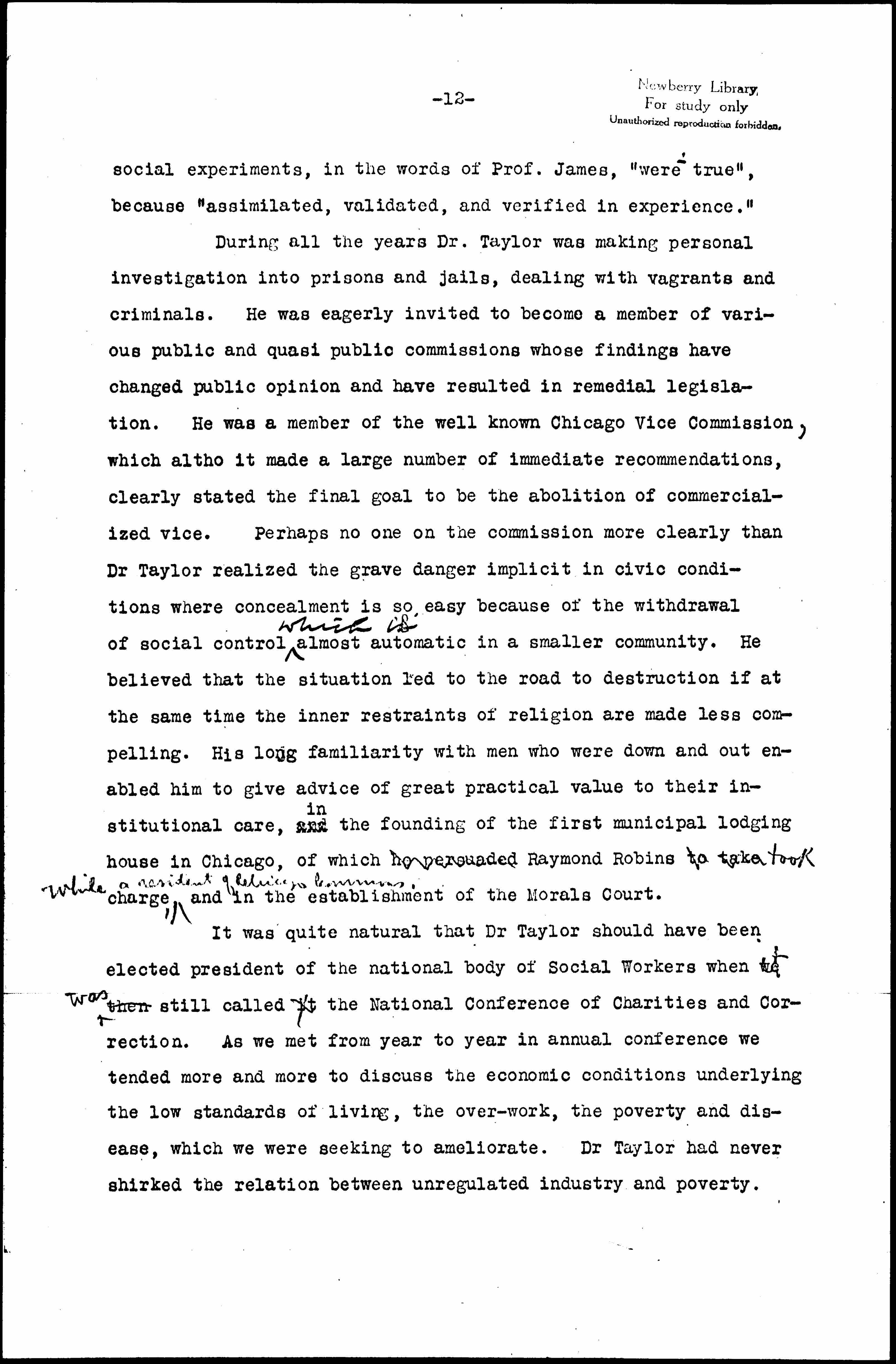
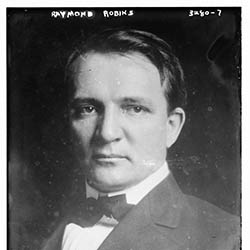
During all the years Dr. Taylor was making personal investigation into prisons and jails, dealing with vagrants and criminals. He was eagerly invited to become a member of various public and [quasi-public] commissions whose findings have changed public opinion and have resulted in remedial legislation. He was a member of the [well-known] Chicago Vice Commission, which [although] it made a large number of immediate recommendations, clearly stated the final goal to be the abolition of commercialized vice. Perhaps no one on the commission more clearly than Dr Taylor realized the grave danger implicit in civic conditions where concealment is so easy because of the withdrawal of social control ↑which is↓ almost automatic in a smaller community. He believed that the situation led to the road to destruction if at the same time the inner restraints of religion are made less compelling. His long familiarity with men who were down and out enabled him to give advice of great practical value to their institutional care, and ↑in↓ the founding of the first municipal lodging house in Chicago, of which he persuaded Raymond Robins to take ↑took↓ charge ↑while a resident of Chicago Commons,↓ and in the establishment of the Morals Court.
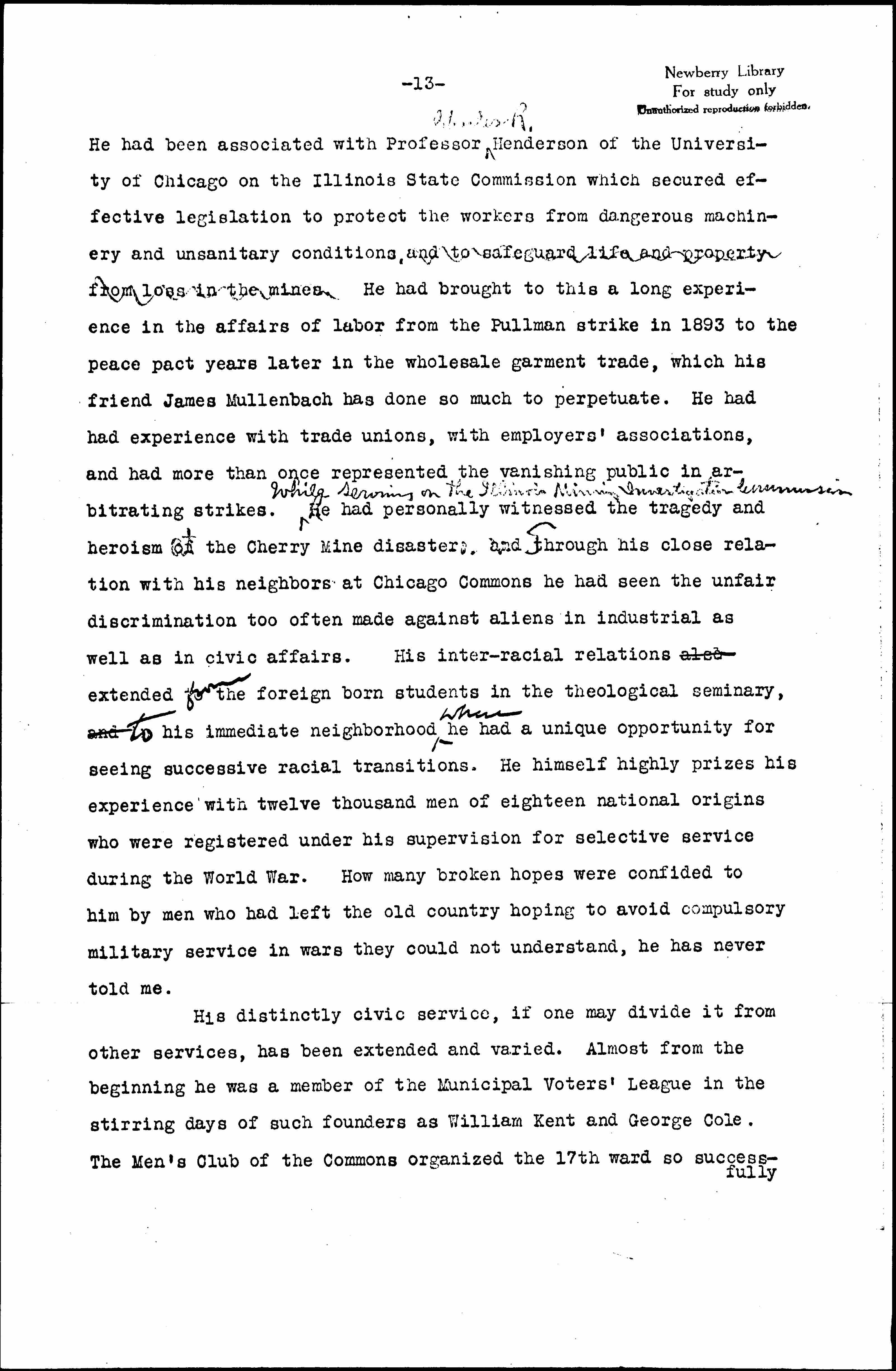
It was quite natural that Dr Taylor should have been elected president of the national body of Social Workers when we ↑it was↓ still called it the National Conference of Charities and Correction. As we met from year to year in annual conference we tended more and more to discuss the economic conditions underlying the low standards of living, the over-work, the poverty and disease, which we were seeking to ameliorate. Dr Taylor had never shirked the relation between unregulated industry and poverty. [page 13] He had been associated with Professor ↑Charles R.↓ Henderson of the University of Chicago on the Illinois State Commission which secured effective legislation to protect the workers from dangerous machinery and unsanitary conditions. and to safeguard life and property from logs in the mines. He had brought to this a long experience in the affairs of labor from the Pullman strike in 1893 to the peace pact years later in the wholesale garment trade, which his friend James Mullenbach has done so much to perpetuate. He had had experience with trade unions, with employers' associations, and had more than once represented the vanishing public arbitrating strikes. ↑While serving on the Illinois Mining Investigation Commission↓ he had personally witnessed the tragedy and heroism at the Cherry Mine disasters. and Through his close relation with his neighbors at Chicago Commons he had seen the unfair discrimination too often made against aliens in industrial as well as in civic affairs. His [interracial] relations also extended to ↑from↓ the foreign born students in the theological seminary, and ↑to↓ his immediate neighborhood ↑where↓ he had a unique opportunity for seeing successive racial transitions. He himself highly prizes his experience with twelve thousand men of eighteen national origins who were registered under his supervision for selective service during the World War. How many broken hopes were confided to him by men who had left the old country hoping to avoid compulsory military service in wars they could not understand, he has never told me.
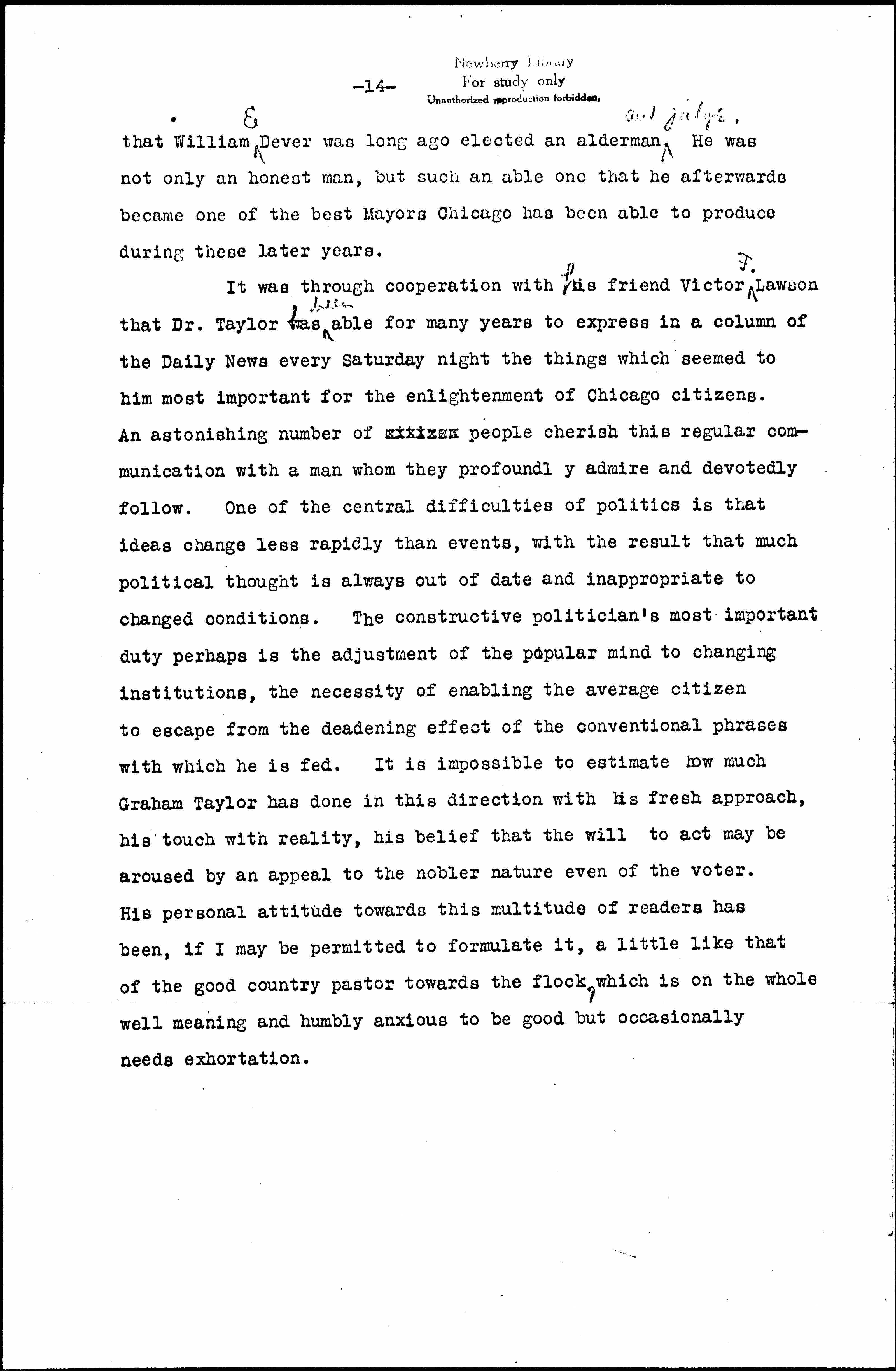
His distinctly civic service, if one may divide it from other services, has been extended and varied. Almost from the beginning he was a member of the Municipal Voters' League in the stirring days of such founders as William Kent and George Cole. The Men's Club of the Commons organized the 17th Ward so successfully [page 14] that William E Dever was long ago elected an alderman ↑and judge↓. He was not only an honest man, but such an able one that he afterward became one of the best Mayors Chicago has been able to produce during these later years.
It was through cooperation with his friend Victor ↑F.↓ Lawson that Dr. Taylor has ↑been↓ able for many years to express in a column of the Daily News every Saturday night the things which seemed to him most important for the enlightenment of Chicago citizens. An astonishing number of citizen people cherish this regular communication with a man whom they profoundly admire and devotedly follow. One of the central difficulties of politics is that ideas change less rapidly than events, with the result that much political thought is always out of date and inappropriate to changed conditions. The constructive politician's most important duty perhaps is the adjustment of the popular mind to changing institutions, the necessity of enabling the average citizen to escape from the deadening effect of the conventional phrases with which he is fed. It is impossible to estimate how much Graham Taylor has done in this direction with his fresh approach, his touch with reality, his belief that the will to act may be aroused by an appeal to the nobler nature even of the voter. His personal attitude towards this multitude of readers has been, if I may be permitted to formulate it, a little like that of the good country pastor toward the flock, which is on the whole [well-meaning] and humbly anxious to be good but occasionally needs exhortation. [page 15]
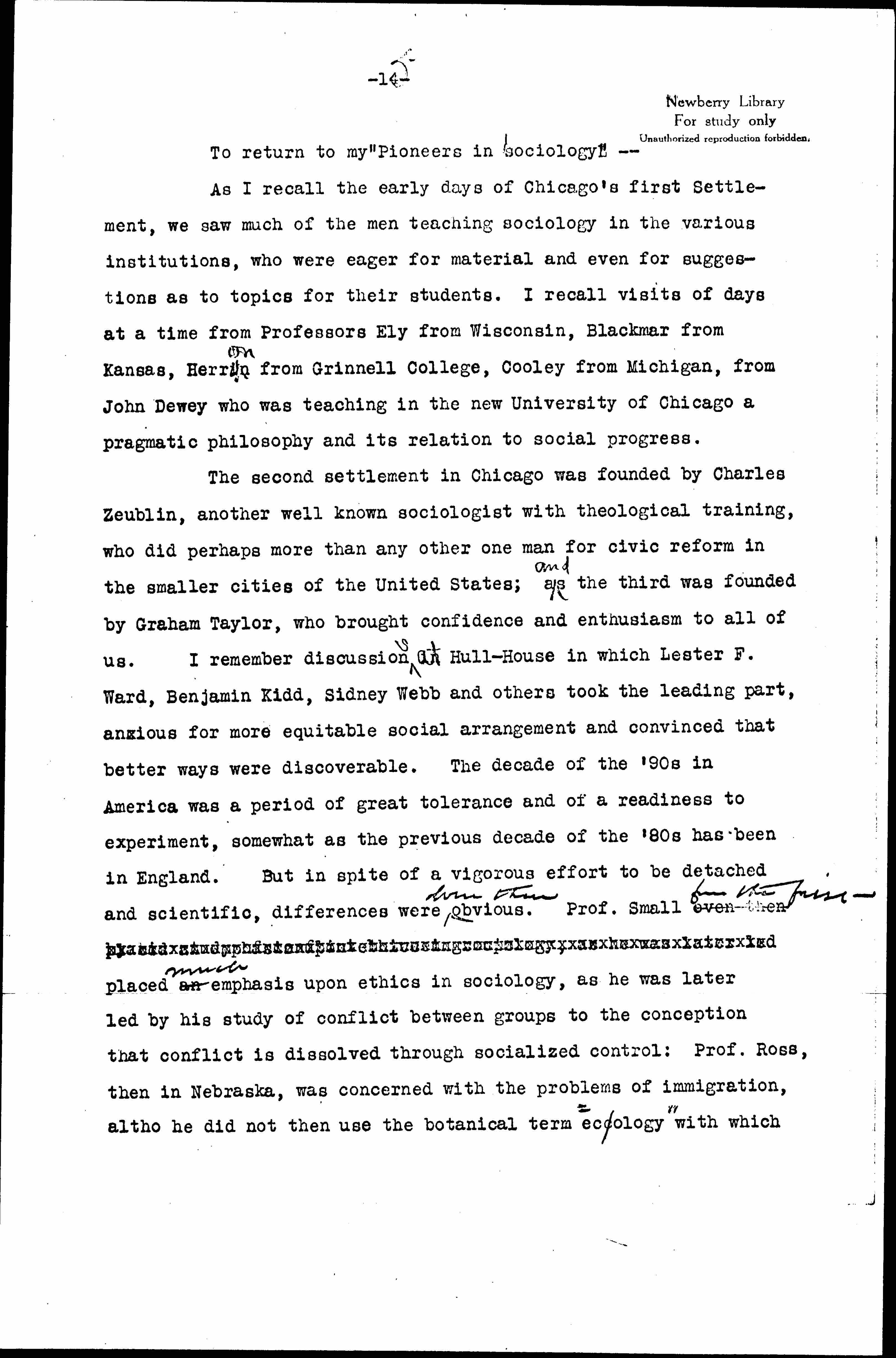
To return to my "Pioneers in sociology" --
As I recall the early days of Chicago's first Settlement, we saw much of the men teaching sociology in the various institutions, who were eager for material and even for suggestions as to topics for their students. I recall visits of days at a time from Professors Ely from Wisconsin, Blackmar from Kansas, Herron from Grinnell College, Cooley from Michigan, from John Dewey who was teaching in the new University of Chicago a pragmatic philosophy and its relation to social progress.
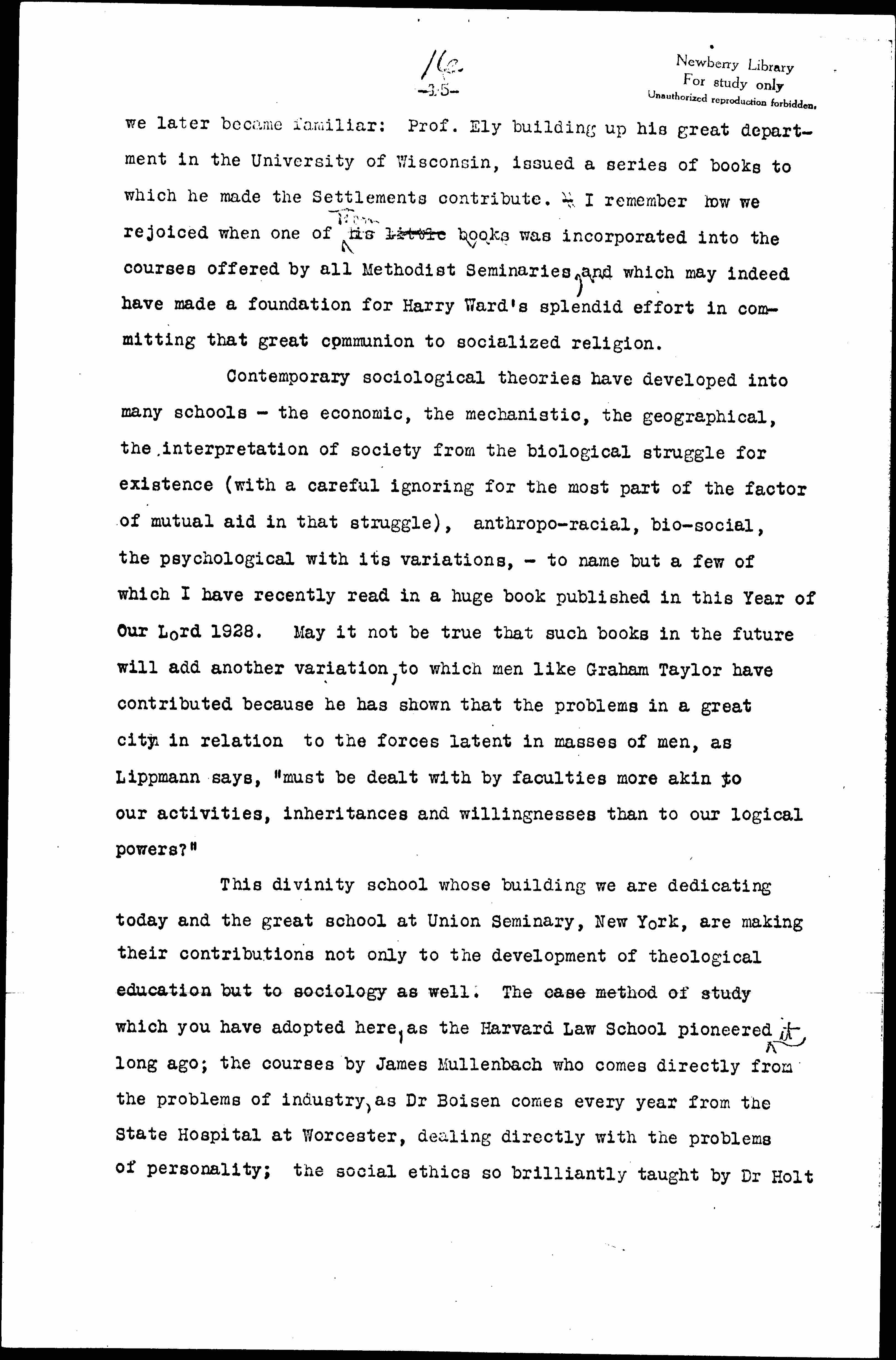
The second settlement in Chicago was founded by Charles [Zueblin], another [well-known] sociologist with theological training, who did perhaps more than any other one man for civic reform in the smaller cities of the United States; as ↑and↓ as the third was founded by Graham Taylor, who brought confidence and enthusiasm to all of us. I remember discussions at Hull-House in which Lester F. Ward, Benjamin Kidd, Sidney Webb and others took the leading part, anxious for more equitable social arrangement and convinced the better ways were discoverable. The decade of the '90s in America was a period of great tolerance and of a readiness to experiment, somewhat as the previous decade of the '80s had been in England. But in spite of a vigorous effort to be detached and scientific, differences were ↑[from] them↓ obvious. Prof. Small even then ↑from the first↓ [illegible] placed an ↑much↓ emphasis upon ethics in sociology, as he was later led by his study of conflict between groups to the conception that conflict is dissolved through socialized control; Prof. Ross, then in Nebraska, was concerned with the problems of immigration, [although] he did not then use the botanical term "ecology" with which [page 16] we later became familiar; Prof. Ely building up his great department in the University of Wisconsin, issued a series of books to which he made the Settlements contribute. I remember how we rejoiced when one of ↑them↓ his little books was incorporated into the courses offered by all Methodist Seminaries, and which may indeed have made a foundation for Harry Ward's splendid effort in committing that great communion to socialized religion.
Contemporary sociological theories have developed into many schools -- the economic, the mechanistic, the geographical, the interpretation of society from the biological struggle for existence (with a careful ignoring for the most part of the factor of mutual aid in that struggle), anthropo-racial, bio-social, the psychological with its variations, -- to name but a few of which I have recently read in a huge book published in this Year of Our Lord 1928. May it not be true that such books in the future will add another variation, to which men like Graham Taylor have contributed because he has shown that the problems in a great city in relation to the forces latent in masses of men, as Lippman says, "must be dealt with by faculties more akin to our activities, inheritance and willingness than to our logical powers?"
This divinity school whose building we are dedicating today and the great school at Union Seminary, New York, are making their contributions not only to the development of theological education but to sociology as well. The case method of study which you have adopted here, as the Harvard Law School pioneered ↑it↓ long ago; the courses by James Mullenbach who comes directly from the problems of industry, as Dr Boisen comes every year from the State Hospital at Worcester, dealing directly with the problems of personality; the social ethics so brilliantly taught by Dr Holt [page 17] with ↑as by↓ his recent investigation into the consciences of the farmers in McHenry County; -- these and many other achievements could be pointed out as the beginnings, if you choose to use the name, of these ↑this↓ religio-social group, adding more to the bewildering array of sociological variants. How many we shall have before the philosopher is born who shall make for us a satisfactory synthesis I do not know, [although] I predict that even then, that protecting himself as best he may by philosophic calm, he will have to take his stand in the very center of ↑its↓ "vortex causation."
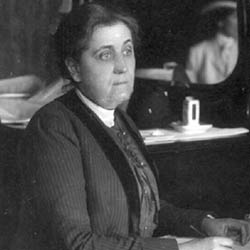
Jane Addams




Comments
Cathy Moran Hajo
Thanks to Akheel Mohammed for identifying Cesare Beccaria as the Italian opponent of the death penalty!