Commission Seeking Remedy For Eradicating The Causes Which Make Social Outcasts, May 31, 1927 [fragment]

REEL0019_0313.jpg

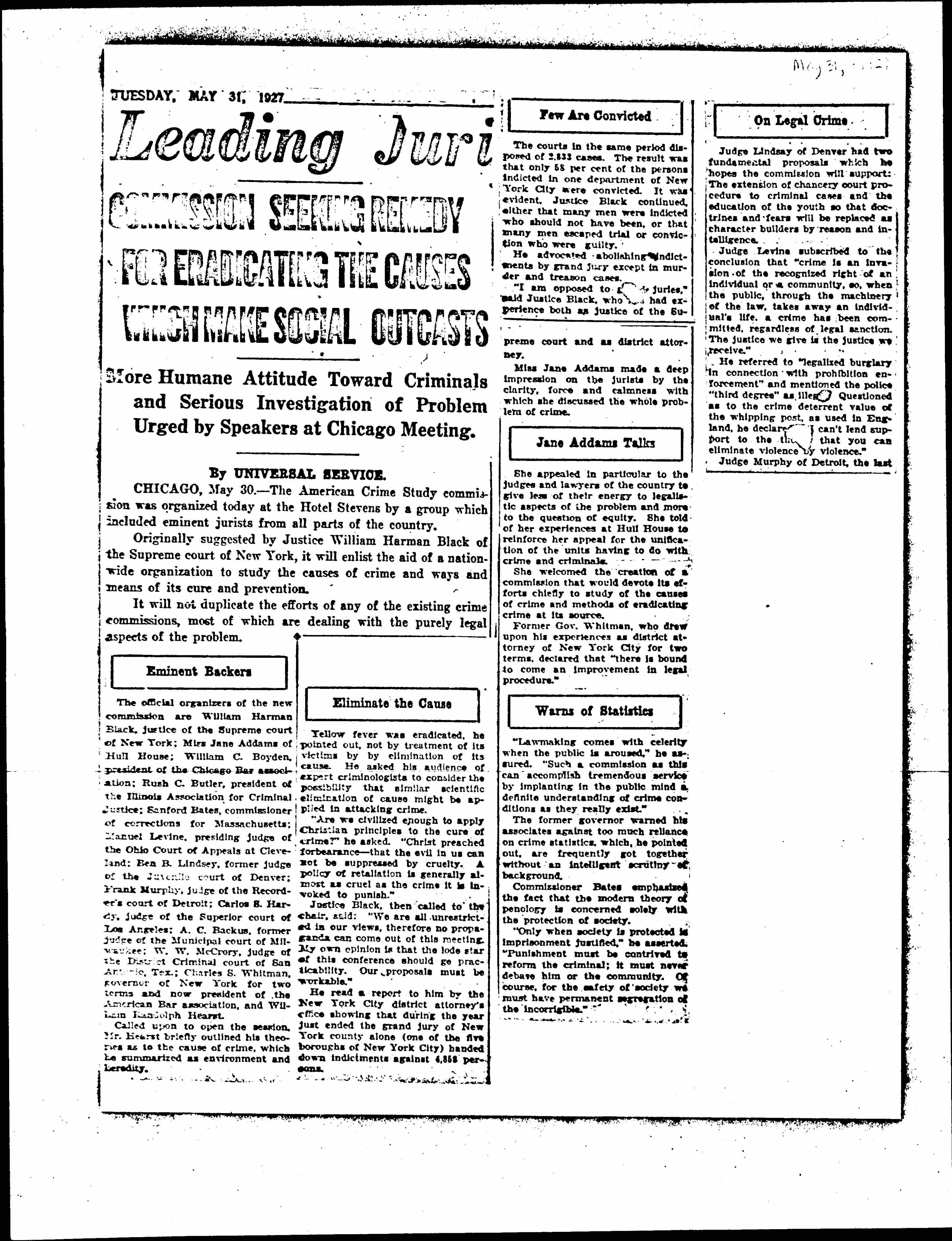
CHICAGO, MAY 30 -- The American Crime Study Commission was organized today at the Hotel Stevens by a group which included eminent jurists from all parts of the country.

Originally suggested by Justice William [Harmon] Black of the Supreme Court of New York, it will enlist the aid of a nationwide organization to study the causes of crime and ways and means of its cure and prevention.

It will not duplicate the efforts of any of the existing crime commissions, most of which are dealing with the purely legal aspects of the problem.

The official organizers of the new commission are William [Harmon] Black, justice of the Supreme Court of New York; Miss Jane Addams of Hull House; William C. Boyden, president of the Chicago Bar Association; Rush C. Butler, president of the Illinois Association for Criminal Justice; Sanford Bates, commissioner of corrections for Massachusetts; [Emanuel] Levine, presiding judge of the Ohio Court of Appeals at Cleveland; Ben B. Lindsey, former judge of the Juvenile Court of Denver; Frank Murphy, judge of the Recorder's Court of Detroit; Carlos S. Hardy, judge of the Superior Court of Los Angeles; A. C. Backus, former judge of the Municipal Court of Milwaukee; W. W. McCrory, judge of the District Criminal Court of San Antonio, Tex.; Charles S. Whitman, governor of New York for two terms and now president of the American Bar Association, and William Randolph Hearst.

Called upon to open the session, Mr. Hearst briefly outlined his theories as to the cause of crime, which he summarized as environment and heredity.

Yellow fever was eradicated, he pointed out, not by treatment of its victims [but] by elimination of its cause. He asked his audience of expert criminologists to consider the possibility that similar scientific elimination of cause might be applied in attacking crime.

"Are we civilized enough to apply Christian principles to the cure of crime?" he asked. "Christ preached forbearance -- that the evil in us can not be suppressed by cruelty. A policy of retaliation is generally almost as cruel as the crime it is invoked to punish."

Justice Black, then called to the chair, said: "We are all unrestricted in our views, therefore no propaganda can come out of this meeting. My own opinion is that the lode star of this conference should [get] practicability. Our proposals must be workable."

He read a report to him by the New York City district attorney's office showing that during the year just ended the grand jury of New York county alone (one of the five boroughs of New York City) handed down indictments against [4,858] persons.

The courts in the same period disposed of 2,833 cases. The result was that only 58 [percent] of the persons indicted in one department of New York City were convicted. It was evident, Justice Black continued, either that many men were indicted who should not have been, or that many men escaped trial or conviction who were guilty.

He advocated abolishing indictments by grand jury except in murder and treason cases.

"I am opposed to [grand] juries," said Justice Black, who [has] had experience both as justice of the Supreme Court and as district attorney.

Miss Jane Addams made a deep impression on the jurists by the clarity, force and calmness with which she discussed the whole problem of crime.

She appealed in particular to the judges and lawyers of the country to give less of their energy to legalistic aspects of the problem and more to the question of equity. She told of her experiences at Hull House to reinforce her appeal for the unification of the units having to do with crime and criminals.

She welcomed the creation of a commission that would devote its efforts chiefly to study of the causes of crime and methods of eradicating crime at its source.

Former Gov. Whitman, who drew upon his experiences as district attorney of New York City for two terms, declared that "there is bound to come an improvement in legal procedure."

"Lawmaking comes with celerity when the public is aroused," he assured. "Such a commission as this can accomplish tremendous service by implanting in the public mind a definite understanding of crime conditions as they really exist."

The former governor warned his associates against too much reliance on crime statistics, which, he pointed out, are frequently got together without an intelligent scrutiny of background.

Commissioner Bates emphasized the fact that the modern theory of penology is concerned solely with the protection of society.

"Only when society is protected is imprisonment justified," he asserted. "Punishment must be contrived to reform the criminal; it must never debase him or the community. Of course, for the safety of society we must have permanent segregation of the incorrigible."

Judge Lindsey of Denver had two fundamental proposals which he hopes the commission will support: The extension of chancery court procedures to criminal cases and the education of the youth so that doctrines and fears will be replaced as character builders by reason and intelligence.

Judge Levine subscribed to the conclusion that "crime is an invasion of the recognized right of an individual or a community, so, when the public, through the machinery of the law, takes away an individual's life, a crime has been committed, regardless of legal sanction. "The justice we give is the justice we receive."

He referred to "legalized burglary in connection with prohibition enforcement" and mentioned the police "third degrees" as [illegal.] Questioned as to the crime deterrent value of the whipping post, as used in England, he [declared, "I] can't lend support to the [thought] that you can eliminate violence by violence."

Judge Murphy of Detroit, the last [page(s) missing]