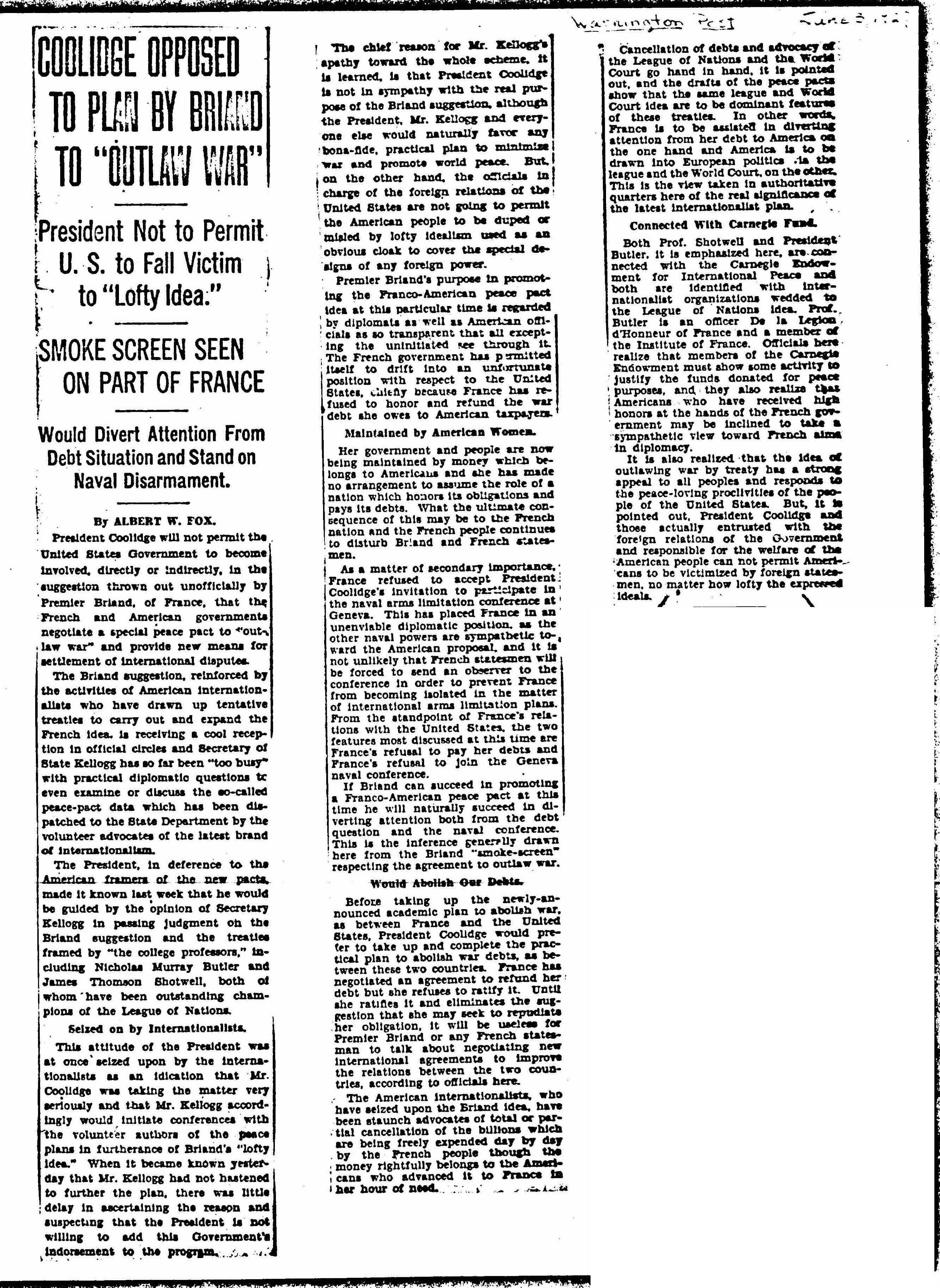
President Coolidge will not permit the United States Government to become involved, directly or indirectly, in the suggestion thrown out unofficially by Premier Briand, of France, that the French and American governments negotiate a special peace pact to "outlaw war" and provide new means for settlement of international disputes.
The Briand suggestion, reinforced by the activities of American internationalists who have drawn up tentative treaties to carry out and expand the French idea, is receiving a cool reception in official circles and Secretary of State Kellogg has so far been "too busy" with practical diplomatic questions to even examine or discuss the so-called peace-pact data which has been dispatched to the State Department by the volunteer advocates of the latest brand of internationalism.
The President, in deference to the American framers of the new pacts, made it known last week that he would be guided by the opinion of Secretary Kellogg in passing judgment on the Briand suggestion and the treaties framed by "the college professors," including Nicholas Murray Butler, and James Thomson Shotwell, both of whom have been outstanding champions of the League of Nations.
This attitude of the President was at once seized upon by the internationalists as an indication that Mr. Coolidge was taking the matter very seriously and that Mr. Kellogg accordingly would initiate conferences with the volunteer authors of the peace plans in furtherance of Briand's "lofty idea." When it became known yesterday that Mr. Kellogg had not hastened to further the plan, there was little delay in ascertaining the reason and suspecting that the President is not willing to add this Government's [endorsement] to the program.
The chief reason for Mr. Kellogg's apathy toward the whole scheme, it is learned, is that President Coolidge is not in sympathy with the real purpose of the Briand suggestion, although the President, Mr. Kellogg and everyone else would naturally favor any bona-fide, practical plan to minimize war and promote world peace. But, on the other hand, the officials in charge of the foreign relations of the United States are not going to permit the American people to be duped or misled by lofty idealism used as an obvious cloak to cover the special designs of any foreign power.
Premier Briand's purpose in promoting the Franco-American peace pact idea at this particular time is regarded by diplomats as well as American officials as so transparent that all excepting the uninitiated see through it. The French government has permitted itself to drift into an unfortunate position with respect to the United States, chiefly because France has refused to honor and refund the war debt she owes to American taxpayers.
Her government and people are now being maintained by money which belongs to Americans and she has made no arrangement to assume the role of a nation which honors its obligations and pays its debts. What the ultimate consequence of this may be to the French nation and the French people continues to disturb Briand and French statesmen.
As a matter of secondary importance, France refused to accept President Coolidge's invitation to participate in the naval arms limitation conference at Geneva. This has placed France in an unenviable diplomatic position, as the other naval powers are sympathetic toward the American proposal, and it is not unlikely that French statesmen will be forced to send an observer to the conference in order to prevent France from becoming isolated in the matter of international arms limitation plans. From the standpoint of France's relations with the United States, the two features most discussed at this time are France's refusal to pay her debts and France's refusal to join the Geneva naval conference.
If Briand can succeed in promoting a Franco-American peace pact at this time he will naturally succeed in diverting attention both from the debt question and the naval conference. This is the inference generally drawn here from the Briand "smoke-screen" respecting the agreement to outlaw war.
Before taking up the newly-announced academic plan to abolish war, as between France and the United States, President Coolidge would prefer to take up and complete the practical plan to abolish war debts, as between these two countries. France has negotiated an agreement to refund her debt but she refuses to ratify it. Until she ratifies it and eliminates the suggestion that she may seek to repudiate her obligation, it will be useless for Premier Briand or any French statesman to talk about negotiating new international agreements to improve the relations between the two countries, according to officials here.
The American internationalists, who have seized upon the Briand idea, have been staunch advocates of total or partial cancellation of the billions which are being freely expended day by day by the French people though the money rightfully belongs to the Americans who advanced it to France in her hour of need.
Cancellation of debts and advocacy of the League of Nations and the World Court go hand in hand, it is pointed out, and the drafts of the peace pacts show that the same league and World Court idea are to be dominant features of these treaties. In other words, France is to be assisted in diverting attention from her debt to America on the one hand and America is to be drawn into European politics via the league and the World Court, on the other. This is the view taken in authoritative quarters here of the real significance of the latest internationalist plan.
Both Prof. Shotwell and President Butler, it is emphasized here, are connected with the Carnegie Endowment for International Peace and both are identified with internationalist organizations wedded to the League of Nations idea. Prof. Butler is an officer De la Legion d'Honneur of France and a member of the Institute of France. Officials here realize that members of the Carnegie Endowment must show some activity to justify the funds donated for peace purposes, and they also realize that Americans who have received high honors at the hands of the French government may be inclined to take a sympathetic view toward French aims in diplomacy.
It is also realized that the idea of outlawing war by treaty has a strong appeal to all peoples and responds to the peace-loving proclivities of the people of the United States. But, it is pointed out, President Coolidge and those actually entrusted with the foreign relations of the Government and responsible for the welfare of the American people can not permit Americans to be victimized by foreign statesmen, no matter how lofty the expressed ideals.

Comments