
Problem of Crime Unsolved, Let Us Start at It Anew, May 30, 1927

REEL0048_0864.jpg
REEL0048_0865.jpg
REEL0048_0866.jpg
REEL0048_0867.jpg
REEL0048_0868.jpg
REEL0048_0869.jpg
REEL0048_0870.jpg
REEL0048_0871.jpg
REEL0048_0872.jpg
REEL0048_0873.jpg
REEL0048_0874.jpg

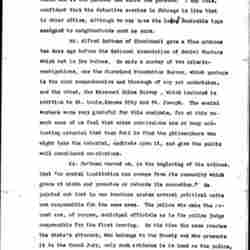
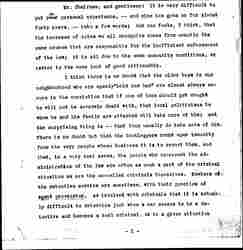
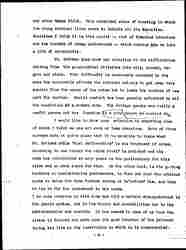
Mr. Chairman, and gentlemen: It is very difficult to put your ↓a↑ personal experience, -- and mine has gone on for almost forty years, -- into a few words; but one feels, I think, that the increase of crime we all recognize comes from exactly the same causes that are responsible for the inefficient enforcement of the law; it is all due to the same community conditions, or rather to the same lack of good citizenship.

I think there is no doubt that the older boys in our neighborhood who are openly "bold and bad" are almost always secure in the conviction that if one of them should get caught he will not be severely dealt with, that local politicians to whom he and his family are attached will take care of him; and the surprising thing is -- that they usually do take care of him. There is no doubt but that the bootleggers count upon immunity from the very people whose business it is to report them, and that, in a very real sense, the people who represent the administration of the law are often as much a part of the criminal situation as are the so-called criminals themselves. Members of the detective service are sometimes, with their practice of agent provocateur, so involved with criminals that it is actually difficult to determine just when a man ceases to be a detective and becomes a real criminal, or in a given situation [page 2] which one is the pursuer and which the pursued. I say this, confident that the detective service in Chicago is like that in other cities, although we may have the least desirable type assigned to neighborhoods such as ours.

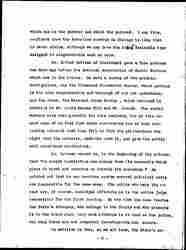
Mr. Alfred Bettman of Cincinnati gave a fine address ten days ago before the National Association of Social Workers which met in Des Moines. He made a survey of two crime investigations, one the Cleveland Foundation Survey, which perhaps is the most comprehensive and thorough of any yet undertaken, and the other, the Missouri Crime Survey, which included in addition to St. Louis, Kansas City and St. Joseph. The social workers were very grateful for this analysis, for at this moment some of us feel that crime commissions are so busy collecting material that they fail to find the philosophers who might take the material, meditate upon it, and give the public well considered conclusions.

Mr. Bettman warned us, in the beginning of his address, that "no social institution can escape from its community which gives it birth and promotes or retards its operation." He pointed out that in our American system several political units are responsible for the same case. The police who make the arrest are, of course, municipal officials as is the police judge responsible for the first hearing. By the time the case reaches the State's Attorney, who belongs to the County and who presents it to the Grand Jury, only such evidence is in hand as the police, who many times are not competent investigators, can secure.

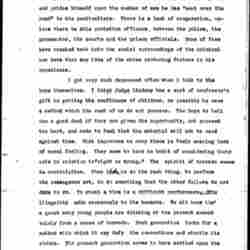
In addition to this, as we all know, the State's Attorney [page 3] very often uses the whole situation as political capital and prides himself upon the number of men he has "sent over the road" to the penitentiary. There is a lack of cooperation, unless there be able probation officers, between the police, the prosecutor, the courts and the prison officials. None of them have reached back into the social surroundings of the criminal nor have they any idea of the crime producing factors in his experience.

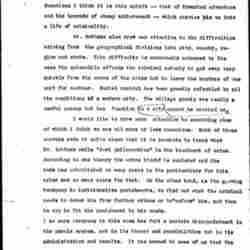
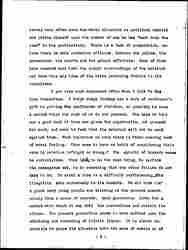
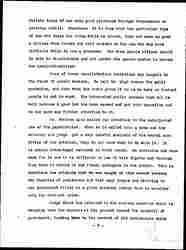
I get very much depressed often when I talk to the boys themselves. I think Judge [Lindsey] has a sort of confessor's gift in getting the confidence of children, or possibly he uses a method which the rest of us do not possess. The boys do tell one a good deal if they are given the opportunity, not pressed too hard, and made to feel that the material will not be used against them. What impresses me many times is their amazing lack of moral feeling. They seem to have no habit of considering their acts in relation to "right or wrong." The spirit of bravado seems to controls them. They lack ↑like↓ to do the rash thing, to perform the courageous act, to do something that the other fellows do not dare to do. To steal a tire is a difficult performance ↑and↓ its illegality adds enormously to its hazards. We all know that a great many young people are drinking at the present moment solely from a sense of bravado. Each generation looks for a method with which it may defy the conventions and startle its elders. The present generation seems to have settled upon the obtaining and consuming of illicit liquor. It is almost impossible to place the situation into the area of morals or of [page 4] any other human field. This unnatural state of boasting in which the young criminal lives seems to inhibit all his faculties. Sometimes I think it is this spirit -- that of thwarted adventure and the bravado of cheap achievement -- which carries him on into a life of criminality.

Mr. Bettman also drew our attention to the difficulties arising from the geographical divisions into city, county, region and state. This difficulty is enormously enhanced by the ease the automobile affords the criminal not only to get away very quickly from the scene of the crime but to leave the borders of one unit for another. Social control has been greatly enfeebled by all the conditions of a modern city. The village gossip was really a useful person but her function cannot be carried on in a city.

I would like to draw your attention to something else of which I think we are all more or less conscious. Both of these surveys made it quite clear that it is possible to trace what Mr. Bettman calls "dual philosophies" in the treatment of crime. According to the one theory the crime itself is punished and the code has established so many years in the penitentiary for this crime and so many years for that. On the other hand, is the growing tendency to individualize punishments, to find out what the criminal needs to deter him from further crimes or to "reform" him, and then to try to fit the punishment to his needs.

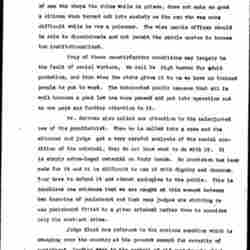
I am sure everyone in this room has felt a certain disappointment in the parole system, not in its theory and possibilities but in its administration and results. It has seemed to some of us that the system is founded too much upon the good behavior of the prisoner during his life in the institution in which he is incarcerated. [page 5] Certain types of men make good prisoners through temperament or previous habits. Sometimes it is true that the particular type of man who obeys the rules while in prison, does not make as good a citizen when turned out into society as the man who was more difficult while he was a prisoner. The wise parole officer should be able to discriminate and not permit the parole system to become too institutionalized.

Many of these unsatisfactory conditions may largely be the fault of social workers. We call to high heaven for adult probation, and then when the state gives it to us we have no trained people to put to work. The interested public assumes that all is well because a good law had been passed and put into operation and no one pays any further attention to it.

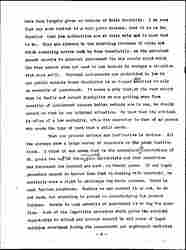
Mr. Bettman also called our attention to the maladjusted use of the psychiatrist. When he is called into a case and the attorney and judge get a very careful analysis of the mental condition of the criminal, they do not know what to do with it. It is simply extra-legal material on their hands. No provision has been made for it and it is difficult to use it with dignity and decorum. They have to defend it and almost apologize to the public. This is doubtless one evidence that we are caught at this moment between two theories of punishment and that many judges are striving to use punishment fitted to a given criminal rather than to consider only the abstract crime.

Judge Black has referred to the curious reaction which is sweeping over the country at the present moment for severity of punishment, leading even to the revival of old punishments which [page 6] have been largely given up because of their brutality. I am sure that any such revival is a very grave mistake, that it is indication that the authorities are at their wits end to know what to do. They are alarmed by the startling increase of crime and think something severe must be done immediately, as the untrained parent resorts to physical punishment for his unruly child which the wise parent does not need to use because he manages a situation with more skill. Physical punishments are prohibited by law in our public schools where discipline is no longer permitted to rely on severity of punishment. It seems a pity that, at the very moment when in family and school discipline we are getting away from severity of punishment because better methods are in use, we should revert to that in our criminal situation. We know that the criminal is often of a low mentality, often his character is that of a person who need the type of care that a child needs.

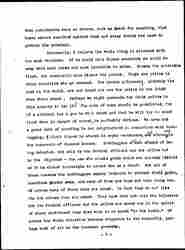
That our present methods are ineffective is obvious. All the surveys show a large number of repeaters in the penal institutions. I think it was shown that in the correctional institutions of St. Louis two out of three ↑inmates↓ were recidivists and that recidivism had increased one hundred [percent] in twenty years. If our legal procedure cannot do better than that in dealing with criminals, we certainly have a right to challenge the whole process. There is rank failure somewhere. Whether we can correct it or not, we do not know, but something is gained in acknowledging the present failure. Merely to urge severity of punishment is to beg the question. Much of the legalistic procedure which gives the criminal opportunity to defend and protect himself by all sorts of legal quibbles developed during the seventeenth and eighteenth centuries [page 7] when punishments where so severe, such as death for poaching, that human nature revolted against them and every device was used to protect the criminal.

Personally, I believe the whole thing is attended with too much violence. If we could only disarm everybody we could do away with much crime and much incentive to crime. Disarm the criminals first, but eventually also disarm the police. There are police in other countries who go unarmed. The London policemen, probably the best in the world, are not armed nor are the police in the Irish Free State armed. Perhaps we might persuade the Irish police in this county to try it! The sale of arms should be prohibited, for if a criminal has a gun he will shoot and that he will try to shoot first when in danger of arrest, is perfectly obvious. We have had a great deal of shooting in our neighborhood in connection with bootlegging, illicit liquor is stored in empty warehouse, and ↑in↓ stores ↑and↓ in the basements of disused houses. Bootleggers are much afraid of being detected, not only by the Federal officers and the police but by the hijacker -- the man who steals goods which are already illicit so it is almost impossible to arrest him as a thief. For all of these reasons the bootleggers employ lookouts to protect their goods, sometimes blocks away, and many of them are boys and very young men. Of course many of these boys are armed. In fact they do not like the job unless they are armed. They know that not only the hijackers but the Federal officers and the police are armed and in the spirit of sheer excitement they also wish to be armed "to the teeth." Of course the whole situation becomes dangerous to the community, perhaps most of all the innocent passerby. [page 8]

In the midst of such a shocking situation, the ↑Chicago↓ Chief of Police says that he is ready to promote an officer who kills a officer ↑criminal↓ whom he is arresting. The Chief is quite willing that the police officer should be judge, jury and executioner all in one. We all apparently forget that the officer's sole business is to arrest his man and that it is the office of the judge and jury to determine his guilt, and that the final object of his punishment is to restore him at last to normal society.

I would like to say just one thing more, inasmuch as so many of you here are lawyers and judges. I may never have the opportunity again of seeing so many of you in one room together. I should think it would be a matter of your professional interest and of your professional pride to know why, in the minds of many good, simple people, you are believed to give your energies to the purely legalistic aspect of a case rather than the ↑to↓ finding out the equity and justice involved. I am confident that this widespread belief brings a certain lack of respect to ↑for↓ the courts, a certain willingness to get out of trouble in any way that is possible, by political pull and even by bribing, because the whole thing is a legal game and acquittal for any reason is a victory. It is curious that in every popular revolution the people begin their housecleaning by abolishing their courts. They very quickly have to establish others, of course, but there is no doubt that their distrust of the existing courts is a profound one. I was in Ireland last summer and was interested to find out that for many months before the establishment of the Free State the Irish had refused to use the British courts and had set up their own courts in which they administered a rough justice. [page 9] It was not only a gesture of revolt. They seemed really anxious to get away from the legal quibbling to which they felt themselves subjected for so many years.

At any rate, many of the lawyers who defend Chicago boys for the commission of crime give them the impression that their clients can always get out of their difficulties, and that it is merely a question of the cleverness of their lawyers. Some of the boys gradually find stealing the easiest way of supporting themselves. They begin with tires and go on to automobiles and they are getting away with it in a large number of cases. Of course there is connivance somewhere along the line. The system has all been built up together and can only be corrected together. Just where we should begin I do not know. We used to think when we started our Juvenile Court here -- and we claim that we had the first juvenile court here in Chicago, although Denver is a close second -- that the juvenile probation officers with their method of approach might in time modify existing procedure. They find out concerning the family of the delinquent child, his school, his church and all the social influences surrounding him. They hope so to guard the child in society itself that he may remain there. This method, however, has not much influenced the other courts and perhaps never will.

You may think it is easy for a social worker not responsible for court administration to say these things. It is not easy, for we are full of humility and remorse over the failures we see all about us in our given neighborhoods. [page 10]

There are many more things I should like to discuss at this meeting, but I am sure I have already filled my time. I was much interested in what Judge Black said in regard to our ignorance of the real situation. [although] But various crime commissions are making their reports, and an exhaustive study is now being conducted, as you know, by the Harvard Law School. In time this knowledge must affect the actual procedure, but only, I think, if we consider it in the light of our daily experiences. [page 11]

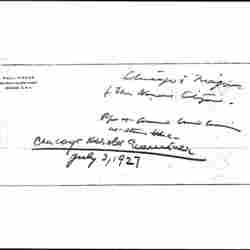
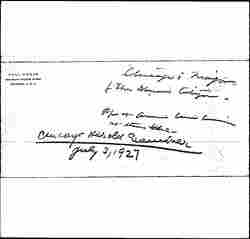
[written on a Hull-House envelope] Chicago's Mayor for the Woman's Citizen.

Paper at American Crime Commission at Stevens Hotel.

Chicago Herold Examiner

July 3, 1927