



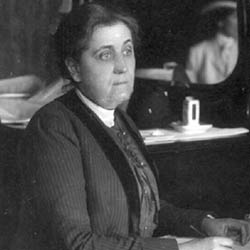
MISS JANE ADDAMS (Chicago, Illinois): I understand that I have to say very little, and then we are to have literally a Round Table Discussion, so that I shall merely open the subject, and then Mrs. MacLeish will keep us in order, so that no one talks too much, and then we will all have a show.
The Topic, "Children's Social Attitudes and Character," is, of course, suggested to me from my own neighborhood. I have seen a great deal of children and young people who were the children of immigrants, and who [page 2] had great difficulty with the social attitude which the people about them, especially when they went to public school, and still more if they went to the colleges, and so forth, that the people about them took towards the immigrants in general, and they had to make up their minds what they were going to do. They had to remake up their wills every single morning, every time they went out into the society of other people, and some of them have come out quite splendidly, and occasionally, of course, they fall down.
One or two or more that I could illustrate with have fallen down, and their characters have deteriorated under the strain.
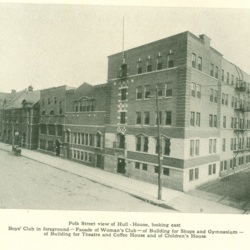
It has been a very interesting thing to watch, as I have lived now for nearly forty years in an immigrant community, populated largely with Italians, not that they are unlike other people, but they are more marked, because the grown-up adult Italian man or woman has great difficult in speaking English fluently, and they retain their foreign air long after other nationalities have lost it. They may have been in this country for many years, and are still quite obviously of Italian origin.
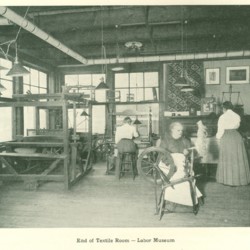
We started several years ago in our house a Labor Museum. We tried to put in different methods of weaving and spinning and other activities connected with textiles, in order to show the young people that their mothers, who [page 3] could not do the thing the American women could do, really did have an old honorable craft, and that this craft had a historic place in the development of the things which most of them were handling at that time in sweatshops and other clothing establishments.
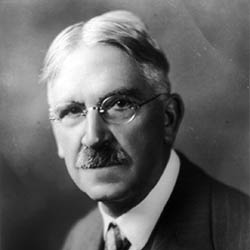
It was very interesting to see the response, the almost overwhelmingly joyous response which many of the young Italians took towards this little exhibit. At that time John Dewey, when we started it, was at the School of Education in the University of Chicago, and was thinking a good deal of that sort of industrial activity. The teachers used to come down from his school in great numbers. The whole Department of Psychology and Education came down to see these women weave and spin.
That impressed the children very much. They said, "The university is coming down to see my mother; there were a whole lot of people from the university watching her spin." They used this old-fashioned spinning stick which was the only one used in Europe for centuries. Europe never heard of the spinning wheel until the Fifteenth Century. And then they used the spindle which came after the spinning stick.
This was an illustration of what the young people felt. It sort of elevated them to find that people would come there to watch them spin. [page 4]
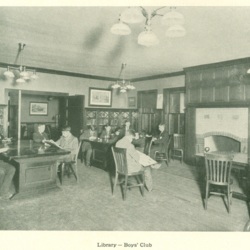
We had a young man in the neighborhood who came into the Boys' Club one day -- he was about sixteen but he looked much younger, and he told the Boys' Club people that he had three thousand dollars in the bank. Well, the Boys' Club Director made some remarks about the folly of boasting, whereupon the young boy went home and brought back his bank book, and he did have three thousand dollars in the bank. He had gotten the three thousand dollars driving a booze wagon from Joliet to Chicago, and because it was a dangerous job, with great danger from [hijackers] and other folk he was paid two hundred dollars or two hundred and fifty dollars a trip, and he accumulated this money before the [hijackers] and others discovered he was driving a booze wagon.
He took the money and went to a state university. I won't tell you which one. The first thing he wrote back about was the drinking he had found when he came to the state university. He said the Italians made booze but they did not drink it. He did not at all like the type of young man he met there and did not think they compared any too favorably with the young men in our part of town. He also was shocked by the lack of chaperonage of the women students of the university, being accustomed to the Southern European standard of chaperonage of the young girl.
He took two years in high school and he is going to take four years in the university. [page 5]
He came to see us at Christmas time. I was very much interested in talking to him and I had a very sharp sense of contrast between the standards which he had been accustomed to in his Italian family and the standards he encountered at this university, and the first result of the impact had been to drive him back to believe in the old-fashioned European standards which he resented all through his life, as his sisters resented them, and as all Italians resent the very careful care which is given them. The result had been when he went into a larger community to fall back upon and prize very much these peasant conventions.
It works in all kinds of ways.
I would like to say something about the children among the radicals. They don't need to be very radical, but the children of parents who differ from the rest of society. I know a little girl who suffered horribly because her mother was a vegetarian. She could hardly stand it because her mother did not take a plate of food and consume it as other people did. It seemed very disgraceful. That, of course, was an example of the children who like to conform, and therefore must dislike the difference among people to whom they are accustomed.
I have gotten the same sort of reaction among the children of people who differ from the ordinary society in which move. That I have gotten over and over again from [page 6] children of immigrants, because those people also seem different from the rest of society.
Another thing comes in in the whole situation of children of immigrants. That is the moving pictures. They have in their mind these two ideals, the life which they see about them at home and in their own colony -- I am not speaking about children in the settlement but the life which they see depicted on the screen. That is an enormously different thing. They are very much interested, of course, in the moving picture shows, and yet they get a very curious impression of it. They get, of course, a very great impression of domestic infelicity, which is horribly exaggerated, and that often throws them back to a belief in the simple families in which they have been born.
They get a very curious impression of American clothes and American houses, which, of course, they admire very much, especially the grand houses which inevitably come, as you know, in every kind of moving picture show.
Then they get, outside of that, a great range of geographic releases. They are enormously interested in the Wild West and they are enormously interested in the parts of the world which are portrayed, often incidentally in the moving picture shows, and that release, giving the mind the range that they get, letting them out into the wide world is, to my mind, a very great gift, a very great advantage which [page 7] the cinemas bring over and over again to the children of people of limited social experience and limited outlook.
Here again we have a great clash between what they see and constantly admire and grow familiar with, and their daily home experiences on the other. I believe that we have material there for great character building. You see it coming out all the time in young people.
We were making a review the other day, quite incidentally, in connection with our Music School. We find one of our boys is a member of a Philharmonic Orchestra in Europe. He has had a very great struggle. He has had help from his parents, but he has had a tremendous struggle, and he kept up that struggle always with the feeling that his family must be with him and were with him, and as fast as he got up they came up with him. He would not go a step where they could not follow. There were four different boys from our band -- if you have ever heard the band you know what it is; it is a horrible brass band, at moments it almost takes the roof off of the house -- nevertheless, four boys from the brass band are in the Symphony Orchestra of Chicago. That means a very great deal of struggle and hard work. It is done by children who have the character to do it, and in many instances their character, I think, has been evolved out of this sense of conflict, if you please, between their background and the contemporaneous society and conditions in which [page 8] they move.
Now, I am not going to get into any psychiatric social worker talk in the midst of an audience like this, where we have psychologists. I am looking very fearfully at Dr. Jastrow as I speak. There is something, is there not, in that integrating of conflict, to be able to make that connection, your synthesis between the difference that confronts you in two given situations and that opportunity for character, that opportunity for releasing the mind for getting up into a little higher plane and bursting into your emotional life, bursting out instead of being oppressed by the old, insisting that it shall flow out into the new as well? I believe it has worked very wonderful things on the many children and young people whom I might give you in detail if you challenged me.
It is now two o'clock and I have talked for ten minutes, and I think that is long enough to give you a chance to open the discussion.
CHAIRMAN MacLEISH: I'd like to ask Miss Addams about these other children in the public schools who have made it necessary for the immigrant children to feel so ill at ease. Where was the character effect, or what sort of character are they building up for themselves?
MISS JANE ADDAMS: I suppose it is very easy for children to be snobbish, simply because they are such [page 9] great conformists and seem to be superior. If they seem more American than the Italian children, they have oftentimes a certain sense of responsibility and a very great kindliness to these other children.
We have had in Hull House for a year or two an Art School, and the children have done awfully interesting things in pottery. We have three kilns and are putting up another. There is a great demand among the Mexican and Southern Italy children for working in clay and pottery. It has been very good for the so-called American children because they can't do it nearly so well. Many of them come from [Guadalajara] and Pueblo, where the tribal people were potters. They seem to know it instinctively. They come in and make beautiful pottery and decorate them out of their heads. That is very good for the young people that come from different parts of town to learn pottery. The Mexican is excelling in the thing they want to do. I don't think it is very good for the child that is made to feel superior any more than it is for the child that is made to feel very keenly the difference.
MISS DUMMER: You spoke of some of the children who fall by the wayside, for whom the struggle is too much. We find that in communities where the children are considered very fortunate, too. How are we to measure when the conflict is too much or when we think it is going to be too much for them? How much is good for them and how much will be [page 10] destructive?
MISS JANE ADDAMS: Some of these observations have been made in regard to children over whose environment I had no control, and not as an educator at all, merely as an observer, if you will. I think children are constantly being put up against situations that are too much for them. I think we constantly expect a moral precocity and rectitude years before we have a right to demand it. Many of the children go under and get a sense of inferiority which they never lose and it has a great deal to do with their success in their later life.
MARK A. MAY (Yale): What happens in the case of ordinary, every-day situations is very much the same. You see here that a child meets a situation that he can face frankly, fairly and squarely. It is only when he has to meet a situation that is too difficult for him that he resorts to subterfuge and dodges around. It seems that the moral of that story is, as far as our school is concerned, that our schools as they are set up, it seems to me, seem to feature these situations that the child can't meet fairly and squarely, that we ought to feature the other kind of situations. That is the reason I say our character education can't come until we are ready for it.
MISS DUMMER: How would growth come about if you did that? [page 11]
DR. MAY: You have to do the same thing as in teaching arithmetic. You don't begin teaching the child arithmetic with problems and calculus. You begin with addition.
CHAIRMAN MacLEISH: This young lady is making a record of this discussion. Will you please give your name when asking a question?
MRS. BERTRAND RUSSELL (England): We have one individual instance of that. We had a young child in the school that we have just started who had been taught by his parents standards of behavior to his small brother that were just beyond his age to manage, and this small child, I found, although he was outwardly kindly to the younger children, would, whenever he got a chance, show his feelings toward the youngest boys in the school. He evidently nourished a grudge against always having to be kind to younger children. That child meant to adjust himself gradually to better social behavior simply by contact with children his own age, who taught him really the human relations of equal human beings of the democracy. They simply were much harsher than any adult would have been. They would not let him have that particular toy that he wanted. He is now evolving something out of his own social behavior which he could not have learned from his parents.
MRS. CHARTERS: I wonder if you could give us [page 12] mothers a hint as to how we mothers could meet for a new generation these interracial problems.
MISS JANE ADDAMS: I think children naturally are very unconscious of racial differences until they imitate it from other people. I remember once in our neighborhood some years ago, when we had the negro riots in Chicago, that a colored man was killed by Italians not very far from Hull House, eight or ten blocks away. It seemed to be very strange because the Italians and all Latin people have very little feeling against negro people, and the Italians are especially free from it.
I came home, and I went up and asked the Italian doctors, who meet every month at Hull House, twelve or fifteen of them, probably the most intelligent men in the Italian community, why they supposed it had happened, because they knew of this lack of feeling. They said, quite simply, without trying to be funny, "They are getting Americanized." They are getting the American attitude towards colored people. It is not their own attitude; it is not the attitude which they brought with them from Italy. They are taking on the American attitude, and I think that we all take on the attitude too much of the community towards a certain situation.
I suppose all you can do is to cultivate a certain natural attitude that your child has when he is smaller, and try to keep it with him. [page 13]
I have found sometimes with young people who are inclined to be snobbish -- we have them in our people as you have everywhere -- I always tell them they are going to limit themselves tremendously if they make up their minds they are only going to know people of a certain class, certain economic standing, certain race, certain this or that, that life is going to be very much less interesting, because there whole fields of it they will never know anything about, and they are going to choose a narrow path instead of having a nice wide range over which to roam, and they do respond to that more or less.
I had an interesting experience the other day, Lincoln's birthday. I talked to the boys a little about Lincoln, how he always read, and studied how people felt and thought, and how he remembered them and talked about them when we went to the next place, and when he went to Illinois from Kentucky, and to Washington from Illinois, how he was always talking about the man down in Sangamon County. He was always getting in his experience more and more people. I told them they were going to miss out tremendously if they did not associate with these people. It was a very long, stupid talk, and afterwards I heard one boy say to another boy, "You can't do that. You can't treat these Mexicans that way because if you do you shut yourselves out of all the interesting things in Mexico." [page 14]
I think there are a good many ways in which you can appeal to children against that. They come up against a little snobbishness which they are quick to imitate, which I don't think they naturally easily generate themselves. Perhaps it is the wickedness of the human heart, I don't know.
DR. MAY: What would you think is the effect on children of the use of such terms as "nigger" and "wop?"
MISS JANE ADDAMS: I think it is very unfortunate, of course. I think they are used constantly in children's hearings. I think children get used to them and they don't take them seriously, or would not if it were not for the communication of the feeling that they recognize as going with them.
DR. MAY: In my boy of seven, when he was five years old I discovered he had a notion that the word "negro" was a derogatory one, and the word "nigger" was the honorable one. He just had it reversed exactly. I don't know how it happened.
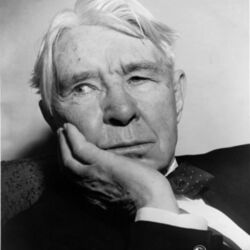
MISS JANE ADDAMS: He agreed with Carl Sandburg. Sandburg has tried very hard to have the colored people take over the word "nigger." He says it is a good strong word that is used all over the United States, and he wants to drop the euphemistic expressions with which we clothe the situation.
MRS. BERTRAND RUSSELL: Do you think it is a good plan for the odd children to be reared in a special [page 15] school? It is bad for them to be odd early in their contact with people. Would it not be better to let them reach full development at sixteen or seventeen before they meet too great conflict?
MISS JANE ADDAMS: I suppose it would be. I suppose if you would get your special school not too unlike the rest of the world it would be a great advantage, just as you cherish children in other ways. You don't throw them out into the dangers and difficulties of society until they are ready for it. I think the only difficulty about the special school sometimes is that it is a little hot-housy, is it not, a little unnatural? (Laughter)
CHAIRMAN MacLEISH: Is there something more? Don't hesitate because time is going.
DR. JOSEPH JASTROW (New York): I don't want to distract the conversation from the social influences of character, but I am one of those incorrigible heretics who believes a good deal in heredity, and I find that the problems of children that are the most serious to them are the ones most interesting to me, and they are all inner problems.
First, and very common, why do children not do things? They don't do the things they don't do well. They don't like to come out second best, so they withdraw. There is a real attitude in character training you have to meet day after day. These children really should be born so gifted [page 16] that they play the violin the first time without any training, and can throw the ball accurately the first time and do roller skating without tumbling. As you see, though, they are born for a much more perfect world than this, and they have already found this world is extremely inconvenient as a place to be happy in, so when they start out with any difficult problem, it is a peculiar child problem that they are unwilling to do anything they can't do well, and that has to be met.
Miss Addams' story of the vegetarian reminds me of the girl who went to school the first day and her mother filled out some of the blanks, and they had forgotten to fill out the religious faith. She did not know, but she thought they were cafetarians. (Laughter)
One must remember that it is these little intimate situations of life that determine character, and probably what happens in a cafeteria is twice as significant as what happens in a church.
I mention then that one difficulty which is a very serious matter. How are you going to meet it if you have such very high standards as these children of seven and eight have, that they won't do anything unless it is done perfectly the first time? You are going to have a difficult time in life.
Another problem which is similar and which comes from the feeling that everything that is done is an encroachment on your liberty, that no matter what task is [page 17] imposed, you might impose a task of eating candy six times a day, and this type of child would definitely from then refuse ever to touch candy, because you have made a task of it.
Children like to sing. I have a mother who wrote to me of a boy who draws remarkably well, but the minute she asks him to draw he won't do it, because that spoils the whole thing. Dealing with inherent characteristics, they won't do anything that is a task. They don't like school friends because they didn't choose those friends. They found them at school. If they could gather them in from the back alley they would be perfectly happy, because it is their gang.
There are two character traits you have got to consider. They have nothing to do with social environment, particularly. They seem to come out of inherent difficulty in establishing social relations. I am one of those disagreeable people who propose difficult problems. I never ask a question I can answer myself. I can't answer it.
MISS JANE ADDAMS: That is that old thing, is it not, of life being a stream down which we are floating, being shoved by the force of heredity all the time, while the winds and the waves buffet us. The question is how much you can use them to steer a course by, whether you are going with the wind or against it or by the side of it. You do have a good deal of the steering in your own hands. [page 18]
Children feel that they are very much absorbed in this inner life, this inner pattern to which they are conforming. They do like to talk about it. They won't sit down and talk about it, but you can draw them out about it in a rather surprising way. We have been having classes lately in poetry and some classes in imaginative drawing and things of that sort. It is quite amazing, this inner life which you get revealed in those ways, and, of course, if you can show the child how stupid it is to think he is going to do everything well the first time, that he is never going to do anything that he cannot do well the first time if he is going to keep on with that stupid notion, I think you can more or less laugh him out of it. It is this negativism, of course.
MRS. BERTRAND RUSSELL: Is not that sometimes with the child that won't do anything unless he can do it well due to the fact that it may have been given things a little too difficult? We have very, very elementary things that the child can do at each stage. You can get them along quite nicely at times that way.
DR. JASTROW: I have not found it so. I think it is definitely temperamental. When it does happen you have one of those little problems.
MRS. BERTRAND RUSSELL: I have a child like that in my school.
CHAIRMAN MacLEISH: They are not hearing over [page 19] at the far end of the room and this is an interesting topic.
MISS JANE ADDAMS: We had fallen into conversation over here.
CHAIRMAN MacLEISH: Mrs. Russell's point is, if the children are given simple and easy things to do that problem will be solved, and Professor Jastrow is not sure he agrees with it.
DR. JASTROW: That type of child is just as likely to be the type of child that will do rather difficult things that will be ahead of him, but do the things his own way.
QUESTION: How early does that appear?
DR. JASTROW: It certainly appears at four or five.
MRS. RUSSELL: I have that in my school. She is only four and she has already had it a year and a half, at least.
DR. MAY: Do you think it is hereditary?
DR. JASTROW: All I mean by that is it offers a resistance to the shaping of environment.
CHAIRMAN MacLEISH: Do you not think that some children are born with naturally very high standards? They are not satisfied with anything which does not come up to certain aesthetic or certain general standards.
DR. JASTROW: It is what we would call standards. [page 20]
DR. MAY: They don't recognize them as such.
DR. JASTROW: At that level it is the lack of satisfaction.
MISS JANE ADDAMS: It is lack of imagination; imaginative children never feel that way.
DR. JASTROW: I don't know just how far that goes. It is equally true it may be a different contact but then I am not so sure.
MISS JANE ADDAMS: Little bits of children seldom play together of their own accord. There were two little children of two, evidently building a house together, and the teacher was very much pleased at the early social contact which she was observing, and asked them what they were doing. One child, looking at the structure with great fatuous pleasure, said it was his engine. The other child, looking at it with equal pride, said it was his house. (Laughter)
CHAIRMAN MacLEISH: Are there any other questions or suggestions on character development and social contacts?
MRS. BAILEY: I would like to ask how far that social equality can go before we reach a danger point? Is there a danger point, and how can we avoid it?
MISS JANE ADDAMS: I don't suppose anybody wants a child in contact with any one whose behavior is wrong, [page 21] whether little or big, and I suppose wise parents do steer the child's course so he is kept away from them, but the mere difference of economic standing or race or any of those things I should say the child ought to be given those contacts as soon as possible.
MRS. BAILEY: You are only speaking for the child that has the contact.
MISS JANE ADDAMS: I should never force a friendship for the child. I think it would be like the little boy who was taught too early to be kind to his brother. I think those made-up attitudes are the worst things you can put on a child. He never gets over them.
CHAIRMAN MacLEISH: You think the feeling has to come from the inside of the child instead of being put on on the outside?
MISS JANE ADDAMS: Yes, giving him a chance to express himself and feel kindly and help him along, because he feels kindly, but I think this being told what you must do under given circumstances is very irksome to children usually ends in a very strange situation.
MRS. BAILEY: Is it necessary that a child has a sensation of friendliness toward these Mexican or Italian children?
MISS JANE ADDAMS: It is not, of necessity, but he will if he has a chance to play with them and have contact [page 22] with them.
MRS. BAILEY: I just wonder, under the circumstances, how far that ought to go, where the danger line is going to be. Suppose the child is thrown with Mexican and colored people and Italians. How long would it be before we should make some definite proposition to the child about what his choice in life because of his wonderful ancestry should be? (Laughter)
MISS JANE ADDAMS: That ought to go to Dr. Jastrow. I don't meet up with these wonderful ancestries. (Laughter and applause)
DR. JASTROW: That is a question in social application; that belongs to Miss Addams. (Laughter)
MRS. BAILEY: Shame on you. We came here for enlightenment.
MISS JANE ADDAMS: I don't think you want to force it. I think a child seeks his companionship. I would simply give him the opportunity for all kinds of companionship. I would not force him, certainly, to consort with people.
MRS. BAILEY: I don't mean force. I was very far from that thought. I just meant a child thrown with these absolutely different children, what we call absolutely different, how far should we go toward our encouragement at all of his attitude of friendliness toward them?
MISS JANE ADDAMS: I think naturally he would [page 23] go to school with the children of his own cultural standing, whose parents have very much the same standards as his parents, and he naturally would have his friends among them, but I should certainly give him the opportunity while still young.
MRS. BAILEY: In Chicago they have an opportunity to meet these different classes and even in the suburbs you find the same situation.
MISS JANE ADDAMS: Don't you think it is an advantage?
MRS. BAILEY: I think it is a very great advantage, and I am wondering when we should say it is not wise.
QUESTION: May I ask why it is not wise?
MISS MARY D. BRADFORD (Kenosha): The point the lady has raised here brings to mind a story I know to be true, that happened in a Sunday School. There was a church in Boston that was inclined to be very liberal in its attitude toward colored children, and admitted them, with the others. There came into the Sunday School a very beautiful mulatto girl who was associated with the other children in the Sunday School. At a certain age a boy of a very high family in Boston fell in love with this beautiful girl and they were married, and great social trouble and family trouble came as a consequence of it. [page 24]
It was brought to my attention when as Sunday School Superintendent in another city I plead very hard for the opening of the doors to some colored children who wanted to come into the Sunday School. This was brought up and related to me and the danger that might ensue if the contact were extended and permitted between the children of white and colored people. I am not inclined to draw the color line in the school systems and in the ones I have charge of there is no such line, but I support the question this lady has asked. Is there not a danger in that contact if it is not watched?
MISS JANE ADDAMS: The marriageable ages, that is a question quite by itself, and a great latitude in there might be dangerous, but certainly the children would not be subjected to this danger. I should throw a child naturally with his own sort of people, but I would make some effort to have a mixing.
MISS DAUCHER: I read the other day that intermarriage would have as far-reaching results as the evolution of sex.
CHAIRMAN MacLEISH: I want to tell a little story on the other side of a little boy I knew who in his boyhood was greatly limited because his mother would not allow him to associate with any poor little boys or any boys who might bring dirt into the house or teach him bad words. [page 25] That poor little boy grew up to have almost no friends, and when he went to college he did not know how to associate with boys, and his life was terribly limited because he had not been allowed to associate with boys that were, perhaps, just as good as he, but did not wear as good clothes and perhaps did not speak always as correct language. There is that side of it that I think perhaps was in the mind of the one who first introduced this subject.
MRS. CHARTERS: A group of us out in Dr. Gilchrist's church which, as most of you know, is one of the broadest churches in the city, and is working very hard to study this problem of interracial attitudes, has made an effort with our children not to develop with the little children racial prejudices, and we are finding in incidental ways that they are growing up to judge their friends by standards that we would like to have them judge them by, important standards of morality, of cleanliness, of vital human standards, not standards of color or of speech or of patches, and I think perhaps that will eventually be the basic method of choosing our friends and of teaching our children to choose friends on exactly the same basis which they choose friends in our own social group.
MISS JANE ADDAMS: I don't want to sidestep Miss Daucher's question but, of course, it is a wholly new question, is it not?
CHAIRMAN MacLEISH: It is now half past two.
... Adjourned at two-thirty ...




Comments