
March 7, 1928.
Dear Miss Addams:
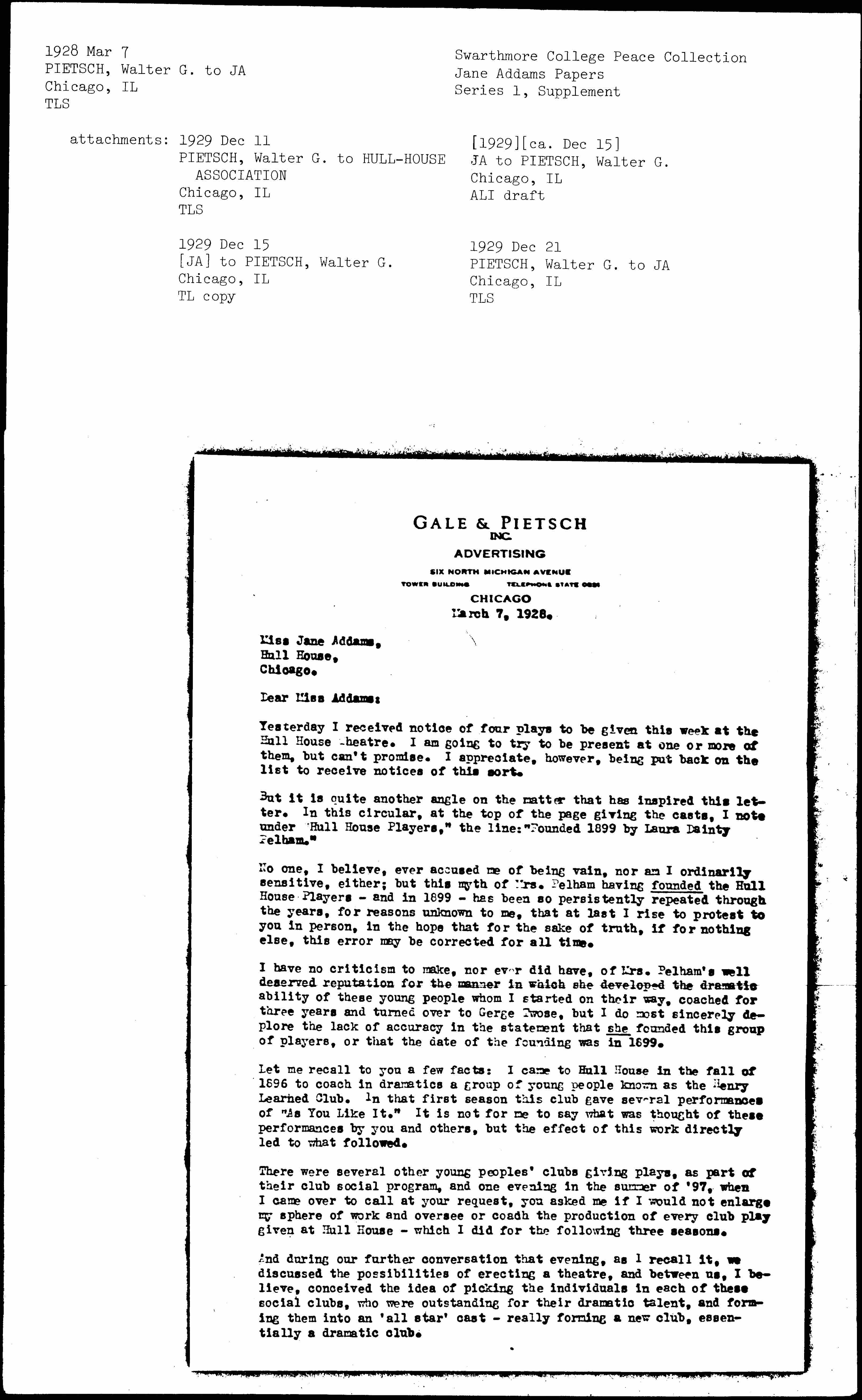
Yesterday I received notice of four plays to be given this week at the Hull House Theatre. I am going to try to be present at one or more of them, but can't promise. I appreciate, however, being put back on the list to receive notices of this sort.
But it is quite another angle on the matter that has inspired this letter. In this circular, at the top of the page giving the casts, I note under "Hull House Players," the line: "Founded 1899 by Laura Dainty Pelham."
No one, I believe, ever accused me of being vain, nor am I ordinarily sensitive, either; but this myth of Mrs. Pelham having founded the Hull House Players -- and in 1899 -- has been so persistently repeated through the years, for reasons unknown to me, that at last I rise to protest to you in person, in the hope that for the sake of truth, if for nothing else, this error may be corrected for all time.
I have no criticism to make, nor ever did have, of Mrs. Pelham's well deserved reputation for the manner in which she developed the dramatic ability of these young people whom I started on their way, coached for three years and turned over to [George] Twose, but I do most sincerely deplore the lack of accuracy in the statement that she founded this group of players, or that the date of the founding was in 1899.
Let me recall to you a few facts: I came to Hull House in the fall of 1896 to coach in dramatics a group of young people known as the Henry Learned Club. In that first season this club gave several performances of "As You Like It." It is not for me to say what was thought of these performances by you and others, but the effect of this work directly led to what followed.
There were several other young peoples' clubs giving plays, as part of their club social program, and one evening in the summer of '97, when I came over to call at your request, you asked me if I would not enlarge my sphere of work and oversee or coach the production of every club play given at Hull House -- which I did for the following three seasons.
And during our further conversation that evening, as I recall it, we discussed the possibilities of erecting a [theater], and between us, I believe, conceived the idea of picking the individuals in each of these social clubs, who were outstanding for their dramatic talent, and forming them into an "all star" cast -- really forming a new club, essentially a dramatic club. [page 2]
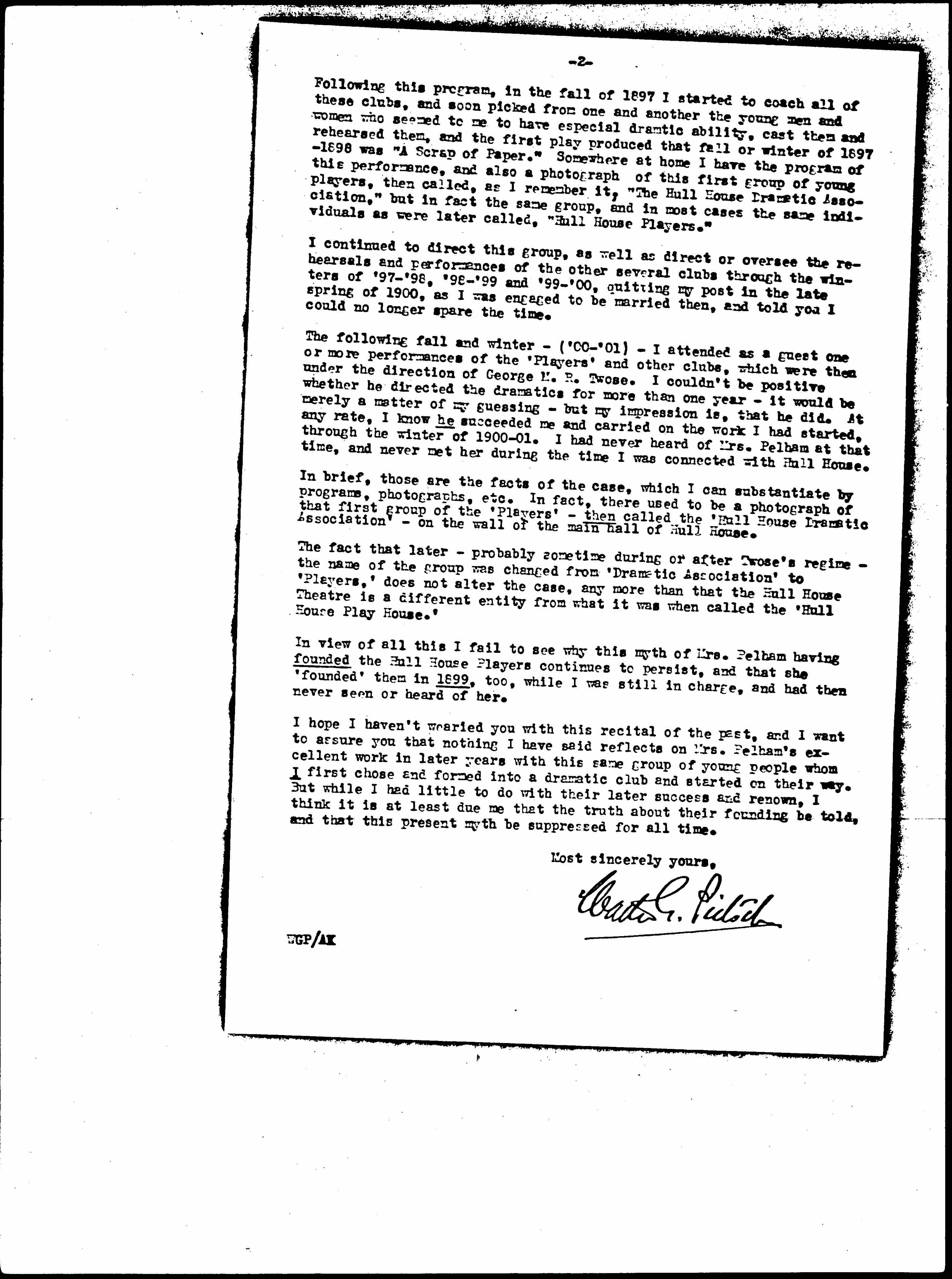
Following this program, in the fall of 1897 I started to coach all of these clubs, and soon picked from one and another the young men and women who seemed to me to have especial dramatic ability, cast them and rehearsed them, and the first play produced that fall or winter of 1897-1898 was "A Scrap of Paper." Somewhere at home I have the program of this performance, and also a photograph of this first group of young players, then called, as I remember it, "The Hull House Dramatic Association," but in fact the same group, and in most cases the same individuals as were later called, "Hull House Players."
I continued to direct this group, as well as direct or oversee the rehearsals and performances of the other several clubs through the winters of '97-'98, '98-'99, and '99-'00, quitting my post in the late spring of 1900, as I was engaged to be married then, and told you I could no longer spare the time.
The following fall and winter -- ('00-'01) -- I attended as a guest one or more performances of the "Players" and other clubs, which were then under the direction of George M. R. Twose. I couldn't be positive whether he directed the dramatics for more than one year -- it would be merely a matter of my guessing -- but my impression is, that he did. At any rate, I know he succeeded me and carried on the work I had started, through the winter of 1900-01. I had never heard of Mrs. Pelham at that time, and never met her during the time I was connected with Hull House.
In brief, those are the facts of the case, which I can substantiate by programs, photographs, etc. In fact, there used to be a photograph of that first group of the "Players" -- then called the "Hull House Dramatic Association" -- on the wall of the main hall of Hull House.
The fact that later -- probably sometime during or after Twose's regime -- the name of the group was changed from "Dramatic Association" to "Players," does not alter the case, any more than that the Hull House Theatre is a different entity from what it was when called the "Hull House Play House."
In view of all this I fail to see why this myth of Mrs. Pelham having founded the Hull House Players continues to persist, and that she "founded" them in 1899, too, while I was still in charge, and had then never seen or heard of her.
I hope I haven't wearied you with this recital of the past, and I want to assure you that nothing I have said reflects on Mrs. Pelham's excellent work in later years with this same group of young people whom I first chose and formed into a dramatic club and started on their way. But while I had little to do with their later success and renown, I think it is at least due me that the truth about their founding be told, and that this present myth be suppressed for all time.
Most sincerely yours,
Walter G. Pietsch [signed]


Comments