DETROIT. July 5, 1927.
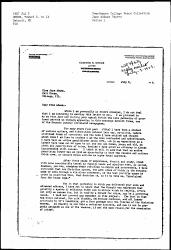
Dear Miss [Addams]: --
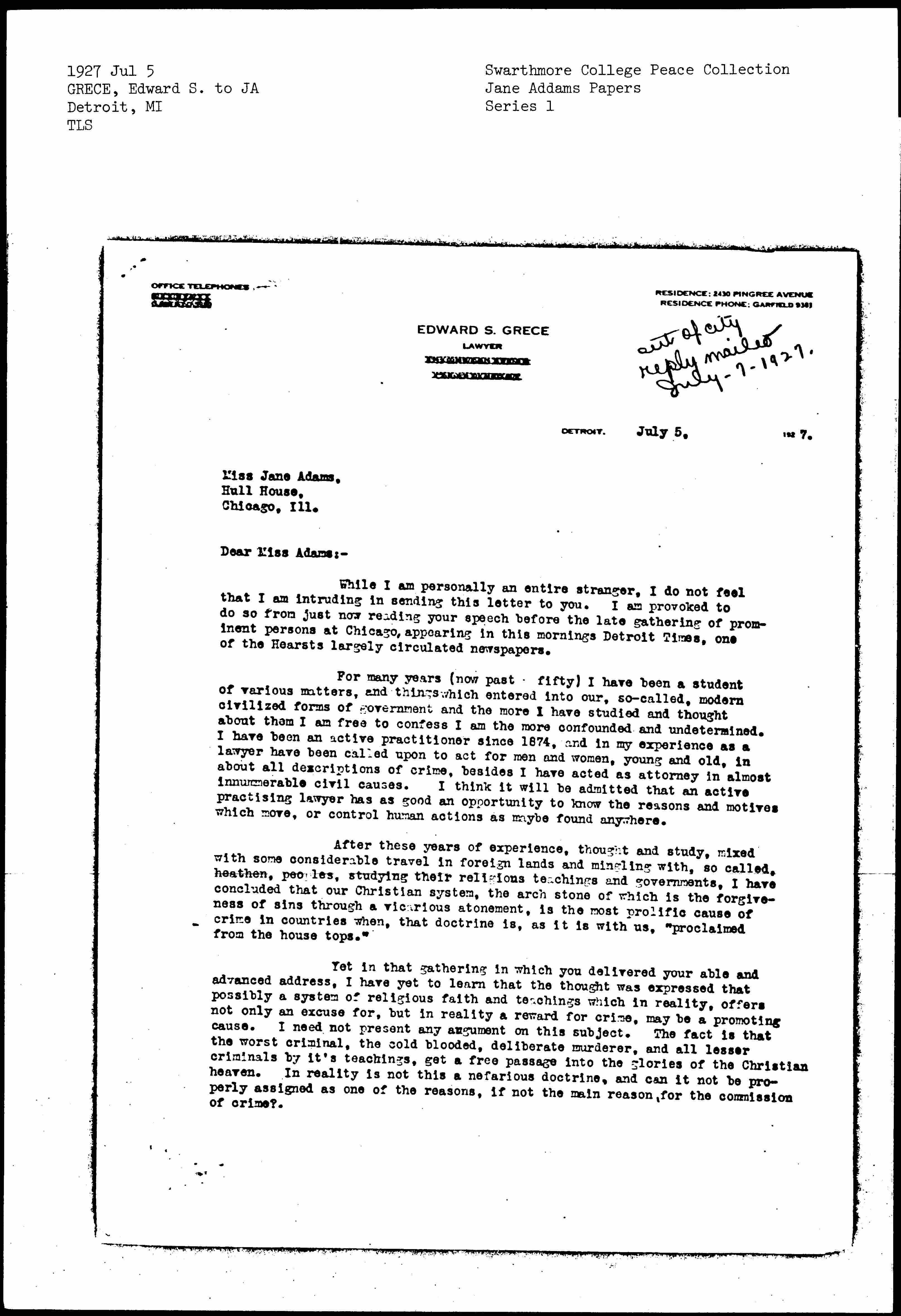
While I am personally an entire stranger, I do not feel that I am intruding in sending this letter to you. I am provoked to do so from just now reading your speech before the late gathering of prominent persons at Chicago, appearing in this morning's Detroit Times, one of the Hearsts largely circulated newspapers.
For many years (now past fifty) I have been a student of various matters, and things which entered into our, so-called, modern civilized forms of government and the more I have studied and thought about them I am free to confess I am the more confounded and undetermined. I have been an active practitioner since 1874, and in my experience as a lawyer have been called upon to act for men and women, young and old in about all descriptions of crime, besides I have acted as attorney in almost innumerable civil cases. I think it will be admitted that an active practicing lawyer has as good an opportunity to know the reasons and motives which move, or control human actions as [may be] found anywhere.
After these years of experience, thought and study, mixed with some considerable travel in foreign lands and mingling with, so called, heathen, peoples, studying their religions, teachings and governments, I have concluded that our Christian system, the arch stone of which is the forgiveness of sins through a vicarious atonement, is the most prolific cause of crime in countries when, that doctrine is, as it is with us, "proclaimed from the house tops."
Yet in that gathering in which you delivered your able and advanced address, I have yet to learn that the thought was expressed that possibly a system of religious faith and teachings which in reality, offers not only an excuse for, but in reality a reward for crime, may be a promoting cause. I need not present any argument on this subject. The fact is that the worst criminal, the cold blooded, deliberate murder, and all lesser criminals by [its] teachings, get a free passage into the glories of the Christian heaven. In reality is not this a nefarious doctrine, and can it not be properly assigned as one of the reasons, if not the main reason, for the commission of crime? [page 2]
Cont'd.
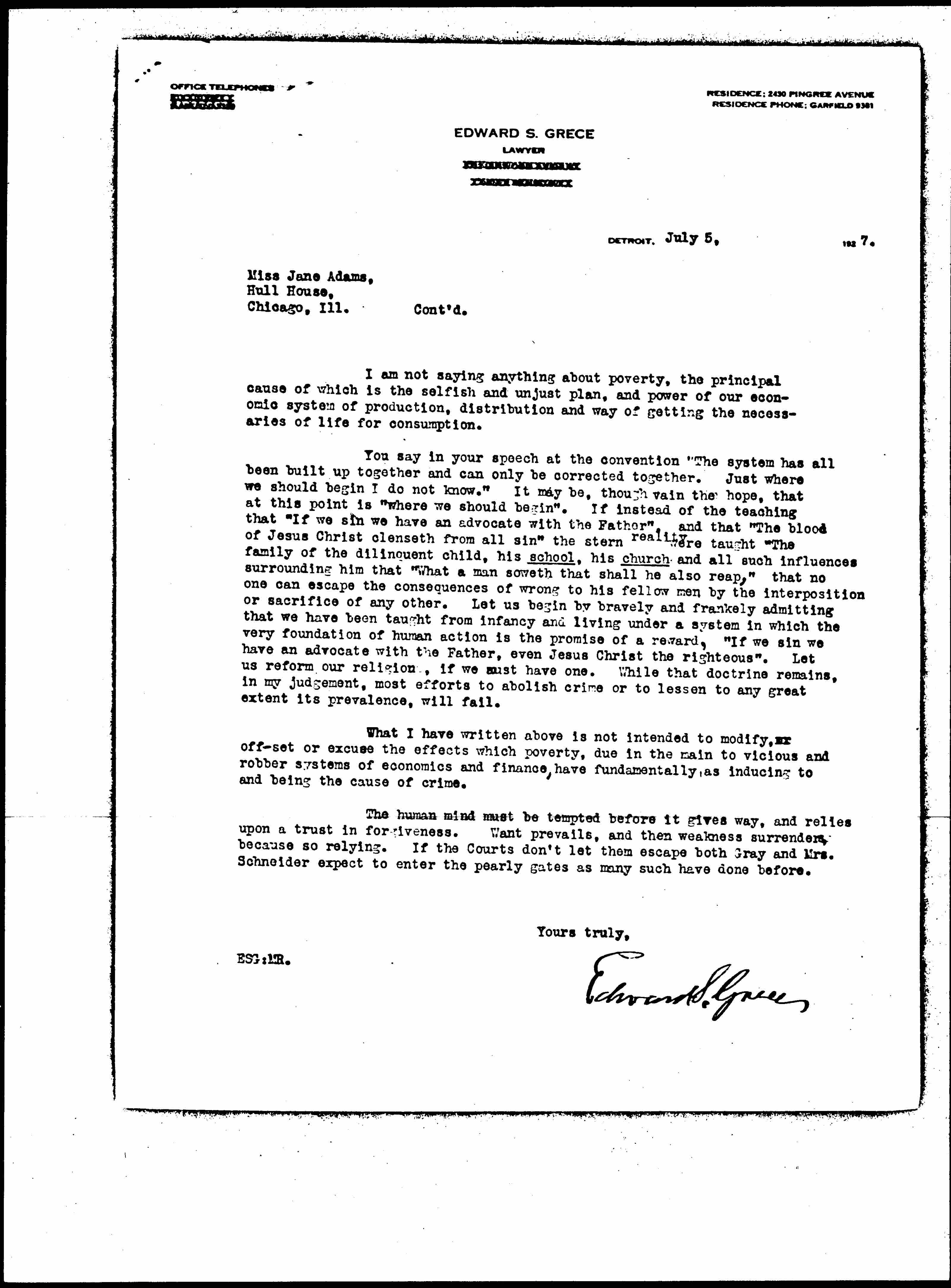
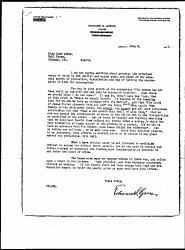
I am not saying anything about poverty, the principal cause of which is the selfish and unjust plan, and power of our economic system of production, distribution and way of getting the necessaries of life for consumption.
You say in your speech at the convention "The system has all been built up together and can only be corrected together. Just where we should begin I do not know." It may be, though vain the hope, that at this point is "where we should begin." If instead of the teaching that "If we sin we have an advocate with the Father" and that "The Blood of Jesus Christ cleanseth from all sin" the stern reality were taught "The family of the [delinquent] child, his school, his church, and all such influences surrounding him that 'What a man soweth that shall he also reap,'" that no one can escape the consequences of wrong to his fellow men by the interposition or sacrifice of any other. Let us begin by bravely and [frankly] admitting that we have been taught from infancy and living under a system in which the very foundation of human action is the promise of a reward, "If we sin we have an advocate with the Father, even Jesus Christ the righteous." Let us reform our religion, if we must have one. While that doctrine remains, in my [judgment], most efforts to abolish crime or to lessen to any great extent its prevalence, will fail.
What I have written above is not intended to modify, or off-set or excuse the effects which poverty, due in the main to vicious and robber systems of economics and finance, have fundamentally, as inducing to and being the cause of crime.
The human mind must be tempted before it gives way, and relies upon a trust in forgiveness. Want prevails, and then weakness surrenders, because so relying. If the Courts don't let them escape both Gray and Mrs. [Snyder] expect to enter the pearly gates as many such have done before.
Yours truly,
Edward S. Grece [signed]

Comments