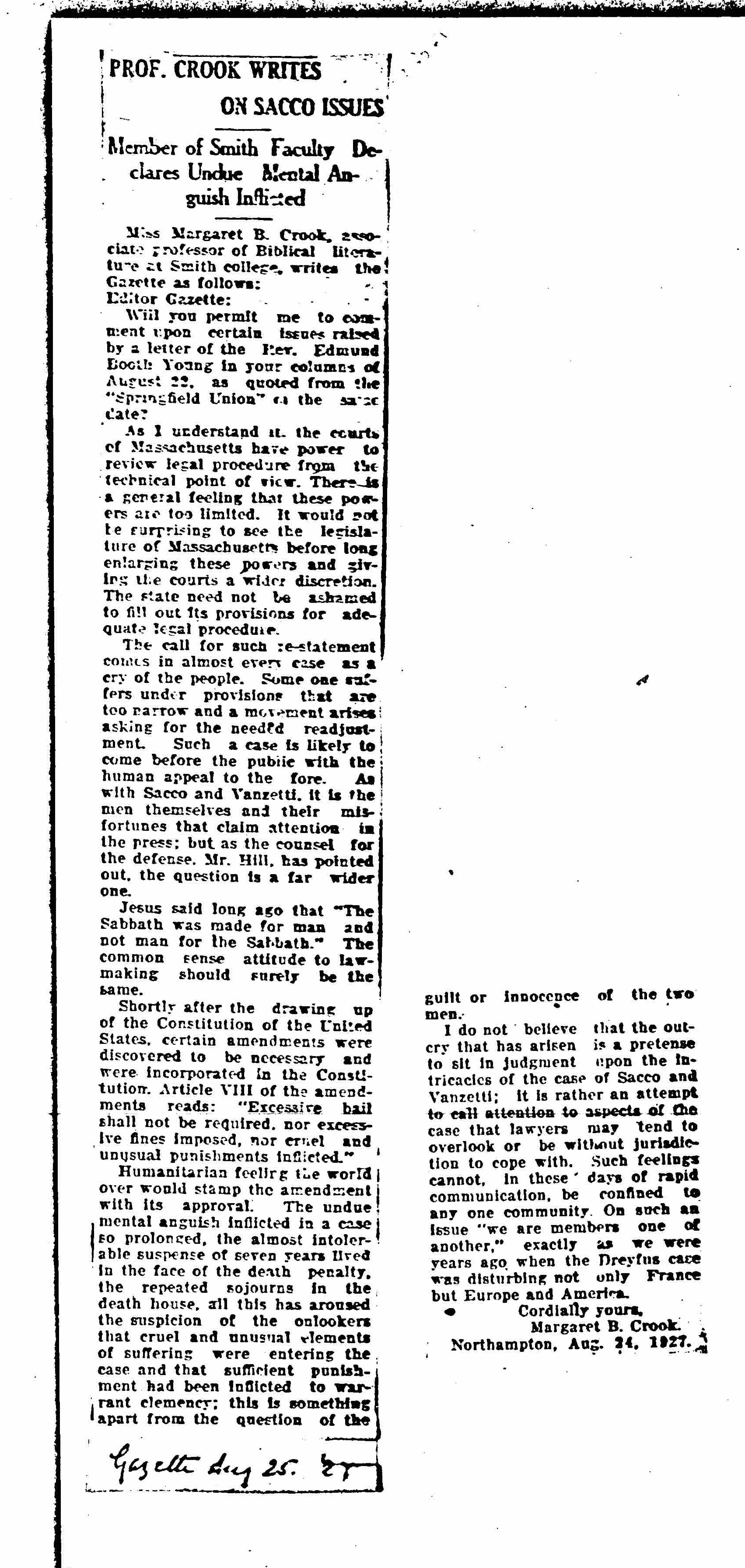
Miss Margaret B. Crook, associate professor of Biblical literature at Smith College, writes the Gazette as follows:
Editor Gazette:
Will you permit me to comment upon certain issues raised by a letter of the Rev. Edmund Booth Young in your columns of August 22, as quoted from the "Springfield Union" on the same date?
As I understand it, the courts of Massachusetts have power to review legal procedure from the technical point of view. There is a general feeling that these powers are too limited. It would not be surprising to see the legislature of Massachusetts before long enlarging these powers and giving the courts a wider discretion. The state need not be ashamed to fill out its provisions for adequate legal procedure.
The call for such [restatement] comes in almost every case as a cry of the people. Some one suffers under provisions that are too narrow and a movement arises asking for the needed readjustment. Such a case is likely to come before the public with the human appeal to the fore. As with Sacco and Vanzetti, it is the men themselves and their misfortunes that claim attention in the press; but as the counsel for the defense, Mr. Hill, has pointed out, the question is a far wider one.
Jesus said long ago that "The Sabbath was made for man and not man for the Sabbath." The common sense attitude to lawmaking should surely be the same.
Shortly after the drawing up of the Constitution of the United States, certain amendments were discovered to be necessary and were incorporated in the Constitution. Article VIII of the amendments reads: "Excessive bail shall not be required, nor excessive fines imposed, nor cruel and unusual punishments inflicted."
Humanitarian feeling the world over would stamp the amendment with its approval. The undue mental anguish inflicted in a case so prolonged, the almost intolerable suspense of seven years lived in the face of the death penalty, the repeated sojourns in the death house, all this has aroused the suspicion of the onlookers that cruel and unusual elements of suffering were entering the case and that sufficient punishment had been inflicted to warrant clemency; this is something apart from the question of the guilt or innocence of the two men.
I do not believe that the outcry that has arisen is a pretense to sit in judgment upon the intricacies of the case of Sacco and Vanzetti; it is rather an attempt to call attention to aspects of the case that lawyers may tend to overlook or be without jurisdiction to cope with. Such feelings cannot, in these days of rapid communication, be confined to any one community. On such an issue "we are members one of another," exactly as we were years ago when the Dreyfus case was disturbing not only France but Europe and America.
Cordially yours,

Comments