Charles C. Cooper to John Lovejoy Elliott, September 2, 1927

COPY

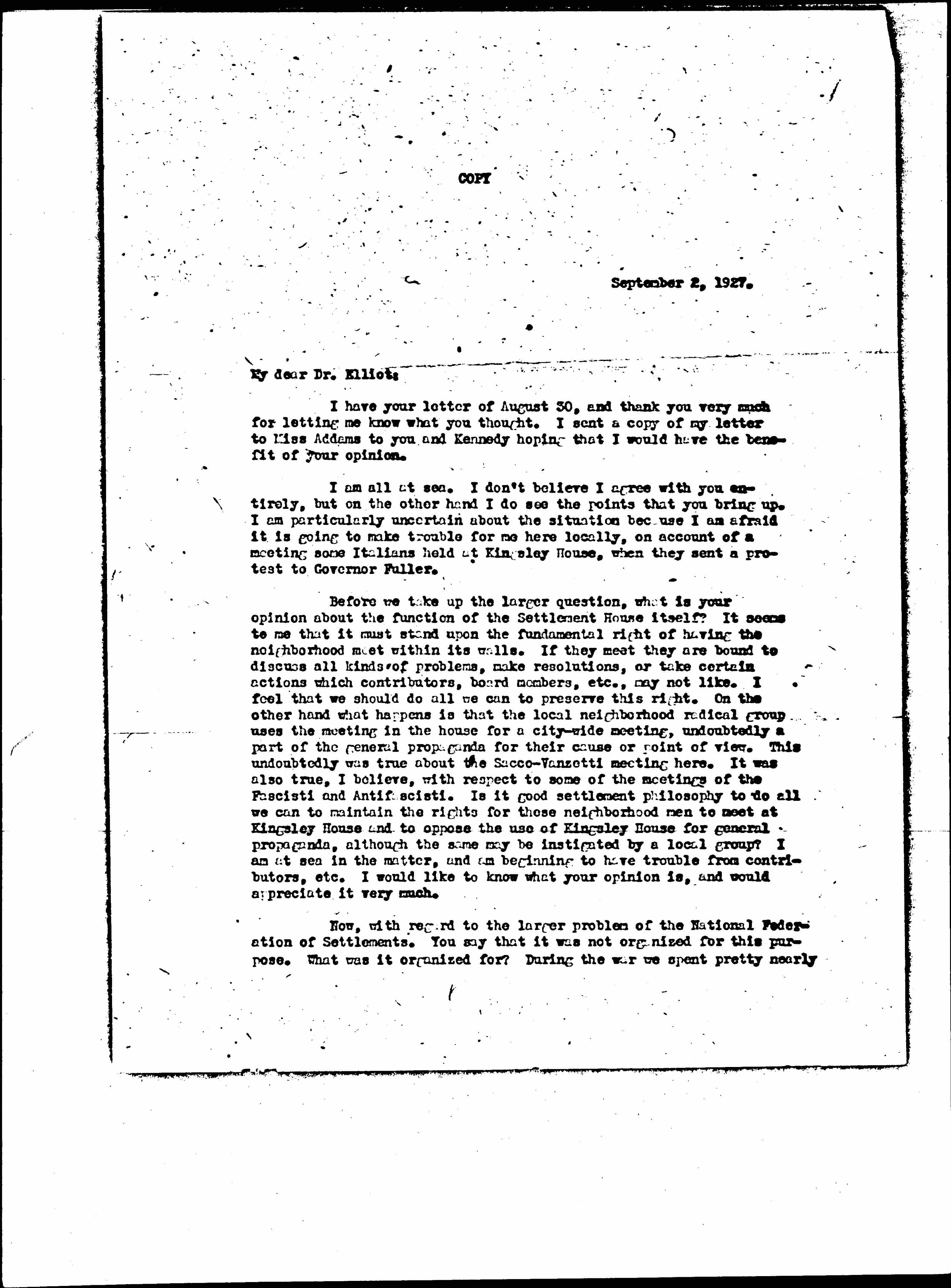
September 2, 1927.

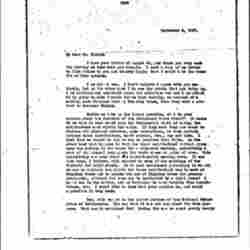
My dear Dr. [Elliott]:

I have your letter of August 30, and thank you very much for letting me know what you thought. I sent a copy of my letter to Miss Addams to you and Kennedy hoping that I would have the benefit of your opinion.

I am all at sea. I don't believe I agree with you entirely, but on the other hand I do see the points that you bring up. I am particularly uncertain about the situation because I am afraid it is going to make trouble for me here locally, on account of a meeting some Italians held at Kingsley House, when they sent a protest to Governor Fuller.

Before we take up the larger question, what is your opinion about the function of the Settlement House itself? It seems to me that it must stand upon the fundamental right of having the neighborhood meet within its walls. If they meet they are bound to discuss all kinds of problems, make resolutions, or take certain actions which contributors, board members, etc., may not like. I feel that we should do all we can to preserve this right. On the other hand what happens is that the local neighborhood radical group uses the meeting in the house for a city-wide meeting, undoubtedly a part of the general propaganda for their cause or point of view. This undoubtedly was true about the Sacco-Vanzetti meeting here. It was also true, I believe, with respect to some of the meetings of the Fascisti and Antifascisti. Is it good settlement philosophy to do all we can to maintain the rights for these neighborhood men to meet at Kingsley House and to oppose the use of Kingsley House for general propaganda, although the same may be instigated by a local group? I am at sea in the matter, and am beginning to have trouble from contributors, etc. I would like to know what your opinion is, and would appreciate it very much.

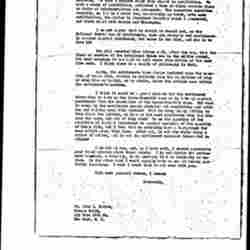
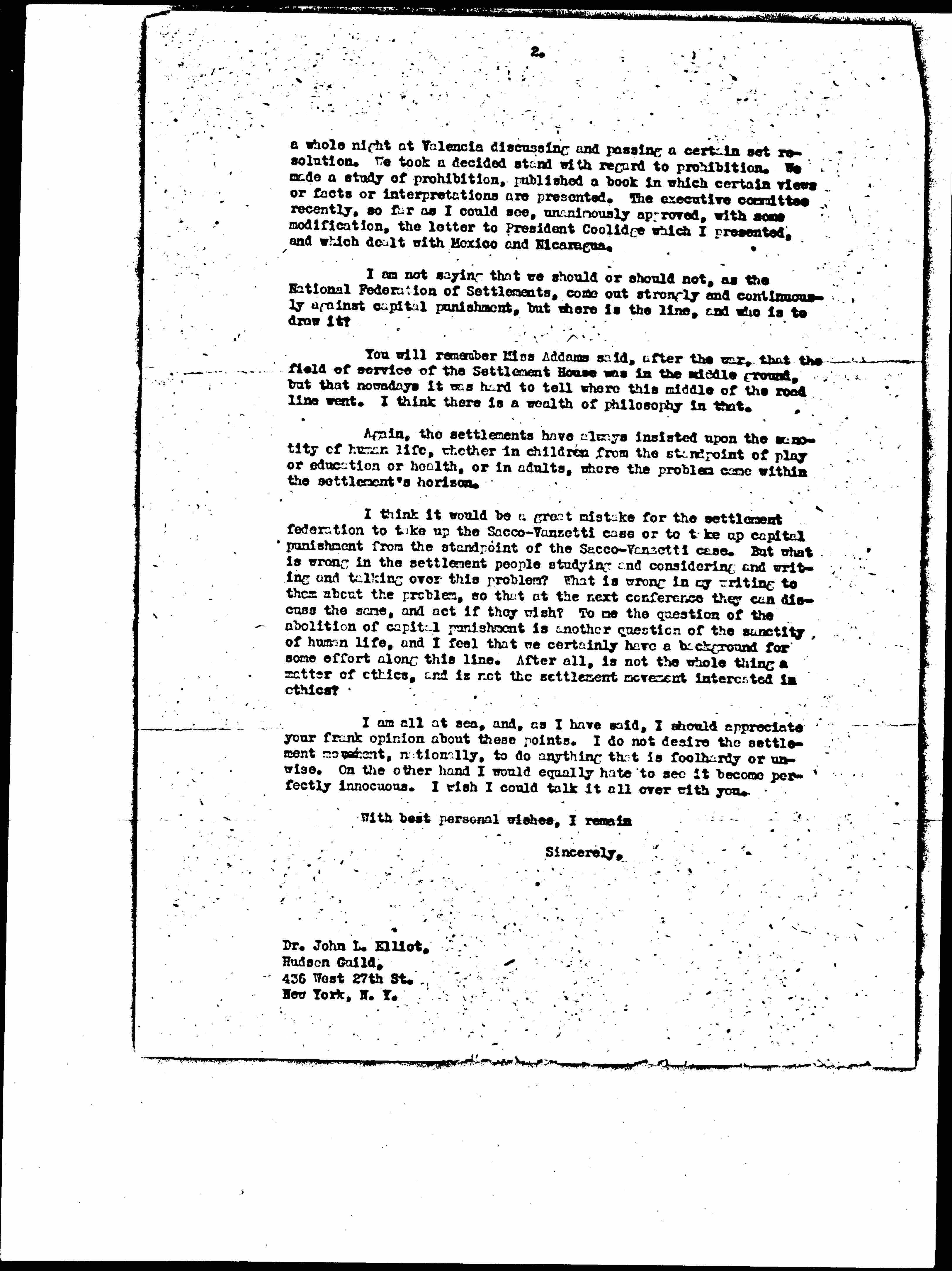
Now, with regard to the larger problem of the National Federation of Settlements. You say that it was not organized for this purpose. What was it organized for? During the war we spent pretty nearly [page 2] a whole night at Valencia discussing and passing a certain set resolution. We took a decided stand with regard to prohibition. We made a study of prohibition, published a book in which certain views or facts or interpretations are presented. The executive committee recently, so far as I could see, unanimously approved, with some modification, the letter to President Coolidge which I presented, and which dealt with Mexico and Nicaragua.

I am not saying that we should or should not, as the National Federation of Settlements, come out strongly and continuously against capital punishment, but where is the line, and who is to draw it?

You will remember Miss Addams said, after the war, that the field of service of the Settlement House was in the middle ground, but that nowadays it was hard to tell where this middle of the road line went. I think there is a wealth of philosophy in that.

Again, the settlements have always insisted upon the sanctity of human life, whether in children from the standpoint of play or education or health, or in adults, where the problem came within the settlement's horizon.

I think it would be a great mistake for the settlement federation to take up the Sacco-Vanzetti case or to take up capital punishment from the standpoint of the Sacco-Vanzetti case. But what is wrong in the settlement people studying and considering and writing and talking over this problem? What is wrong in my writing to them about the problem, so that at the next conference they can discuss the same, and act if they wish? To me the question of the abolition of capital punishment is another question of the sanctity of human life, and I feel that we certainly have a background for some effort along this line. After all, is not the whole thing a matter of ethics, and is not the settlement movement interested in ethics?

I am all at sea, and, as I have said, I should appreciate your frank opinion about these points. I do not desire the settlement movement, nationally, to do anything that is foolhardy or unwise. On the other hand I would equally hate to see it become perfectly innocuous. I wish I could talk it all over with you.

With best personal wishes, I remain

Sincerely, 

Dr. John L. [Elliott],
Hudson Guild,
436 West 27th St.
New York, N.Y.