

Study of Public Record of Miss Jane Addams, May 17, 1927

REEL0018_1727.jpg
REEL0018_1728.jpg
REEL0018_1729.jpg
REEL0018_1730.jpg
REEL0018_1731.jpg
REEL0018_1732.jpg
REEL0018_1733.jpg
REEL0018_1734.jpg
REEL0018_1735.jpg
REEL0018_1736.jpg
REEL0018_1737.jpg
REEL0018_1738.jpg
REEL0018_1739.jpg
REEL0018_1740.jpg
REEL0018_1741.jpg
REEL0018_1742.jpg
REEL0018_1743.jpg
REEL0018_1744.jpg
REEL0018_1745.jpg
REEL0018_1746.jpg
REEL0018_1747.jpg
REEL0018_1748.jpg
REEL0018_1749.jpg
REEL0018_1750.jpg
REEL0018_1751.jpg
REEL0018_1752.jpg
REEL0018_1753.jpg

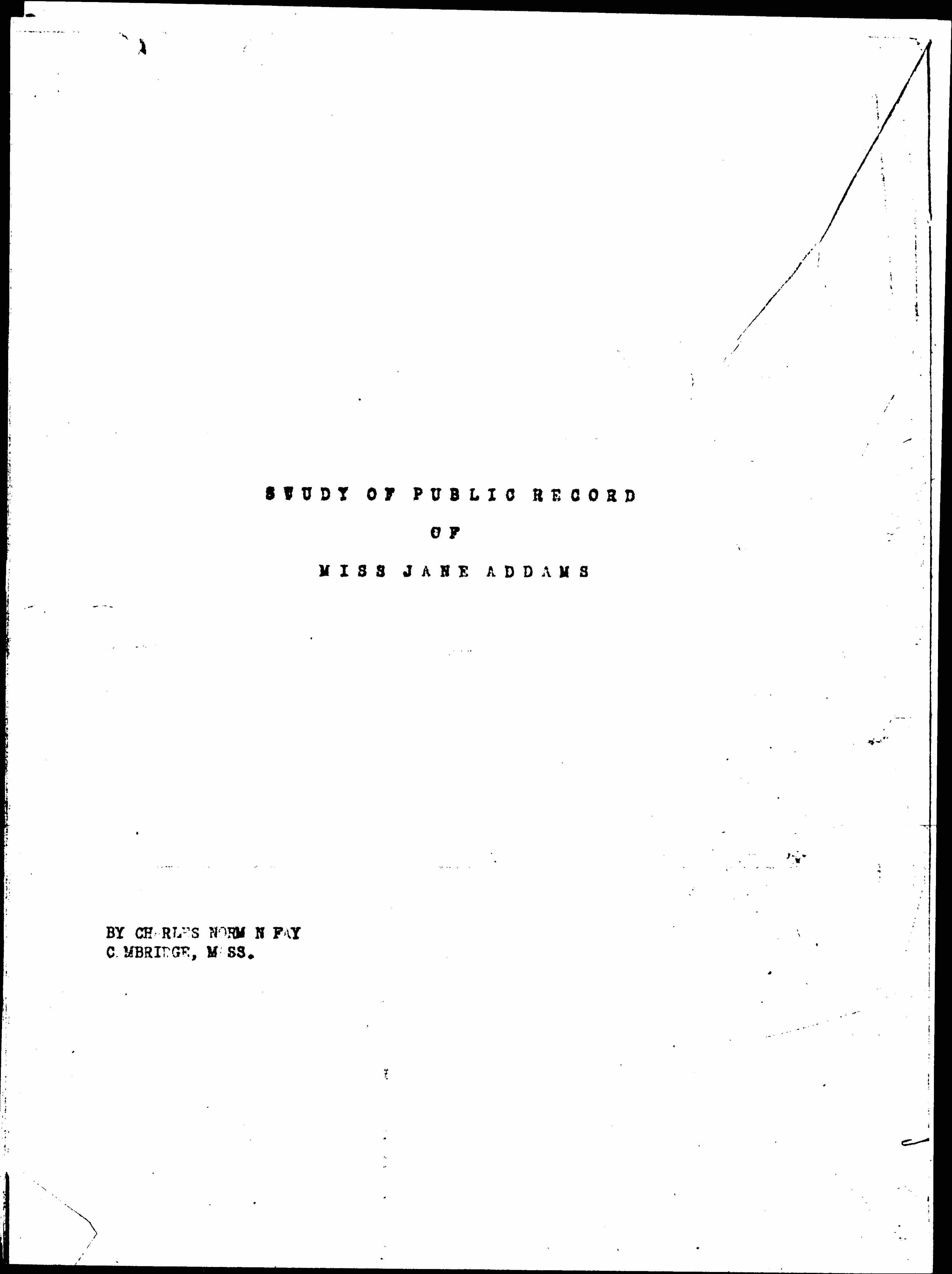
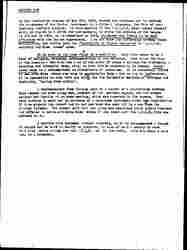
STUDY OF PUBLIC RECORD

OF

MISS JANE ADDAMS

BY CHARLES NORMAN FAY
CAMBRIDGE, MASS. [page 2]

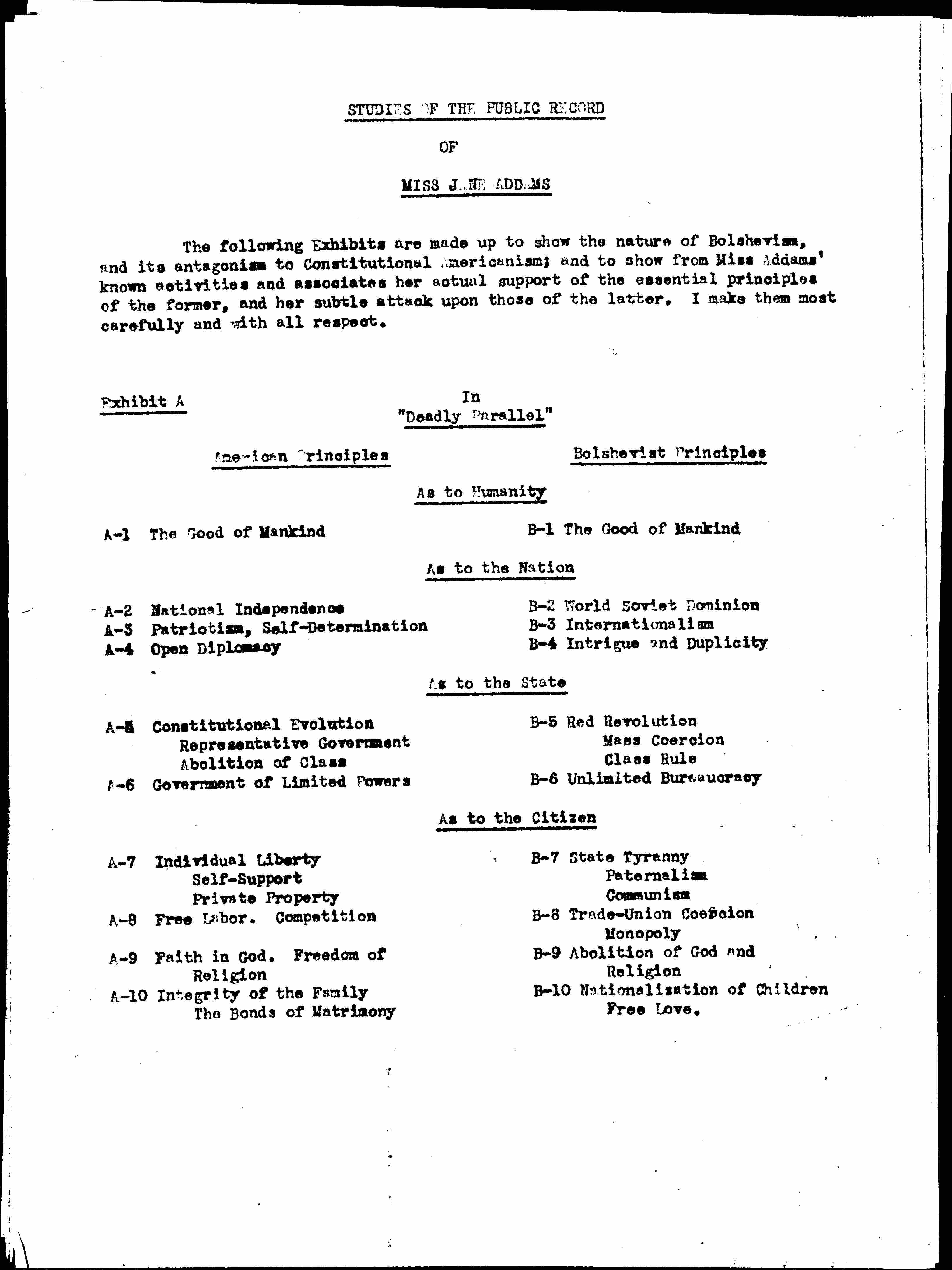
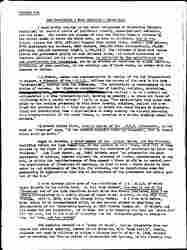
STUDIES OF THE PUBLIC RECORD

OF

MISS JANE ADDAMS

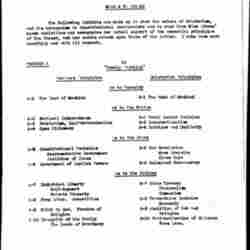
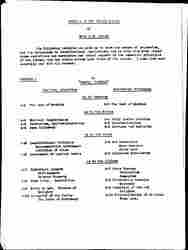
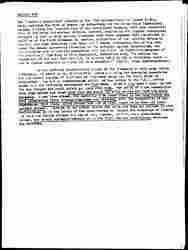
The following Exhibits are made up to show the nature of Bolshevism, and its antagonism to Constitutional Americanism; and to show from Miss Addams' known activities and associates her actual support of the essential principles of the former, and her subtle attack upon those of the latter. I make them most carefully and with all respect.

Exhibit A In
"Deadly Parallel"
American Principles Bolshevist Principles
As to Humanity
A-1 The Good of Mankind B-1 The Good of Mankind
As to the Nation
A-2 National Independence B-2 World Soviet Domination
A-3 Patriotism, Self-Determination B-3 Internationalism
A-4 Open Diplomacy B-4 Intrigue and Duplicity
As to the State
A-5 Constitutional Evolution B-5 Red Revolution
Representative Government
Abolition of Class
Mass Coercion
Class Rule
A-6 Government of Limited Powers B-6 Unlimited Bureaucracy
As to the Citizen
A-7 Individual Liberty B-7 State Tyranny
Self-Support
Private Property
Paternalism
Communism
A-8 Free Labor. Competition B-8 Trade-Union Coercion
Monopoly
A-9 Faith in God. Freedom of Religion B-9 Abolition of God and Religion
A-10 Integrity of the Family B-10 Nationalization of Children
The Bonds of Matrimony Free Love. [page 3]

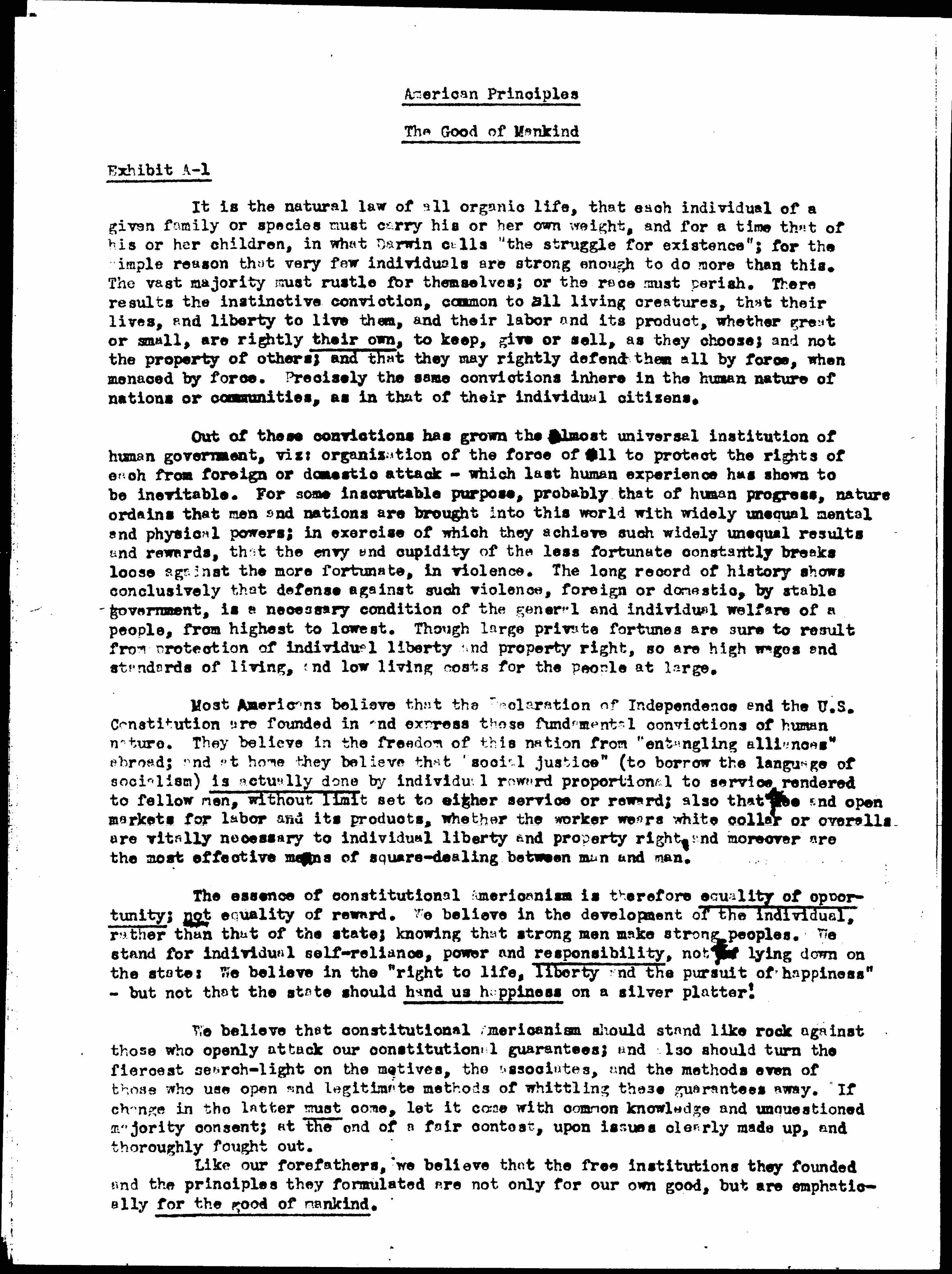
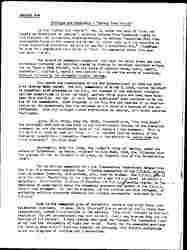
American Principles

The Good of Mankind

Exhibit A-1

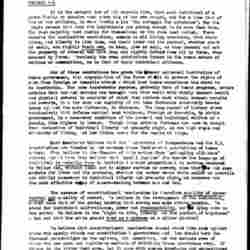
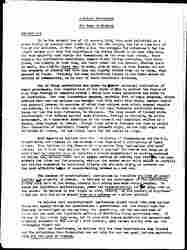
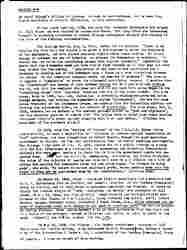
It is the natural law of all organic life, that each individual of a given family or species must carry his or her own weight, and for a time that of his or her children, in what Darwin calls "the struggle for existence"; for the simple reason that very few individuals are strong enough to do more than this. The vast majority must rustle for themselves; or the race must perish. There results the instinctive conviction, common to all living creatures, that their lives, and liberty to live them, and their labor and its product, whether great or small, are rightly their own, to keep, to give or sell, as they choose; and not the property of others; and that they may rightly defend them all by force, when menaced by force. Precisely the same convictions [inure?] in the human nature of nations or communities, as in that of their individual citizens.

Out of these convictions has grown the almost universal institution of human government, vis: organization of the force of all to protect the rights of each from foreign or domestic attack -- which last human experience has shown to be inevitable. For some inscrutable purpose, probably that of human progress, nature ordains that men and nations are brought into this world with widely unequal mental and physical powers; in exercise of which they achieve such widely unequal results and rewards, that the envy and cupidity of the less fortunate constantly breaks loose against the more fortunate, in violence. The long record of history shows conclusively that defense against such violence, foreign or domestic, by stable government, is a necessary condition of the general and individual welfare of a people, from highest to lowest. Though large private fortunes are sure to result from protection of individual liberty and property right, so are high wages and standards of living, and low living costs for the people at large.

Most Americans believe that the Declaration of Independence and the U.S. Constitution are founded in and express those fundamental convictions of human nature. They believe in the freedom of this nation from "entangling alliances" abroad; and at home they believe that "social justice" (to borrow the language of socialism) is actually done by individual reward proportional to service rendered to fellow men, without limit set to either service or reward; also that [free] and open markets for labor and its products, whether the worker wears white collar and overalls the most effective [means] of square-dealing between man and man.

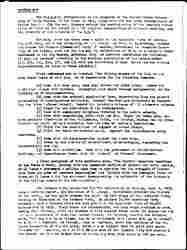
The essence of constitutional Americanism is therefore equality of opportunity; not equality of reward. We believe in the development of the individual, rather than that of the state; knowing that strong men make strong peoples. We stand for individual self-reliance, power and responsibility, not [for] lying down on the state. We believe in the "right to life, liberty and the pursuit of happiness" -- but not that the state should hand us happiness on a silver platter!

We believe that constitutional Americanism should stand like rock against those who openly attack our constitutional guarantees; and also should turn the fiercest search-light on the motives, the associates, and the methods even of those who use open and legitimate methods of whittling these guarantees away. If change in the latter must come, let it come with common knowledge and unquestioned majority consent; at the end of a fair context, upon issues clearly made up, and thoroughly fought out.

Like our forefathers, we believe that the free institutions they founded and the principles they formulated are not only for our own good, but are empathically for the good of mankind. [page 4]

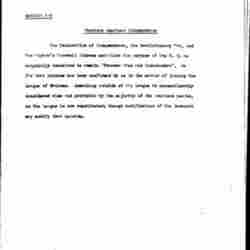
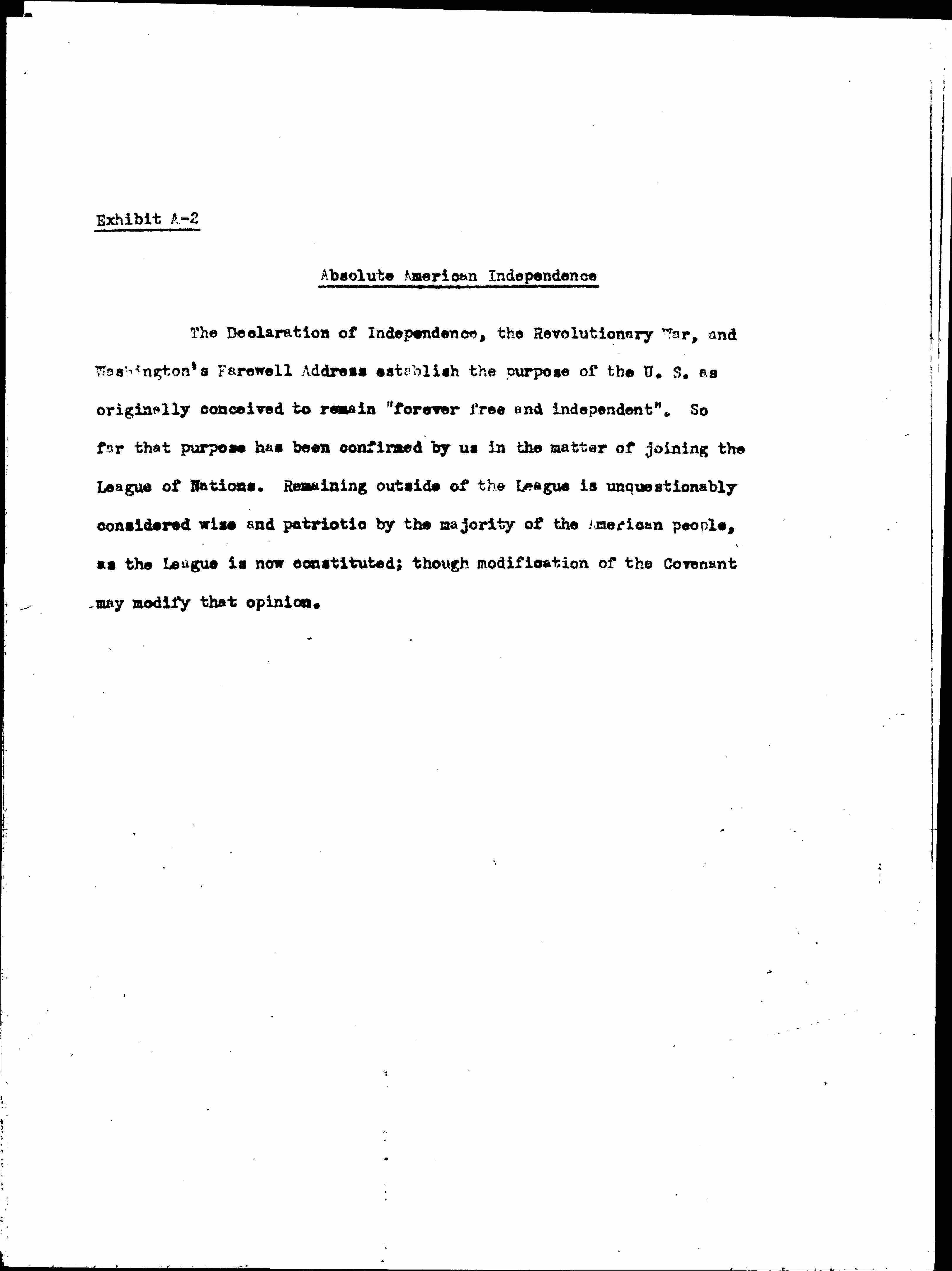
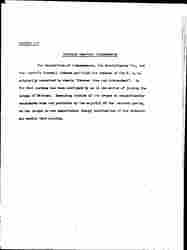
Exhibit A-2

Absolute American Independence

The Declaration of Independence, the Revolutionary War, and Washington's Farewell Address establish the purpose of the U.S. as originally conceived to remain "forever free and independent." So far that purpose has been confirmed by us in the matter of joining the League of Nations. Remaining outside of the League is unquestionably considered wise and patriotic by the majority of the American people, as the League is now constituted; though modification of the Covenant may modify that opinion. [page 5]

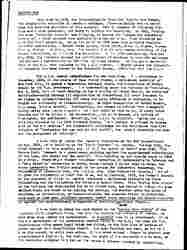
Bolshevist Principles

The Good of Mankind

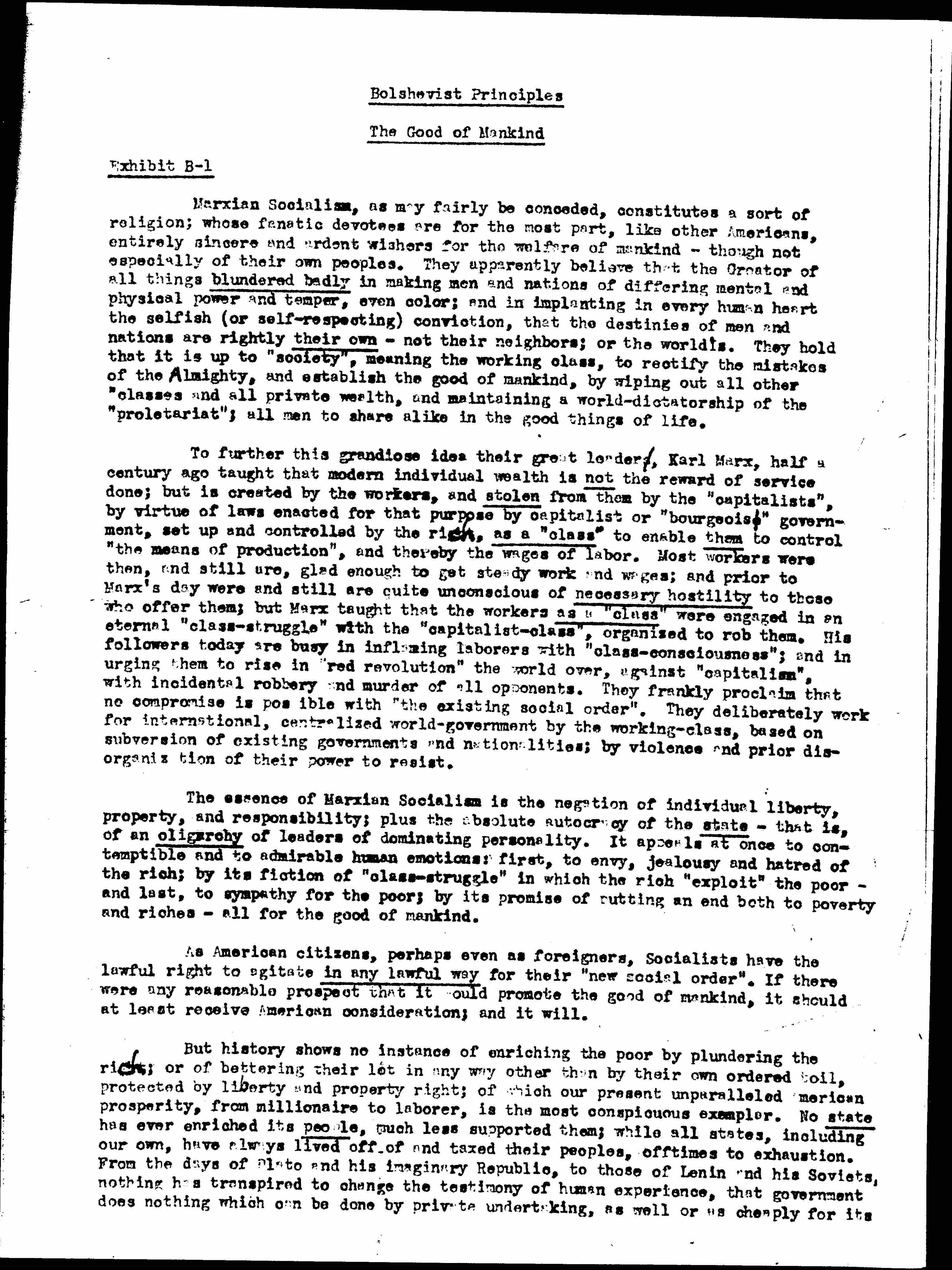
Exhibit B-1

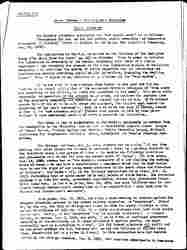
Marxian Socialism, as may fairly be conceded, constitutes a sort of religion; whose fanatic devotees are for the most part, like other Americans, entirely sincere and ardent wishers for the welfare of mankind -- though not especially of their own peoples. They apparently believe that the Creator of all things blundered badly in making men and nations of differing mental and physical power and temper, even color; and in implanting in every human heart the selfish (or self-respecting) conviction, that the destinies of men and nations are rightly their own -- not their neighbors; or the worlds. They hold that it is up to "society," meaning the working class, to rectify the mistakes of the Almighty, and establish the good of mankind, by wiping out all other "classes["] and all private wealth, and maintaining a world-dictatorship of the "proletariat;" all men to share alike in the good things of life.

To further this grandiose idea their great leader, Karl Marx, half a century ago taught that modern individual wealth is not the reward of service done; but is created by the workers, and stolen from them by the "capitalists," by virtue of laws enacted for that purpose by capitalist or "bourgeois" government, set up and controlled by the right, as a "class" to enable them to control "the means of production," and thereby the wages of labor. Most workers were then, and still are, glad enough to get steady work and wages; and prior to Marx's day were and still quite unconscious of necessary hostility to those who offer them; but Marx taught that the workers as a "class" were engaged in an eternal "class-struggle" with the "capitalist-class," organized to rob them. His followers today are busy in inflaming laborers with "class-consciousness;" and in urging them to rise in "red revolution" the world over, against "capitalism," with incidental robbery and murder of all opponents. They frankly proclaim that no compromise is possible with "the existing social order." They deliberately work for international, centralized world-government by the working-class, based on subversion of existing governments and nationalities; by violence and prior disorganization of their power to resist.

The essence of Marxian Socialism is the negation of individual liberty, property, and responsibility; plus the absolute autocracy of the state -- that is, of an oligarchy of leaders of dominating personality. It appeals at once to contemptible and to admirable human emotions: first, to envy, jealousy and hatred of the rich; by its fiction of "class-struggle" in which the rich "exploit" the poor -- and last, to sympathy for the poor; by its promise of putting an end both to poverty and riches -- all for the good of mankind.

As American citizens, perhaps even as foreigners, Socialists have the lawful right to agitate in any lawful way for their "new social order." If there were any reasonable prospect that it [would] promote the good of mankind, it should at least receive American consideration; and it will.

But history shows no instance of enriching the poor by plundering the rich; or of bettering their lot in any way other than by their own ordered toil, protected by liberty and property right; of which our present unparalleled American prosperity, from millionaire to laborer, is the most conspicuous exemplar. No state has ever enriched its people, much less supported them; while all states, including our own, have always lived off of and taxed their peoples, [ofttimes] to exhaustion. From the days of Plato and his imaginary Republic, to those of Lenin and his Soviets, nothing has transpired to change the testimony of human experience, that government does nothing which can be done by private undertaking, as well or as cheaply for its [page 6] people. There is no reason to trust a Socialist politician any further than any other politician. The safer way is not to load too much on government! But that is not the socialist's idea. History is not "progressive" enough for him; and he has no "decent respect for the opinions of mankind." [page 7]

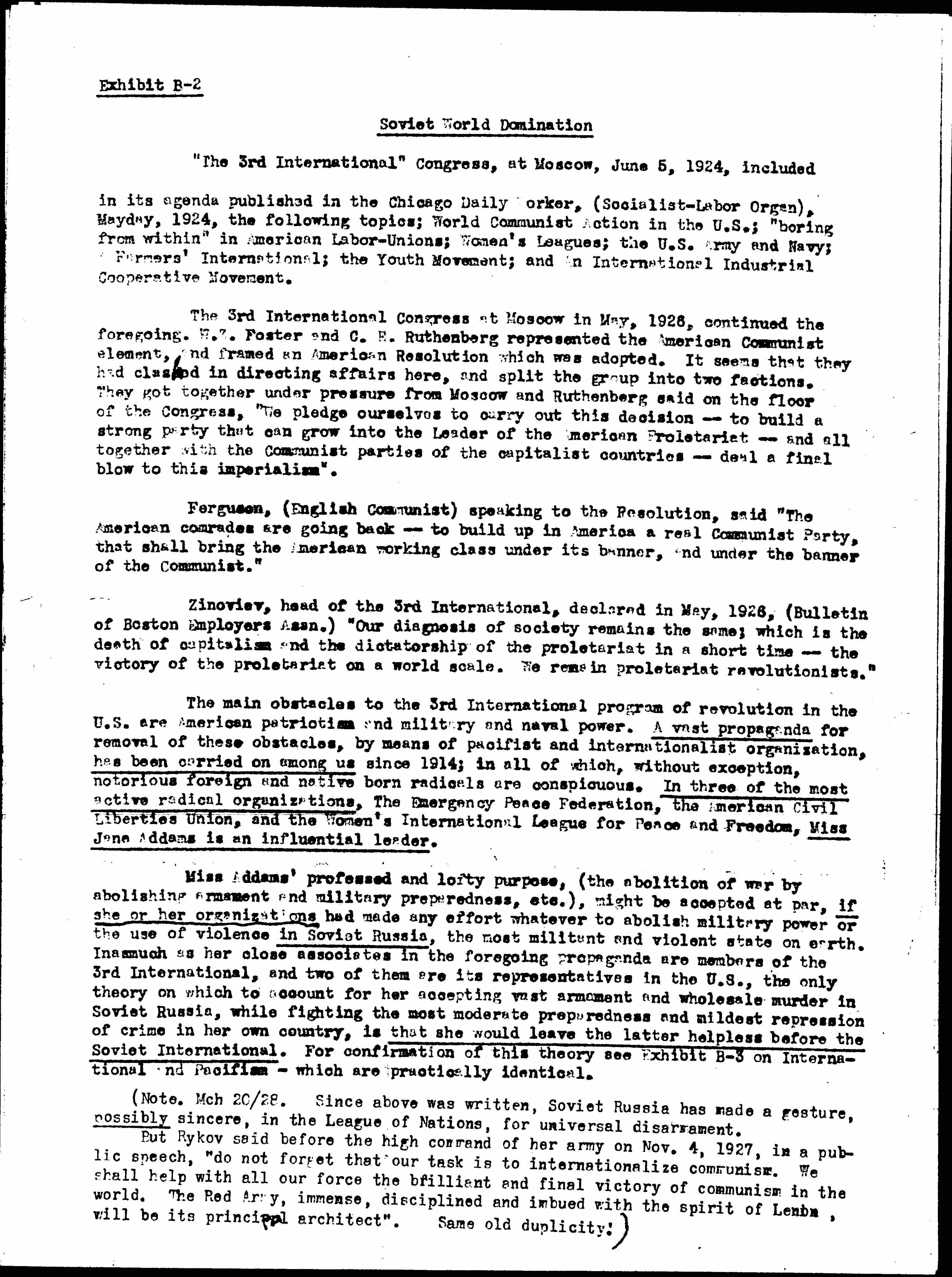
Exhibit B-2

Soviet World Domination

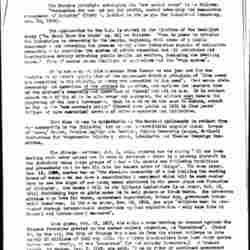
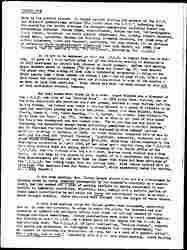
"The 3rd International" Congress, at Moscow, June 5, 1924, included in its agenda published in the Chicago Daily Worker, (Socialist-Labor Organ), Mayday, 1924, the following topics: World Communist Action in the U.S.; "boring from within" in American Labor-Unions; Women's Leagues; the U.S. Army and Navy; Farmers' International; the Youth Movement; and an International Industrial Cooperative Movement.

The 3rd International Congress at Moscow in May, 1926, continued the foregoing. W. Z. Foster and C. E. Ruthenberg represented the American Communist element, and framed an American Resolution which was adopted. It seems that they had clashed in directing affairs here, and split the group into two fractions. They got together under pressure from Moscow and Ruthenberg said on the floor of the Congress, "We pledge ourselves to carry out this decision -- to build a strong party that can grow into the Leader of the American Proletariat -- and all together with the Communist parties of the capitalist countries -- deal a final blow to this imperialism."

Ferguson, (English Communist) speaking to the Resolution, said "The American comrades are going back -- to build up in America a real Communist Party, that shall bring the American working class under its banner, and under the banner of the Communist."

Zinoviev, head of the 3rd International, declared in May, 1926, (Bulletin of Boston Employers Assn.) "Our diagnosis of society remains the same; which is the death of capitalism and the dictatorship of the proletariat in a short time -- the victory of the proletariat on a world scale. We remain proletariat revolutionists."

The main obstacles to the 3rd International program of revolution in the U.S. are American patriotism and military and naval power. A vast propaganda for removal of these obstacles, by means of pacifist and internationalist organization, has been carried on among us since 1914; in all of which, without exception, notorious foreign and native born radicals are conspicuous. In three of the most active radical organizations, The Emergency Peace Federation, the American Civil Liberties Union, and the Women's International League for Peace and Freedom, Miss Jane Addams is an influential leader.

Miss Addams' professed and lofty purpose, (the abolition of war by abolishing armament and military preparedness, etc.), might be accepted at par, if she or her organizations had made any effort whatever to abolish military power or the use of violence in Soviet Russia, the most militant and violent state on earth. Inasmuch as her close associates in the foregoing propaganda are members of the 3rd International, and two of them are its representatives in the U.S., the only theory on which to account for the accepting vast armament and wholesale murder in Soviet Russia, while fighting the most moderate preparedness and mildest repression of crime in her own country, is that she would leave the latter helpless before the Soviet International. For confirmation of this theory see Exhibit B-3 on International and Pacifism -- which are practically identical.

(Note. Mch 20/28. Since above was written, Soviet Russia has made a gesture, possibly sincere, in the League of Nations, for universal disarmament.

But Rykov said before the high command of her army on Nov. 4, 1927, in a public speech, "do not forget that our task is to internationalize communism. We shall help with all our force the brilliant and final victory of communism in the world. The Red Army, immense, disciplined and imbued with the spirit of Lenin, will be its principal architect." Same old duplicity!) [page 8]

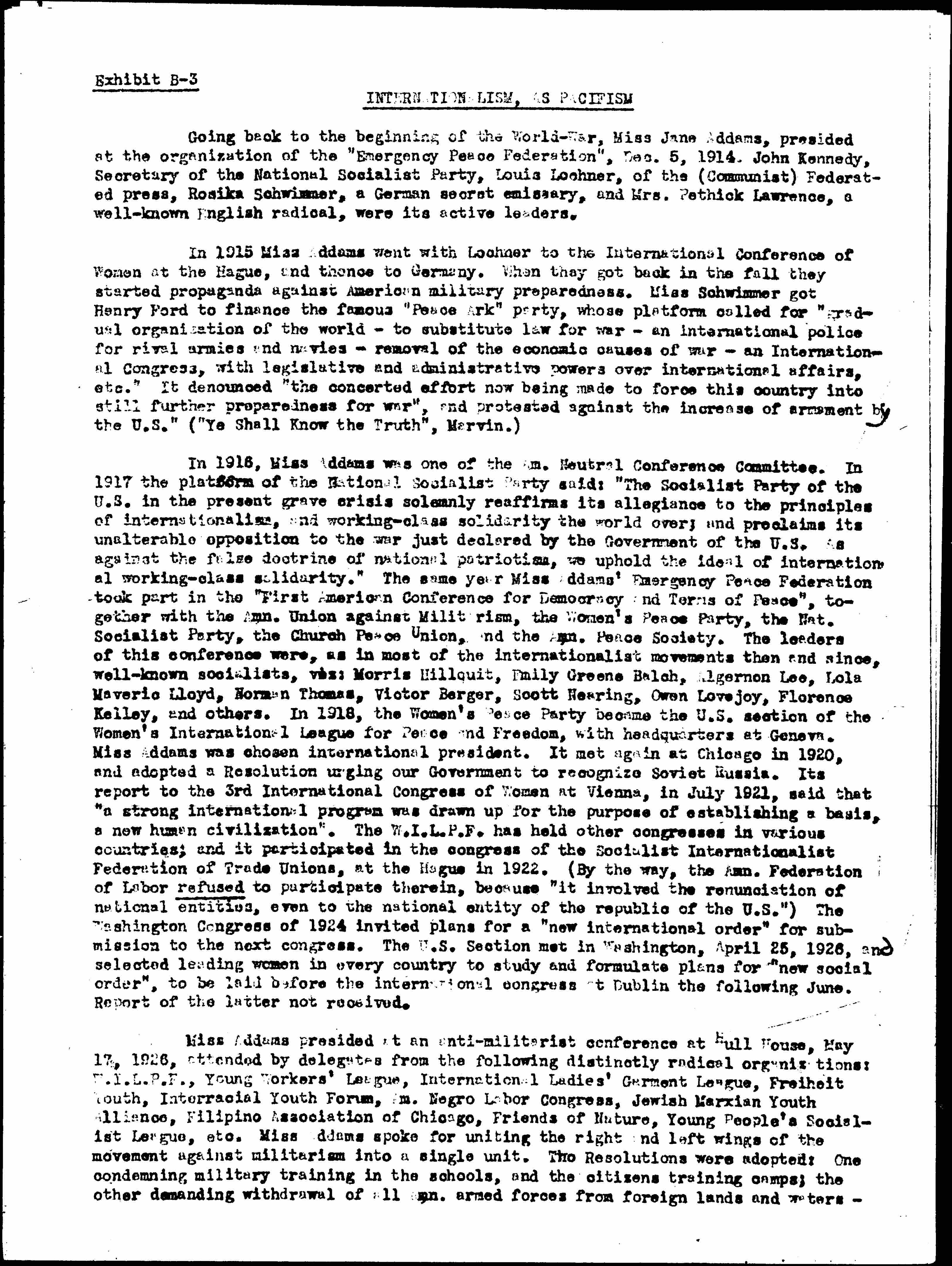
Exhibit B-3

INTERNATIONALISM, AS PACIFISM

Going back to the beginning of the World-War, Miss Jane Addams, presided at the organization of the "Emergency Peace Federation," Dec. 5, 1914. John Kennedy, Secretary of the National Socialist Party, Louis Lochner, of the (Communist) Federation press, Rosika Schwimmer, a German secret emissary, and Mrs. Pethick Lawrence, a well-known English radical, were its active leaders.

In 1915 Miss Addams went with Lochner to the International Conference of Women at The Hague, and thence to Germany. When they got back in the fall they started propaganda against American military preparedness. Miss Schwimmer got Henry Ford to finance the famous "Peace Ark" party, whose platform called for "gradual organization of the world -- to substitute law for war -- an international police for rival armies and navies -- removal of the economic causes of war -- an International Congress, with legislative and administrative powers over international affairs, etc." It denounced "the concerted effort now being made to force this country into still further preparedness for war," and protested ["]against the increase of armament by the U.S." ("Ye Shall Know the Truth," Marvin.)

In 1916, Miss Addams was one of the Am. Neutral Conference Committee. In 1917 the platform of the National Socialist Party said: "The Socialist Party of the U.S. in the present grave crisis solemnly reaffirms its allegiance to the principles of internationalism, and working-class solidarity to the world over; and proclaims its unalterable opposition to the war just declared by the Government of the U.S. As against the false doctrine of national patriotism, we uphold the ideal of international working-class solidarity." The same year Miss Addams' Emergency Peace Federation took part in the "First American Conference for Democracy and Terms of Peace," together with the Amn. Union against Militarism, the Women's Peace Party, the Nat. Socialist Party, the Church Peace Union, and the Amn. Peace Society. The leaders of this conference were, as in most of the internationalist movements then and since, well-known socialists, viz: Morris Hillquit, Emily Greene Balch, Algernon Lee, Lola Maverick Lloyd, Norman Thomas, Victor Berger, Scott Nearing, Owen Lovejoy, Florence Kelley, and others. In 1918, the Women's Peace Party became the U.S. section of the Women's International League for Peace and Freedom, with headquarters at Geneva. Miss Addams was chosen international president. It met again at Chicago in 1920, and adopted a Resolution urging our Government to recognize Soviet Russia. Its report to the 3rd International Congress of Women at Vienna, in July 1921, said that "a strong international program was drawn up for the purpose of establishing a basis, a new human civilization." The W.I.L.P.F. has held other congresses in various countries; and it participated in the congress of the Socialist Internationalist Federation of Trade Unions, at The Hague in 1922. (By the way, the Amn. Federation of Labor refused to participate therein, because "it involved the renunciation of national entities, even to the national entity of the republic of the U.S.") The Washington Congress of 1924 invited plans for a "new international order" for submission to the next congress. The U.S. Section met in Washington, April 25, 1926, and selected leading women in every country to study and formulate plans for "new social order," to be laid before the international congress at Dublin the following June. Report of the latter not received.

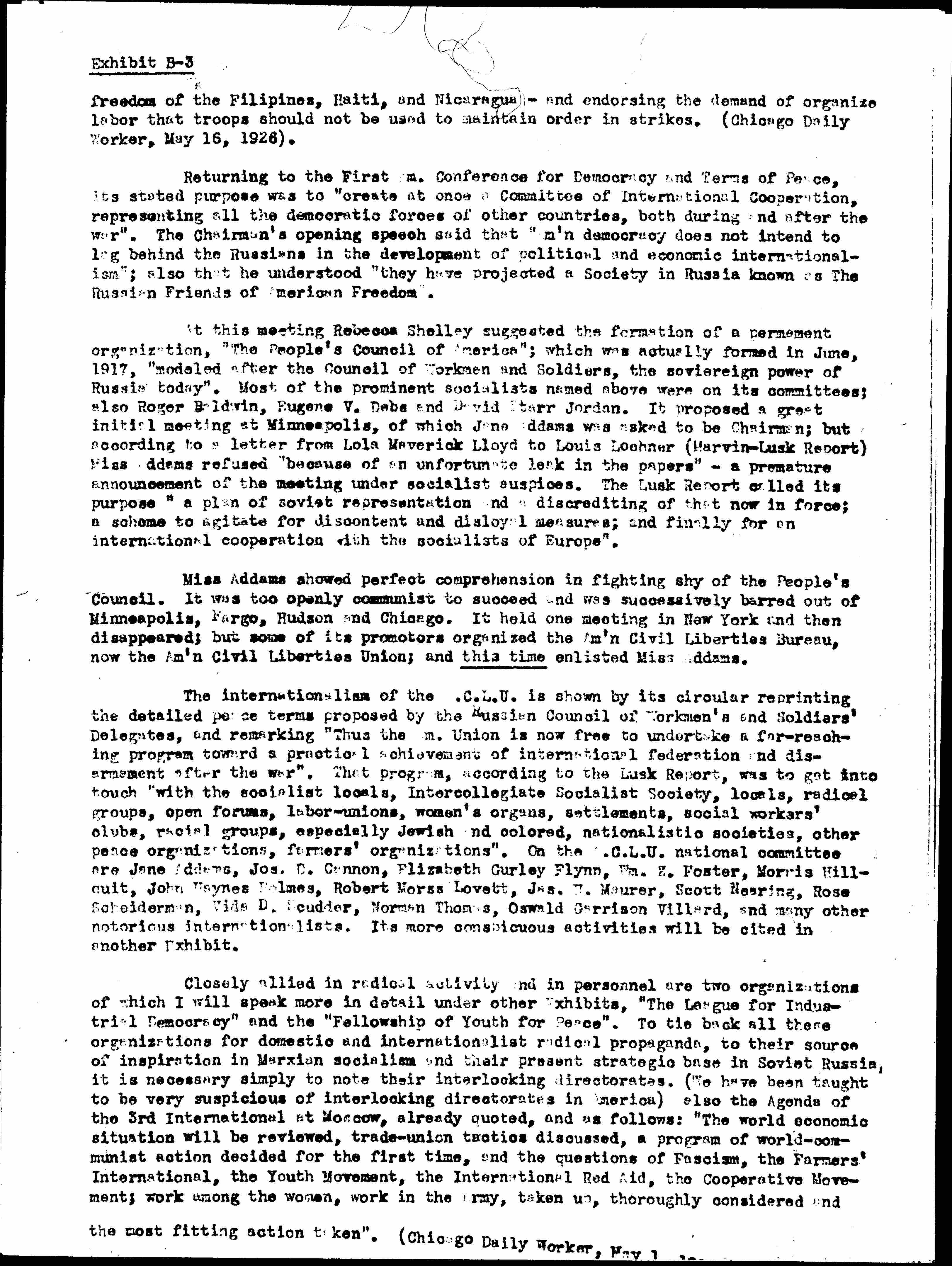
Miss Addams presided at an [antimilitarist] conference at Hull House, May 17, 1926, attended by delegates from the following distinctly radical organizations: W.I.L.P.F., Young Workers' League, International Ladies' Garment League, Freiheit Youth, Interracial Youth Forum, Am. Negro Labor Congress, Jewish Mexican Youth Alliance, Filipino Association of Chicago, Friends of Nature, Young People's Socialist League, etc. Miss Addams spoke for uniting the right and left wings of the movement against militarism into a single unit. The Resolutions were adopted: One condemning military training in the schools, and the citizens training camps; the other demanding withdrawal of all Amn. forces for foreign lands and waters -- [page 9] freedom of the [Philippines], Haiti, and Nicaragua -- and endorsing the demand of organize labor that troops should not be used to maintain order in strikes. (Chicago Daily Worker, May 16, 1926).

Returning to the First Am. Conference for Democracy and Terms of Peace, its stated purpose was to "create at once a Committee of International Cooperation, representing all the democratic forces of other countries, both during and after the war." The Chairman's opening speech said that "Am'n democracy does not intend to lag behind the Russians in the development of political and economic internationalism;" also that he understood "they have projected a Society in Russia known as The Russian Friends of American Freedom."

At this meeting Rebecca Shelley suggested the formation of a permanent organization, "The People's Council of America;" which was actually formed in June, 1917, "modeled after the Council of Workmen and Soldiers, the sovereign power of Russia today." Most of the prominent socialists named above were on its committees; also Roger Baldwin, Eugene V. Debs and David Starr Jordan. It proposed a great initial meeting at Minneapolis, of which Jane Addams was asked to be Chairman; but according to a letter from Lola Maverick Lloyd to Louis Lochner (Marvin-Lusk Report) Miss Addams refused "because of an unfortunate leak in the papers" -- a premature announcement of the meeting under socialist auspices. The Lusk Report called its purpose "a plan of soviet representation and a discrediting of that now in force; a scheme to agitate for discontent and disloyal measures; and finally for an international cooperation with the socialists of Europe."

Miss Addams showed perfect comprehension in fighting shy of the People's Council. It was too openly communist to succeed and was successively barred out of Minneapolis, Fargo, Hudson and Chicago. It held one meeting in New York and then disappeared; but some of its promoters organized the Am'n Civil Liberties Bureau, now the Am'n Civil Liberties Union; and this time enlisted Jane Addams.

The internationalism of the [A.C.L.U.] is shown by its circular reprinting the detailed peace terms proposed by the Russian Council of Workmen's and Soldiers' Delegates, and remarking "Thus the Am. Union is now free to undertake a far-reaching program toward a practical achievement of international federation and disarmament after the war." That program, according to the Lusk Report, was to get into touch "with the socialist locals, Intercollegiate Socialist Society, locals, radical groups, open forums, labor-unions, women's organs, settlements, social workers' clubs, racial groups, especially Jewish and colored, nationalistic societies, other peace organizations, farmers' organizations." On the [A.C.L.U.] national committee are Jane Addams, Jos. D. Cannon, Elizabeth Gurley Flynn, Wm. Z. Foster, Morris Hillquit, John Haynes Holmes, Robert Morss Lovett, Jas. H. Maurer, Scott Nearing, Rose [Schneiderman], Vida D. Scudder, Norman Thomas, Oswald Garrison Villard, and many other notorious internationalists. Its more conspicuous activities will be cited in another Exhibit.

Closely allied in radical activity and in personnel are two organizations of which I will speak more in detail under other Exhibits, "The League for Industrial Democracy" and the "Fellowship of Youth for Peace." To tie back all these organizations for domestic and internationalist radical propaganda, to their source of inspiration in Marxian socialism and their present strategic base in Soviet Russia, it is necessary simply to note their interlocking directorates. (We have been taught to be very suspicious of interlocking directorates in America) also the Agenda of the 3rd International at Moscow, already quoted, and as follows: "The world economic situation will be reviewed, trade-union tactics discussed, a program of world-communist action decided for the first time, and the questions of Fascism, the Farmers' International, the Youth Movement, the International Red Aid, the Cooperative Movement; work among the women, work in the [Army], taken up, thoroughly considered and the most fitting action taken." (Chicago Daily Worker, May 1, [1926.] [page 10]

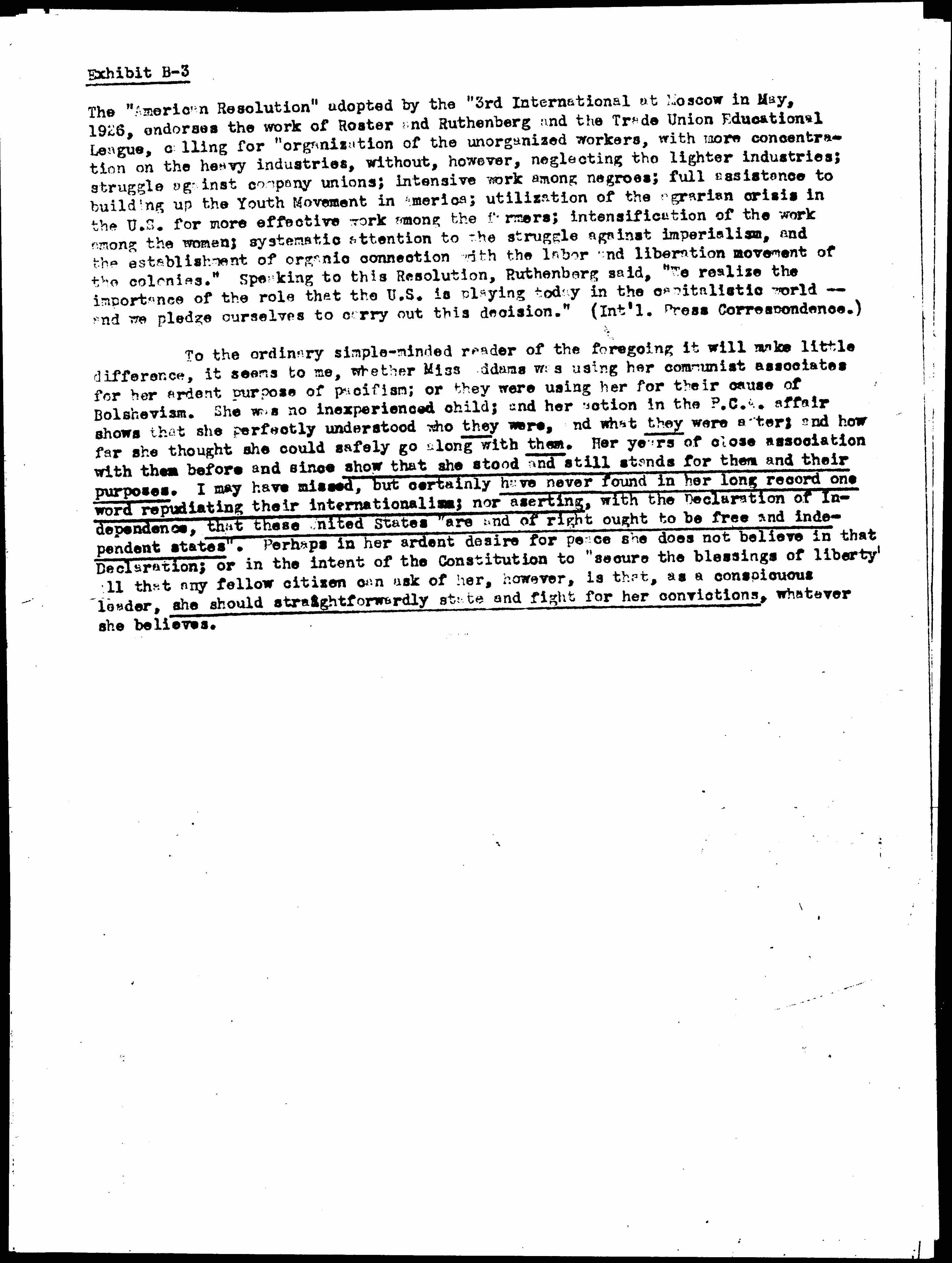
The "American Resolution" adopted by the "3rd International at Moscow in May, 1926, endorses the work of [Foster] and Ruthenberg and the Trade Union Educational League, calling for "organization of the unorganized workers, with more concentration on the heavy industries, without, however, neglecting the lighter industries; struggle against company unions; intensive work among negroes; full assistance to building up the Youth Movement in America; utilization of the agarian crisis in the U.S. for more effective work among the farmers; intensification of the work among the women; systematic attention to the struggle against imperialism, and the establishment of organic connection with the labor and liberation movement of the colonies." Speaking to this Resolution, Ruthenberg said, "We realize the importance of the role that the U.S. is playing today in the capitalistic world -- and we pledge ourselves to carry out this decision." (Int'l. Press Correspondence.)

To the ordinary simple-minded reader of the foregoing it will make little difference, it seems to me, whether Miss Addams was using her communist associates for her ardent purpose of pacifism; or they were using her for their cause of Bolshevism. She was no inexperienced child; and her section in the P.C.A. affair shows that she perfectly understood who they were, and what they were after; and how far she thought she could safely go along with them. Her years of close association with them before and since show that she stood and still stands for them and their purposes. I may have missed, but certianly have never found in her long record one word repudiating their internationalism; nor aserting, with the Declaration of Independence, that these United States "are and of right ought to be free and independent states." Perhaps in her ardent desire for peace she does not believe in that Declaration; or in the intent of the Constitution to "secure the blessings of liberty" [all] that any fellow citizen can ask of her, however, is that, as a conspicuous leader, she should straightforwardly state and fight for her convictions, whatever she believes. [page 11]

Exhibit B-4

Intrigue and Duplicity -- "Boring from Within"

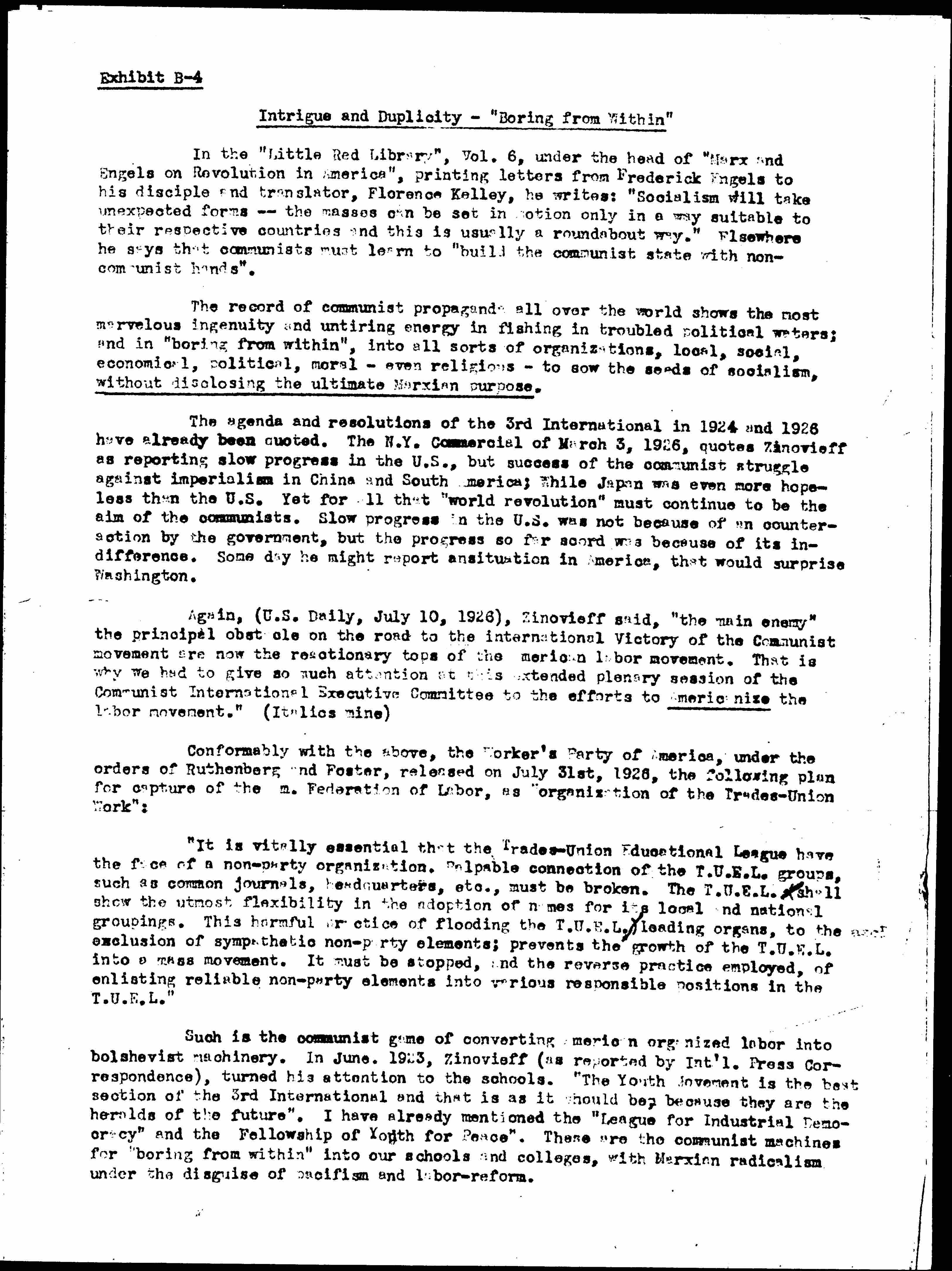
In the "Little Red Library," Vol. 6, under the head of "Marx and Engels on Revolution in America," printing letters from [Friedrich] Engels to his disciple and translator, Florence Kelley, he writes: "Socialism will take unexpected forms -- the masses can be set in motion only in a way suitable to their respective countries and this is usually a roundabout way." Elsewhere he says that communists must learn to "build the communist state with noncommunist hands."

The record of communist propaganda all over the world shows the most marvelous ingenuity and untiring energy in fishing in troubled political waters; and in "boring from within," into all sorts of organizations, local, social, economical, political, moral -- even religious -- to sow the seeds of socialism, without disclosing the ultimate Marxian purpose.

The agenda and resolutions of the 3rd International in 1924 and 1926 have already been quoted. The N.Y. Commercial of March 3, 1926, quotes [Zinoviev] as reporting slow progress in the U.S., but success of the communist struggle against imperialism in China and South America; while Japan was even more hopeless than the U.S. Yet for all that "world revolution" must continue to be the aim of the communists. Slow progress in the U.S. was not because of [a] counteraction by the government, but the progress so far [scored?] was because of its indifference. Some day he might report a situation in America, that would surprise Washington.

Again, (U.S. Daily, July 10, 1926), [Zinoviev] said, "'the main enemy' the principal obstacle on the road to the international Victory of the Communist movement are now the reactionary tops of the American Labor movement. That is why we had to give so much attention at this extended plenary session of the Communist International Executive Committee to the efforts to Americanize the labor movement." (Italics mine)

Conformably with the above, the Worker's Party of America, under the orders of Ruthenberg and Foster, released on July 31st, 1926, the following plan for capture of the [Am.] Federation of Labor, as "organization of the Trades-Union Work":

"It is vitally essential that the Trades-Union Educational League have the face of a [nonparty] organization. Palpable connection of the T.U.E.L. groups, such as common journals, headquarters, etc., must be broken. The T.U.E.L. shall show the utmost flexibility in the adoption of names for its local and national groupings. This harmful [practice] of flooding the T.U.E.L. leading organs, to the exclusion of sympathetic [nonparty] elements; prevents the growth of the T.U.E.L. into a mass movement. It must be stopped, and the reverse practice employed, of enlisting reliable [nonparty] elements into various responsible positions in the T.U.E.L."

Such is the communist game of converting American organized labor into Bolshevist machinery. In June, 1923, [Zinoviev] (as reported by Int'l. Press Correspondence), turned his attention to the schools. "The Youth Movement is the best section of the 3rd International and that is as it should be because they are the heralds of the future." I have already mentioned the "League for Industrial Democracy" and the "Fellowship of Youth for Peace." These are the communist machines for "boring from within" into our schools and colleges, with Marxian radicalism under the disguise of pacifism and labor-reform. [page 12]

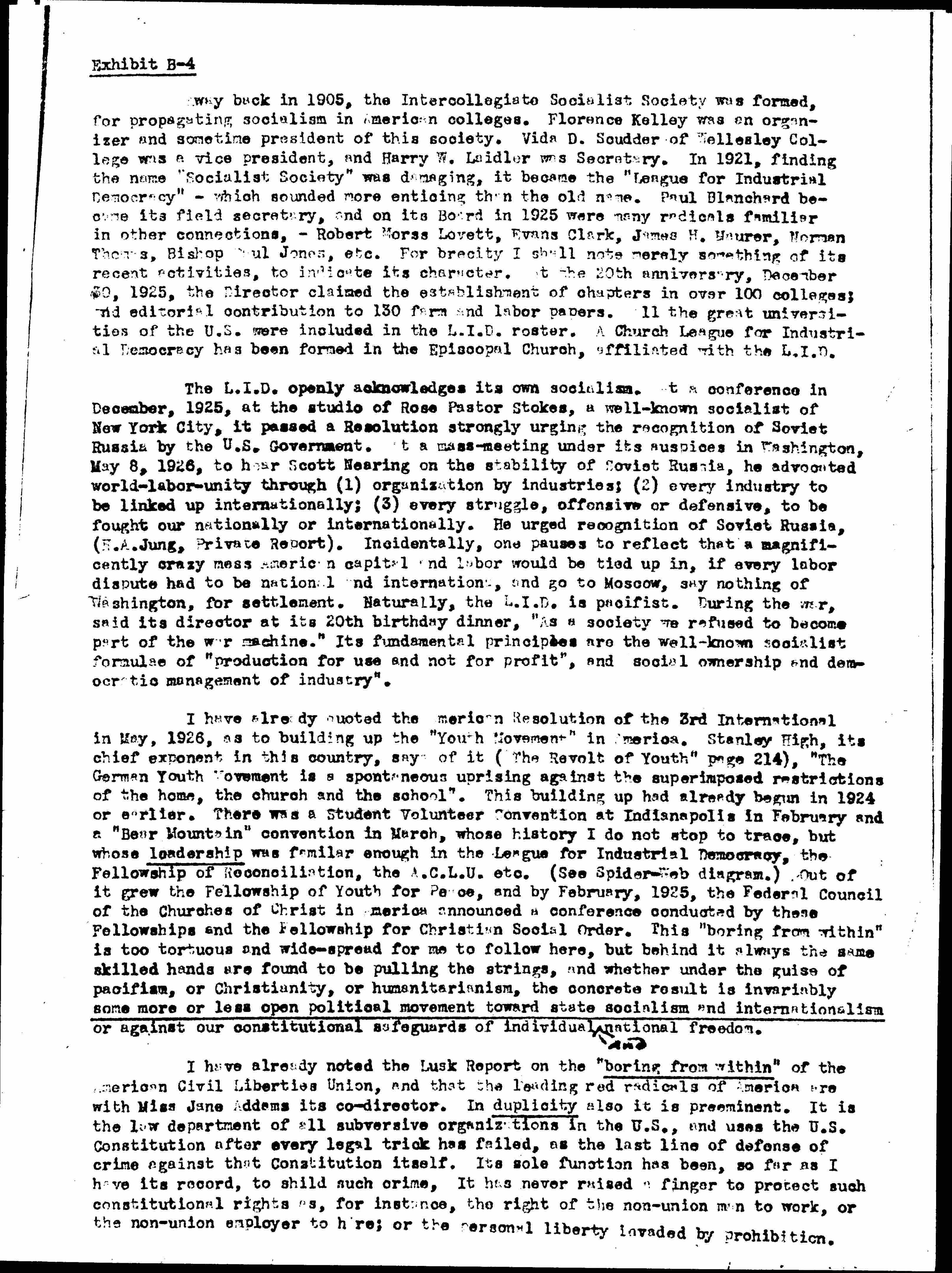
Way back in 1905, the Intercollegiate Socialist Society was formed, for propagating socialism in American colleges. Florence Kelley was an organizer and sometime president of this society. Vida D. Scudder of Wellesley College was a vice president, and Harry W. Laidler was Secretary. In 1921, finding the name "Socialist Society" was damaging, it became the "League for Industrial Democracy" -- which sounded more enticing than the old name. Paul [Blanshard] became its field secretary, and on its Board in 1925 were many radicals familiar in other connections, -- Robert Morss Lovett, Evans Clark, James H. Maurer, Norman Thomas, Bishop Paul Jones, etc. For brevity I shall note merely something of its recent activities, to indicate its character. At the 20th anniversary, December 30, 1925, the Director claimed the establishment of chapters in over 100 colleges; and editorial contribution of 130 farm and labor papers. All the great universities of the U.S. were included in the L.I.D. roster. A Church League for Industrial Democracy has been formed in the Episcopal Church, affiliated with the L.I.D.

The L.I.D. openly acknowledges its own socialism. At a conference in December, 1925, at the studio of Rose Pastor Stokes, a well-known socialist of New York City, it passed a Resolution strongly urging the recognition of Soviet Russia by the U.S. Government. At a mass-meeting under its auspices in Washington, May 8, 1926, to hear Scott Nearing on the stability of Soviet Russia, he advocated world-labor-unity through (1) organization by industries; (2) every industry to be linked up internationally; (3) every struggle, offensive or defensive, to be fought [for?] nationally or internationally. He urged recognition of Soviet Russia, (H. A. Jung, Private Report). Incidentally, one pauses to reflect that a magnificently crazy mess American capital and labor would be tied up in, if every labor dispute had to be national and international, and go to Moscow, say nothing of Washington, for settlement. Naturally, the L.I.D. is pacifist. During the war, said its director at its 20th birthday dinner, "As a society we refused to become part of the war machine." Its fundamental principles are the well-known socialist formulae of "production for use and not for profit," and "social ownership and democratic management of industry."

I have already quoted the American Resolution of the 3rd International in May, 1926, as to building up the "Youth Movement" in America. Stanley High, its chief exponent in this country, says of it ("The Revolt of Youth" page 214), "The German Youth Movement is a spontaneous uprising against the superimposed restrictions of the home, the church and the school." This building up had already begun in 1924 or earlier. There was a Student Volunteer Convention at Indianapolis in February and a "Bear Mountain" convention in March, whose history I do not stop to trace, but whose leadership was familiar enough in the League for Industrial Democracy, the Fellowship of Reconciliation, the A.C.L.U. etc. (See Spider-Web diagram.) Out of it grew the Fellowship of Youth for Peace, and by February, 1925, the Federal Council of the Churches of Christ in America announced a conference conducted by these Fellowships and the Fellowship for Christian Social Order. This "boring from within" is too tortuous and wide-spread for me to follow here, but behind it always the same skilled hands are found to be pulling the strings, and whether under the guise of pacifism, or Christianity, or humanitarianism, the concrete result is invariably some more or less open political movement toward state socialism and internationalism or against our constitutional safeguards of individual ↑and↓ national freedom.

I have already noted the Lusk Report on the "boring from within" of the American Civil Liberties Union, and that the leading red radicals of America are with Miss Jane Addams its [codirector]. In duplicity also it is preeminent. It is the law department of all subversive organizations in the U.S., and uses the U.S. Constitution after every legal trick has failed, as the last line of defense of crime against that Constitution itself. Its sole function has been, so far as I have its record, to [shield] such crime. It has never missed a finger to protect such constitutional rights as, for instance, the right of the [nonunion] man to work, or the nonunion employer to hire; or the personal liberty invaded by prohibition. [page 13]

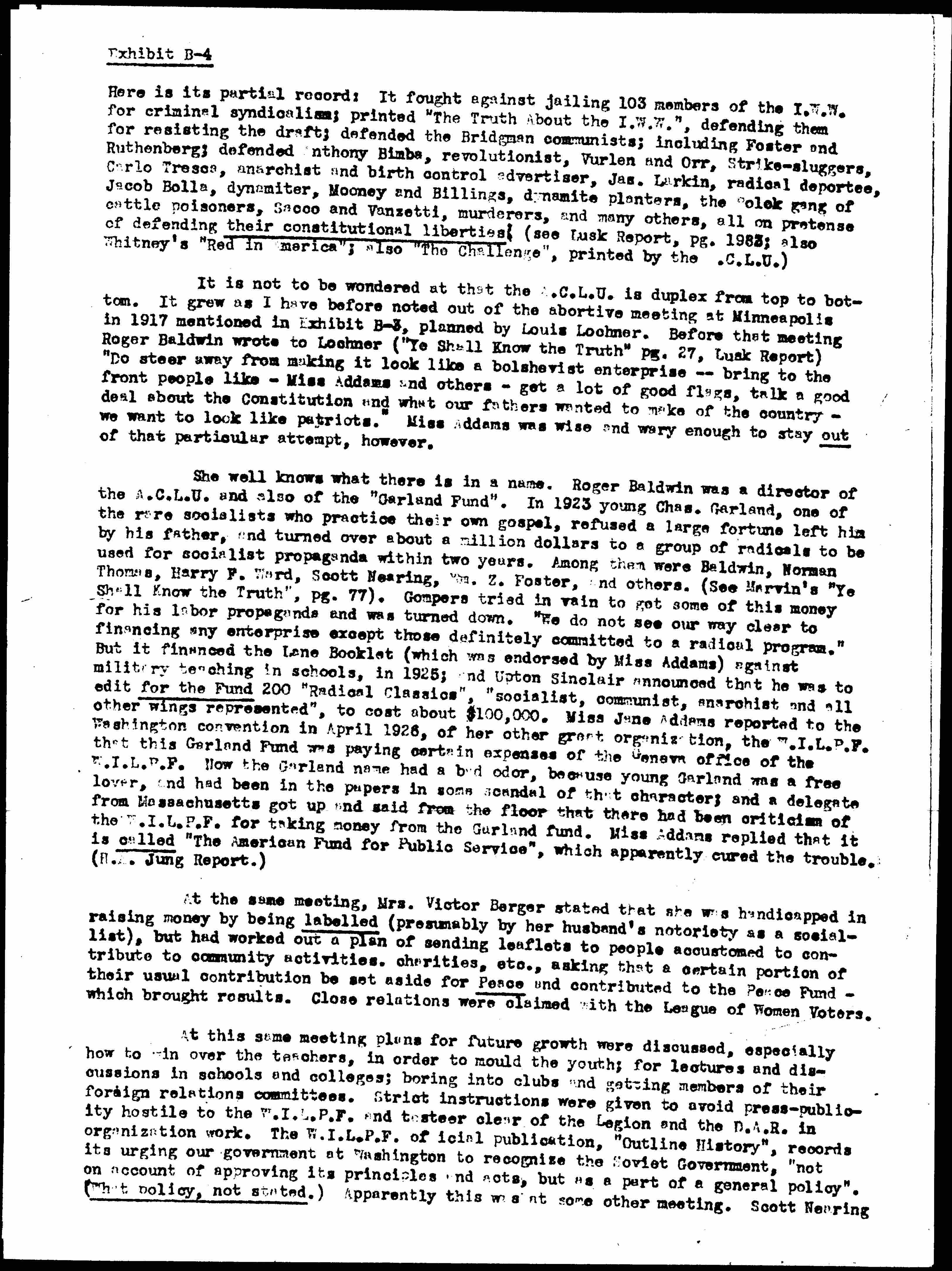
Here is its partial record: It fought against jailing 103 members of the I.W.W. for criminal syndicalism; printed "The Truth About the I.W.W.," defending them for resisting the draft; defended the Bridgman communists, including Foster and Ruthenberg; defended Anthony Bimba, revolutionist; [Verlen Orr], Strike-sluggers; Carlo Tresca, anarchist and birth control advertiser; Jas. Larkin, radical deportee; Jacob Bolla, dynamiter; Mooney and Billings, dynamite planters; the [Polack?] gang of cattle poisoners; Sacco and Vanzetti, murderers; and many others, all on pretense of defending their constitutional liberties (see Lusk Report, pg. [1933]; also Whitney's "Red in America;" also "The Challenge," printed by the [A.C.L.U.])

It is not to be wondered at that the A.C.L.U. is duplex from top to bottom. It grew as I have before noted out of the abortive meeting at Minneapolis in 1917 mentioned in Exhibit B-3, planned by Louis Lochner. Before that meeting Roger Baldwin wrote to Lochner ("Ye Shall Know the Truth" pg. 27, Lusk Report) "Do steer away from making it look like a Bolshevist enterprise -- bring to the front people like -- Miss Addams and others -- get a lot of good flags, talk a good deal about the Constitution and what our fathers wanted to make of the country -- we want to look like patriots." Miss Addams was wise and wary enough to stay out of that particular attempt, however.

She well knows what there is in a name. Roger Baldwin was a director of the A.C.L.U. and also of the "Garland Fund." In 1923 young Chas. Garland, one of the rare socialists who practice their own gospel, refused a large fortune left him by his father, and turned over about a million dollars to a group of radicals to be used for socialist propaganda within two years. Among them were Baldwin, Norman Thomas, Harry F. Ward, Scott Nearing, Wm. Z. Foster, and others. (See Marvin's "Ye Shall Know the Truth," pg. 77). Gompers tried in vain to get some of this money for his labor propaganda and was turned down. "We do not see our way clear to financing any enterprise except those definitely committed to a radical program." But it financed the Lane Booklet (which was endorsed by Miss Addams) against military teaching in schools, in 1925; and Upton Sinclair announced that he was to edit for the fund 200 "Radical Classics," "socialist, communist, anarchist and all other wings represented," to cost about $100,000. Miss Jane Addams reported to the Washington convention in April 1926, of her other grant organization, the W.I.L.P.F. that this Garland Fund was paying certain expenses of the Geneva office of the W.I.L.P.F. How the Garland name has a bad odor, because young Garland was a free lover, and had been in the papers in some scandal of that character; and a delegate from Massachusetts got up and said from the floor that there had been criticism of the W.I.L.P.F. for taking money from the Garland fund. Miss Addams replied that it is called "The American Fund for Public Service," which apparently cured the trouble. (H. A. Jung Report.)

At the same meeting, Mrs. Victor Berger stated that she was handicapped in raising money by being [labeled] (presumably by her husband's notoriety as a socialist), but had worked out a plan of sending leaflets to people accustomed to contribute to community activities, charities, etc., asking that a certain portion of their usual contribution be set aside for Peace and contributed to the Peace Fund -- which brought results. Close relations were claimed with the League of Women Voters.

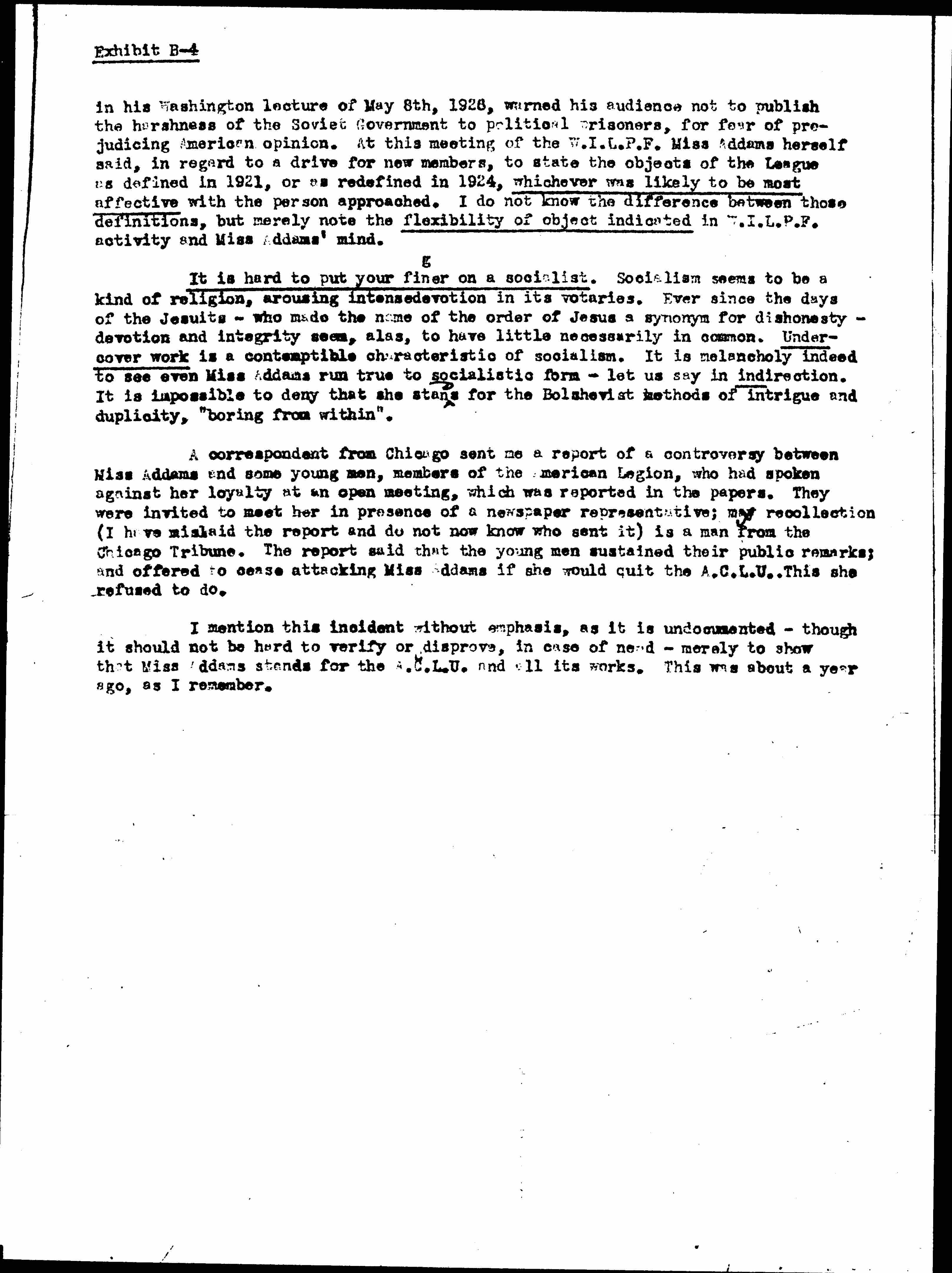
At this same meeting plans for future growth were discussed, especially how to win over the teachers, in order to [mold] the youth; for lectures and discussions in schools and colleges; boring into clubs and getting members of their foreign relations committees. Strict instructions were given to avoid press-publicity hostile to the W.I.L.P.F. and to steer clear of the Legion and the D.A.R. in organization work. The W.I.L.P.F. official publication, "Outline History," records its urging our government at Washington to recognize the Soviet Government, "not on account of approving its principles and acts, but as a part of a general policy." (What policy, not stated.) Apparently this wasn't some other meeting. Scott Nearing [page 14] in his Washington lecture of May 8th, 1926, warned his audience not to publish the harshness of the Soviet Government to political prisoners, for fear of prejudicing American opinion. At this meeting of the W.I.L.P.F. Miss Addams herself said, in regard to a drive for new members, to state the objects of the League as defined in 1921, or as redefined in 1924, whichever was likely to be most [effective] with the person approached. I do not know the difference between those definitions, but merely note the flexibility of object indicated in W.I.L.P.F. activity and Miss Addams' mind.

It is hard to put your [finger] on a socialist. Socialism seems to be a kind of religion, arousing intense devotion in its votaries. Ever since the days of the Jesuits -- who made the name of the order of Jesus a synonym for dishonesty -- devotion and integrity seem, alas, to have little necessarily in common. Undercover work is a contemptible characteristic of socialism. It is melancholy indeed to see even Miss Addams run true to socialistic form -- let us say in indirection. It is impossible to deny that she stands for the Bolshevist methods of intrigue and duplicity, "boring from within."

A correspondent from Chicago sent me a report of a controversy between Miss Addams and some young men, members of the American Legion, who had spoken against her loyalty at an open meeting, which was reported in the papers. They were invited to meet her in presence of a newspaper representative; my recollection (I have mislaid the report and do not now know who sent it) is a man from the Chicago Tribune. The report said that the young men sustained their public remarks; and offered to cease attacking Miss Addams if she would quit the A.C.L.U. This she refused to do.

I mention this incident without emphasis, as it is undocumented -- though it should not be hard to verify or disprove, in case of need -- merely to show that Miss Addams stands for the A.C.L.U. and all its works. This was about a year ago, as I remember. [page 15]

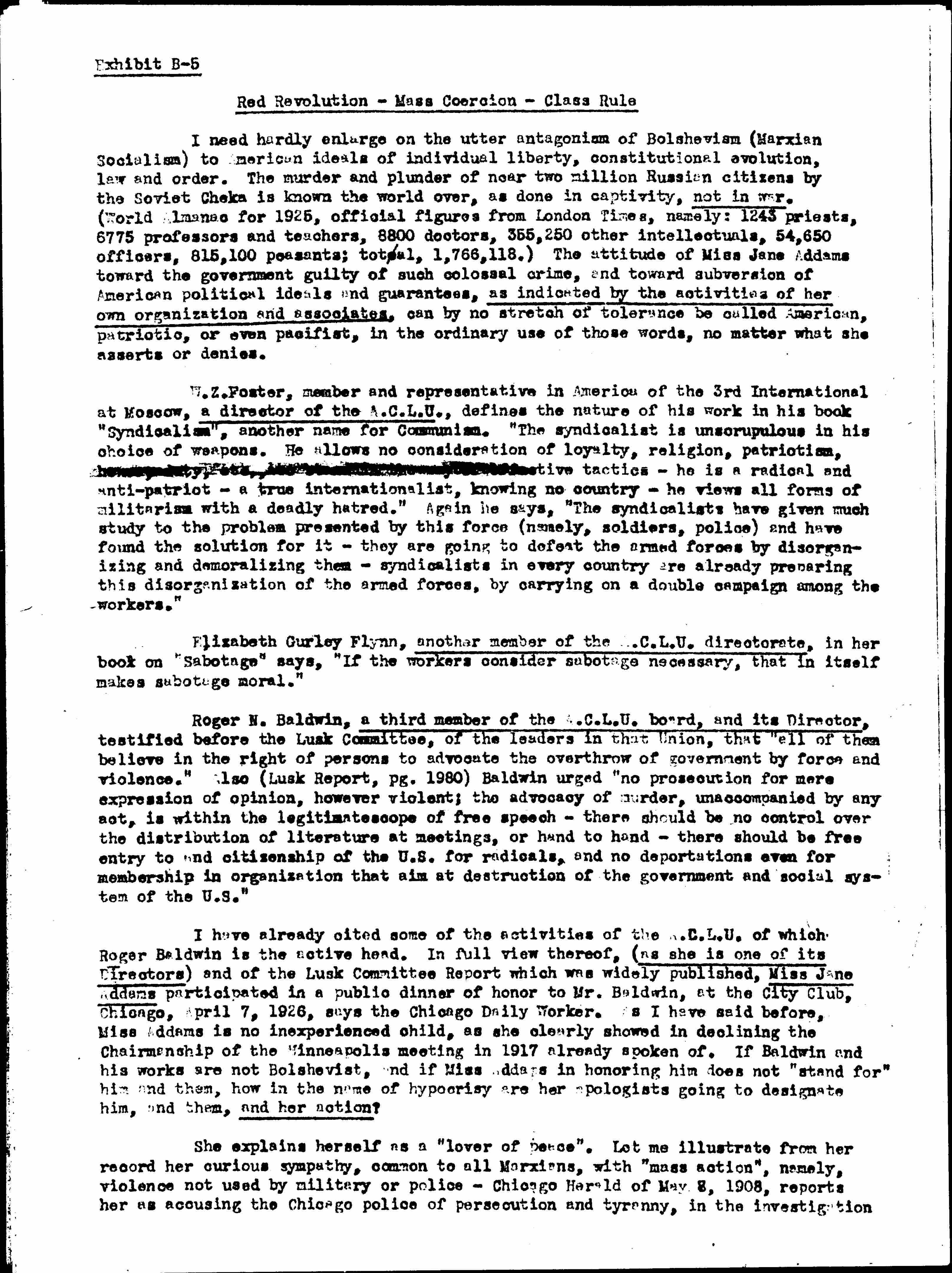
Exhibit B-5

Red Revolution -- Mass Coercion -- Class Rule

I need hardly enlarge on the utter antagonism of Bolshevism (Marxian Socialism) to American ideals of individual liberty, constitutional evolution, law and order. The murder and plunder of near two million Russian citizens by the Soviet Cheka is known the world over, as done in captivity, not in war. (World Almanac for 1925, official figures from London Times, namely: 1243 priests, 6775 professors and teachers, 8800 doctors, 355,250 other intellectuals, 54,650 officers, 815,100 peasants; total, 1,766,118.) The attitude of Miss Jane Addams toward the government guilty of such colossal crime, and toward subversion of American political ideals and guarantees, as indicated by the activities of her own organization and associates, can by no stretch of tolerance be called American, patriotic, or even pacifist, in the ordinary use of those words, no matter what she asserts or denies.

W. Z. Foster, member and representative in America of the 3rd International at Moscow, a director of the A.C.L.U., defines the nature of his work in his book "Syndicalism," another name for Communism. "The syndicalist is unscrupulous in his choice of weapons. He allows no consideration of loyalty, religion, patriotism -- [illegible] [active?] tactics -- he is a radical and [antipatriot] -- a true internationalist, knowing no country -- he views all forms of militarism with a deadly hatred." Again he says, "The syndicalists have given much study to the problem presented by this force (namely, soldiers, police) and have found the solution for it -- they are going to defeat the armed forces by disorganizing and demoralizing them -- syndicalists in every country are already preparing this disorganization of the armed forces, by carrying on a double campaign among the workers."

Elizabeth Gurley Flynn, another member of the A.C.L.U. directorate, in her book on "Sabotage" says, "If the workers consider sabotage necessary, that in itself makes sabotage moral."

Roger N. Baldwin, a third member of the A.C.L.U. board, and its Director, testified before the Lusk Committee, of the leaders in that Union, that "all of them believe in the right of persons to advocate the overthrow of government by force and violence." Also (Lusk Report, pg. 1980) Baldwin urged "no prosecution for mere expression of opinion, however violent; the advocacy of murder, unaccompanied by any act, is within the legitimate scope of free speech -- there should be no control over the distribution of literature at meetings, or hand to hand -- there should be free entry to and citizenship of the U.S. for radicals, and no deportations even for membership in organization that aim at destruction of the government and social system of the U.S."

I have already cited some of the activities of the A.C.L.U. of which Roger Baldwin is the active head. In full view thereof, (as she is one of its Directors) and of the Lusk Committee Report which was widely published, Miss Jane Addams participated in a public dinner of honor to Mr. Baldwin at the City Club, Chicago, April 7, 1926, says the Chicago Daily Worker. As I have said before, Miss Addams is no inexperienced child, as she clearly showed in declining the Chairmanship of the Minneapolis meeting in 1917 already spoken of. If Baldwin and his works are not Bolshevist, and if Miss Addams in honoring him does not "stand for" him and them, how in the name of hypocrisy are her apologists going to designate him, and them, and her action?

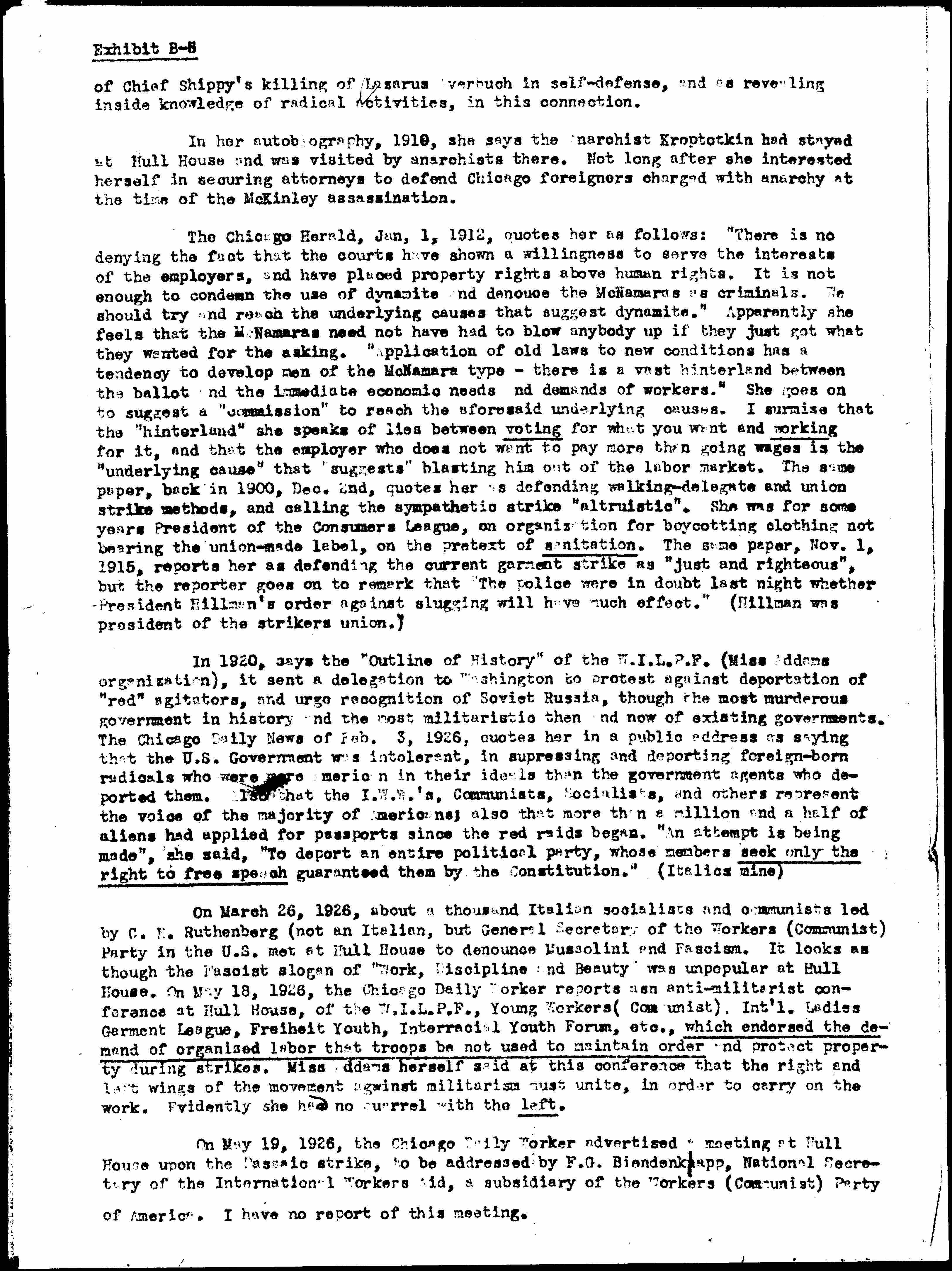
She explains herself as a "lover of peace." Let me illustrate from her record her curious sympathy, common to all Marxians, with "mass action," namely, violence not used by military or police -- Chicago Herald of May 8, 1908, reports her as accusing the Chicago police of persecution and tyranny, in the investigation [page 16] of Chief Shippy's killing of Lazarus Averbuch in self-defense, and as revealing inside knowledge of radical activities, in this connection.

In her autobiography, 1910, she says the Anarchist [Kropotkin] had stayed at Hull House and was visited by anarchists there. Not long after she interested herself in securing attorneys to defend Chicago foreigners charged with anarchy at the time of the McKinley assassination.

The Chicago Herald, Jan. 1, 1912, quotes her as follows: "There is no denying the fact that the courts have shown a willingness to serve the interests of the employers, and have placed property rights above human rights. It is not enough to condemn the use of dynamite and denounce the McNamaras as criminals. We should try and reach the underlying causes that suggest dynamite." Apparently she feels that the McNamaras need not have had to blow anybody up if they just got what they wanted for the asking. "Application of old laws to new conditions has a tendency to develop men of the McNamara type -- there is a vast hinterland between the ballot and the immediate economic needs and demand of workers." She goes on to suggest a "commission" to reach the aforesaid underlying causes. I surmise that the "hinterland" she speaks of lies between voting for what you want and working for it, and that the employer who does not want to pay more than going wages is the "underlying cause" that "suggests" blasting him out of the labor market. The same paper, back in 1900, Dec. 2nd, quotes her as defending walking-delegate and union strike methods, and calling the sympathetic strike "altruistic." She was for some years President of the Consumers League, an organization for boycotting clothing not bearing the union-made label, on the pretext of sanitation. The same paper, Nov. 1, 1915, reports her as defending the current garment strike as "just and righteous," but the reporter goes on to remark that "The police were in doubt last night whether President Hillman's order against slugging will have such effect." (Hillman was president of the strikers union.)

In 1920, says the "Outline of History" of the W.I.L.P.F. (Miss Addams organization), it sent a delegation to Washington to protest against deportation of "red" agitators, and urge recognition of Soviet Russia, though the most murderous government in history and the most militaristic then and now of existing governments. The Chicago Daily News of Feb. 3, 1926, quotes her in a public address as saying that the U.S. Government was intolerant, in suppressing and deporting foreign-born radicals who were more American in their ideals than the government agents who deported them. Also that the I.W.W.'s, Communists, Socialists, and others represent the voice of the majority of Americans; also that more than a million and a half of aliens had applied for passports since the red raids began. "An attempt is being made," she said, "To deport an entire political party, whose members seek only the right to free speech guaranteed them by the Constitution." (Italics mine)

On March 26, 1926, about a thousand Italian socialists and communists led by C. E. Ruthenberg (not an Italian), but General Secretary of the Workers (Communist) Party in the U.S. met at Hull House to denounce Mussolini and Fascism. It looks as though the Fascist slogan of "Work, Discipline and Beauty" was unpopular at Hull House. On May 18, 1926, the Chicago Daily Worker reports [an] [antimilitarist] conference at Hull House, of the W.I.L.P.F., Young Workers (Communist). Itn'l Ladies German League, Freiheit Youth, Interracial Youth Forum, etc., which endorsed the demand of organized labor that troops be not used to maintain order and protect property during strikes. Miss Addams herself said at this conference that the right and left wings of the movement against militarism must unite, in order to carry on the work. Evidently she had no quarrel with the left.

On May 19, 1926, the Chicago Daily Worker advertised [a] meeting at Hull House upon the Passaic strike, to be addressed by F. G. [Biedenkapp], National Secretary of the International Workers Aid, a subsidiary of the Workers (Communist) Party of America. I have no report of this meeting. [page 17]

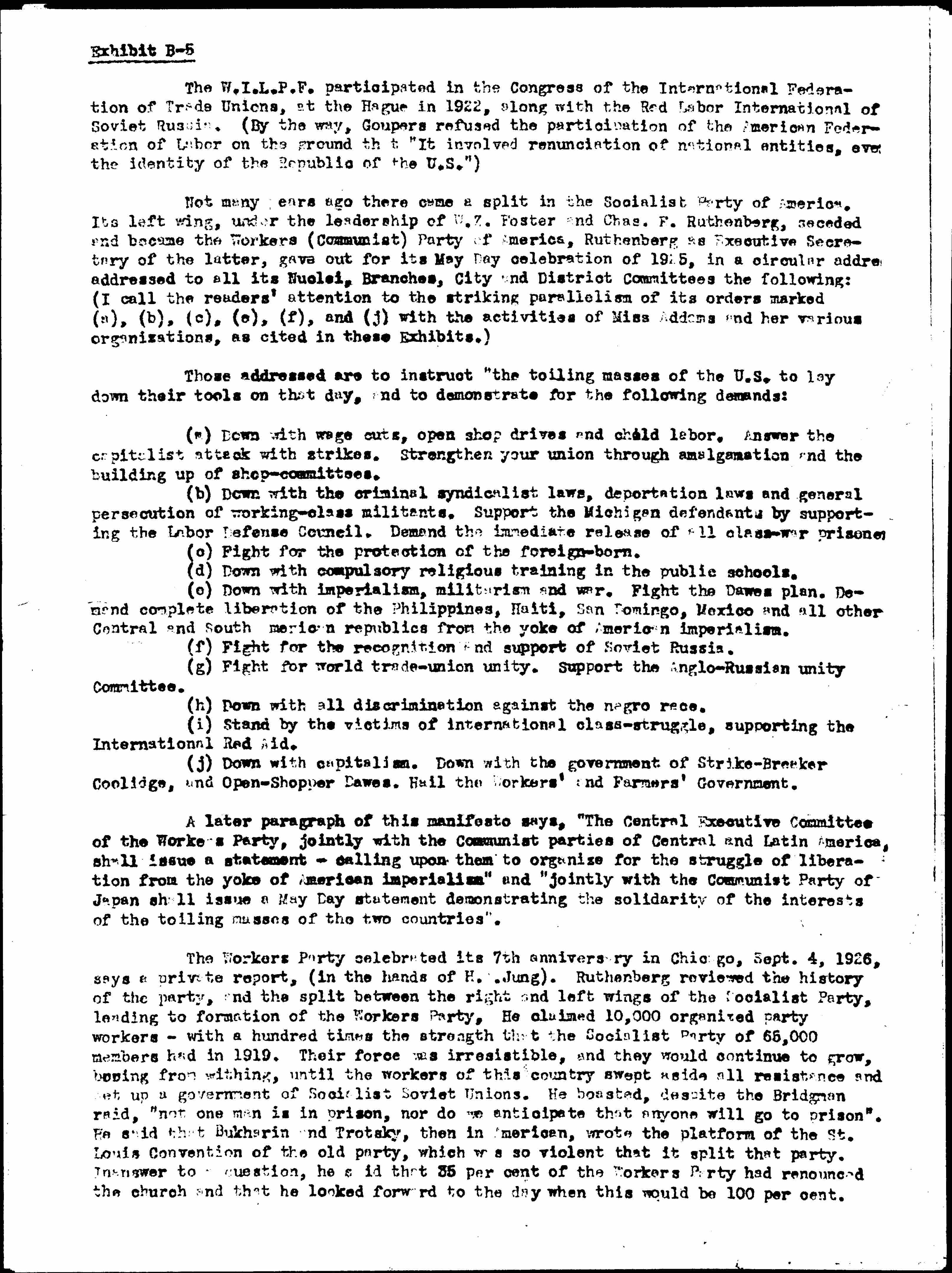
The W.I.L.P.F. participated in the Congress of the International Federation of Trade Unions, at The Hague in 1922, along with the Red Labor International of Soviet Russia. (By the way, [Gompers] refused the participation of the American Federation of Labor on the ground that "It involved renunciation of national entities, even the identity of the Republic of the U.S.")

Not many years ago there came a split in the Socialist Party of America. Its left wing, under the leadership of W. Z. Foster and Chas. F. Ruthenberg, seceded and became the Workers (Communist) Party of America, Ruthenberg as Executive Secretary of the latter, gave out for its May Day celebration of 1925, in a circular addressed to all its Nuclei, Branches, City and District Committees the following: (I call the readers' attention to the striking parallelism of its orders marked (a), (b), (c), (e), (f), and (j) with the activities of Miss Addams and her various organizations, as cited in these Exhibits.)

Those addressed are to instruct "the toiling masses" of the U.S. to lay down their tools on that day, and to demonstrate for the following demands:

(a) Down with wage cuts, open shop drives and child labor. Answer the capitalist attack with strikes. Strengthen your union through amalgamation and the building up of shop-committees.

(b) Down with the criminal syndicalist laws, deportation laws and general persecution of working-class militants. Support the Michigan defendants by supporting the Labor Defense Council. Demand the immediate release of all class-war [prisoners.]

(c) Fight for the protection of the foreign-born.

(d) Down with compulsory religious training in the public schools.

(e) Down with imperialism, militarism and war. Fight the Dawes plan. Demand complete liberation of the Philippines, Haiti, San Domingo, Mexico and all other Central and South American republics from the yoke of American imperialism.

(f) Fight for the recognition and support of Soviet Russia.

(g) Fight for world trade-union unity. Support the Anglo-Russian unity Committee.

(h) Down with all discrimination against the negro race.

(i) Stand by the victims of international class-struggle, supporting the International Red Aid.

(j) Down with capitalism. Down with the government of Strike-Breaker Coolidge, and Open-Shopper Dawes. Hail the Workers' and Farmers' Government.

A later paragraph of this manifesto says, "The Central Executive Committee of the Workers Party, jointly with the Communist parties of Central and Latin America, shall issue a statement -- calling upon them to organize for the struggle of liberation from the yoke of American imperialism" and "jointly with the Communist Party of Japan shall issue a May Day statement demonstrating the solidarity of the interests of the toiling masses of the two countries."

The Workers Party celebrated its 7th anniversary in Chicago, Sept. 4, 1926, says a private report, (in the hands of H. A. Jung). Ruthenberg reviewed the history of the party, and the split between the right and left wings of the Socialist Party, [leading] to formation of the Workers Party. He claimed 10,000 organized party workers -- with a hundred times the strength that the Socialist Party of 65,000 members had in 1919. Their forces was irresistible, and they would continue to grow, boring from [within], until the workers of this country swept aside all resistance and set up a government of Socialist Soviet Unions. He boasted, despite the Bridgman raid, "not one man is in prison, nor do we anticipate that anyone will go to prison." He said that Bukharin and Trotsky, then in [America], wrote the platform of the St. Louis Convention of the old party, which was so violent that it split that party. In answer to [a] question, he said that 35 [percent] of the Workers Party had renounced the church and that he looked forward to the day when this would be 100 [percent]. [page 18]

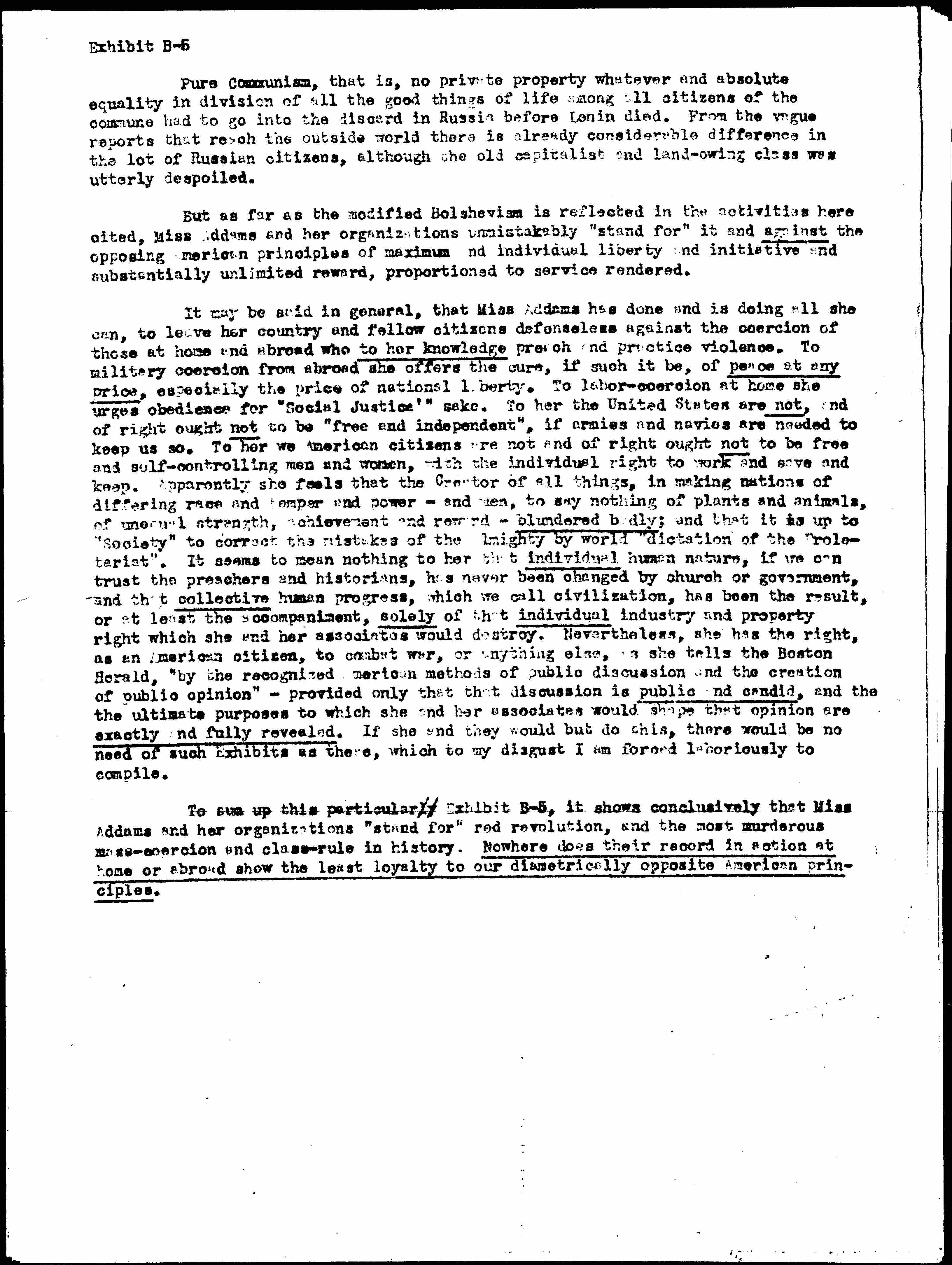
Pure Communism, that is, no private property whatever and absolute equality in division of all the good things of life among all citizens of the commune had to go into the [discard] in Russia before Lenin died. Prom the vague reports that reach the outside world there is already considerable difference in the lot of Russian citizens, although the old capitalist and land-owing class were utterly despoiled.

But as far as the modified Bolshevism is reflected in the activities here cited, Miss Addams and her organizations unmistakably "stand for" it and against the opposing American principles of maximum and individual liberty and initiative and substantially unlimited reward, proportioned to service rendered.

It may be said in general, that Miss Addams has done and is doing all she can, to leave her country and fellow citizens defenseless against the coercion of those at home and abroad who to her knowledge preach and practice violence. To military coercion from abroad she offers the cure, if such it be, of peace at any price, especially the price of national liberty. To labor-coercion at home she urges obedience for "Social Justice'" sake. To her the United States are not, and of right ought not to be "free and independent," if armies and navies are needed to keep us so. To her we American citizens are not and of right ought not to be free and self-controlling men and women, with the individual right to work and save and keep. Apparently she feels that the Creator of all things, in making nations of differing race and temper and power -- and men, to say nothing of plants and animals, of unequal strength, achievement and reward -- blundered badly; and that it is up to "Society" to correct the mistakes of the Almighty by world "dictation of the Proletariat." It seems to mean nothing to her that individual human nature, if we can trust the preachers and historians, has never been changed by church or government, and that collective human progress, which we call civilization, has been the result, or at least the accompaniment, solely of that individual industry and property right which she and her associates would destroy. Nevertheless, she has the right, as an American citizen, to combat war, or anything else, as she tells the Boston Herald, "by the recognized American methods of public discussion and the creation of public opinion" -- provided only that that discussion is public and candid, and the ultimate purposes to which she and her associates would shape that opinion are exactly and fully revealed. If she and they would but do this, there would be no need of such Exhibits as these, which to my disgust I am forced laboriously to compile.

To sum up this particular Exhibit B-5, it shows conclusively that Miss Addams and her organizations "stand for" red revolution, and the most murderous mass-coercion and class-rule in history. Nowhere does their record in action at home or abroad show the least loyalty to our diametrically opposite American principles. [page 19]

Exhibit B-6

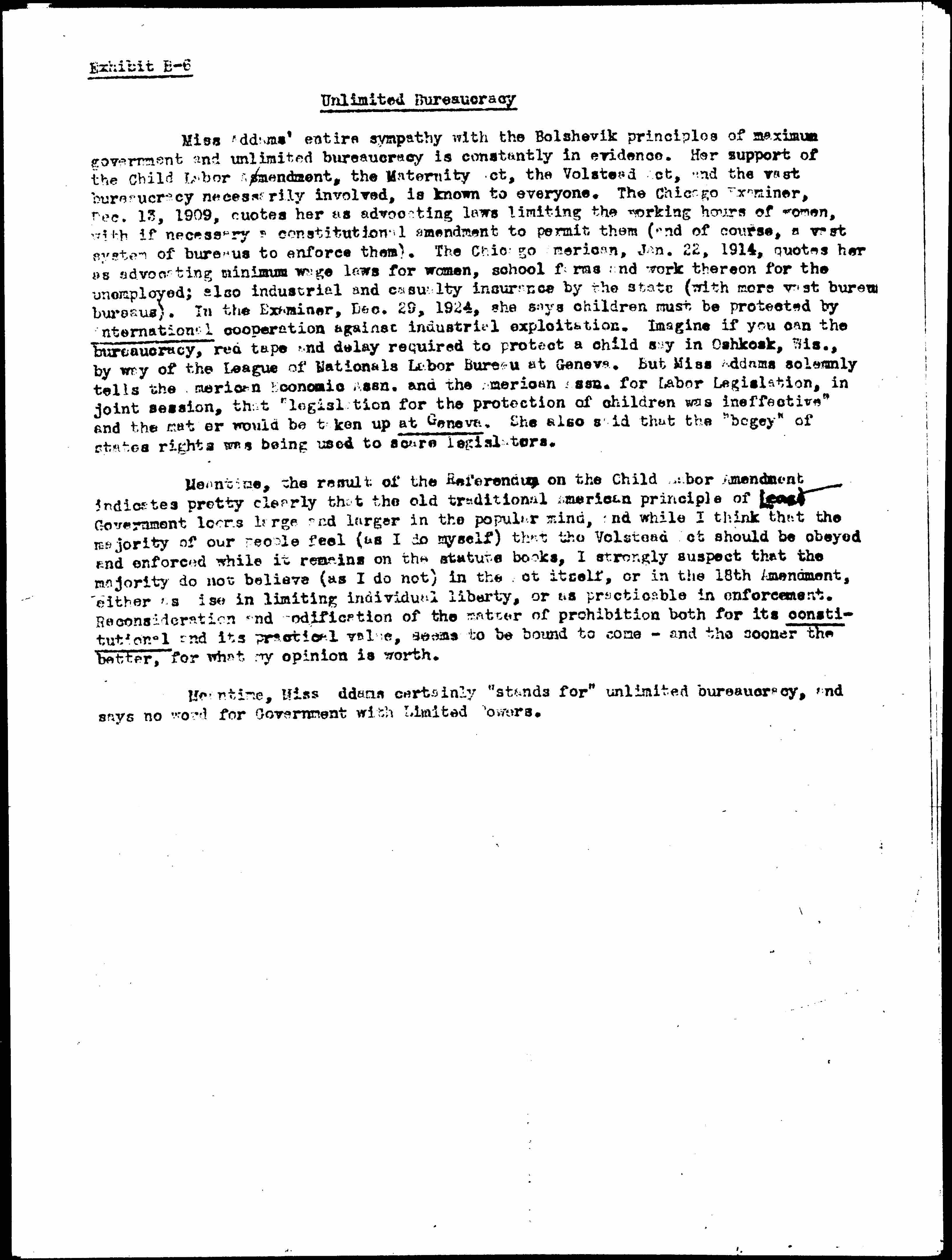
Unlimited Bureaucracy

Miss Addams' entire sympathy with the Bolshevik principles of maximum government and unlimited bureaucracy is constantly in evidence. Her support of the Child Labor Amendment, the Maternity Act, the Volstead Act, and the vast bureaucracy necessarily involved, is known to everyone. The Chicago Examiner, Dec. 13, 1909, quotes her as advocating laws limiting the working hours of women, with if necessary a constitutional amendment to permit them (and of course, a vast system of bureaus to enforce them). The Chicago American, Jan. 22, 1914, quotes her as advocating minimum wage laws for women, school farms and work thereon for the unemployed; also industrial and casualty insurance by the state (with more vast bureaus). In the Examiner, Dec. 29, 1924, she says children must be protected by International cooperation against industrial exploitation. Imagine if you can the bureaucracy, red tape and delay required to protect a child say in [Oshkosh], Wis., by way of the League of Nationals Labor Bureau at Geneva. But Miss Addams solemnly tells the American Economic Assn. and the American Assn. for Labor Legislation, in joint session, that "legislation for the protection of children was ineffective" and the [matter] would be taken up at Geneva. She also said that the "bogey" of states rights was being used to scare legislators.

Meantime, the result of the Referendum on the Child Labor Amendment indicates pretty clearly that the old traditional American principle of [least] Government looms large and larger in the popular mind, and while I think that the majority of our people feel (as I do myself) that the Volstead Act should be obeyed and enforced while it remains on the statute books, I strongly suspect that the majority do not believe (as I do not) in the Act itself, or in the 18th Amendment, either as [wise] in limiting individual liberty, or as practicable in enforcement. Reconsideration and modification of the matter of prohibition both for its constitutional and its practical value, seems to be bound to come -- and the sooner the better, for what my opinion is worth.

Meantime, Miss Addams certainly "stands for" unlimited bureaucracy, and says no word for Government with Limited Powers. [page 20]

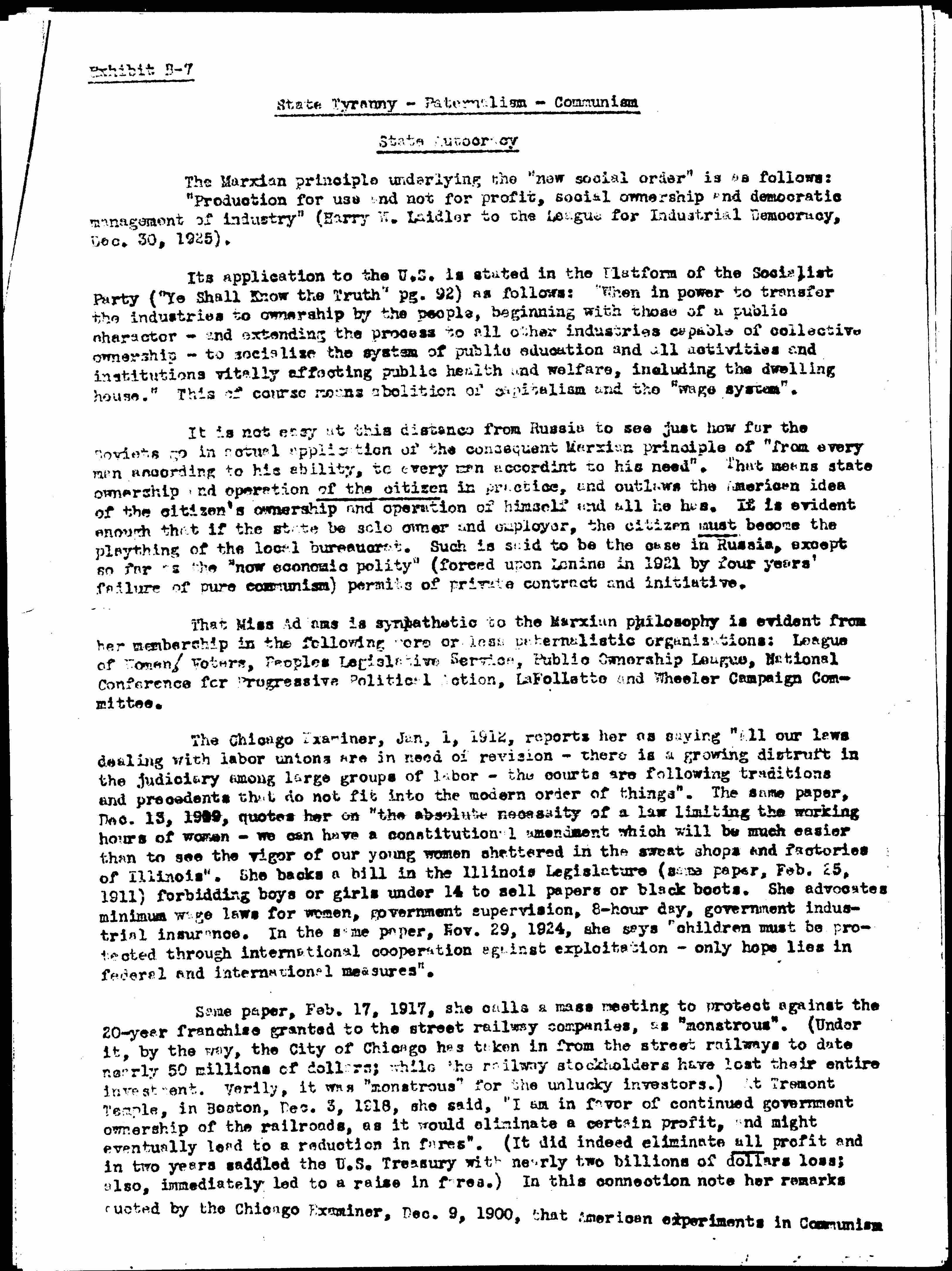
Exhibit B-7

State Tyranny -- Paternalism – Communism

State Autocracy

The Marxian principle underlying the "new social order" is as follows: "Production for use and not for profit, social ownership and democratic management of industry" (Harry W. Laidler to the League for Industrial Democracy, Dec. 30, 1925).

Its application to the U.S. is stated in the Platform of the Socialist Party ("Ye Shall Know the Truth" pg. 92) as follows: "When in power to transfer the industries to ownership by the people, beginning with those of a public character -- and extending the process to all other industries capable of collective ownership -- to socialize the system of public education and all activities and institutions vitally affecting public health and welfare, including the dwelling house." This of course means abolition of capitalism and the "wage system."

It is not easy at this distance from Russia to see just how far the Soviets go in actual application of the consequent Marxian principle of "from every man according to his ability, to every man [accordant ] to his need." That means state ownership and operation of the citizen in practice, and outlaws the American idea of the citizen's ownership and operation of himself and all he has. It is evident enough that if the state be solo owner and employer, the citizen must become the plaything of the local bureaucrat. Such is said to be the case in Russia, except so far as the "[new] economical polity" (forced upon [Lenin] in 1921 by four years' failure of pure communism) permits of private contract and initiative.

That Miss Addams is sympathetic to the Marxian philosophy is evident from her membership in the following more or less [paternalistic] organizations: League of Women Voters, Peoples Legislative Service, Public Ownership League, National Conference for Progressive Political Action, La Follette and Wheeler Campaign Committee.

The Chicago Examiner, Jan, 1, 1912, reports her as saying, "All our laws dealing with labor unions are in need of revision -- there is a growing distrust in the judiciary among large groups of labor -- the courts are following traditions and precedents that do not fit into the modern order of things." The same paper, Dec. 15, 1909, quotes her on "the absolute necessity of a law limiting the working hours of women -- we can have a constitutional amendment which will be much easier than to see the vigor of our young women shattered in the sweat shops and factories of Illinois." She backs a bill in the Illinois Legislature (same paper, Feb. 25, 1911) forbidding boys and girls under 14 to sell papers or black boots. She advocates minimum wage laws for women, government supervision, 8-hour day, government industrial insurance. In the same paper, Nov. 29, 1924, she says "children must be protected through international cooperation against exploitation -- only hope lies in federal and international measures."

Same paper, Feb. 17, 1917, she calls a mass meeting to protect against the 20-year franchise granted to the street railway companies, as "monstrous." (Under it, by the way, the City of Chicago has taken in from the street railways to date nearly 50 millions of dollars; while the railway stockholders have lost their entire investment. Verily, it was "monstrous" for the unlucky investors.) At Tremont Temple, in Boston, Dec. 3, 1918, she said, "I am in favor of continued government ownership of the railroads, as it would eliminate a certain profit, and might eventually lead to a reduction in fares." (It did indeed eliminate all profit and in two years saddled the U.S. Treasury with nearly two billions of dollars loss; also, immediately led to a raise in fares.) In this connection note her remarks quoted by the Chicago Examiner, Dec. 9, 1900, that American experiments in Communism [page 21] had not proved that it is impracticable. "In nearly every case the causes for the failure may be traced to the incompetency of the leaders." Precisely so! Competent leaders don't undertake that which is doomed to fail. But that lesson is entirely lost on Miss Addams.

Miss Addams' greatest organization, the W.I.L.P.F., in its Vienna Congress of 1921, recommended "gradual abolition of property privileges." Miss Addams was at the Congress. Its 4th Congress in Washington, 1924, planned for studies of a "New Social Order," to be submitted to the next Congress at Dublin, in 1926. I do not know what was done about this at Dublin, where I believe the Congress took place duly Miss Addams recently explained to the Boston Herald, not very convincingly, that she "Believes in private property," and desires more "rectification of undue, unfair privileges claimed or possessed by property, and not to secure the abolition of [property] itself." She does not identify the "privileges" in which she is like La Follette, the great baiter of privilege. (She reminds one of the boy who said he "wasn't going to kill the [cat], but only to cut off its head and tail.") Unfortunately for her desire, our Constitution protects property, and our Supreme Court in interpreting the Constitution does not draw fine distinctions between property and its privileges -- of which ownership and use seem to be all there are. Logically enough Miss Addams joined in Mr. La Follett's 1924 campaign, to do away with that and other constitutional powers of the Supreme Court.

Miss Addams as International President of the W.I.L.P.F. was presumably present at this 1924 Congress, but the record I have does not show that fact. She must have known what was done at it. [page 22] 

Exhibit B-8

Trade-Union Monopoly and Coercion

I am not clear as to the relation of the union worker, (all workers have to be union men in Russia, as I understand it) to his sole employer, the Soviet State. My impression is that the Soviets are the trade unions of the various crafts and industries, including agriculture, acting as political constituencies, and electing delegates who form the government. If so, the workers must have a monopoly of their crafts, but be subject to the will of the politicians as to their individual jobs. The system must be the opposite of our highly free and largely competitive labor market here, which is limited only by politics and such monopoly as the trade unions are able in practice to effect. It is clear, however, from the foregoing Exhibits, which I need not repeat, that Miss Addams favors the trade union monopoly and coercion practiced in this country, and has not the least sympathy with the constitutional right of the employers, to hire any man who is willing to work for his wages and take his orders -- while she has little if any regard for the [nonunion] man who wants that work and wages when refused by the union man. Not once has her American Civil Liberties Union moved to protect the right to work and to life itself, of the [nonunion] man, but has moved again and again to protect the slugger. Only the courts have extended the aegis of the law over the free laboring man, for which reason Miss Addams joins with Senator La Follette to paralyze the arm of the judge, who would shield the free worker from the "free speech and peaceful assembly" of organized labor. As a good pacifist, she probably sincerely detests the crime of violence, but she has evidently immense sympathy for the criminal, and proposes a commission to reach the underlying causes that "suggest dynamite."

Just what Bolshevism hold regarding labor I do not know, but it is certain that Miss Addams does not "stand for" for American Constitutional right of the laborer to a free and open market for his strength. Mr. Gompers got Congress to declare that the "labor of a human being is not an article of commerce" but it is all most laborers have to sell. Should that point ever come before the Supreme Court for decision, the Court will probably say that Congress was mistaken. Meantime, should the laborer continue to wear a union collar, that act perhaps might not "suggest dynamite." [page 23]

Exhibit B-9

Atheism -- Outlawry of Religion

In Miss Addams' public record, as in that of her principal organizations, I find no mention of God or religion. A friend of mine who is familiar with Hull House says it has never taken any active part in religion. Miss Addams, as is well [known], is a Quaker and my friend says she once in a while has a Quaker meeting at Hull House, open but not obligatory to the inmates and frequenters of that institution. All religions are on an equal footing there.

Certainly Miss Addams does not "stand for" abolition of God and religion, as the Bolshevists do. To that extent my statement that she "stands for everything Bolshevist" is false and is gladly withdrawn. The matter of God and religion in fact never came to my mind, when making that sweeping remark. [page 24]

Exhibit B-10

Free Love -- Nationalization of Women and Children

Here again is a phase of Bolshevism which never came to my mind when I said that Miss Addams stands for everything Bolshevist. Miss Addams and Hull House seem to have taken no stand for or against marriage and the family obligation. Neither do I come across any reference to them in the activities of her organizations, except as follows:

On February 16th, 1926, at the University of Chicago, was held the Second Annual Institute of Liberal Thought. On its program was the heading, "The World Challenge to Youth," and the names of the speakers, among them well-known socialists Stanley High, Robert Minor, Eugene V. Debs and others, and Jane Addams. Minor's subject was "Peace Through Communism." Debs' subject was "Peace Through Socialism." This affair brings Miss Addams very close to the so-called "Youth Movement."

I have already quoted Zinoviev on the Youth Movement. It was described by Stanley High, its great apostle in this country, in his book, "The Revolt of Youth," as follows: "The German Youth Movement is a spontaneous uprising against the superimposed restrictions of the home, the church and the school." Miss Addams, who is not dull, must have known that her appearance with him on such a program implied at least tolerance of his gospel. Indeed she herself said in addressing this Institute, "The Youth Movement is composed of young people who are going back to a more wholesome culture. While in Europe I saw large numbers of youth hiking through the country in unconventional manner -- more unconventional than even the unconventional youth of America."

The Youth Movement is considered by many a free-love affair, I know too little of it to judge it. Marvin ("Ye Shall Know the Truth," pg. 72) quotes members of the movement as follows: "They felt a continuous of [marital] relations between people who are no longer congenial is merely prostitution;" also, "Many others who advocated wedlock without marriage were lofty idealists." Perhaps they were!

All that can be ascertained from Miss Addams' public record as to her attitude on marriage and the family is, that her advocacy of the maternity act and state control of child labor; the A.C.L.U. defense of the birth control advertiser, Tresca, [and] her friendly words on the German Youth Movement, tend to show that in sex relations, as in industrial relations, she turns away from the American ideal of freedom of contract and individual responsibility, toward the Bolshevist idea of concentrating all initiative and all moral and legal responsibility in the state.

My statement that she stands for everything Bolshevist must be changed to the "Scotch Verdict" -- not proven as to marriage and the family.

She surely breaks no lances for the old fashioned moralities. [page 25]

Miss Addams' Autobiography

"Twenty Years at Hull House"

Whatever one may think of Miss Addams' economics and politics, one cannot read her book, "Twenty Years at Hull House" without seeing a great heart and personality there, and honoring a life of beautiful devotion to fellow men and women. It makes a man feel rather cold and heartless, calmly to appraise her judgment, and the actual value of her work to her own city, her country and the world. There can be no doubt of the hold she has upon the affections of her admirers, or of their number. A few weeks ago a public dinner was given her in Chicago, which became a tremendous ovation, shared in by distinguished personages elsewhere, among the President of the United States. It seems impossible that a woman so beloved could be dangerous to her country; yet the student of current attacks upon the constitutional principles that have made that country so great cannot but see that her influence toward undermining them is the more to be dreaded, because she stands so high in popular esteem. Her autobiography reveals her mentality with entire candor.

Wonderfully compassionate and generous by nature, from early childhood she seems to have been possessed by a spirit of revolt against things as they are -- which can mean nothing but government as it is -- because poverty and misery exist in the world. She lays the blame not to individual ignorance and weakness; not to the natural and eternal difference in power and efficiency which the Creator for some inscrutable purpose (perhaps for human progress) has ordained among men; but to a "system" devised and maintained by human greed. She rebels against what she speaks of as "the accepted belief that the well being of the privileged few might justly be built upon the ignorance and sacrifice of the many" -- a belief, by the way, that certainly has not generally been accepted by the civilized world since the French Revolution, if it ever was. She refers to "fervid desire for juster social conditions," to "social confusion," "social chaos," "social maladjustment," "unnecessary industrial confusion," to that "dubious area where wealth is accumulated." She resents her own comfortable position "with a sudden sense of snobbery." "A settlement" she says, "is above all a place for enthusiasms; a spot to which those who have a passion for the equalization of human joys and opportunities are early attracted." She would build "a cathedral of humanity -- beautiful enough to persuade men to hold fast to the vision of human solidarity." She recites the creed of some young settlement workers that "in a democratic country nothing can be permanently achieved save through the masses of the people -- the blessings which we associate with a life of refinement and cultivation can be made universal; and must be made universal if they are to be permanent." She demands a philosophy whose foundation is on the solidarity of the human race; a philosophy which will not waver when the race happens to be represented by "a drunken women or an idiot boy." She voices the "increasing conviction that social arrangements can be transformed through men's conscious and deliberate effort." She says "we became convinced of the need for social control and protective legislation." She quotes H. G. Wells, "that somewhere in Church or State are a body of authoritative people, who will put things to rights as soon as they really know what is wrong." Settlement residents argue, she says, "that as the very existence of the State depends upon the character of its citizens, therefore if certain industrial conditions are forcing the workers below the standard of decency, it becomes possible to deduce the right of State regulation."

So, while denying socialism, she leans far over to collectivism; that is, to collective action by the many, industrial or political, to coerce the few, or limit their liberty in some way -- something hard to distinguish from socialism. Invariably her generous purpose is to help that small fraction of the people who are utterly unable to help themselves; and to do so she could cut the straight-jacket of law upon that vast and quiet majority which can and habitually do help themselves, especially upon that small but necessary minority who not only help themselves, but many thousands of others to an honest living. For fear that those last may reap [page 26] reward proportionate to service rendered, she would hand their activities over to the [omniscience?] and honesty of politicians, or the [omnipotence?] and public spirit of labor agitators; rather than to trust to the liberty and common-sense of the individual citizen, under the law, to take care of himself -- although he has done so for a century and a half in this country with marvelous success. Repeatedly she records from her own abundant experience in Chicago, the foolishness of the strike, the graft, inertia and incompetence of politics of bureaucracy, even of unionism; she speaks of the "inevitable revolt of human nature" against autocracy, of the futility of boards and commissions; yet comes back strong for more of the same kind of thing, without the least suspicion of politics or trades-unionism as "systems," worked by a few for the exploitation of the many. She speaks of the "starvation struggle which makes up the life of at least half the race" -- and indeed the whole of it would starve if it quit work even for a month. She remarks that attainment of her early hopes of doing something for humanity, "so far as they have been realized at all, seems to have come from men of affairs rather than from those given to speculation;" yet without the least apparent thought of the immensity of the job of putting half the race on easy street, she mentions "national conferences of settlements" out of which "will in all probability arise the most significant suggestions for eradicating poverty."

Elsewhere she says happily that 9000 persons a week visit Hull House -- which is indeed a great many; -- who, if they go there as seldom as once a month, would total 9000x52/12, or say 39000 persons who enjoy its hospitality in the course of a year; viz, one-and-one-third percent of ↑Chicago's↓ more than three millions of population. Including Hull House, the 10 Chicago Settlements of which of she speaks on another page may reach 5 percent of its people. But what of the other 95 percent, say nothing of the rest of the world? Would the vast life of Chicago be seriously disturbed, if fire were to wipe the ↑settlements↓ all out tomorrow? Do all the Settlements in all the cities, everywhere, admirable as they are, hold out the faintest hope of "eradicating poverty?"

As if bureaucracy in Chicago and the U.S. would not be plenty big enough, Miss Addams turns with unquenchable ardor toward Internationalism. Beside the occasional matter of War, which comes only once in every few years, she unhesitatingly tackles the truly colossal task of International Labor Legislation; in which thousands of conflicting interests clash every day in every year. Such trifling complications as time, distance, race, national habits and hostilities, do not phase her for a moment. Certainly, so far as Peace and International Concert are consistent with the Declaration of Independence and the Constitution of the U.S. many thousands of her countrymen, including myself, heartily sympathize with her purposes; though badly discredited by various questionable sponsorship here, and the shadow of Moscow in the background.

But how can reasonable men respect a mentality which lacks all sense of proportion? What can one who tries to keep his intellectual feet on the ground say of a philanthropist who cannot see that, if half the race is living (as it is) from hand to mouth, its only possible hope of betterment must lie in greater production -- not in mere government; which last never in all history produced a pound of beef or a loaf of bread? What can one do with a reformer who benevolently offers remedies worse than their diseases? Nothing, it seems to me, but sigh, and own the charm of her lovely charity; while doing what one can to minimize the mischief of ↑her↓ politics.

Item Relations

Browse all mentions in this document

Comments

Allowed tags: <p>, <a>, <em>, <strong>, <ul>, <ol>, <li>