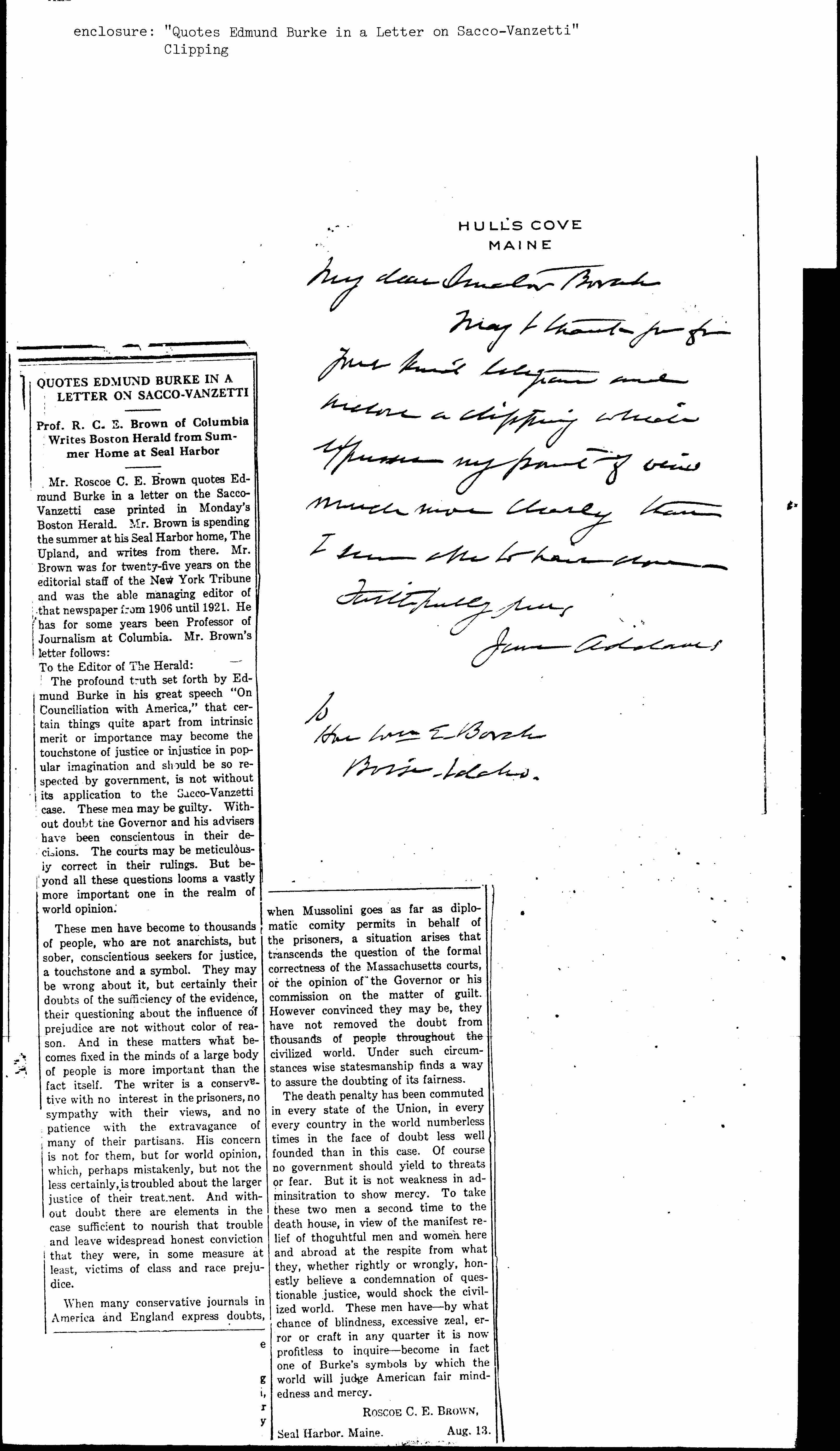
QUOTES EDMUND BURKE IN A LETTER ON SACCO-VANZETTI
Prof. R. C. E. Brown of Columbia Writes Boston Herald from Summer Home at Seal Harbor
Mr. Roscoe C. E. Brown quotes Edmund Burke in a letter on the Sacco-Vanzetti case printed in Monday's Boston Herald. Mr. Brown is spending the summer at his Seal Harbor home, The Upland, and writes from there. Mr. Brown was for twenty-five years on the editorial staff of the New York Tribune and was the able managing editor of that newspaper from 1906 until 1921. He has for some years been Professor of Journalism at Columbia. Mr. Brown’s letter follows:
To the Editor of The Herald:
The profound truth set forth by Edmund Burke in his great speech "On [Conciliation] with America," that certain things quite apart from intrinsic merit or importance may become the touchstone of justice or injustice in popular imagination and should be so respected by government, is not without its application to the Sacco-Vanzetti case. These men may be guilty. Without doubt the Governor and his advisers have been conscientious in their decisions. The courts may be meticulously correct in their rulings. But beyond all these questions looms a vastly more important one in the realm of world opinion.
These men have become to thousands of people, who are not anarchists, but sober, conscientious seekers for justice, a touchstone and a symbol. They may be wrong about it, but certainly their doubts of the sufficiency of the evidence, their questioning about the influence of prejudice are not without color of reason. And in these matters what becomes fixed in the minds of a large body of people is more important than the fact itself. The writer is a conservative with no interest in the prisoners, no sympathy with their views, and no patience with the extravagance of many of their partisans. His concern is not for them, but for world opinion, which, perhaps mistakenly, but not the less certainly, is troubled about the larger justice of their treatment. And without doubt there are elements in the case sufficient to nourish that trouble and leave widespread honest conviction that they were, in some measure at least, victims of class and race prejudice.
When many conservative journals in America and England express doubts, when Mussolini goes as far as diplomatic comity permits in behalf of the prisoners, a situation arises that transcends the question of the formal correctness of the Massachusetts courts, or the opinion of the Governor or his commission on the matter of guilt. However convinced they may be, they have not removed the doubt from thousands of people throughout the civilized world. Under such circumstances wise statesmanship finds a way to assure the doubting of its fairness.
The death penalty has been commuted in every state of the Union, in every country of the world numberless times in the face of doubt less well founded than in this case. Of course no government should yield to threats or fear. But it is not weakness in administration to show mercy. To take these two men a second time to the death house, in view of the manifest relief of thoughtful men and women here and abroad at the respite from what they, whether rightly or wrongly, honestly believe a condemnation of questionable justice, would shock the civilized world. These men have -- by what chance of blindness, excessive zeal, error or craft in any quarter it is now profitless to inquire -- become in fact one of Burke's symbols by which the world will judge American fair mindedness and mercy.
ROSCOE C. E. BROWN,
Seal Harbor. Maine. Aug. 13.

Comments