
NATIONAL COUNCIL OF WOMEN OF THE UNITED STATES
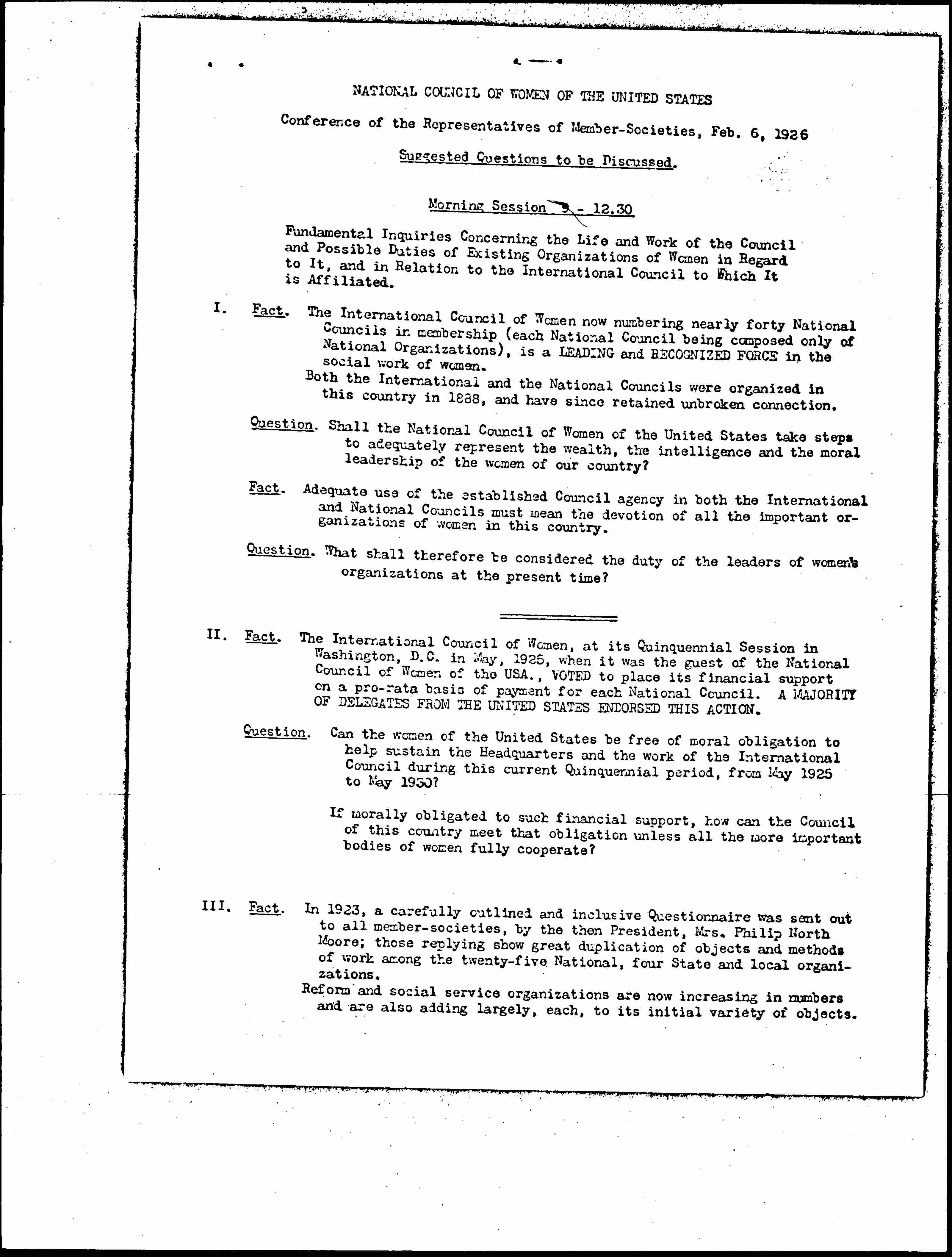
Conference of the Representatives of Member-Societies, Feb. 6, 1926
Suggested Questions to be Discussed.
Morning Session 9-12.30
Fundamental Inquiries Concerning the Life and Work of the Council and Possible Duties of Existing Organizations of Women in Regard to It, and in Relation to the International Council to Which It is Affiliated.
I. Fact. The International Council of Women now numbering nearly forty National Councils in membership (each National Council being composed only of National Organizations), is a LEADING and RECOGNIZED FORCE in the social work of women.
Both the International and the National Councils were organized in this country in 1888, and have since retained unbroken connection.
Question. Shall the National Council of Women of the United States take steps to adequately represent the wealth, the intelligence and the moral leadership of the women of our country?
Fact. Adequate use of the established Council agency in both the International and National Councils must mean the devotion of all the important organizations of women in this country.
Question. What shall therefore be considered the duty of the leaders of women's organizations at the present time?
§
II. Fact. The International Council of Women, at its Quinquennial Session in Washington, D.C. in May, 1925, when it was the guest of the National Council of Women of the USA., VOTED to place its financial support on a pro-rata basis of payment for each National Council. A MAJORITY OF DELEGATES FROM THE UNITED STATES ENDORSED THIS ACTION.
Question. Can the women of the United States be free of moral obligation to help sustain the Headquarters and the work of the International Council during this current Quinquennial period, from May 1925 to May 1930?
If morally obligated to such financial support, how can the Council of this country meet that obligation unless all the more important bodies of women fully cooperate.
III. Fact. In 1923, a carefully outlined and inclusive Questionnaire was sent out to all member-societies, by the then President, Mrs. Phillip North Moore; those replying show great duplication of objects and methods of work among the twenty-five national, four State and local organizations.
Reform and social service organizations are now increasing in numbers and are also adding largely, each, to its initial variety of objects. [page 2]
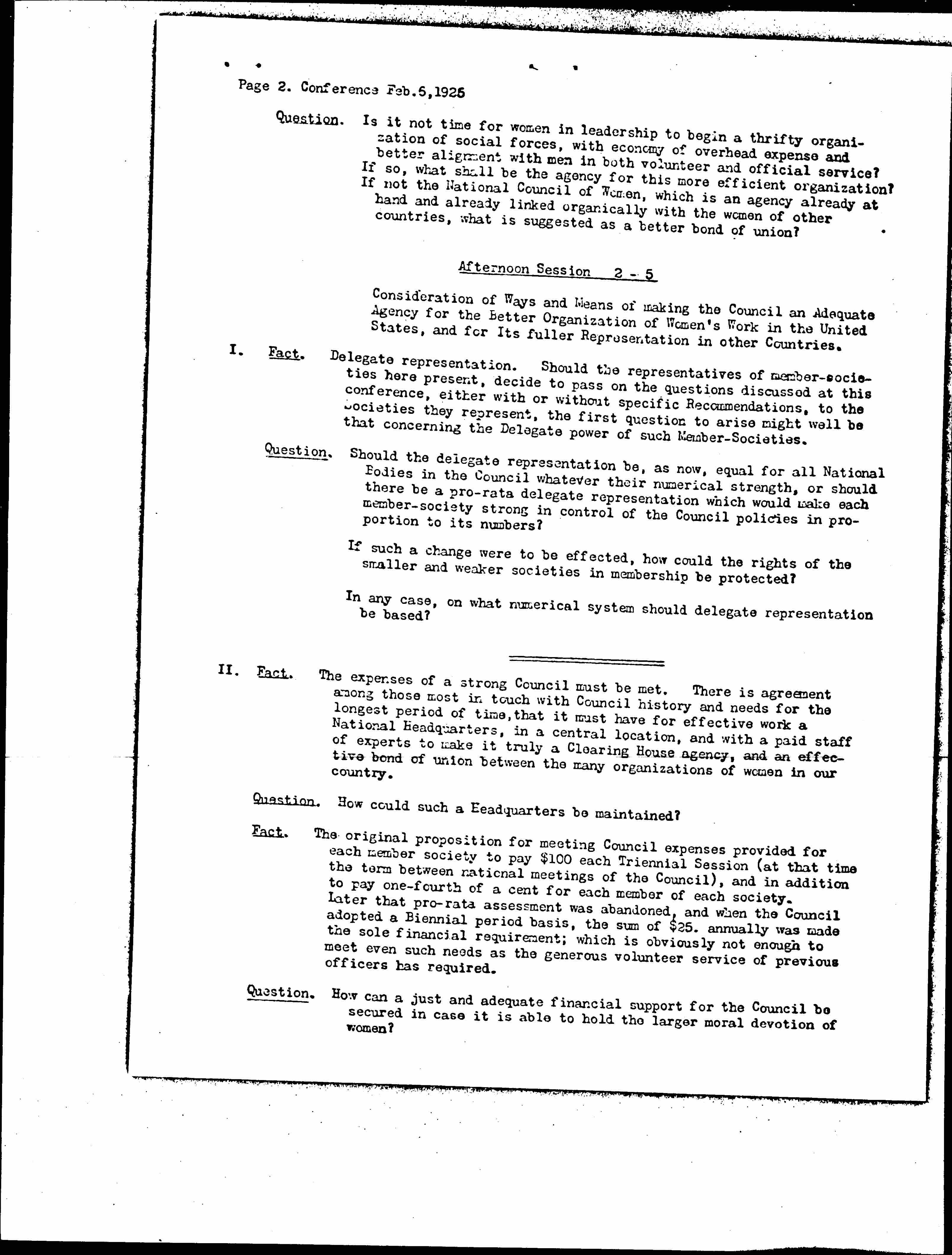
Question. Is it not time for women in leadership to begin a thrifty organization of social forces, with economy of overhead expense and better alignment with men in both volunteer and official service?
If so, what shall be the agency for this more efficient organization?
If not the National Council of Women, which is an agency already at hand and already lined organically with the women of other countries, what is suggested as a better bond of union?
Afternoon Session 2-5
Consideration of Ways and Means of making the Council an Adequate Agency for the better Organization of Women's Work in the United States, and for Its fuller Representation in other Countries.
I. Fact. Delegate representation. Should the representatives of member-societies here present, decide to pass on the questions discussed at this conference, either with or without specific Recommendations, to the Societies they represent, the first question to arise might well be that concerning the Delegate power of such Member-Societies.
Question. Should the delegate representation be, as now, equal for all National Bodies in the Council whatever their numerical strength, or should there be a pro-rata delegate representation which would make each member-society strong in control of the Council policies in proportion to its members?
If such a change were to be effected, how could the rights of the smaller and weaker societies in membership be protected?
In any case, on what numerical system should delegate representation be based?
§
II. Fact. The expenses of a strong Council must be met. There is agreement among those most in touch with Council history and needs for the longest period of time, that it must have for effective work a National Headquarters, in a central location, and with a paid staff of experts to make it truly a Clearing House agency, and an effective bond of union between the many organizations of women in our country.
Question. How could such a Headquarters be maintained?
Fact. The original proposition for meeting Council expenses provided for each member society to pay $100 each Triennial Session (at that time the term between national meetings of the Council), and in addition to pay one-fourth of a cent for each member of each society. Later that pro-rate assessment was abandoned, and when the Council adopted a Biennial period basis, the sum of $25, annually was made the sole financial requirement; which is obviously not enough to meet even such needs as the generous volunteer service of previous officers has required.
Question. How can a just and adequate financial support for the Council be secured in case it is able to hold the larger moral devotion of women? [page 3]
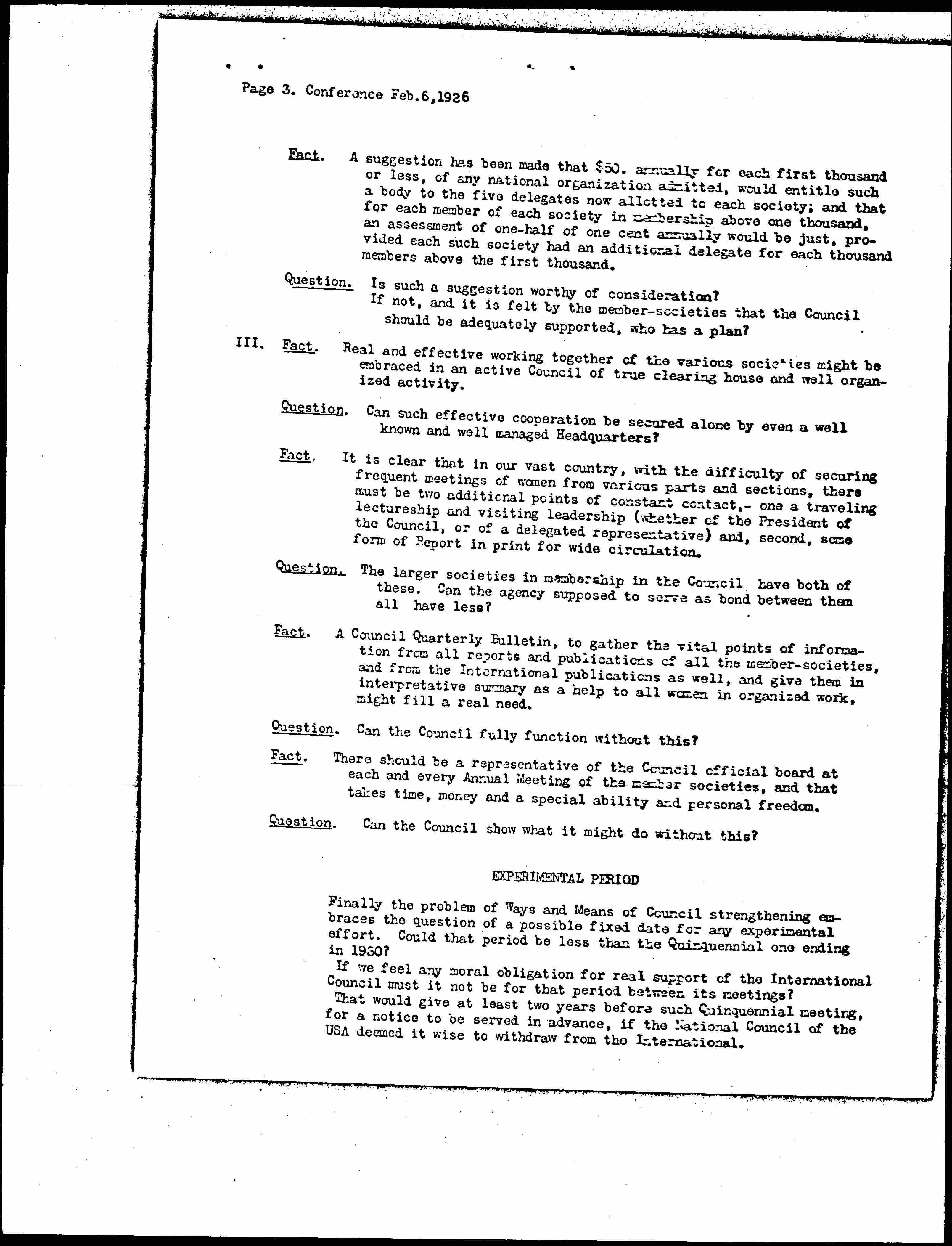
Fact. A suggestion has been made that $50. annually for each first thousand or less, of any national organization admitted, would entitle such a body to the five delegates now allotted to each society; and that for each member of each society in membership above one thousand, an assessment of one-half of one cent annually would be just, provided each such society had an additional delegate for each thousand members above the first thousand.
Question. Is such a suggestion worthy of consideration?
If not, and it is felt by the member-societies that the Council should be adequately supported, who has a plan?
III. Fact. Real and effective working together of the various societies might be embraced in an active Council of true clearing house and well organized activity.
Question. Can such effective cooperation be secured alone by even a well known and well managed Headquarters.
Fact. It is clear that in our vast country, with the difficulty of securing frequent meetings of women from various parts and sections, there must be two additional points of constant contact, -- one a traveling lectureship and visiting leadership (whether of the President of the Council, or of a delegated representative) and, second, some form of Report in print for wide circulation.
Question. The larger societies in membership in the Council have both of these. Can the agency supposed to serve as bond between them all have less?
Fact. A Council Quarterly Bulletin, to gather the vital points of information from all reports and publications of all the member-societies, and from the International publications as well, and give them in interpretive summary as a help to all women in organized work, might fill a real need.
Question. Can the Council fully function without this?
Fact. There should be a representative of the Council official board at each and every Annual Meeting of the member societies, and that takes time, money and a special ability and personal freedom.
Question. Can the Council show what it might do without this?
EXPERIMENTAL PERIOD
Finally the problem of Ways and Means of Council strengthening embraces the question of a possible fixed date for any experimental effort. Could that period be less than the Quinquennial one ending in 1930?
If we feel any moral obligation for real support of the international Council must it not be for that period between its meetings?
That would give at least two years before such Quinquennial meeting, for a notice to be served in advance, if the National Council of the USA deemed it wise to withdraw from the International. [page 4]
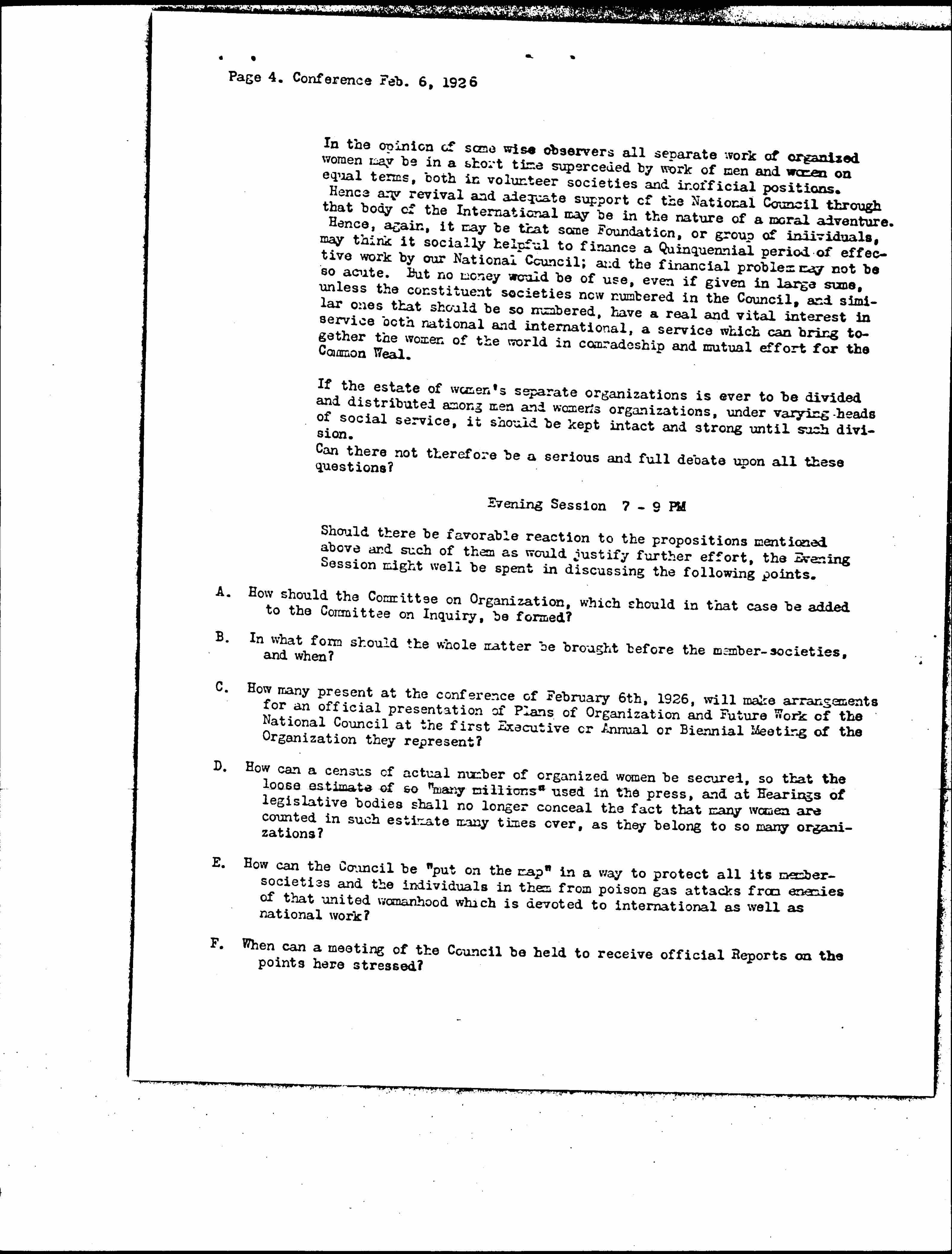
In the opinion of some wise observers all separate work of organized women may be in a short time [superseded] by work of men and women on equal terms, both in volunteer societies and in official positions.
Hence any revival and adequate support of the National Council through that body of the International may be in the nature of a moral adventure.
Hence, again, it may be that some Foundation, or group of individuals, may think it socially helpful to finance a Quinquennial period of effective work by our National Council; and the financial problem may not be so acute. But no money would be of use, even if given in large sums, unless the constituent societies now numbered in the Council, and similar ones that should be so numbered, have a real and vital interest in service both national and international, a service which can bring together the women of the world in comradeship and mutual effort for the Common Weal.
If the estate of women's separate organizations is ever to be divided and distributed among men and women's organizations, under varying heads of social service, it should be kept intact and strong until such division.
Can there not therefore be a serious and full debate upon all these questions?
Evening Session 7-9 PM
Should there be favorable reaction to the propositions mentioned above and such of them as would justify further effort, the Evening Session might well be spent in discussing the following points.
A. How should the Committee on Organization, which should in that case be added to the Committee on Inquiry, be formed?
B. In what form should the whole matter be brought before the member-societies, and when?
C. How many present at the conferences of February 6th, 1926, will make arrangements for an official presentation of Plans of Organization and Future Work of the National Council at the first Executive or Annual or Biennial Meeting of the Organization they represent?
D. How can a census of actual number of organized women be secured, so that the loose estimate of so "many millions" used in the press, and at Hearings of legislative bodies shall no longer conceal the fact that many women are counted in such estimate many times over, as they belong to so many organizations?
E. How can the Council be "put on the map" in a way to protect all its member-societies and the individuals in them from poison gas attacks from enemies of that united womanhood which is devoted to international as well as national work?
F. When can a meeting of the Council be held to receive official Reports on the points here stressed? [page 5]
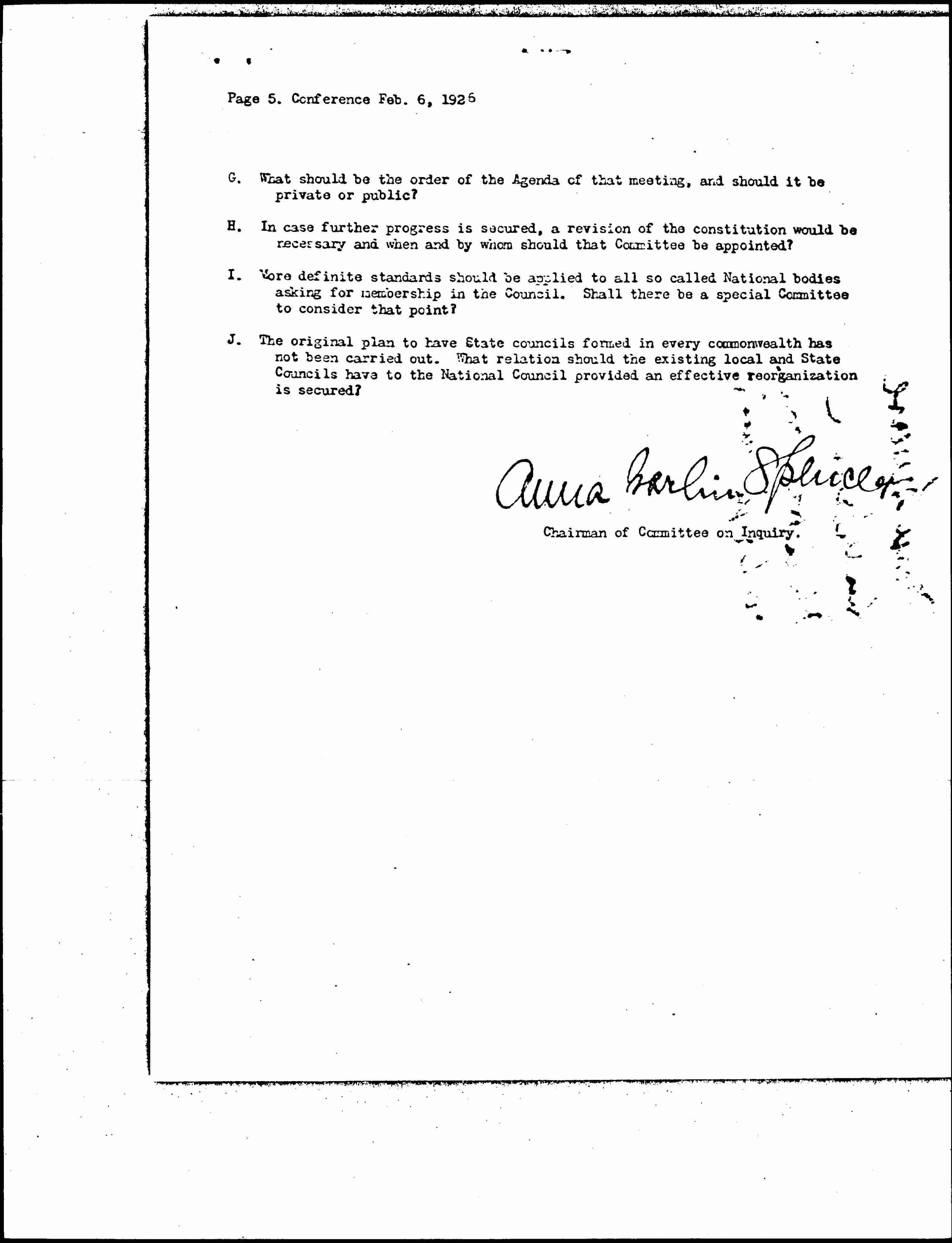
G. What should be the order of the Agenda of that meeting, and should it be private or public?
H. In case further progress is secured, a revision of the constitution would be necessary and when and by whom should that Committee be appointed?
I. More definite standards should be applied to all so called national bodies asking for membership in the Council. Shall there be a special Committee to consider that point?
J. The original plan to have State councils formed in every commonwealth has not been carried out. What relation should the existing local and State Councils have to the National Council provided an effective reorganization is secured?


Comments