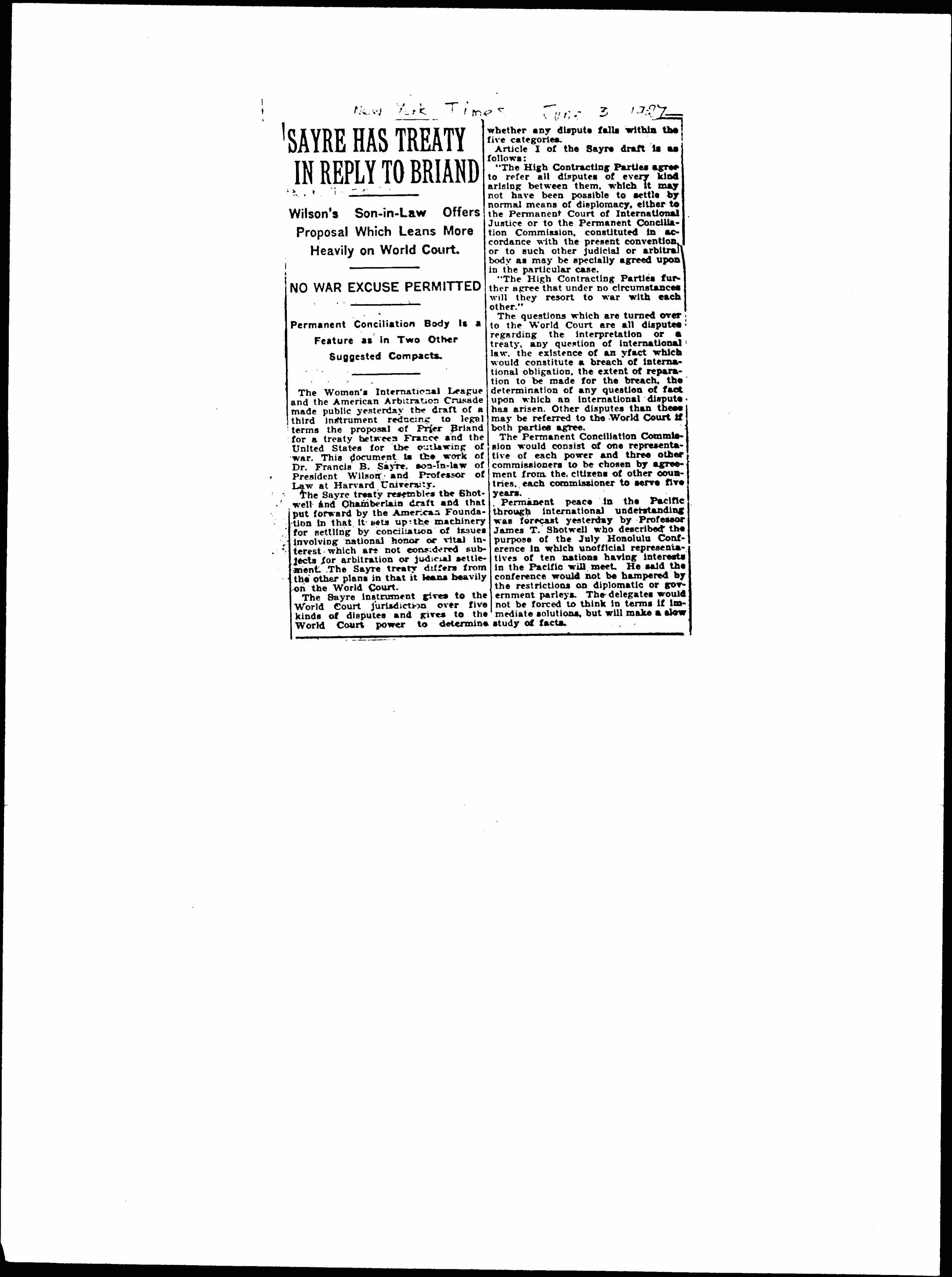
Sayre Has Treaty in Reply to Briand, June 3, 1927

REEL0019_0021.jpg

The Women's International League and the American Arbitration Crusade made public yesterday the draft of a third instrument reducing to legal terms the proposal of [Prem.?] Briand for a treaty between France and the United States for the outlawing of war. This document is the work of Dr. Francis B. Sayre, son-in-law of President Wilson and Professor of Law at Harvard University.

The Sayre treaty resembles the Shotwell and Chamberlain draft and that put forward by the American Foundation in that it sets up the machinery for settling by conciliation of issues involving national honor or vital interest which are not considered subjects for arbitration or judicial settlement. The Sayre treaty differs from the other plans in that it leans heavily on the World Court.

The Sayre instrument gives to the World Court jurisdiction over five kinds of disputes and gives to the World Court power to determine whether any dispute falls within the five categories.

Article I of the Sayre draft is as follows

"The High Contracting Parties agree to refer all disputes of every kind arising between them, which it may not have been possible to settle by normal means of diplomacy, either to the Permanent Court of International Justice or to the Permanent Conciliation Commission, constituted in accordance with the present convention or to such other judicial or arbitral body as may be specially agreed upon in the particular case.

"The High Contracting Parties further agree that under no circumstances will they resort to war with each other."

The questions which are turned over to the World Court are all disputes regarding the interpretation or a treaty, any question of international law, the existence of any fact which would constitute a breach of international obligation, the extent of reparation to be made for the breach, the determination of any question of fact upon which an international dispute has arisen. Other disputes than these may be referred to the World Court if both parties agree.

The Permanent Conciliation Commission would consist of one representative of each power and three other commissioners to be chosen by agreement from the citizens of other countries, each commissioner to serve five years.

Permanent peace in the Pacific through international understanding was forecast yesterday by Professor James T. Shotwell who described the purpose of the July Honolulu Conference in which unofficial representatives of ten nations having interests in the Pacific will meet. He said the conference would not be hampered by the restrictions on diplomatic or government parleys. The delegates would not be forced to think in terms [of] immediate solutions, but will make a slow study of facts.