
The League's Return to Chicago
We are celebrating tonight the 38th or the 8th, as you will, anniversary of one of the most popular organizations in America.
It is the 38th anniversary in the effort of American women to secure the franchise; it is the 8th in their efforts to make an intelligent and effective use of the franchise which was at last secured.
As Chicagoans we are very proud that our city was selected in 1920 for the celebration of the Suffrage Victory, for the Victory Convention of the National American Woman's Suffrage Association and the First National Congress of the League of Women Voters were held simultaneously.
Perhaps this windy city of ours was chosen in 1920 (we are all acting so much from the subconscious just now) because the trumpets of victory had need of much wind to be heard far and near, because the long road ahead of us required a full deep breath for the very first lap of our new enterprise. Possibly this subconscious selection of Chicago (for, as we all know, the subconscious is naturally base and low down) carried the implication that the field of practical politics into which the women were then making formal entrance was filled with the vain and empty sounds which come from much shouting and boasting, as the wind itself blows with noise and confusion.
For whatever reason you have come in this year of 1928, we are profoundly grateful. Your committee must have selected [page 2] Chicago months ago, long before our primary day, and we feel somewhat as a badly behaved child must feel when in the midst of his disgrace the family arrange to give him a party! We suspect therefore that you have come to Chicago this time as converts to that "progressive education" which makes much of innate self respect. Conscientiously ignoring any lapses therefrom, your educational code does not permit disciplinary remarks, -- and we joyfully welcome you as only well bred and high minded guests can be welcomed.
Eight years ago the League of Women Voters was accompanied by the spirit of youth, a charming eager-eyed creature, who filled our ears with the alluring cry, "With me all things are possible." During the intervening years of experience the League has adopted a settled policy that the organization shall give every subject a prolonged period of study and if possible observe voluntary experiments before legislation upon a given line is undertaken.
We have learned that life is never logical and on the surface, not even reasonable, -- at least, a surface reasonableness is often misleading as to the profounder motives and trends underneath. Take, for example, the Cable Act, by which an American born woman citizen retained her citizenship after her marriage to a foreigner. The League of Women Voters early endorsed this act and did much to secure its passage. What could be more logical and patriotic? And yet those of us who have much to do with immigrants are constantly filled [page 3] with profound doubt as to its advisability. I know a charming [Romanian] woman married to a prosperous American. For three years she has wished to go back to visit her aged parents. The [Romanian] consul would not give her a passport because under the laws of his country she is an American. She is not eligible to an American passport because under our laws she is a [Romanian], and once out of the country -- if she could ever get out of it before her parents die -- she could only return as part of the [Romanian] quota. She cannot bring her parents here because no provision has been made in the quota regulation for fireside relatives. The family are as completely separated as if steamships and [airplanes] had never been invented. I could add many stories of the separation of a husband from a wife, of little children who cannot possibly be with both of their parents at the same time. These parents may be united in affection and in legal marriage, but are effectively separated by the restrictive immigration act and definitions of nationality.
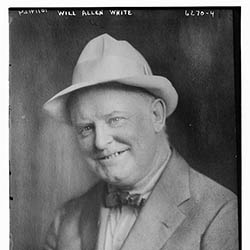
Everything has been complicated between the years 1920 and 1928 by the fact that we have lived in the midst of a post war psychology, and that which has complicated the situation much more, these years have been concurrent with the development of a revolution in Russia which has filled the entire civilized world with a paralyzing fear that the rights of property may be abrogated. Under such a panic almost anything may happen. William Allen White somewhere says that his definition of hell is a place where each man has little property and is afraid [page 4] he is about to lose it.
The situation is analogous to the cold fear which held Europe in its grip during the three decades following the French revolution. Even free-born Englishmen, Members of Parliament, abandoned their advocacy of the abolition of slavery and even of the regulation of the slave trade, because any attempt to modify existing conditions, however nefarious those conditions might be, was looked upon as revolutionary and held up as an attack upon religion and upon the family. A brilliant study has been made of this social psychology by a young Oxford man who lost his life in the World War. His book is called The French Revolution in English History. It remains for an American student -- let us hope she may be a woman -- to make a similar study of the Russian revolution in American history. To point out that as both religion and the family survived the French revolution (which was indeed the merest episode in the long history of both institutions), so doubtless the institution of private property will long survive the Russian revolution; in fact, at the present moment 90 percent of property in Russia is held as private property much more widely and safely distributed than before the revolution. Our student of the future will be obliged ↑however↓ to point out that it was a great detriment to our national development that for three decades our national policies were directed so largely by the panic stricken, by the skeptics of the integrity of human nature. Such a study might illuminate some of our most bewildering experiences. This [page 5] terrorized state of the public mind may be shown to have been responsible for the abiding opposition to two federal measures which the League has sponsored: the [Sheppard] Towner bill and the amendment to the Constitution permitting Congress to regulate the labor of Child Producers in Industry, as interstate commerce acts permitted the regulation of the shipment of industrial products. Both pieces of legislation are reasonable and necessary. They have to do with affairs in the special field of woman's experiences -- child birth, the rearing of children, their protection from premature labor in the interest of health and education; and yet these two measures are commonly attacked not on their merits, which would launch a very interesting discussion valuable for the entire country, but upon the charge that they are Bolshevik and that they threaten American heritage. The fate of these two beneficial measures -- one as to its careful and universal administration, the other as to its ratification in the state legislatures -- still hangs in the balance. In the meantime the hysterical charges continue to reverberate. They will afford a brilliant illustration to our hypothetical young student when she writes her sorely needed interpretation. Perhaps she will even supplement Graham [Wallas's] able treatise on Human Nature in Politics.
In the meantime the members of the League are obtaining a valuable training, which has been described by Josephine Butler in these words, "It is well to be trained early in swimming against the tide, or at least in standing firm and letting [page 6] the tide go by, and in maintaining while doing so a charitable attitude toward those who conscientiously differ and towards the thousands more who float contentedly down the stream of the fashionable opinion of the day."
In the very decades in which American women obtained the franchise striking changes were taking place in the parliamentary form of government all over the world, and the usefulness of the old fashioned political party is being challenged as never before.
A brilliant young Frenchman has recently pointed out that while we in the United States have no labor party, no piece of legislation affecting labor is brought into Congress before the American Association of Labor has been directly or indirectly "sounded;" we have no businessmen's party, and yet the National Association of Chambers of Commerce and similar organizations maintain headquarters in Washington that their interests may be safeguarded; we have no third estate representing the professions, but the American Bar Association would inevitably be consulted before any change would be advocated in legal procedure; that the most striking piece of popular legislation of this century was achieved not by either of the great political parties but by a voluntary agency called the Anti Saloon League. If this is the American development of the party system in contra distinction to the "balance of power by third party" development in the Mother of Parliaments, may not the League of Voters in time come to be naturally the official representative of woman's interests, depending for the [page 7] success of their legislation upon the appeal and argument they can make to right thinking men and women irrespective of their party affiliation? In time we may develop a psychiatric political worker similar in function to our psychiatric social worker, who will see through and beyond party organization to the actual human beings who compose them. Human beings who long for justice and thirst for peaceful relations with all mankind!


Comments