
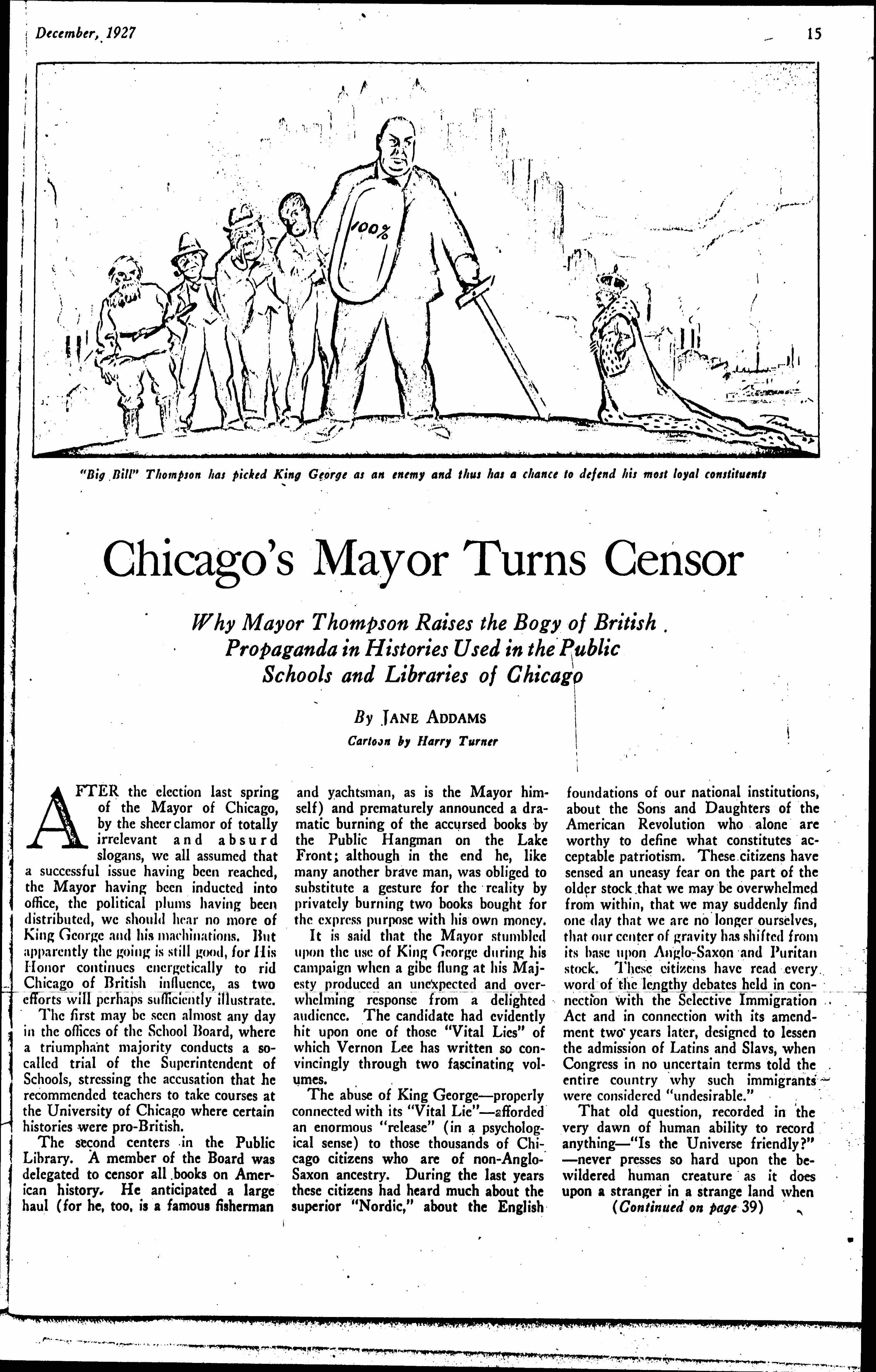


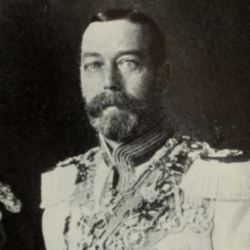
[image: "Big" Bill Thompson has picked King George as an enemy and thus has a chance to defend his most loyal constituents]
Chicago's Mayor Turns Censor
Why Mayor Thompson Raises the Bogy of British Propaganda in Histories Used in the Public Schools and Libraries of Chicago
By JANE ADDAMS
Cartoon by Harry Turner
After the election last spring of the Mayor of Chicago, by the sheer clamor of totally irrelevant and absurd slogans, we all assumed that a successful issue having been reached, the Mayor having been inducted into office, the political plums having been distributed, we should hear no more of King George and his machinations. But apparently the going is still good, for His Honor continues energetically to rid Chicago of British influence, as two efforts will perhaps sufficiently illustrate.
The first may be seen almost any day in the offices of the School Board, where a triumphant majority conducts a so-called trial of the Superintendent of Schools, stressing the accusation that he recommended teachers to take courses at the University of Chicago where certain histories were pro-British.
The second centers in the Public Library. A member of the Board was delegated to censor all books on American history. He anticipated a large haul (for he, too, is a famous fisherman and yachtsman, as is the Mayor himself) and prematurely announced a dramatic burning of the accursed books by the Public Hangman on the Lake Front; although in the end he, like many another brave man, was obliged to substitute a gesture for the reality by privately burning two books bought for the express purpose with his own money.
It is said that the Mayor stumbled upon the use of King George during his campaign when a gibe flung at his Majesty produced an unexpected and overwhelming response from a delighted audience. The candidate had evidently hit upon one of those "Vital Lies" of which Vernon Lee has written so convincingly through two fascinating volumes.
The abuse of King George -- properly connected with its "Vital Lie" -- afforded an enormous "release" (in a psychological sense) to those thousands of Chicago citizens who are of non-Anglo-Saxon ancestry. During the last years these citizens had heard much about the superior "Nordic," about the English foundations of our national institutions, about the Sons and Daughters of the American Revolution who alone are worthy to define what constitutes acceptable patriotism. These citizens have sensed an uneasy fear on the part of the older stock that we may be overwhelmed from within, that we may suddenly find one day that we are no longer ourselves, that our center of gravity has shifted from its base upon Anglo-Saxon and Puritan stock. These citizens have read every word of the lengthy debates held in connection with the Selective Immigration Act and in connection with its amendment two years later, designed to lessen the admission of Latins and Slavs, when Congress in no uncertain terms told the entire country why such immigrants were considered "undesirable."
That old question, recorded in the very dawn of human ability to record anything -- "Is the Universe friendly?" -- never presses so hard upon the bewildered human creature as it does upon a stranger in a strange land when [page 2] his very mother tongue, his inherited customs and manners, his clothing and his food are all subjected to a covert ridicule and considered per se un-American if not indeed dangerous and subversive of American institutions. But at last a champion arose for the diverse groups living in Chicago. The abuse of King George -- naturally pleasing to the Irish and inevitably highly entertaining to the Germans -- embodied for the Slav, the Greek, the Latin, the Turk and all the rest, an assertion that the Anglo-Saxon was no better than he ought to be or at any rate that he would no longer be allowed to dictate what Chicago should teach its school children, whose racial background was as good as anybody's! The day of retribution had arrived. No one was ever hailed more devoutly as a champion of the misrepresented and of the oppressed than was this valiant knight tilting at royalty.
The sweep of this revolt against the dominant race was possibly most conspicuous in its inclusion of the two hundred thousand colored people living in Chicago. Perhaps no one so wistfully feels the need of a champion -- certainly no one can need one more -- than does the Negro. King George represented for the moment the men of those dominant races who were the slave traders on the coast of Africa, who were the masters on Southern plantations, who were the shrouded night riders in the reconstruction days, the members of the Ku Klux Klan, who recently denied full high school privileges to an ambitious colored group living in the neighboring city of Gary.
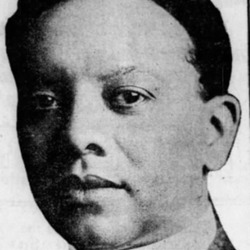
That the floor leader of the Chicago City Council is a Negro should be a matter of no consequence in a political body founded upon city-wide representation; and yet because it has never happened before and could not happen at all unless the Mayor wished it, this "recognition" is accounted for righteousness to the administration by many a colored voter, who is genuinely alarmed over the demoralization of his race resulting from the "wide open" privileges granted to those of them who are least fitted to endure license.
This call to the misrepresented also met a public response from the Chicago members of the Council Fire of American Indians, who begged to be set right in the school histories in which a successful foray by the Red Skins was invariably described as a "massacre," while one by the Whites was called a glorious victory over savages. The Indians also submitted that they were the real one hundred [percent] Americans and that something was due them on that count as well.
Of course all the Mayor's championship was united with a hundred [percent] Americanism; it would have been impossible to put it over unless it had been so yoked and it would also have lost its effectiveness. That which constitutes Americanization had been redefined by one who is a prosperous Anglo-Saxon himself. He had roughly torn the definition out of its narrow wrappings and had gloriously enlarged and ennobled it.
The oldest and easiest methods of fusing diverse elements into one consuming flame (demonstrated by every war from a border raid to a worldwide cataclysm) is to unite men into a mutual hatred of a common enemy. If this can be combined with an appeal to a flaming ideal, set in opposition to those of the nefarious foe, all the elements are present for the manufacturing of an overwhelming zeal. King George was the enemy, a hundred [percent] Americanism was the common ideal and the incessant whooping up of both resulted in an enormous popularity of the protagonist.
We have been recently told by an observant Frenchman that the political parties at the United States are not political parties at all in the original parliamentary sense, that they are political contrivances for nominating and electing office holders, that with the possible exception of the tariff they ordinarily present platforms made up entirely of what the party leaders consider popular issues. He further contends that the advocacy of moral and economic aims associated with political parties in most parliamentary countries is carried on in the United States by voluntary organizations, many of which have their headquarters in Washington; that these organizations, from the Federation of Labor to the National Chamber of Commerce, prefer to interview Congressmen with a non-partisan appeal; that the Anti-Saloon League affords a striking example of the success of such an appeal, that the failure of the United States to enter the League of Nations is a marked example of the departure from it.
If this observation is accepted as well founded it may become more respectable than ever before to be elected upon a platform selected solely for its vote-catching power.
After all, it is very simple, for while [page 3] the one hundred [percent] appeal has almost broken down from overwork in one campaign after another, the championship method is doing splendidly and we may even predict -- although I suggest this with modest pride -- that it may become known as the Chicago Plan.



Comments