Speech to Hammond Woman's Club, April 23, 1927 (excerpts)

JAPA-1878.jpg

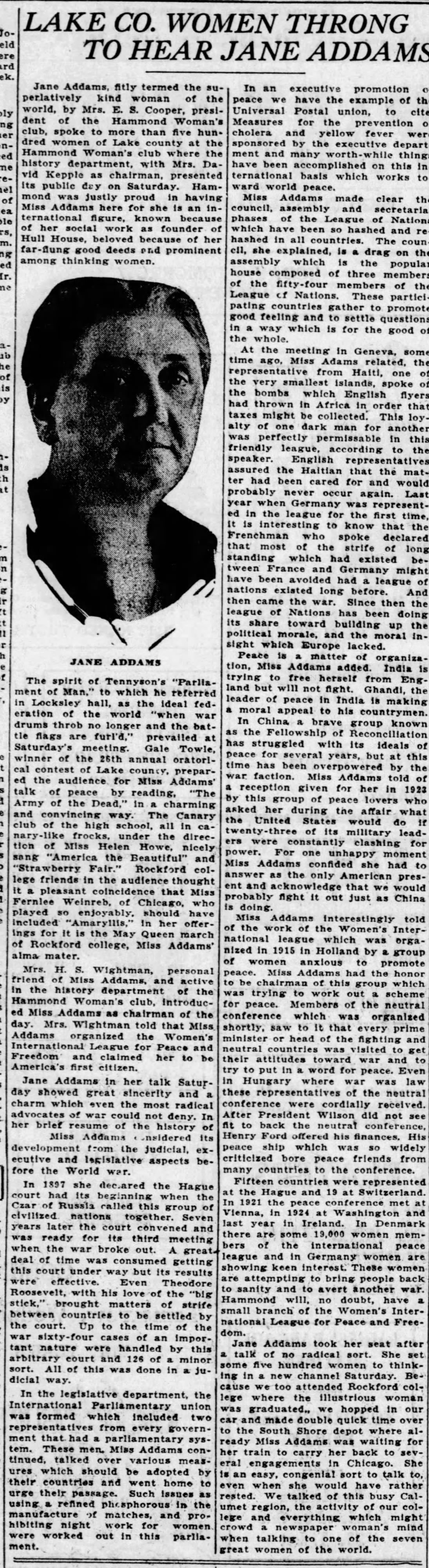
Jane Addams in her talk Saturday showed great sincerity and a charm which even the most radical advocates of war could not deny. In her brief resume of the history of [missing word(s)] Miss Addams considered its development from the judicial, executive and legislative aspects before the World War.

In 1897 she declared The Hague court had its beginning when the Czar of Russia called this group of civilized nations together. Seven years later the court convened and was ready for its third meeting when the war broke out. A great deal of time was consumed getting this court under way but its results were effective. Even Theodore Roosevelt, with his love of the "big stick," brought matters of strife between countries to be settled by the court. Up to the time of the war sixty-four cases of an important nature were handled by this arbitrary court and 126 of a minor sort. All of this was done in a judicial way.

In the legislative department, the International Parliamentary union was formed which included two representatives from every government that had a parliamentary system. These men, Miss Addams continued, talked over various measures which should be adopted by their countries and went home to urge their passage. Such issues as using a refined phosphorus in the manufacture of matches, and prohibiting night work for women were worked out in this parliament.

In an executive promotion [of] peace we have the example of [the] Universal Postal union, to cite. Measures for the prevention [of] cholera and yellow fever were sponsored by the executive department and many worth-while [things] have been accomplished on this international basis which works toward world peace.

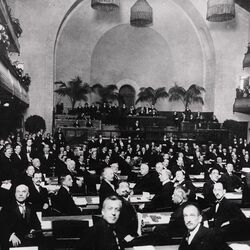
Miss Addams made clear the council, assembly and [secretarial] phases of the League of Nations which have been so hashed and rehashed in all countries. The council, she explained, is a drag on the assembly which is the popular house composed of three members of the fifty-four members of the League of Nations. These participating countries gather to promote good feeling and to settle questions in a way which is for the good of the whole.

At the meeting in Geneva, some time ago, Miss Addams related, the representative from Haiti, one of the very smallest islands, spoke of the bombs which English flyers had thrown in Africa in order that taxes might be collected. This loyalty of one dark man for another was perfectly permissible in this friendly league, according to the speaker. English representatives assured the Haitian that the matter had been cared for and would probably never occur again. Last year when Germany was represented in the league for the first time, it is interesting to know that the Frenchman who spoke declared that most of the strife of long standing which had existed between France and Germany might have been avoided had a league of nations existed long before. And then came the war. Since then the League of Nations has been doing its share toward building up the political morale, and the moral insight which Europe lacked.

Peace is a matter of organization, Miss Addams added. India is trying to free herself from England but will not fight. [Gandhi], the leader of peace in India is making a moral appeal to his countrymen.

In China a brave group known as the Fellowship of Reconciliation has struggled with its ideals of peace for several years, but at this time has been overpowered by the war faction. Miss Addams told of a reception given for her in 1923 by this group of peace lovers who asked her during the affair what the United States would do if twenty-three of its military leaders were constantly clashing for power. For one unhappy moment Miss Addams confided she had to answer as the only American present and acknowledge that we would probably fight it out just as China is doing.

Miss Addams interestingly told of the work of the Women's International league which was organized in 1915 in Holland by a group of women anxious to promote peace. Miss Addams had the honor to be chairman of this group which was trying to work out a scheme for peace. Members of the neutral conference which was organized shortly, saw to it that every prime minister or head of the fighting and neutral countries was visited to get their attitudes toward war and to try to put in a word for peace. Even in Hungary where war was law these representatives of the neutral conference were cordially received. After President Wilson did not see fit to back the neutral conference, Henry Ford offered his finances. His peace ship which was so widely criticized bore peace friends from many countries to the conference.

Fifteen countries were represented at The Hague and 19 at Switzerland. In 1921 the peace conference met at Vienna, in 1924 at Washington and last year in Ireland. In Denmark there are some 19,000 women members of the international peace league and in Germany women are showing keen interest. These women are attempting to bring people back to sanity and to avert another war. Hammond will, no doubt, have a small branch of the Women's International League for Peace and Freedom.