Julia Clifford Lathrop to Benjamin Barr Lindsey, December 7, 1927

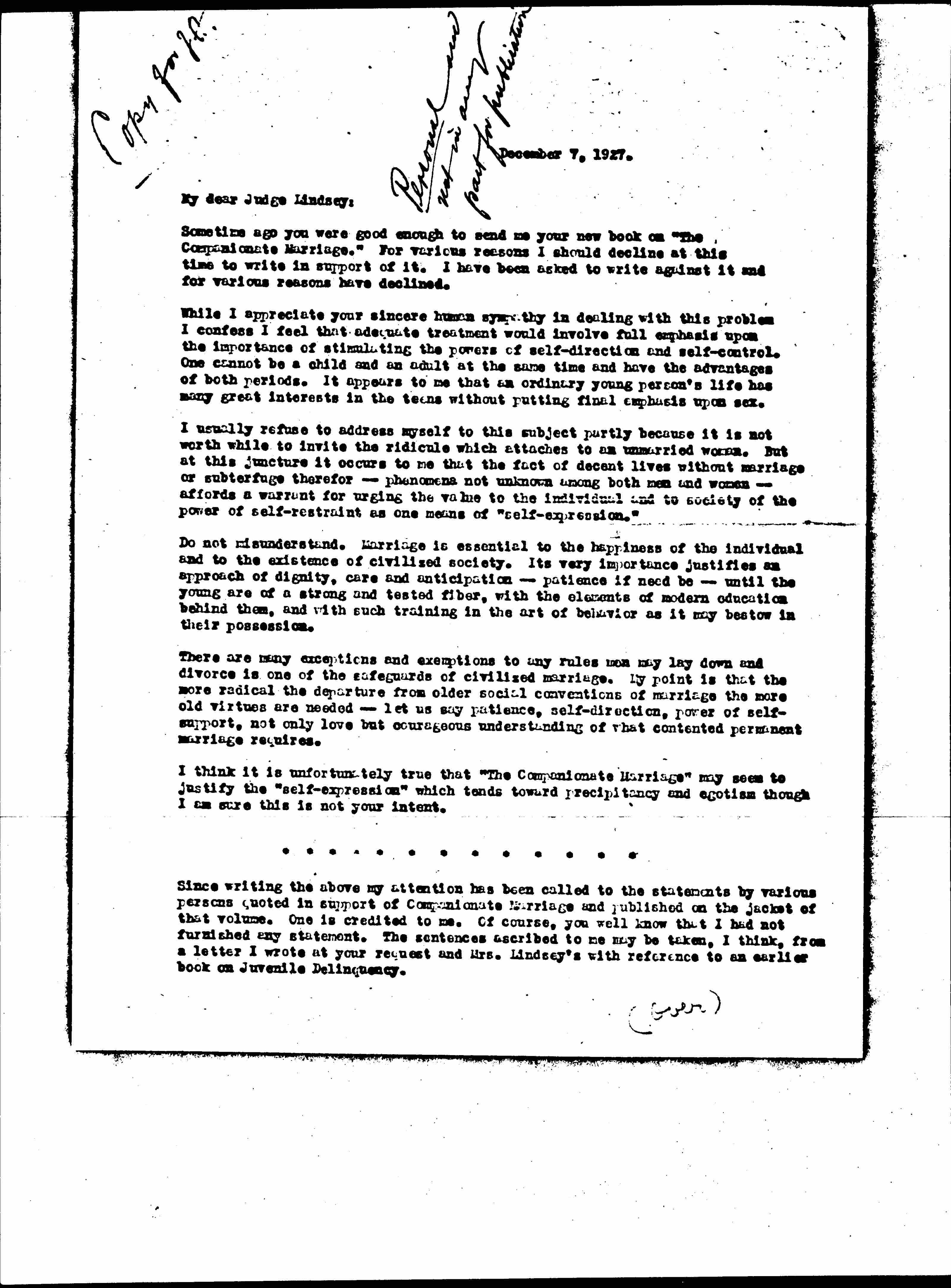
↑Copy for J. A.↓

Personal and not in any part for publication↓

December 7, 1927.

My dear Judge Lindsey,

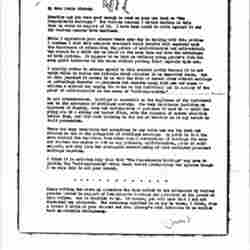
Sometime ago you were good enough to send me your new book on "The Companionate Marriage." For various reasons I should decline at this time to write in support of it. I have been asked to write against it and for various reasons have declined.

While I appreciate your sincere human sympathy in dealing with this problem I confess I feel that adequate treatment would involve full emphasis upon the importance of stimulating the powers of self-direction and self-control. One cannot be a child and an adult at the same time and have the advantages of both periods. It appears to me that an ordinary young person's life has many great interests in the teens without putting final emphasis upon sex.

I usually refuse to address myself to this subject partly because it is not worth while to invite the ridicule which attaches to an unmarried woman. But at this juncture it occurs to me that the fact of decent lives without marriage or subterfuge therefor -- phenomena not unknown among both men and women -- affords a warrant for urging the value to the individual and to society of the power of self-restraint as one means of "self-expression."

Do not misunderstand. Marriage is essential to the happiness of the individual and to the existence of civilized society. Its very importance justifies an approach of dignity, care and anticipation -- patience if need be -- until the young are of a strong and tested fiber, with the elements of modern education behind them, and with such training in the art of behavior as it may bestow in their possession.

There are many exceptions and exemptions to any rules man may lay down and divorce is one of the safeguards of civilized marriage. My point is that the more radical the departure from older social conventions of marriage the more old virtues are needed -- let us say patience, self-direction, power of self-support, not only love but courageous understanding of what contented permanent marriage requires.

I think it is unfortunately true that "The Companionate Marriage" may seem to justify the "self-expression" which tends toward precipitancy and egotism though I am sure this is not your intent.

§

Since writing the above my attention has been called to the statements by various persons quoted in support of Companionate Marriage and published on the jacket of that volume. One is credited to me. Of course, you well know that I had not furnished any statement. The sentences ascribed to me may be taken, I think, from a letter I wrote at your request and Mrs. Lindsey's with reference to an earlier book on Juvenile Delinquency.

↑(over)↓ [page 2]

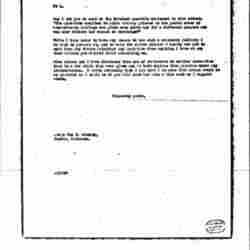
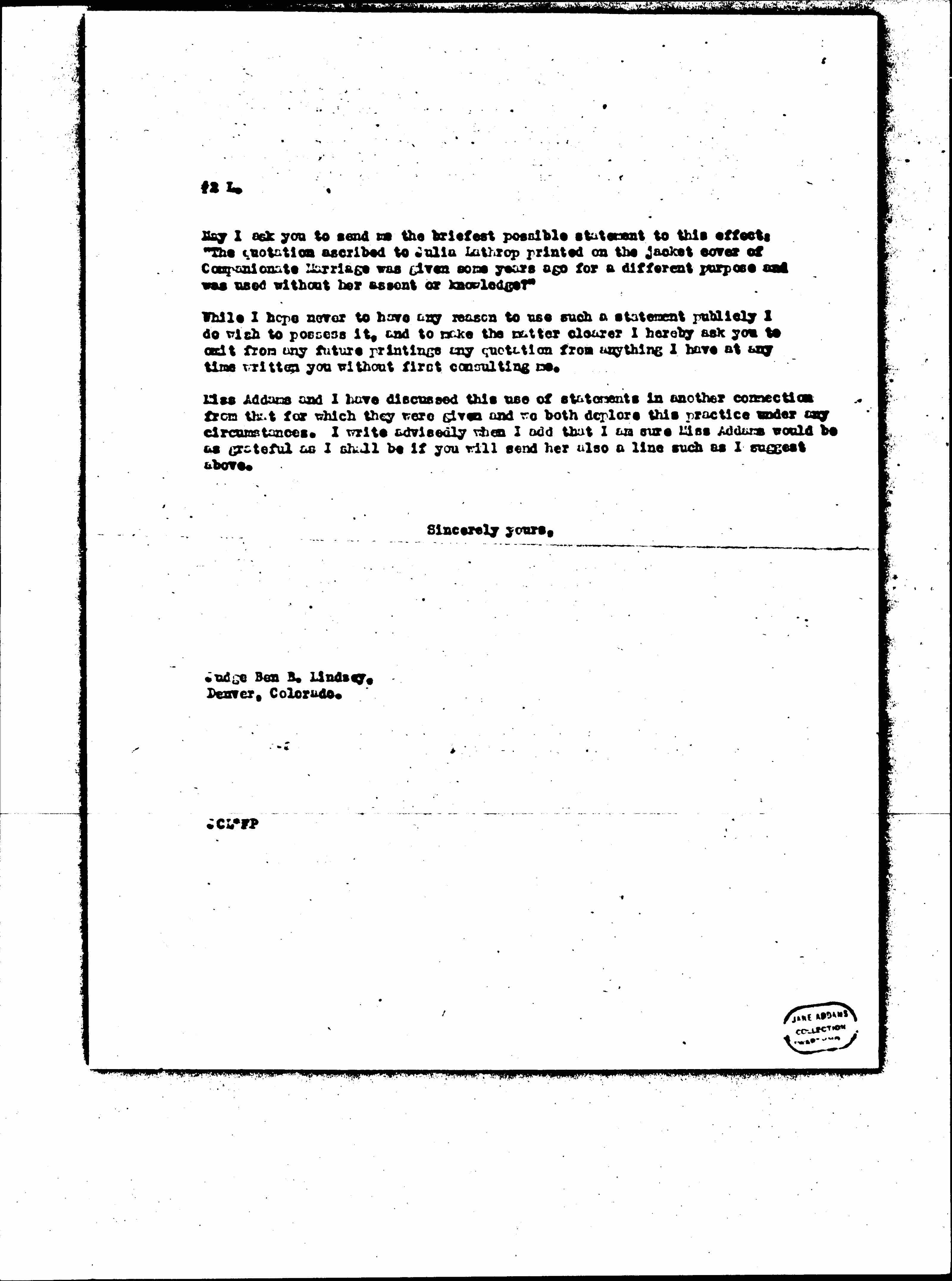
May I ask you to send me the briefest possible statement to this effect: "The quotation ascribed to Julia Lathrop printed on the jacket cover of Companionate Marriage was given some years ago for a different purpose and was used without her assent or knowledge?"

While I hope never to have any reason to use such a statement publicly I do wish to possess it, and to make the matter clearer I hereby ask you to omit from any future printings any quotation from anything I have at any time written you without first consulting me.

Miss Addams and I have discussed this use of statements in another connection from that for which they were given and we both deplore this practice under any circumstances. I write advisedly when I add that I am sure Miss Addams would be as grateful as I shall be if you will send her also a line such as I suggest above.

Sincerely yours,

Judge Ben B. Lindsey.
Denver, Colorado.