"SOME IMPRESSIONS OF THE NATIONALIST GOVERNMENT IN CHINA"
By Chas. K. Edmunds, Ph.D.
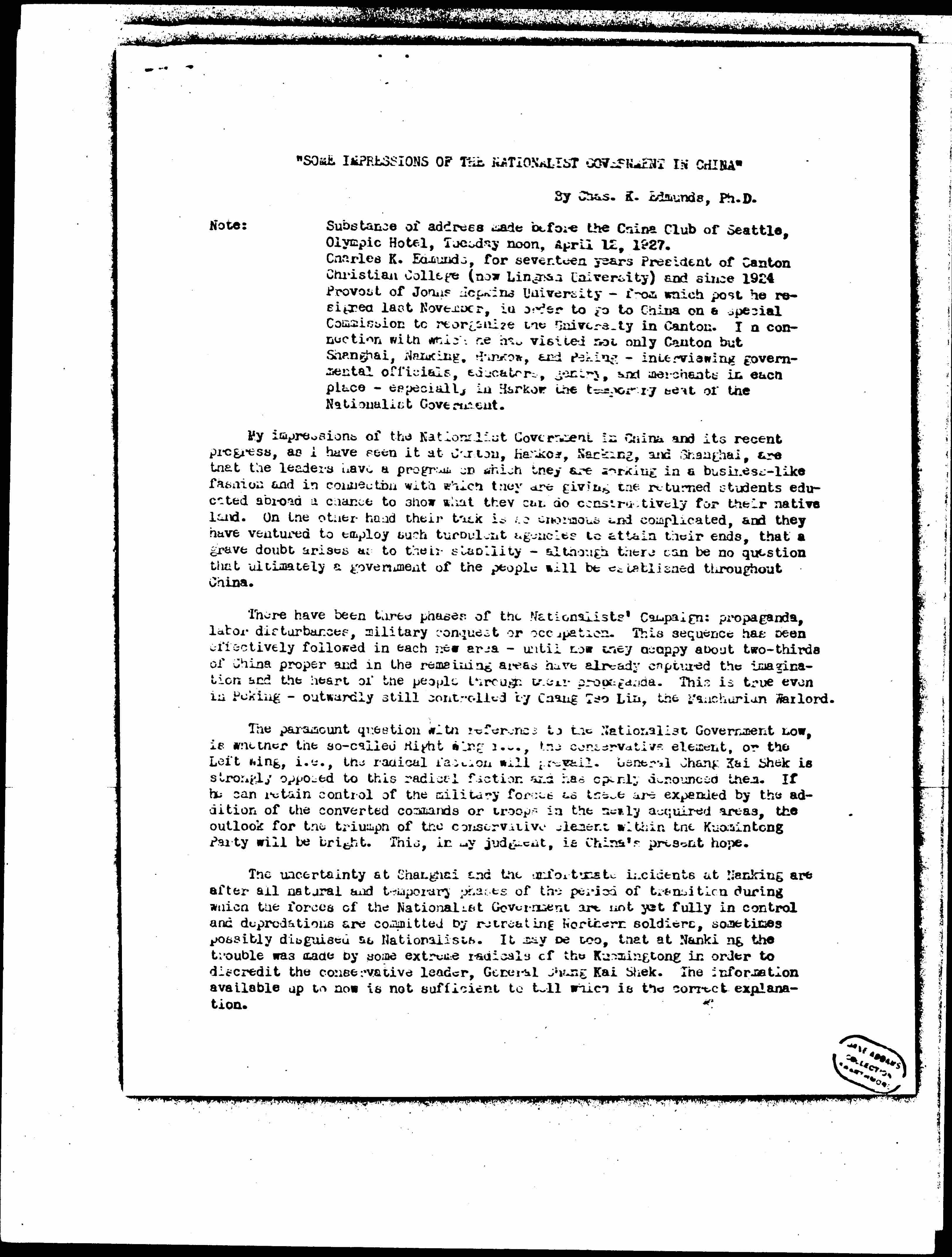
Note: Substance of address made before the China Club of Seattle, Olympic Hotel, Tuesday noon, April 12, 1927. Charles K. Edmunds, for seventeen years President of Canton Christian College (now Lingnan University) and since 1924 Provost of Johns Hopkins University -- from which post he resigned last November, in order to go to China on a special Commission to reorganize the University in Canton. In connection with which he has visited not only Canton but Shanghai, Nanking, Hankow, and Peking -- interviewing governmental officials, educators, gentry, and merchants in each place -- especially in Hankow the temporary seat of the Nationalist Government.
My impressions of the Nationalist Government in China and its recent progress, as I have seen it at Canton, Hankow, Nanking, and Shanghai, are that the leaders have a program on which they are working in a business-like fashion and in connection with which they are giving the returned students educated abroad a chance to show what they can do constructively for their native land. On the other hand their task is so enormous and complicated, and they have ventured to employ such turbulent agencies to attain their ends, that a grave doubt arises as to their stability -- although there can be no question that ultimately a government of the people will be established throughout China.
There have been three phases of the Nationalists' Campaign: propaganda, labor disturbances, military conquest or occupation. This sequence has been effectively followed in each new area -- until now they occupy about two-thirds of China proper and in the remaining areas have already captured the imagination and the heart of the people through their propaganda. This is true even in Peking -- outwardly still controlled by Chang Tso Lin, the Manchurian Warlord.
The paramount question with reference to the Nationalist Government now, is whether the so-called Right Wing i.e., the conservative element, or the Left Wing, i.e., the radical faction will prevail. General [Chiang] Kai Shek is strongly opposed to this radical faction and has openly denounced them. If he can retain control of the military forces as these are expended by the addition of the converted commands or troops in the newly acquired areas, the outlook for the triumph of the conservative element within the [Kuomintang] Party will be bright. This, in my judgment, is China's present hope.
The uncertainty at Shanghai and the unfortunate incidents at Nanking are after all natural and temporary phases of the period of transition during which the forces of the Nationalist Government are not yet fully in control and depredations are committed by retreating Northern soldiers, sometimes possibly disguised as Nationalists. It may be too, that at Nanking the trouble was made by some extreme radicals of the [Kuomintang] in order to discredit the conservative leader, General [Chiang] Kai Shek. The information available up to now is not sufficient to tell when is the correct explanation. [page 2]
Where the Nationalist Government is in full control and under the dominance of the conservative leaders there is quiet and progressive administration -- as at Canton for instance.
At Hankow, the regulations promulgated for the administration of the former British Concession seem entirely appropriate and fair to the British who are given three places out of six on the administrative council, the seventh member, and Chairman, being Chinese. The taxpayers association control the budget of municipal expenses and determine the personnel of this Council. There has not been, and in my judgment there will not be, any effort to take over foreign held property, but only the administration of the area.
Much as we regret the labor disturbances and the turbulent demonstrations against foreign forces in China, we should realize that unfortunately the West has been always just too late in adjusting itself to the inevitable -- in responding to the newer conditions in China. The Western powers have by their delays themselves taught the Chinese that the only way to get what they want or even what has already been promised them, is by creating a howl and a disturbance.
It is, in my judgment, not a correct diagnosis to say that the Russians are responsible for the whole of the turbulent character of the Nationalists' campaign against foreign privileges in China. This campaign is the natural culmination of a process that has been going on for at least two decades to my own knowledge and observation. The Russians have come in on top of an inevitable movement -- not causing it, but taking advantage of it. Neither Great Britain nor America has been astute enough or alert enough to seize the prior opportunity which was theirs -- to countenance and help this movement.
Just now, though formerly one of the chief sinners in aggressions against China's sovereignty, Japan is acting most carefully and with the utmost possible conciliation and in this attitude she is followed by France.
The status of foreigners in China with their special privileges is unnatural and is bound to pass. This being so, it would have been much better for foreign interests had the powers concerned in the unequal treaties and especially those concerned in the maintenance of the settlements and concessions, to have moved definitely toward an adjustment to future conditions, than to attempt to hold on and yield only as forced to by special pressure, which if once developed and its use demonstrated assumes, as it has already done, a drastic form hurtful to foreign and Chinese alike.
The Chinese are determined to control affairs in their own country and there is no stopping them, even if we wished to. Moreover, they are bound to perform their own experiments in self-government and may even venture to try out Communism under modern conditions -- [though] personally, I do not think that is so likely as some suppose. For the Chinese have existed as a Nation long enough [illegible] to have tried nearly every form of social order -- and they tried a form of communism some 300 years ago and found it did not work. I do not fear that the Chinese will really attempt communism in its Russian form, but I am fearful of labor troubles for a period, the length of which [will] depend on how long the new government takes to get an effective control. [page 3]
But such troubles are not confined to China, and whatever the incidental troubles may be, China will learn how to maintain order within her borders and how to handle her internal relations, only by trying out her own experiments in self government and self determination.
The driving force of the present revolution is not anti-foreignism or communism, but pro-nationalism. With the rise of nationalism in China, we fully sympathize. Our friendly influence, so far as it can be brought into play -- should continue to show this and at the same time assure that our nationals in China are not made to suffer for their friendliness.
The Nationalist Government in its foreign relations has exhibited the following attitude:
1. It has refused to receive any communication from the Diplomatic Body, first on the ground that the latter has not officially taken cognizance of the Nationalist Government; and secondly because the very existence and organization of the Diplomatic Body constitutes a super-government which the Nationalist Government refuses to recognize because as the single mouthpiece for the rest of the world in dealing with China such an agency is a diplomatic anomaly --– totally distasteful to the Chinese who stand ready to deal separately with any single power on terms of political equality.
As a matter of fact Great Britain has been forced to deal with the Nationalist Government as the de facto authority for areas under its actual control -- as at Canton, Hankow, Kiukiang, Shanghai, and Nanking.
2. The Chinese resent deeply the foreign attitude that no matter what the Chinese may be trying by civil warfare to accomplish in their own country, it must not interfere with foreign trade or with the passage of foreign steamships on their own inland waterways -- notably the [Yangtze]. They resent deeply that their very serious struggle against the militaristic domination of the warlords and toward a unification of a government for, of, and by the people should be regarded merely as an unwarranted interference with foreign trade.
It should be realized that the Chinese merchants are after all the greatest sufferers from the interruption of trade, and so long as they are willing to suffer in view of the hoped-for political benefit to the nation, they must regard the incidental injury to foreign interests as insufficient to warrant outside interference in China's attempt to solve her own problem of internal political life.
The fact is that the more prompt recognition of China's nationalistic aspirations by the foreign-traders would gain for the latter a good-will which would ensure a larger development of trade whereas the constant unfair and disparaging comment poured out upon the Nationalist Government by the Foreign Language Press in China, especially in Shanghai, has only postponed the inevitable day of adjustment of foreign privileges in China which must precede the development of a better mutual understanding and successful international intercourse, both culturally and commercially.

Comments