Women's International League for Peace and Freedom, June 1927

38945.jpg
REEL0019_0048.jpg
38945-4.jpg

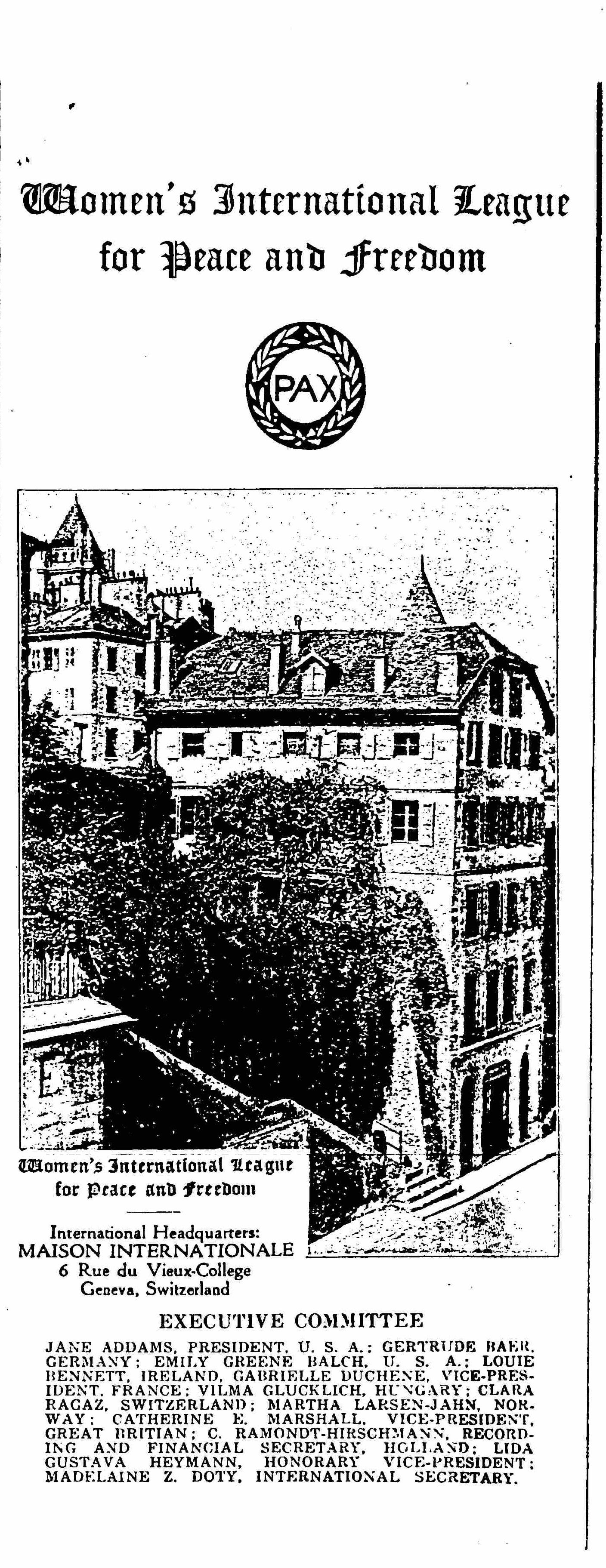
Women's International League for Peace and Freedom

[Image]

Women's International League for Peace and Freedom
International Headquarters:
MAISON INTERNATIONALE
6 Rue du Vieux-College
Geneva, Switzerland

EXECUTIVE COMMITTEE

JANE ADDAMS, PRESIDENT, U.S.A; [GERTRUD] BAER, GERMANY; EMILY GREENE BALCH, U.S.A.; LOUIE BENNETT, IRELAND; GABRIELLE DUCHÊNE, VICE-PRESIDENT, FRANCE; VILMA GLÜCKLICH, HUNGARY; CLARA RAGAZ, SWITZERLAND; MARTHA LARSEN-JAHN, NORWAY; CATHERINE E. MARSHALL, VICE-PRESIDENT, GREAT BRITAIN; C. RAMONDT-HIRSCHMANN, RECORDING AND FINANCIAL SECRETARY, HOLLAND; LIDA GUSTAVA HEYMANN, HONORARY VICE-PRESIDENT; [MADELEINE] Z. DOTY, INTERNATIONAL SECRETARY. [page 2]

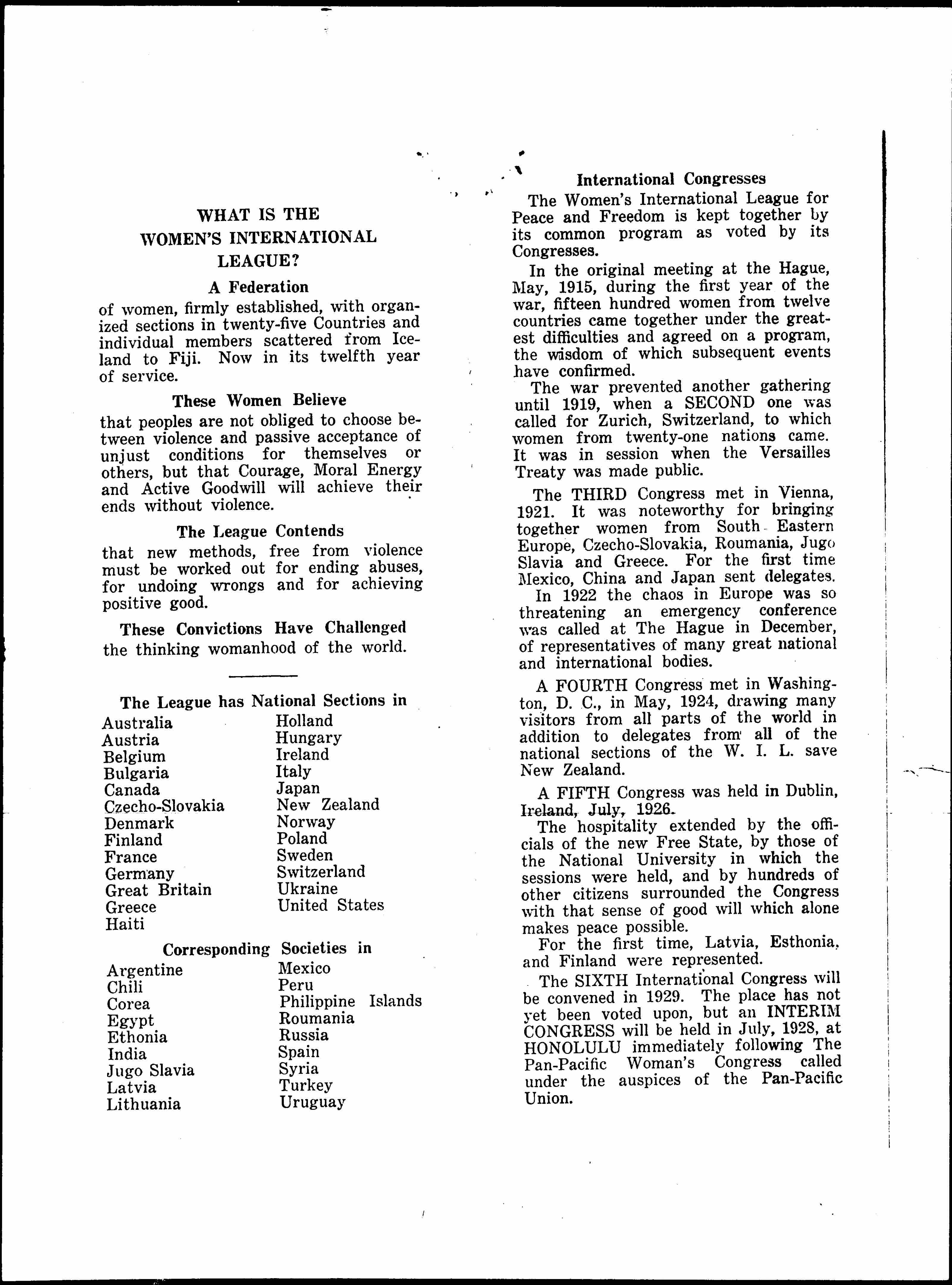
WHAT IS THE WOMEN'S INTERNATIONAL LEAGUE?

A Federation

of women, firmly established, with organized sections in twenty-five Countries and individual members scattered from Iceland to Fiji. Now in its twelfth year of service.

These Women Believe

that peoples are not obliged to choose between violence and passive acceptance of unjust conditions for themselves or others, but that Courage, Moral Energy and Active Goodwill will achieve their ends without violence.

The League Contends

that new methods, free from violence must be worked out for ending abuses, for undoing wrongs and for achieving positive good.

These Convictions Have Challenged

the thinking womanhood of the world.

The League of has National Sections in

Australia

Austria

Belgium

Bulgaria

Canada

[Czechoslovakia]

Denmark

Finland

France

Germany

Great Britain

Greece

Haiti

Holland

Hungary

Ireland

Italy

Japan

New Zealand

Norway

Poland

Sweden

Switzerland

Ukraine

United States

Corresponding Societies in

[Argentina]

[Chile]

[Korea]

Egypt

[Estonia]

India

[Yugoslavia]

Latvia

Lithuania

Mexico

Peru

Philippine Islands

[Romania]

Russia

Spain

Syria

Turkey

Uruguay

International Congresses

The Women's International League for Peace and Freedom is kept together by its common program as voted by its Congresses.

In the original meeting at The Hague, May, 1915, during the first year of the war, fifteen hundred women from twelve countries came together under the greatest difficulties and agreed on a program, the wisdom of which subsequent events have confirmed.

The war prevented another gathering until 1919, when a SECOND one was called for Zurich, Switzerland, to which women from twenty-one nations came. It was in session when the Versailles Treaty was made public.

The THIRD Congress met in Vienna, 1921. It was noteworthy for bringing together women from South Eastern Europe, [Czechoslovakia], [Romania], [Yugoslavia] and Greece. For the first time Mexico, China and Japan sent delegates.

In 1922 the chaos in Europe was so threatening an emergency conference was called at The Hague in December, of representatives of many great national and international bodies.

A FOURTH Congress met in Washington, D.C., in May, 1924, drawing many visitors from all parts of the world in addition to delegates from all of the national sections of the W.I.L. save New Zealand.

A FIFTH Congress was held in Dublin, Ireland, July, 1926.

The hospitality extended by the officials of the new Free State, by those of the National University in which the sessions were held, and by hundreds of other citizens surrounded the Congress with that sense of good will which alone makes peace possible.

For the first time, Latvia, [Estonia], and Finland were represented.

The SIXTH International Congress will be convened in 1929. The place has not yet been voted upon, but an INTERIM CONGRESS will be held in July, 1928, at HONOLULU immediately following The Pan-Pacific Woman's Congress called under the auspices of the Pan-Pacific Union. [page 3]

INTERNATIONAL SUMMER SCHOOLS

The first International Summer School under the auspices of the League was held in Salzburg, Austria, in 1921.

The next year an Easter School was held in Keswick, England.

Later in 1922 two Summer Schools were conducted, one at Burg Lauenstein, an old feudal castle in Upper Franconia, and the second in the Town Hall of Lugano, Switzerland.

In 1923 a fifth Summer School had its sessions in Podĕbrady, [Czechoslovakia].

The Sixth Summer School was held at the University of Chicago, U.S.A., during May, 1924.

The Seventh was held in Thonon, France in 1925.

The Eighth was held in Gland, Switzerland from July 28 to Sept. 2, 1926.

The Ninth will be held in Gland, Switzerland, thirty miles from Geneva, August 25 to September 8, 1927.

International Finances

The International W.I.L. depends upon special contributions from its many friends for its congresses but the expenses of the Geneva office are increasingly defrayed by the annual dues of five dollars each, paid by the International members. Such members are entitled to all the literature sent from the Geneva office including the monthly journal and to the use of the club house, the Maison Internationale, as a pension. They also become general members of the international congresses.

The total membership of the Women's International League scattered over the world, is approximately 50,000, but only 1000 of these pay $5 a year international dues in addition to their national and local dues.

It is most desirable to increase this number of International members, that the Geneva office may become self-supporting as the Summer Schools have already become.

Members from the United States send their international dues of $5.00 to the National Secretary, Dorothy Detzer, at 522 17th N.W., Washington, D.C., the National Headquarters for the U.S.A.

The object of the Section for the United States is to promote that peace between nations, races, and classes which is based on justice and good will, to outlaw war, to substitute law for war, and to [cooperate] with women from other countries who are working for the same ends.

The membership consists of all women who support the object and pay the prescribed dues.

Item Relations

Browse all mentions in this document

Comments

Allowed tags: <p>, <a>, <em>, <strong>, <ul>, <ol>, <li>