Dorothy Detzer to Jane Addams, Hannah Clothier Hull and Emily Greene Balch, May 19, 1927

REEL0018_1757.jpg
REEL0018_1758.jpg
WOMEN'S INTERNATIONAL LEAGUE
U.S. Section, Women's International League for Peace and Freedom
522 17th Street, N.W., Washington, D.C.

May 19, 1927.

My dear Miss Addams, Mrs. Hull and Miss Balch:

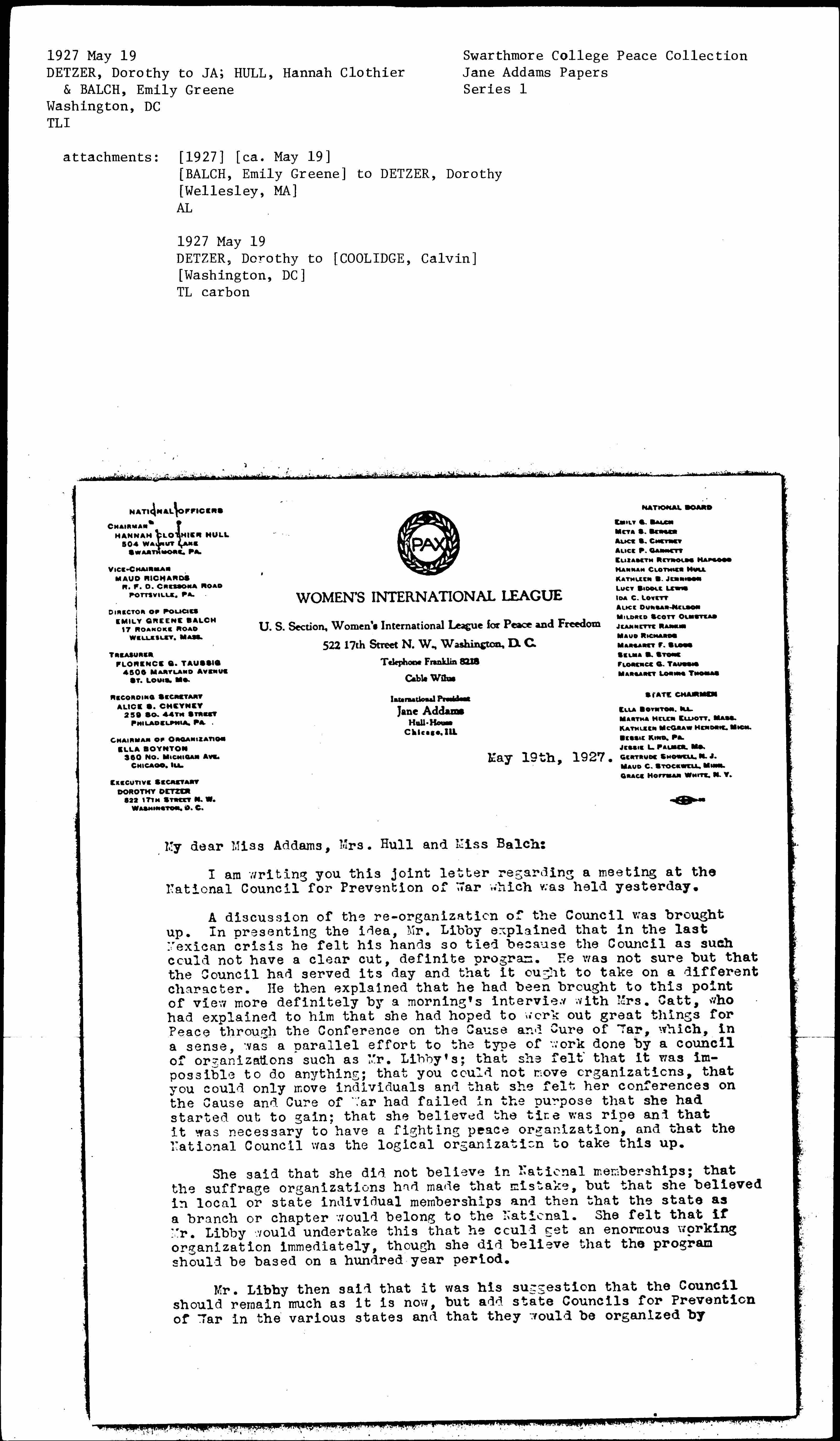
I am writing you this joint letter regarding a meeting at the National Council for Prevention of War which was held yesterday.

A discussion of the [reorganization] of the council was brought up. In presenting the idea, Mr. Libby explained that in the last Mexican crisis he felt his hands so tied because the Council as such could not have a clear cut, definite program. He was not sure but that the Council had served its day and that it ought to take on a different character. He then explained that he had been brought to this point of view more definitely by a morning's interview with Mrs. Catt, who had explained to him that she had hoped to work out great things for Peace through the Conference on the Cause and Cure of War, which, in a sense, was a parallel effort to the type of work done by a council of organizations such as Mr. Libby's; that she felt that it was impossible to do anything; that you could not move organizations, that you could only move individuals and that she felt her conferences on the Cause and Cure of War had failed in the purpose that she had started out to gain; that she believed the time was ripe and that it was necessary to have a fighting peace organization, and that the National Council was the logical organization to take this up.

She said that she did not believe in National memberships; that the suffrage organizations had made that mistake, but that she believed in local or state individual memberships and then that the state as a branch or chapter would belong to the National. She felt that if Mr. Libby would undertake this that he could get an enormous working organization immediately, though she did believe that the program should be based on a hundred year period.

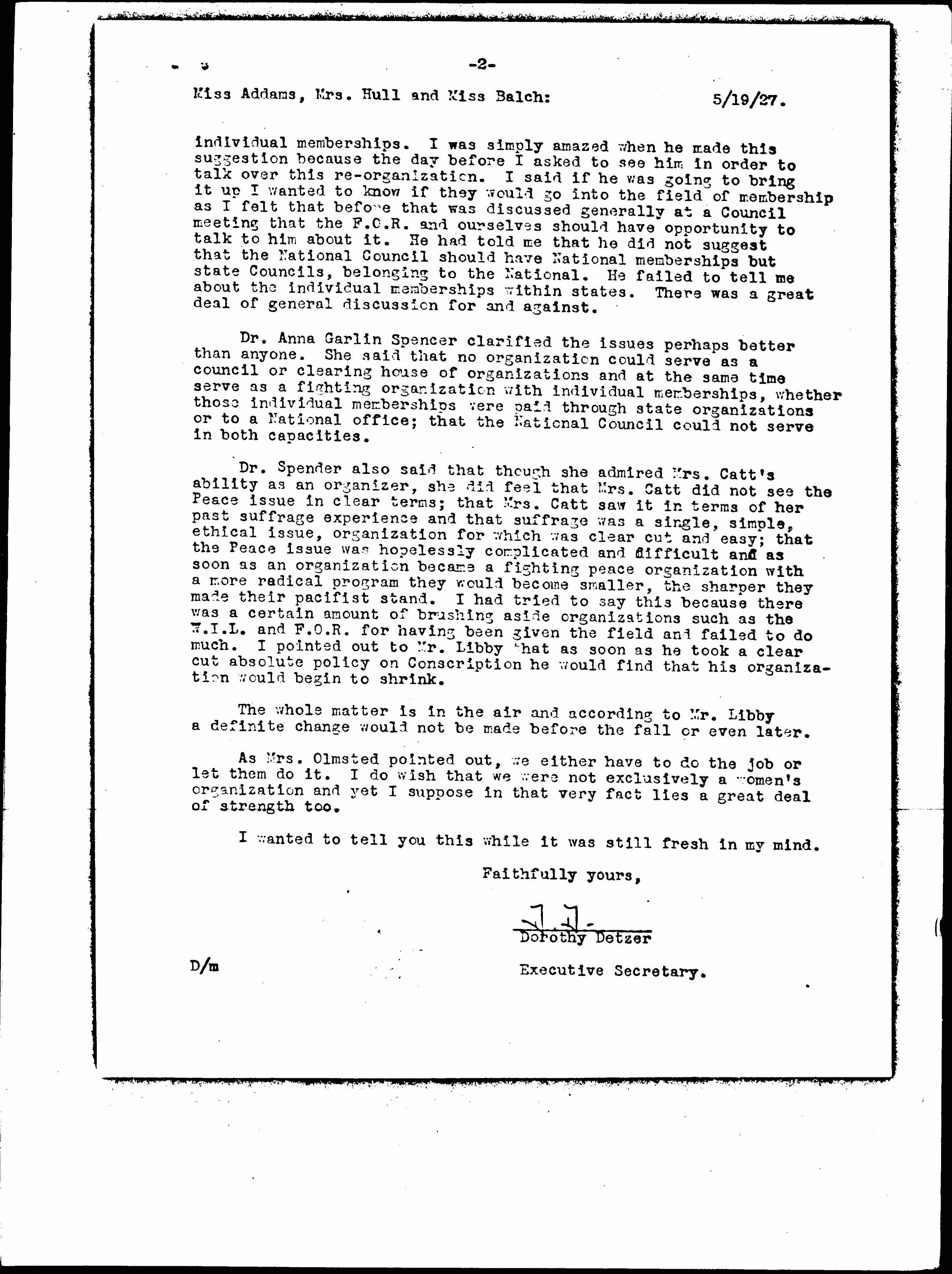
Mr. Libby then said that it was his suggestion that the Council should remain much as it is now, but add state Councils for Prevention of War in the various states and that they would be organized by [page 2] individual memberships. I was simply amazed when he made this suggestion because the day before I asked to see him in order to talk over this [reorganization]. I said if he was going to bring it up I wanted to know if they would go into the field of membership as I felt that before that was discussed generally at a Council meeting that the F.O.R. and ourselves should have opportunity to talk to him about it. He had told me that he did not suggest that the National Council should have National memberships but state Councils, belonging to the National. He failed to tell me about the individual memberships within states. There was a great deal of general discussion for and against.

Dr. Anna Garlin Spencer clarified the issues perhaps better than anyone. She said that no organization could serve as a council or clearing house of organizations and at the same time serve as a fighting organization with individual memberships, whether those individual memberships were paid through state organizations or to a National office; that the National Council could not serve in both capacities.

Dr. Spencer also said that though she admired Mrs. Catt's ability as an organizer, she did feel that Mrs. Catt did not see the Peace issue in clear terms; that Mrs. Catt saw it in terms of her past suffrage experience and that suffrage was a single, simple, ethical issue, organization for which was clear cut and easy; that the Peace issue was hopelessly complicated and difficult and as soon as an organization became a fighting peace organization with a more radical program they would become smaller, the sharper they made their pacifist stand. I had tried to say this because there was a certain amount of brushing aside organizations such as the W.I.L. and F.O.R. for having been given the field and failed to do much. I pointed out to Mr. Libby that as soon as he took a clear cut absolute policy on Conscription he would find that his organization would begin to shrink.

The whole matter is in the air and according to Mr. Libby a definite change would not be made before the fall or even later.

As Mrs. Olmsted pointed out, we either have to do the job or let them do it. I do wish that we were not exclusively a women's organization and yet I suppose in that very fact lies a great deal of strength too.

I wanted to tell you this while it was still fresh in my mind.

Faithfully yours,

D. D. [initialed]
Dorothy Detzer
Executive Secretary.