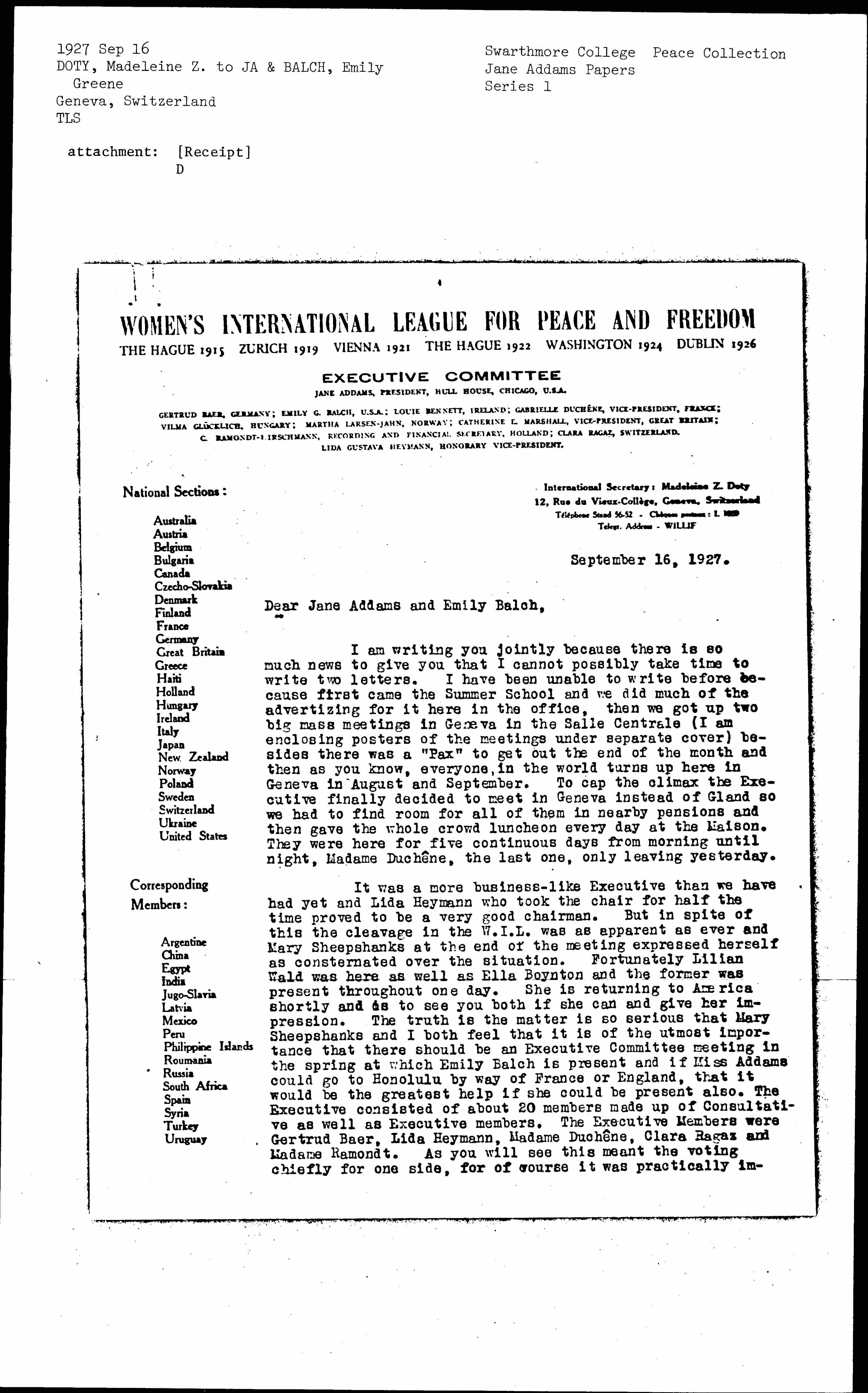
WOMEN'S INTERNATIONAL LEAGUE FOR PEACE AND FREEDOM
September 16, 1927.
Dear Jane Addams and Emily Balch,
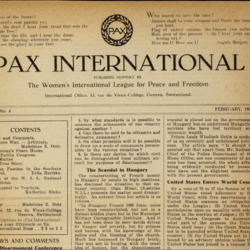
I am writing you jointly because there is so much news to give you that I cannot possibly take the time to write two letters. I have been unable to write before because first came the Summer School and we did much of the [advertising] for it here in the office, then we got up to two big mass meetings in Geneva in the Salle Centrale (I am enclosing posters of the meetings under separate cover) besides there was a "Pax" to get out the end of the month and then as you know, everyone, in the world turns up here in Geneva in August and September. To cap the climax the Executive finally decided to meet in Geneva instead of Gland so we had to find room for all of them in nearby pensions and then gave the whole crowd luncheon every day at the Maison. They were here for five continuous days from morning until night, Madame Duchêne, the last one, only leaving yesterday.
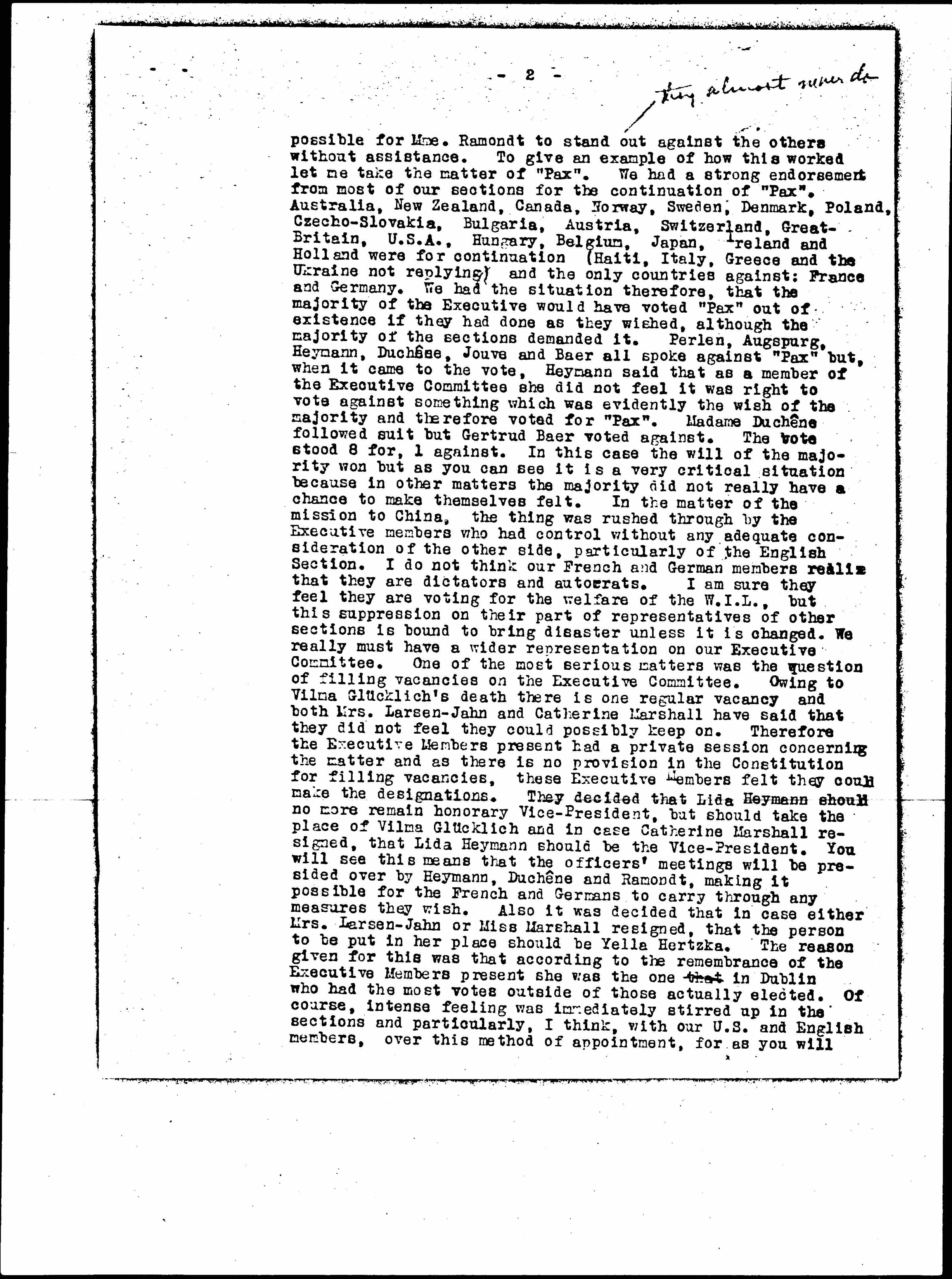
It was a more business-like Executive than we have had yet and Lida Heymann who took the chair for half the time proved to be a very good chairman. But in spite of this the cleavage in the W.I.L. was as apparent as ever and Mary Sheepshanks at the end of the meeting expressed herself as consternated over the situation. Fortunately [Lillian] Wald was here as well as Ella Boynton and the former was present throughout one day. She is returning to America shortly and is to see you both if she can and give her impression. The truth is the matter is so serious that Mary Sheepshanks and I both feel that it is of the utmost importance that there should be an Executive Committee meeting in the spring at which Emily Balch is present and if Miss Addams could go to Honolulu by way of France or England, that it would be the greatest help if she could be present also. The Executive consisted of about 20 members made up of Consultative as well as Executive members. The Executive Members were Gertrud Baer, Lida [Heymann], Madame Duchêne, Clara Ragaz and Madame Ramondt. As you will see this meant the voting chiefly for one side, for of course it was practically impossible [page 2] for Mme. Ramondt to stand out ↑they almost never do↓ against the others without assistance. To give an example of how this worked let me take the matter of "Pax." We had a strong endorsement from most of our sections for the continuation of "Pax." Australia, New Zealand, Canada, Norway, Sweden, Denmark, Poland, [Czechoslovakia], Bulgaria, Austria, Switzerland, Great Britain, U.S.A., Hungary, Belgium, Japan, Ireland and Holland were for continuation (Haiti, Italy, Greece and the Ukraine not replying) and the only countries against: France and Germany. We had the situation therefore, that the majority of the Executive would have voted "Pax" out of existence if they had done as they wished, although the majority of the sections demanded it. Perlen, Augspurg, Heymann, Duchêne, Jouve and Baer all spoke against "Pax" but, when it came to the vote, Heymann said that as a member of the Executive Committee she did not feel it was right to vote against something which was evidently the wish of the majority and therefore voted for "Pax." Madame Duchêne followed suit but Gertrud Baer voted against. The vote stood 8 for, 1 against. In this case the will of the majority won but as you can see it is a very critical situation because in other matters the majority did not really have a chance to make themselves felt. In the matter of the mission to China, the thing was rushed through by the Executive members who had control without any adequate consideration of the other side, particularly of the English Section. I do not think our French and German members [realize] that they are dictators and autocrats. I am sure they feel they are voting for the welfare of the W.I.L., but this suppression on their part of representatives of other sections is bound to bring disaster unless it is changed. We really must have a wider representation on our Executive Committee. One of the most serious matters was the question of filling vacancies on the Executive Committee. Owing to Vilma Glücklich's death there is one regular vacancy and both Mrs. Larsen-Jahn and Catherine Marshall have said that they did not feel they could possibly keep on. Therefore the Executive Members present had a private session concerning the matter and as there is no provision in the Constitution for filling vacancies, these Executive Members felt they could make the designations. They decided that Lida Heymann should no more remain honorary Vice-President, but should take the place of Vilma Glücklich and in case Catherine Marshall resigned, that Lida Heymann should be the Vice-President. You will see this means that the officers' meetings will be presided over by Heymann, Duchêne and Ramondt, making it possible for the French and Germans to carry through any measures they wish. Also it was decided that in case either Mrs. Larsen-Jahn or Miss Marshall resigned, that the person to be put in her place should be Yella Hertzka. The reason given for this was that according to the remembrance of the Executive Members present she was the one that in Dublin who had the most votes outside of those actually elected. Of course, intense feeling was immediately stirred up in the sections and particularly, I think, with our U.S. and English members, over this method of appointment, for as you will [page 3] see, adding Yella Hertzka, will mean adding practically another German vote and since you and Emily Balch do not come to the Executives. The U.S. and England, and if Mrs. Larsen-Jahn resigns, the Scandinavian countries will have no opportunity whatever of expressing their opinion. Of course this situation would be extraordinarily difficult for Mary Sheepshanks. I have found it very difficult to be here without an American member on the Executive and I am sure that if Mary Sheepshanks had no English woman to understand her and appreciate what she was doing, that it would be intolerable. The sections, as I have said, protested very much at the decision of the Executive and it was pointed out that the Executive had no right to take their decision without at least consulting Jane Addams, Emily Balch, Catherine Marshall and Mrs. Larsen-Jahn. The latter was attending the sessions of the League Assembly as an official delegate and was therefore, of course, unable to attend our sessions. You can see how difficult it is to carry on work with two such opposing elements if only one is represented. For instance it was really the will of Madame Duchêne that the Executive be held from the 9th. to the 13th. of September. This meant of course that the other groups in our League who are interested in the League of Nations, either had to sacrifice their work with the League of Nations or sacrifice attendance of the W.I.L. Executive Committee. Of course the reason the French and Germans did not mind holding the Executive at this time is because they do not see the importance of working with the League of Nations that the other sections do.
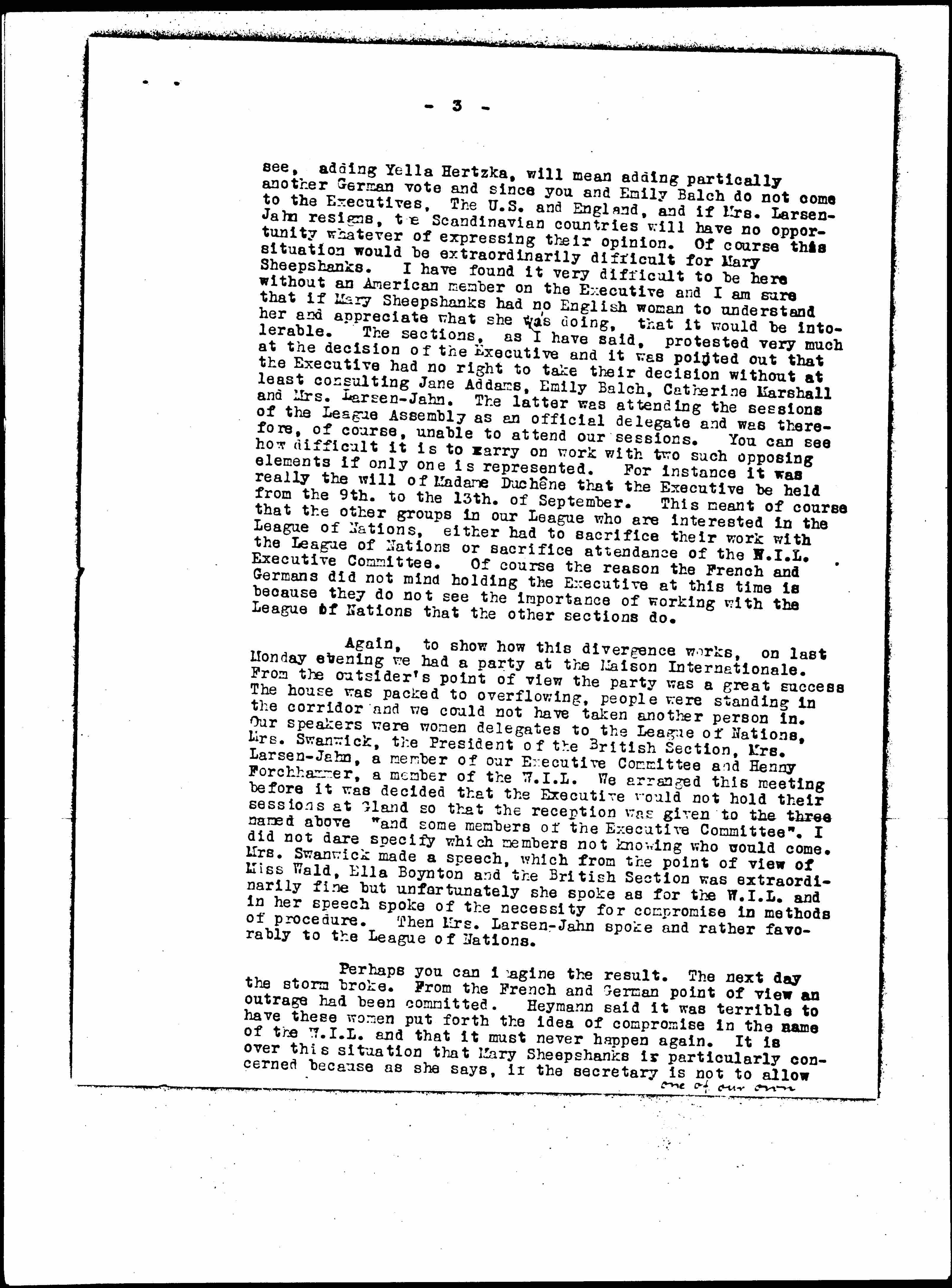
Again, to show how this divergence works, on last Monday evening we had a party at the Maison Internationale. From the outsider's point of view the party was a great success. The house was packed to overflowing, people were standing in the corridor and we could not have taken another person in. Our speakers were women delegates to the League of Nations, Mrs. Swanwick, the President of the British Section; Mrs. Larsen-Jahn, a member of our Executive Committee; and [Henni] Forchhammer, a member of the W.I.L. We arranged this meeting before it was decided that the Executive would not hold their sessions at Gland so that the reception was given to the three named above "and some members of the Executive Committee." I did not dare specify which members not knowing who would come. Mrs. Swanwick made a speech, which from the point of view of Miss Wald, Ella Boynton and the British Section was extraordinarily fine but unfortunately she spoke as for the W.I.L. and in her speech spoke of the necessity for compromise in methods of procedure. Then Mrs. Larsen-Jahn spoke and rather favorably to the League of Nations.
Perhaps you can imagine the result. The next day the storm broke. From the French and German point of view an outrage had been committed. Heymann said it was terrible to have these women put forth the idea of compromise in the name of the W.I.L. and that it must never happen again. It is over this situation that Mary Sheepshanks is particularly concerned because as she says, if the secretary is not to allow ↑one of our own↓ [page 4] Executive Members or the president of a National Section to speak in the name of the W.I.L. or at any rate not without censoring her speech, it is going to be a perfectly impossible situation for her.
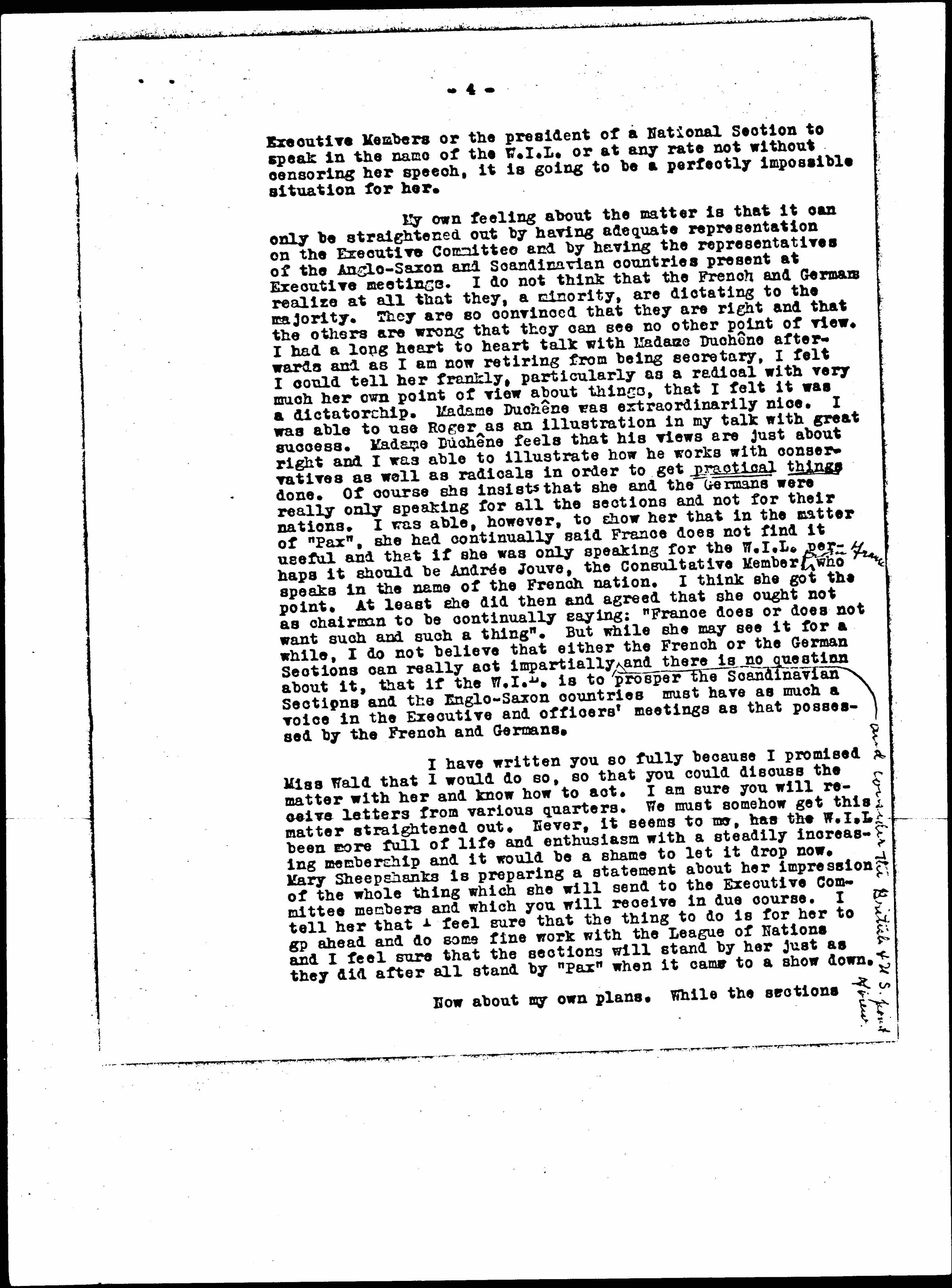
My own feeling about the matter is that it can only be straightened out by having adequate representation on the Executive Committee and by having the representatives of the Anglo-Saxon and Scandinavian countries present at Executive meetings. I do not think that the French and Germans realize at all that they, a minority, are dictating to the majority. They are so convinced that they are right and that the others are wrong that they can see no other point of view. I had a long heart to heart talk with Madame Duchêne afterwards and as I am now retiring from being secretary, I felt I could tell her frankly, particularly as a radical with very much her own point of view about things, that I felt it was a dictatorship. Madame Duchêne was extraordinarily nice. I was able to use Roger as an illustration in my talk with great success. Madame Duchêne feels that his views are just about right and I was able to illustrate how he works with conservatives as well as radicals in order to get practical things done. Of course she insists that she and the Germans were really only speaking for all the sections and not for their nations. I was able, however, to show her that in the matter of "Pax," she had continually said France does not find it useful and that if she was only speaking for the W.I.L. perhaps it should be Andrée Jouve, the Consultative Member ↑from France↓ who speaks in the name of the French nation. I think she got the point. At least she did then and agreed that she ought not as chairman to be continually saying: "France does or does not want such and such a thing." But while she may see it for a while, I do not believe that either the French or the German Sections can really act impartially ↑and consider the British & U.S. point of view↓ and there is no question about it, that is the W.I.L. is to prosper the Scandinavian Sections and the Anglo-Saxon countries must have as much a voice in the Executive and officers' meetings as that possessed by the French and Germans.
I have written you so fully because I promised Miss Wald that I would do so, so that you could discuss the matter with her and know how to act. I am sure you will receive letters from various quarters. We must somehow get this matter straightened out. Never, it seems to me, has the W.I.L. been more full of life and enthusiasm with a steadily increasing membership and it would be a shame to let it drop now. Mary Sheepshanks is preparing a statement about her impression of the whole thing which she will send to the Executive Committee members and which she will receive in due course. I tell her that I feel sure that the thing to do is for her to go ahead and do some fine work with the League of Nations and I feel sure that the sections will stand by her just as they did after all stand by "Pax" when it came to a show down.
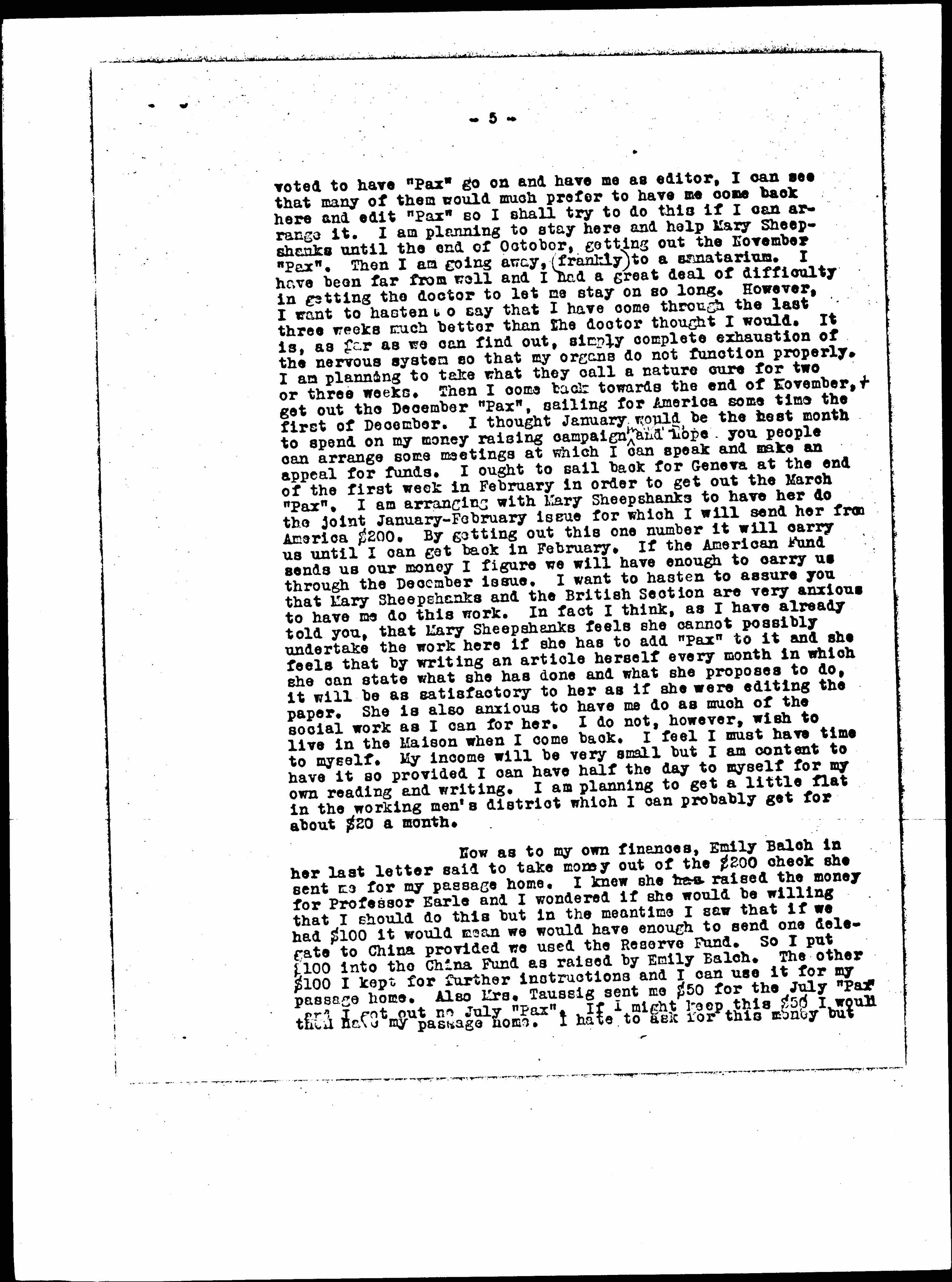
Now about my own plans. While the sections [page 5] voted to have "Pax" go on and have me as editor, I can see that many of them would much prefer to have me come back here and edit "Pax" so I shall try to do this if I can arrange it. I am planning to stay here and help Mary Sheepshanks until the end of October, getting out the November "Pax." Then I am going away, (frankly) to a [sanatorium]. I have been far from well and I have a great deal of difficulty in getting the doctor to let me stay on so long. However, I want to hasten to say that I have come through the last three weeks much better than the doctor thought I would. It is, as far as we can find out, simply complete exhaustion of the nervous system so that my organs do not function properly. I am planning to take what they call a nature cure for two or three weeks. Then I come back towards the end of November, ↑&↓ get out the December "Pax," sailing for America some time the first of December. I thought January would be the best month to spend on my money raising campaign ↑[illegible]↓ and hope you people can arrange some meetings at which I can speak and make an appeal for funds. I ought to sail back for Geneva at the end of the first week in February in order to get out the March "Pax." I am arranging with Mary Sheepshanks to have her do the joint January-February issue for which I will send her from America $200. By getting out this one number it will carry us until I can get back in February. If the American Fund sends us our money I figure we will have enough to carry us through the December issue. I want to hasten to assure you that Mary Sheepshanks and the British section are very anxious to have me do this work. In fact I think, as I have already told you, that Mary Sheepshanks feels she cannot possibly undertake the work here if she has to add "Pax" to it and she feels that by writing an article herself every month in which she can state what she has done and what she proposes to do, it will be as satisfactory to her as if she were editing the paper. She is also anxious to have me do as much of the social work as I can for her. I do not, however, wish to live in the Maison when I come back. I feel I must have time to myself. My income will be very small but I am content to have it so provided I can have half the day to myself for my own reading and writing. I am planning to get a little flat in the working men's district which I can probably get for about $20 a month.
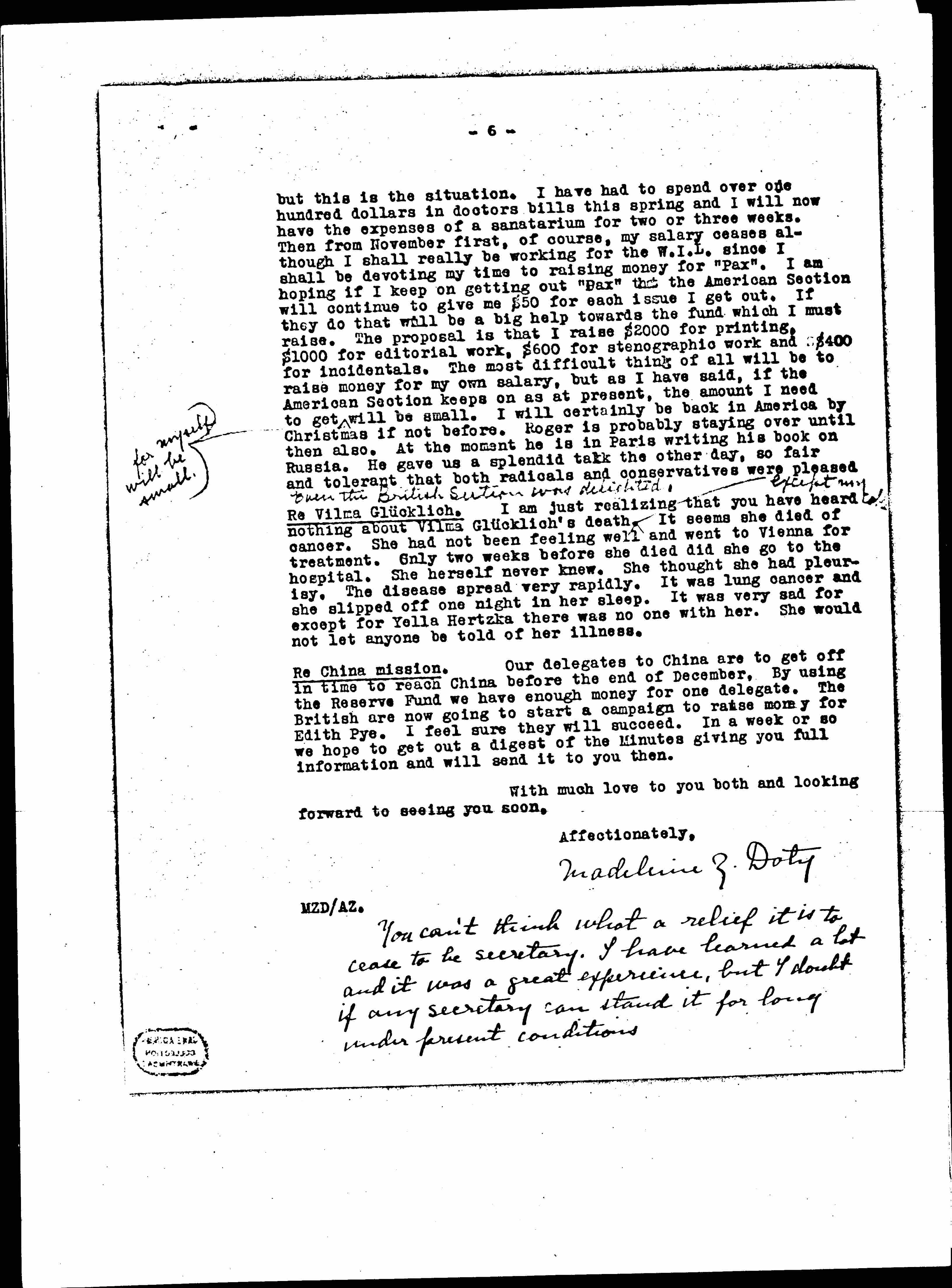
Now as to my own finances, Emily Balch in her last letter said to take money out of the $200 check she sent me for my passage home. I knew she has raised the money for Professor Earle and I wondered if she would be willing that I should do this but in the meantime I saw that if we had $100 it would mean we would have enough to send one delegate to China provided we used the Reserve Fund. So I put $100 into the China Fund as raised by Emily Balch. The other $100 I kept for further instructions and I can use it for my passage home. Also Mrs. Taussig sent me $50 for the July "Pax" and I got out no July "Pax." If I might keep this $50 I would then have my passage home. I hate to ask for this money but [page 6] this is the situation. I have had to spend over one hundred dollars in doctors bills this spring and I will now have the expenses of a [sanatorium] for two or three weeks. Then from November first, of course, my salary ceases although I shall really be working for the W.I.L. since I shall be devoting my time to raising money for "Pax." I am hoping if I keep on getting out "Pax" that the American Section will continue to give me $50 for each issue I get out. If they do that will be a big help towards the fund which I must raise. The proposal is that I raise $2000 for printing, $1000 for editorial work, $600 for stenograph work and $400 for incidentals. The most difficult thing of all will be to raise money for my own salary, but as I have said, if the American Section keeps on as at present, the amount I need to get ↑for myself will be small.↓ I will certainly be back in America by Christmas if not before. Roger is probably staying over until then also. At the moment he is in Paris writing his book on Russia. He gave us a splendid talk the other day, so fair and tolerant that both radicals and conservatives were pleased. ↑Even the British Section was delighted.↓
Re Vilma Glücklich. I am just realizing that you have heard nothing about Vilma Glücklich’s death ↑except my [cable].↓ It seems she died of cancer. She had not been feeling well and went to Vienna for treatment. Only two weeks before she died did she go to the hospital. She herself never knew. She thought she had pleurisy. The disease spread very rapidly. It was lung cancer and she slipped off one night in her sleep. It was very sad except for Yella Hertzka there was no one with her. She would not let anyone be told of her illness.
Re China mission. Our delegates to China are to get off in time to reach China before the end of December. By using the Reserve Fund we have enough money for one delegate. The British are now going to start a campaign to raise money for Edith Pye. I feel sure they will succeed. In a week or so we hope to get out a digest of the Minutes giving you full information and will send it to you then.
With much love to you both and looking forward to seeing you soon,
Affectionately,
Madeleine Z. Doty [signed]
↑You can’t think what a relief it is to cease to be secretary. I have learned a lot and it was a great experience, but I doubt if any secretary can stand it for long under present conditions↓

Comments