
12th June, 1928.
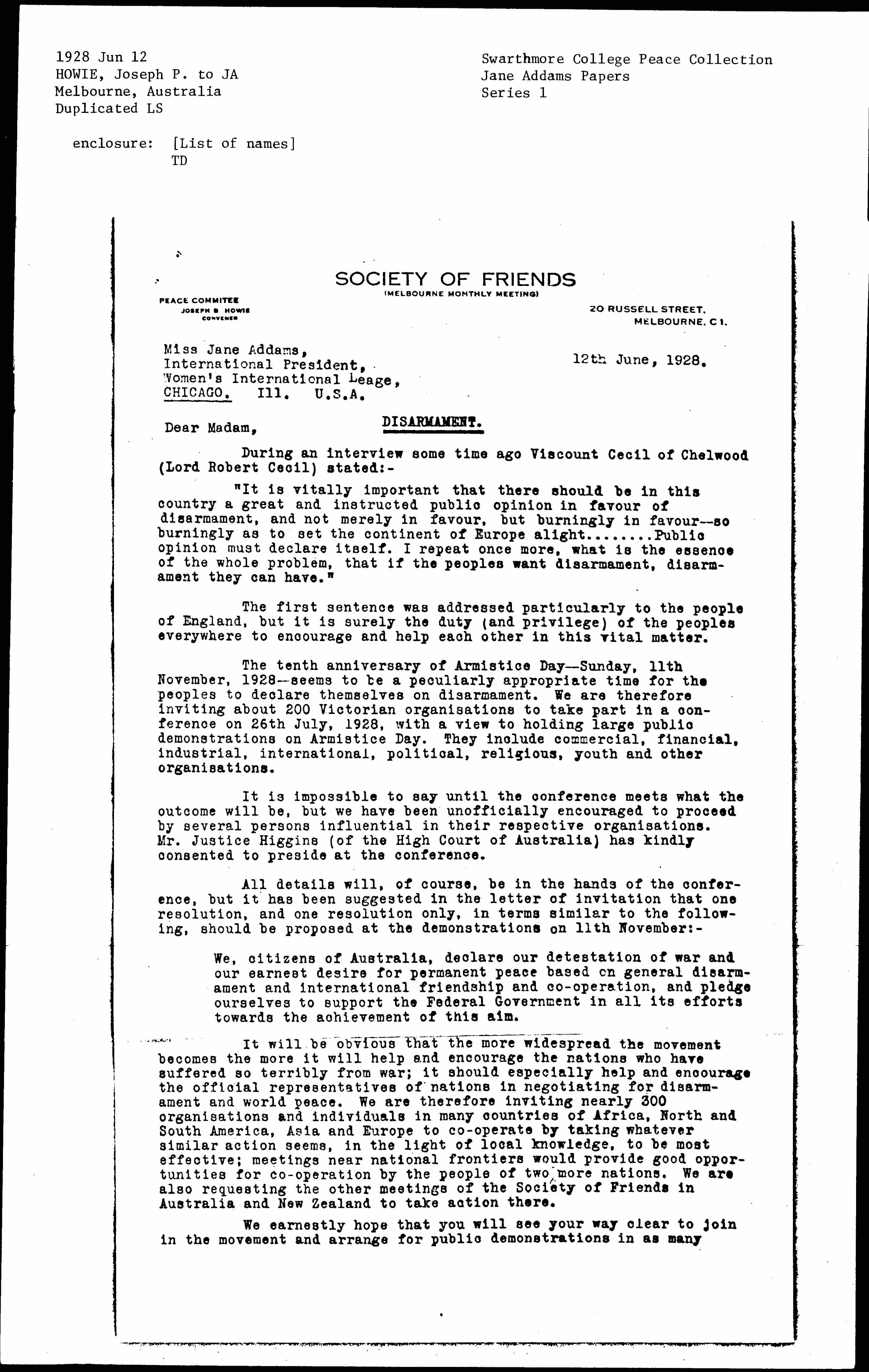
DISARMAMENT.
Dear Madam,
During an interview some time ago Viscount Cecil of Chelwood (Lord Robert Cecil) stated: --
"It is vitally important that there should be in this country a great and instructed public opinion in [favor] of disarmament, and not merely in [favor], but burningly in [favor] -- so burningly as to set the continent of Europe alight. ... Public opinion must declare itself. I repeat once more, what is the essence of the whole problem, that if the peoples want disarmament, disarmament they can have."
The first sentence was addressed particularly to the people of England, but it is surely the duty (and privilege) of the peoples everywhere to encourage and help each other in this vital matter.
The tenth anniversary of Armistice Day -- Sunday, 11th November, 1928 -- seems to be a peculiarly appropriate time for the peoples to declare themselves on disarmament. We are therefore inviting about 200 Victorian [organizations] to take part in a conference on 26th July, 1928, with a view to holding large public demonstrations on Armistice Day. They include commercial, financial, industrial, international, political, religious, youth and other [organizations].
It is impossible to say until the conference meets what the outcome will be, but we have been unofficially encouraged to proceed by several persons influential in their respective [organizations]. Mr. Justice Higgins (of the High Court of Australia) has kindly consented to preside at the conference.
All details will, of course, be in the hands of the conference, but it has been suggested in the letter of invitation that one resolution, and one resolution only, in terms similar to the following, should be proposed at the demonstrations on 11th November: --
We, citizens of Australia, declare our detestation of war and our earnest desire for permanent peace based on general disarmament and international friendship and [cooperation], and pledge ourselves to support the Federal Government in all its efforts towards the achievement of this aim.
It will be obvious that the more widespread the movement becomes the more it will help and encourage the nations who have suffered so terribly from war; and it should especially help and encourage the official representatives of nations in negotiating for disarmament and world peace. We are therefore inviting nearly 300 [organizations] and individuals in many countries of Africa, North and South America, Asia and Europe to [cooperate] by taking whatever similar action seems, in the light of local knowledge, to be most effective; meetings near national frontiers would provide good opportunities for [cooperation] by the people of two more nations. We are also requesting the other meetings of the Society of Friends in Australia and New Zealand to take action there.
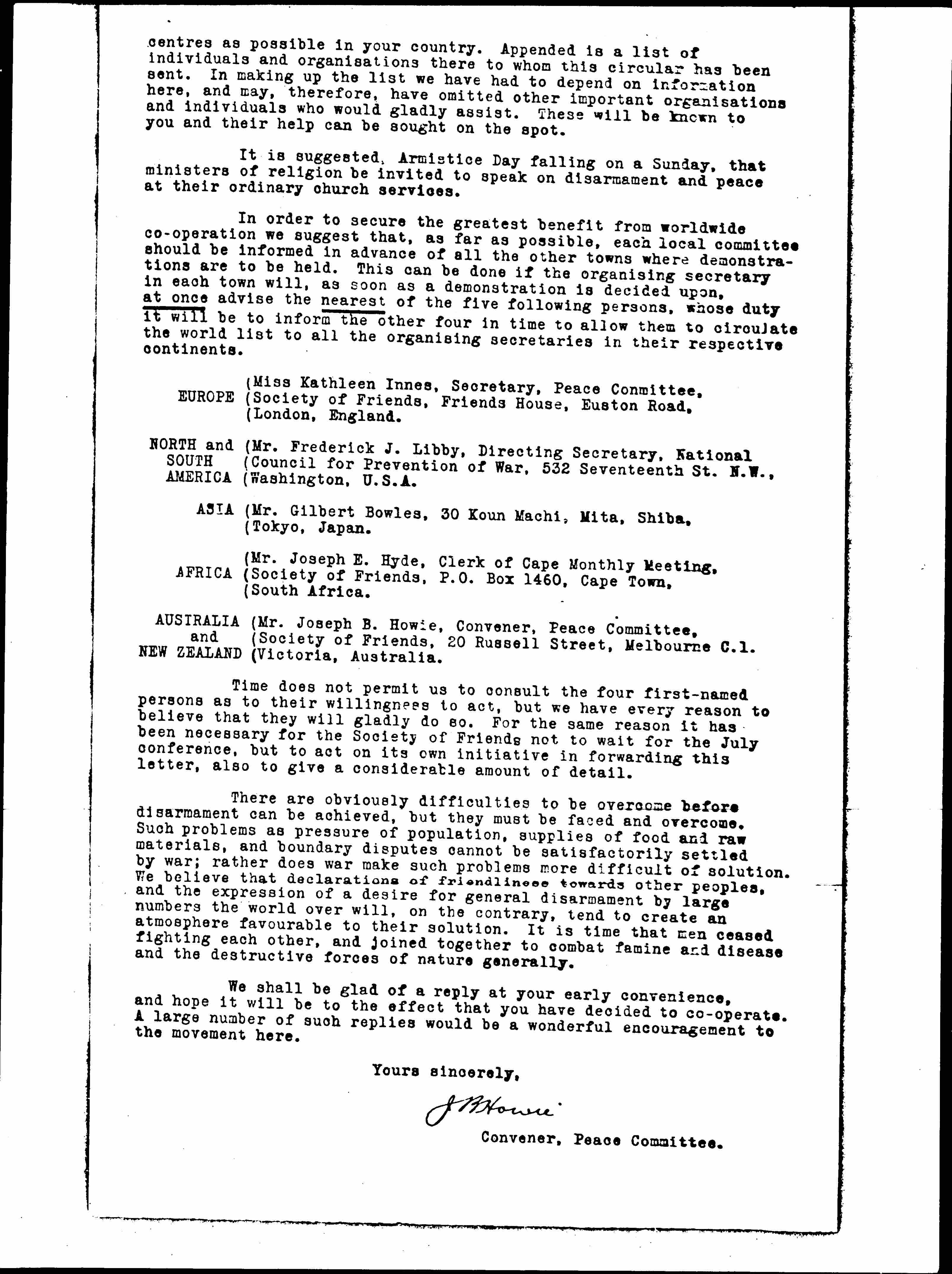
We earnestly hope that you will see your way clear to join in the movement and arrange for public demonstrations in as many [page 2] [centers] as possible in your country. Appended is a list of individuals and [organizations] there to whom this circular has been sent. In making up the list we have had to depend on information here, and may, therefore, have omitted other important [organizations] and individuals who would gladly assist. These will be known to you and their help can be sought on the spot.
It is suggested, Armistice Day falling on a Sunday, that ministers of religion be invited to speak on disarmament and peace at their ordinary church services.
In order to secure the greatest benefit from worldwide [cooperation] we suggest that, as far as possible, each local committee should be informed in advance of all the other towns where demonstrations are to be held. This can be done if the [organizing] secretary in each town will, as soon as a demonstration is decided upon, at once advise the nearest of the five following persons whose duty it will be to inform the other four in time to allow them to circulate the world list to all the [organizing] secretaries in their respective continents.
EUROPE (Miss Kathleen Innes, Secretary, Peace Committee, Society of Friends, Friends House, Euston Road, London, England.)
NORTH and SOUTH AMERICA (Mr. Frederick J. Libby, Directing Secretary, National Council for Prevention of War, 532 Seventeenth St., N.W., Washington, U.S.A.)
ASIA (Mr. Gilbert Bowles, 30 Koun Machi, Mita, Shiba, Tokyo, Japan.)
AFRICA (Mr. Joseph E. Hyde, Clerk of Cape Monthly Meeting, Society of Friends, P.O. Box 1460, Cape Town, South Africa.)
AUSTRALIA and NEW ZEALAND (Mr. Joseph B. Howie, Convener, Peace Committee, Society of Friends, 20 Russell Street, Melbourne C. 1. Victoria, Australia.)
Time does not permit us to consult the four first-named persons as to their willingness to act, but we have every reason to believe that they will gladly do so. For the same reason it has been necessary for the Society of Friends not to wait for the July conference, but to act on its own initiative in forwarding this letter, also to give a considerable amount of detail.
There are obviously difficulties to be overcome before disarmament can be achieved, but they must be faced and overcome. Such problems as pressure of population, supplies of food and raw materials, and boundary disputes cannot be satisfactorily settled by war; rather does war make such problems more difficult of solution. We believe that declarations of friendliness towards other peoples, and the expression of a desire for general disarmament by large numbers the world over will, on the contrary, tend to create an atmosphere [favorable] to their solution. It is time that men ceased fighting each other, and joined together to combat famine and disease and the destructive forces of nature generally.
We shall be glad of a reply at your early convenience, and hope it will be to the effect that you have decided to [cooperate]. A large number of such replies would be a wonderful encouragement to the movement here.
Yours sincerely,



Comments