
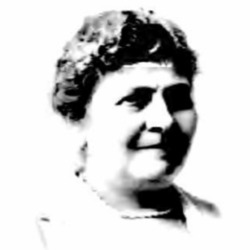
HELEN WINKLER
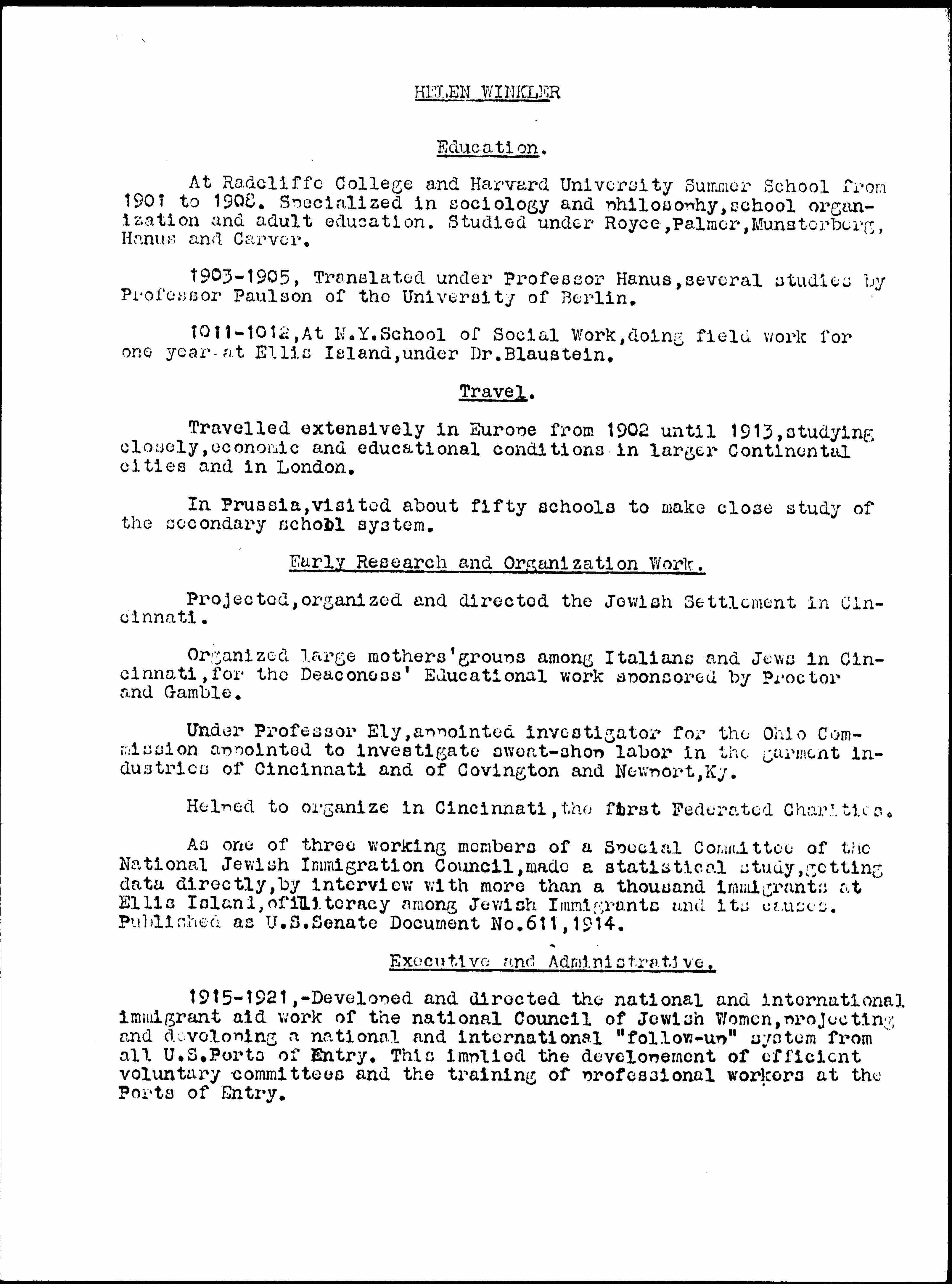
Education.
At Radcliffe College and Harvard University Summer School from 1901 to 1908. Specialized in sociology and philosophy, school organization and adult education. Studied under Royce, Palmer, Munsterberg, Hanus and Carver.
1903-1905, Translated under Professor Hanus, several studies by Professor Paulson of the University of Berlin.
[1911-1912], At N.Y. School of Social Work, doing field work for one year at Ellis Island, under Dr. Blaustein.
Travel.
[Traveled] extensively in Europe from 1902 until 1913, studying closely, economic and educational conditions in larger Continental cities and in London.
In Prussia, visited about fifty schools to make close study of the secondary school system.
Early Research and Organization Work.
Projected, organized and directed the Jewish Settlement in Cincinnati.
Organized large mothers' groups among Italians and Jews in Cincinnati, for the Deaconess' Educational work sponsored by Proctor and Gamble.
Under Professor Ely, appointed investigator for the Ohio Commission appointed to investigate sweat-shop labor in the garment industries of Cincinnati and of Covington and Newport, Ky.
Helped to organize in Cincinnati, the first Federated Charities.
As one of three working members of a Special Committee of the National Jewish immigration Council, made a statistical study, getting data directly, by interview with more than a thousand immigrants at Ellis Island, of illiteracy among Jewish Immigrants and its causes. Published as U.S. Senate Document No. 611, 1914.
Executive and Administrative.
1915-1921, -- Developed and directed the national and international immigrant aid work of the National Council of Jewish Women, projecting and developing a national and international "follow-up" system from all U.S. Ports of Entry. This implied the [development] of efficient voluntary committees and the training of professional workers at the Ports of Entry. [page 2]
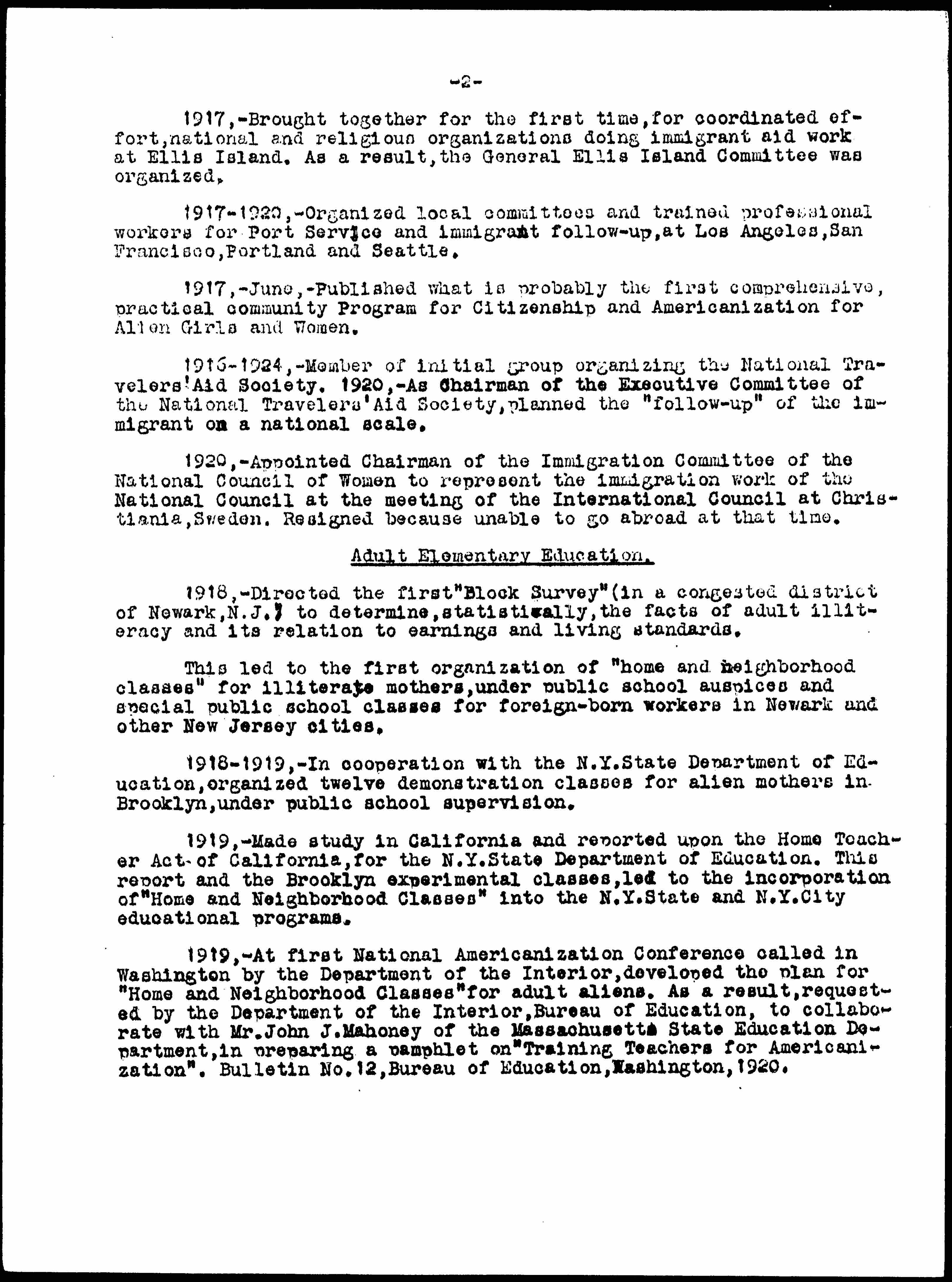
1917, -- Brought together for the first time, for coordinated effort, national and religious organizations doing immigrant aid work at Ellis Island. As a result, the General Ellis Island Committee was organized.
1917-1920, -- Organized local committees and trained professional workers for Port Service and immigrant follow-up, at Los Angeles, San Francisco, Portland and Seattle.
1917, June, -- Published what is probably the first comprehensive, practical community Program for Citizenship and Americanization for Alien Girls and Women.
1916-1924, -- Member of initial group organizing the National Travelers' Aid Society. 1920, -- As Chairman of the Executive Committee of the National Travelers' Aid Society, planned the "follow-up" of the immigrant on a national scale.
1920, -- Appointed Chairman of the Immigration Committee of the National Council of Women to represent the immigration work of the National Council at the meeting of the International Council at Christiania, Sweden. Resigned because unable to go abroad at that time.
Adult Elementary Education.
1918, -- Directed the first "Block Survey" (in a congested district of Newark, N.J.) to determine, statistically, the facts of adult illiteracy and its relation to earnings and living standards.
This led to the first organization of "home and neighborhood classes" for illiterate mothers, under public school auspices and special public school classes for foreign-born workers in Newark and other New Jersey cities.
1918-1919, -- In cooperation with the N.Y. State Department of Education, organized twelve demonstration classes for alien mothers in Brooklyn, under public school supervision.
1919, -- Made study in California and reported upon the Home Teacher Act of California, for the N.Y. State Department of Education. This report and the Brooklyn experimental classes, led to the incorporation of "Home and Neighborhood Classes" into the N.Y. State and N.Y. City educational programs.
1919, -- At first National Americanization Conference called in Washington by the Department of the Interior, developed the plan for "Home and Neighborhood Classes" for adult aliens. As a result, requested by the Department of the Interior, Bureau of Education, to collaborate with Mr. John J. Mahoney of the Massachusetts State Education Department, in preparing a pamphlet on "Training Teachers for Americanization." Bulletin No. 12, Bureau of Education, Washington, 1920. [page 3]
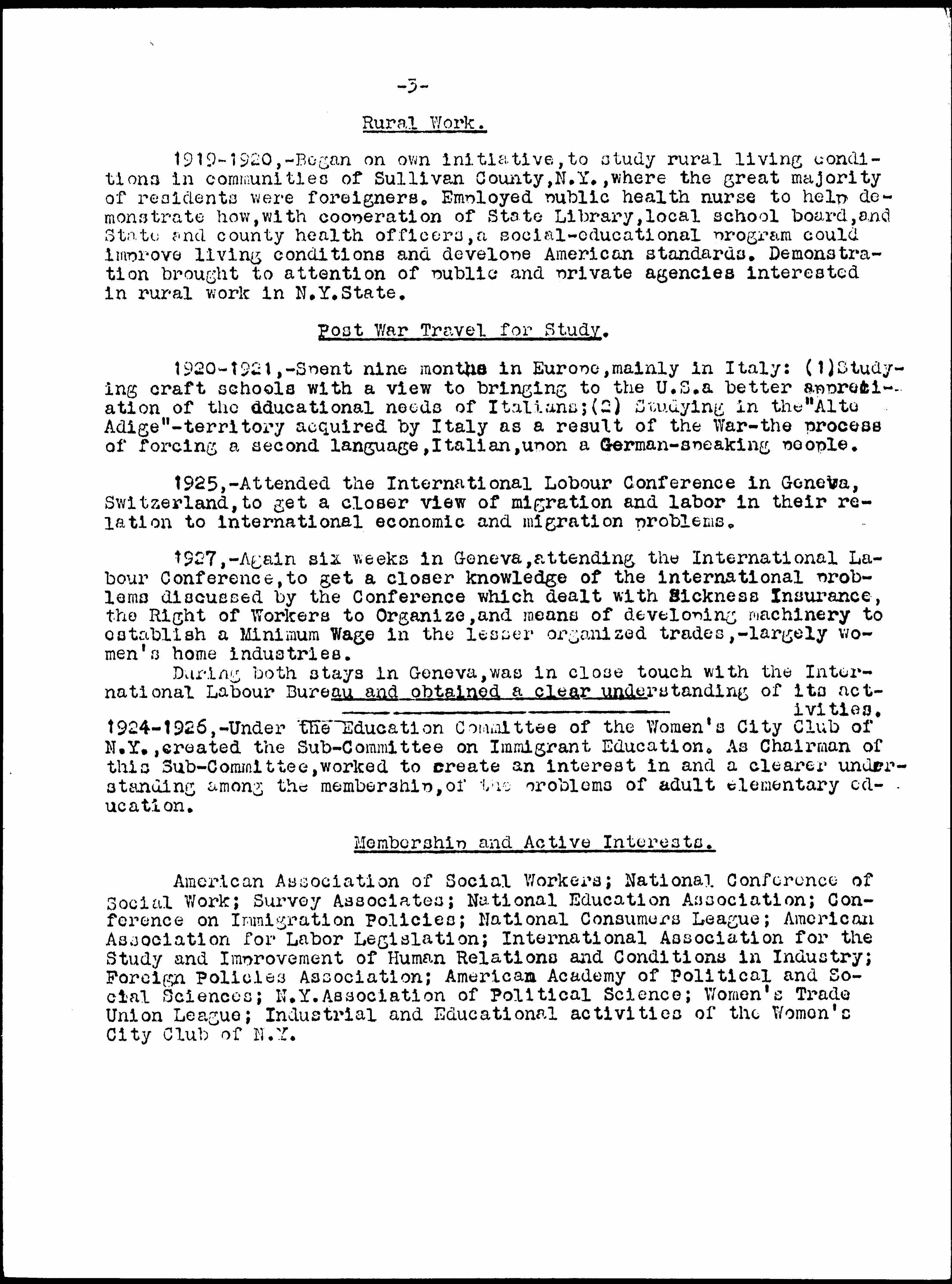
Rural Work.
1919-1920, -- Began on own initiative, to study rural living conditions in communities of Sullivan County, N.Y., where the great majority of residents were foreigners. Employed public health nurse to help demonstrate how, with cooperation of State Library, local school board, and State and county health officers, a social-educational program could improve living conditions and [develop] American standards. Demonstration brought to attention of public and private agencies interested in rural work in N.Y. State.
Post War Travel for Study.
1920-1921, -- Spent nine months in Europe, mainly in Italy: (1) Studying craft schools with a view to bringing to the U.S. a better appreciation of the educational needs of Italians; (2) Studying in the "Alto Adige" -- territory acquired by Italy as a result of the War -- the process of forcing a second language, Italian, upon a German-speaking people.
1925, -- Attended the International Labour Conference in Geneva, Switzerland, to get a closer view of migration and labor in their relation to international economic and migration problems.
1927, -- Again six weeks in Geneva, attending the International Labour Conference, to get a closer knowledge of the international problems discussed by the Conference which dealt with Sickness Insurance, the Right of Workers to Organize, and means of developing machinery to establish a Minimum Wage in the lesser organized trades, -- largely women's home industries.
During both stays in Geneva, was in close touch with the International Labour Bureau and obtained a clear understanding of its activities.
1924-1926, -- Under the Education Committee of the Women's City Club of N.Y., created the Sub-Committee on Immigrant Education. As Chairman of this Sub-Committee, worked to create an interest in and a clearer understanding among the membership, of the problems of adult elementary education.
Membership and Active Interests.
American Association of Social Workers; National Conference of Social Work; Survey Associates; National Education Association; Conference on Immigration Policies; National Consumers' League; American Association for Labor Legislation; International Association for the Study and Improvement of Human Relations and Conditions in Industry; Foreign [Policy] Association; American Academy of Political and Social Sciences; N.Y. Association of Political Science; Women's Trade Union League; Industrial and Educational activities of the Women's City Club of N.Y. [page 4]
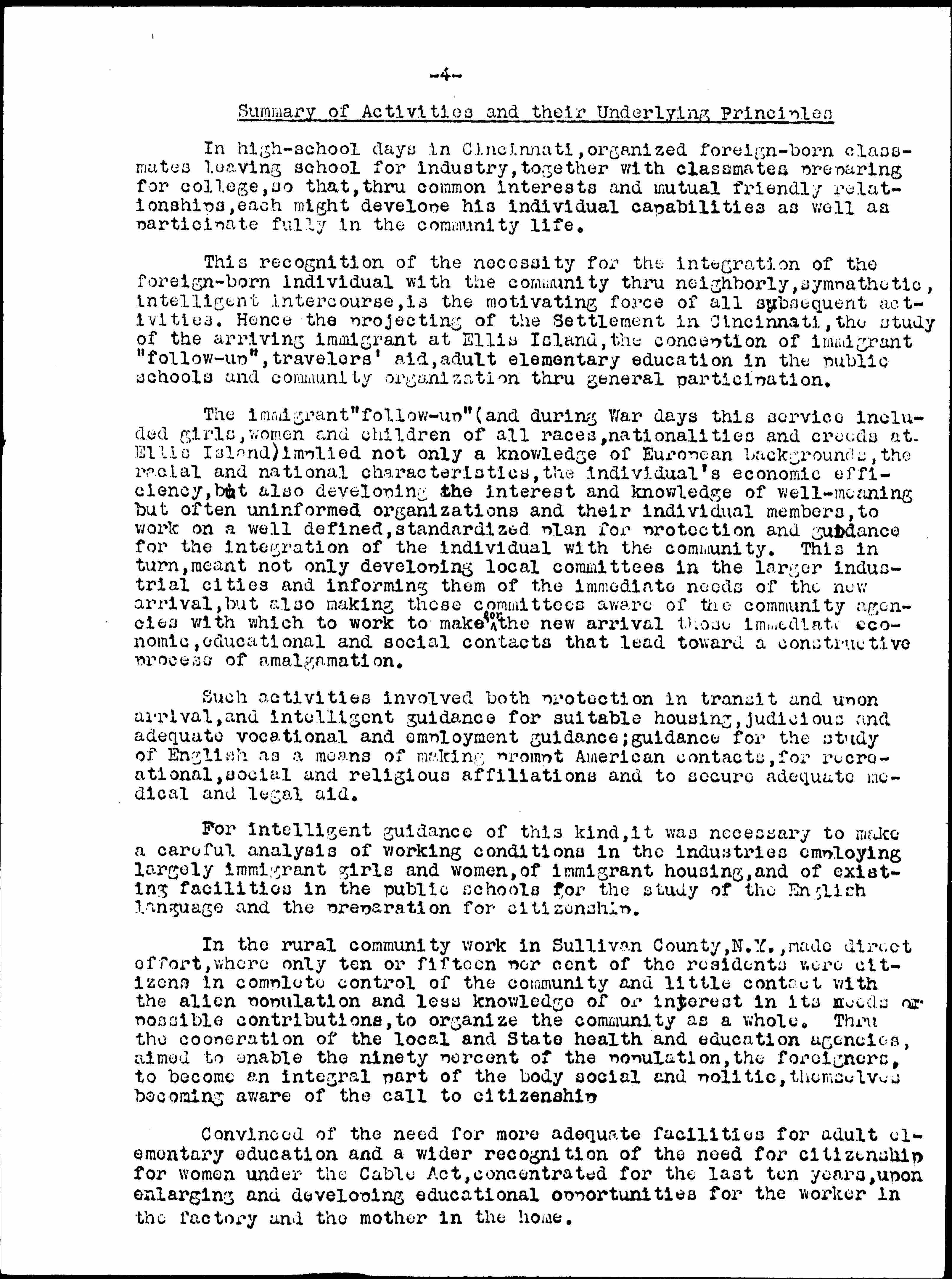
Summary of Activities and their Underlying Principles
In high-school days in Cincinnati, organized foreign-born classmates leaving school for industry, together with classmates preparing for college, so that, [through] common interests and mutual friendly relationships, each might [develop] his individual capabilities as well as participate fully in the community life.
This recognition of the necessity for the integration of the foreign-born individual with the community [through] neighborly, sympathetic, intelligent intercourse, is the motivating force of all subsequent activities. Hence the projecting of the Settlement in Cincinnati, the study of the arriving immigrant at Ellis Island, the conception of immigrant "follow-up," travelers' aid, adult elementary education in the public schools and community and organization [through] general participation.
The immigrant "follow-up" (and during War days this service included girls, women and children of all races, nationalities and creeds at Ellis Island) implied not only a knowledge of European backgrounds, the racial and national characteristics, the individual's economic efficiency, but also developing the interest and knowledge of well-meaning but often uninformed organizations and their individual members, to work on a well defined, standardized plan for protection and guidance for the integration of the individual with the community. This in turn, meant not only developing local committees in the larger industrial cities and informing them of the immediate needs of the new arrival, but also making these committees aware of the community agencies with which to work to make ↑for↓ the new arrival those immediate economic, educational and social contacts that lead toward a constructive process of amalgamation.
Such activities involved both protection in transit and upon arrival, and intelligent guidance for suitable housing, judicious and adequate vocational and employment guidance; guidance for the study of English as a means of making prompt American contacts, for recreational, social and religious affiliations and to secure adequate medical and legal aid.
For intelligent guidance of this kind, it was necessary to make a careful analysis of working conditions in the industries employing largely immigrant girls and women, of immigrant housing, and of existing facilities in the public schools for the study of the English language and the preparation for citizenship.
In the rural community work in Sullivan County, N.Y., made direct effort, where only ten or fifteen percent of the residents were citizens in complete control of the community and little contact with the alien population and less knowledge of or interest in its needs or possible contributions, to organize the community as a whole. [Through] the cooperation of the local and State health and education agencies, aimed to enable the ninety percent of the population, the foreigners, to become an integral part of the body social and politic, themselves becoming aware of the call to citizenship.
Convinced of the need for more adequate facilities for adult elementary education and a wider recognition of the need for citizenship for women under the Cable Act, concentrated for the last ten years, upon enlarging and developing educational opportunities for the worker in the factory and the mother in the home.
Comments