Ellen Wayles Coolidge to Jane Addams, July 28, 1927

REEL0019_0309.jpg
REEL0019_0310.jpg

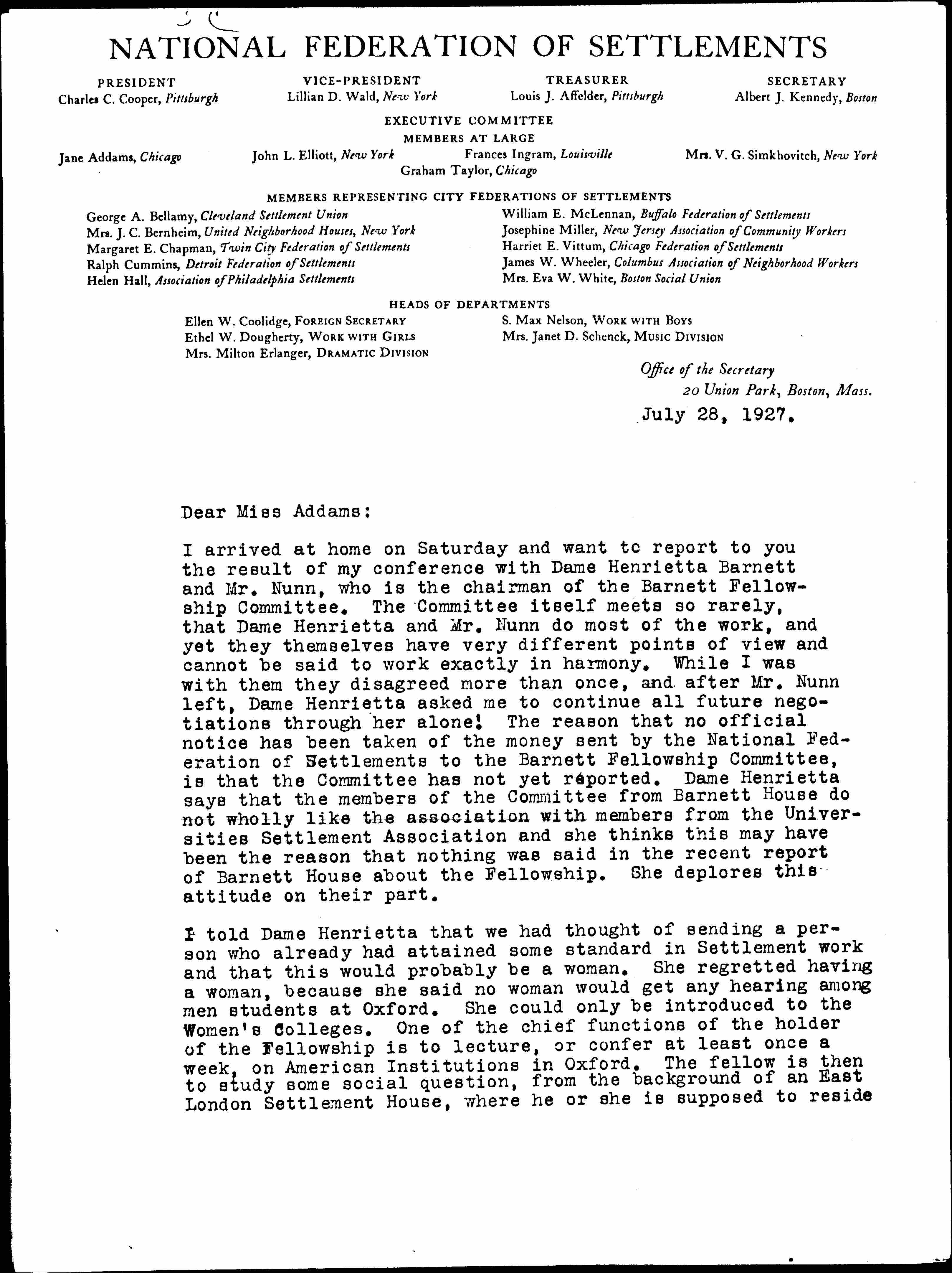
NATIONAL FEDERATION OF SETTLEMENTS

Office of the Secretary
20 Union Park, Boston, Mass.

July 28, 1927.

Dear Miss Addams:

I arrived at home on Saturday and want to report to you the result of my conference with Dame Henrietta Barnett and Mr. Nunn, who is the chairman of the Barnett Fellowship Committee. The Committee itself meets so rarely, that Dame Henrietta and Mr. Nunn do most of the work, and yet they themselves have very different points of view and cannot be said to work exactly in harmony. While I was with them they disagreed more than once, and after Mr. Nunn left, Dame Henrietta asked me to continue all future negotiations through her alone! The reason that no official notice has been taken of the money sent by the National Federation of Settlements to the Barnett Fellowship Committee, is that the Committee has no yet reported. Dame Henrietta says that the members of the Committee from Barnett House do not wholly like the association with members from the Universities Settlement Association and she thinks this may have been the reason that nothing was said in the recent report of Barnett House about the Fellowship. She deplores this attitude on their part.

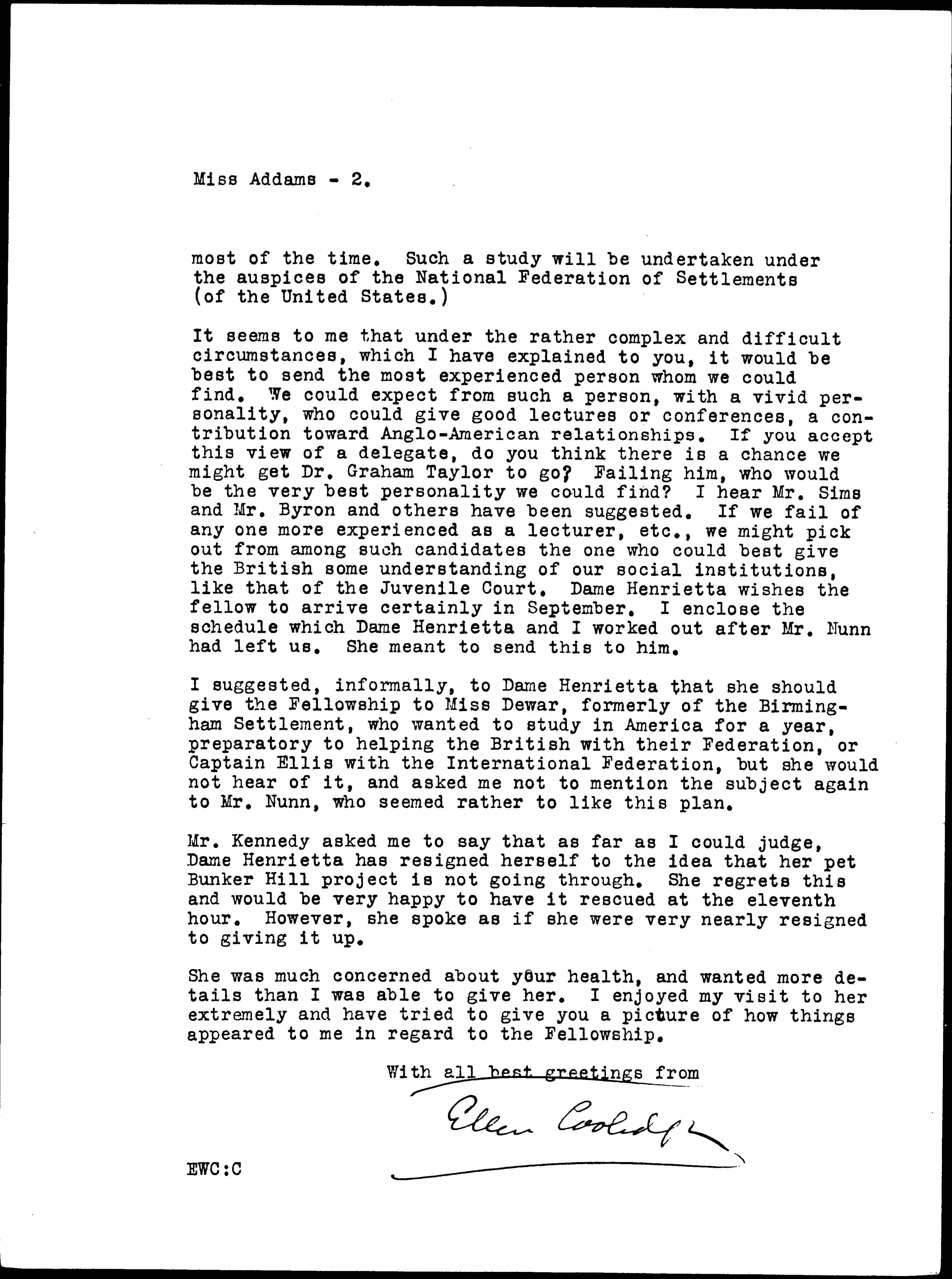
I told Dame Henrietta that we had thought of sending a person who already had attained some standard in Settlement work and that this would probably be a woman. She regretted having a woman, because she said no woman would get any hearing among men students at Oxford. She could only be introduced to the Women's Colleges. One of the chief functions of the holder of the Fellowship is to lecture, or confer at least once a week, on American Institutions in Oxford. The fellow is then to study some social question, from the background of an East London Settlement House, where he or she is supposed to reside [page 2] most of the time. Such a study will be undertaken under the auspices of the National Federation of Settlements (of the United States).

It seems to me that under the rather complex and difficult circumstances, which I have explained to you, it would be best to send the most experienced person whom we could find. We could expect from such a person, with a vivid personality, who could give good lectures or conferences, a contribution toward Anglo-American relationships. If you accept this view of a delegate, do you think there is a chance we might get Dr. Graham Taylor to go? Failing him, who would be the very best personality we could find? I hear Mr. [Simms] and Mr. Byron and others have been suggested. If we fail of any one more experienced as a lecturer, etc., we might pick out from among such candidates the one who could best give the British some understanding of our social institutions, like that of the Juvenile Court. Dame Henrietta wishes the fellow to arrive certainly in September. I enclose the schedule which Dame Henrietta and I worked out after Mr. Nunn had left us. She meant to send this to him.

I suggested, informally, to Dame Henrietta that she should give the Fellowship to Miss Dewar, formerly of the Birmingham Settlement, who wanted to study in America for a year, preparatory to helping the British with their Federation, or Captain Ellis with the International Federation, but she would not hear of it, and asked me not to mention the subject again to Mr. Nunn, who seemed rather to like this plan.

Mr. Kennedy asked me to say that as far as I could judge, Dame Henrietta has resigned herself to the idea that her pet Bunker Hill project is not going through. She regrets this and would be very happy to have it rescued at the eleventh hour. However, she spoke as if she were very nearly resigned to giving it up.

She was much concerned about your health, and wanted more details than I was able to give her. I enjoyed my visit to her extremely and have tried to give you a picture of how things appeared to me in regard to the Fellowship.

With all best greetings from

Ellen Coolidge