What Prohibition Has Done for Chicago, February 2, 1928 (summary)

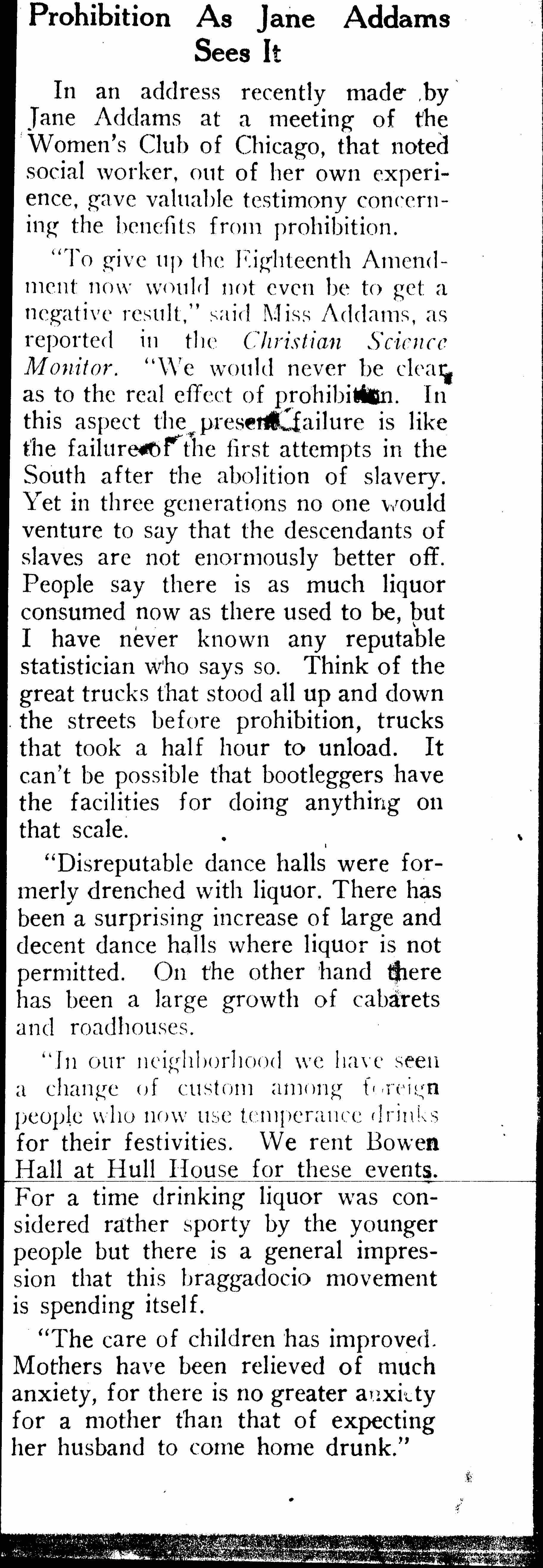
In an address recently made by Jane Addams at a meeting of the [Women's] Club of Chicago, that noted social worker, out of her own experience, gave valuable testimony concerning the benefits from prohibition.

"To give up the Eighteenth Amendment now would not even be to get a negative result," said Miss Addams, as reported in the Christian Science Monitor. "We would never be clear as to the real effect of prohibition. In this aspect the present failure is like the failure of the first attempts in the South after the abolition of slavery. Yet in three generations no one would venture to say that the descendants of slaves are not enormously better off. People say there is as much liquor consumed now as there used to be, but I have never known any reputable statistician who says so. Think of the great trucks that stood all up and down the streets before prohibition, trucks that took a half hour to unload. It can't be possible that bootleggers have the facilities for doing anything on that scale.

"Disreputable dance halls were formerly drenched with liquor. There has been a surprising increase of large and decent dance halls where liquor is not permitted. On the other hand there has been a large growth of cabarets and roadhouses.

"In our neighborhood we have seen a change of custom among foreign people who now use temperance drinks for their festivities. We rent Bowen Hall at Hull House for these events. For a time drinking liquor was considered rather sporty by the younger people but there is a general impression that this braggadocio movement is spending itself.

"The care of children has improved. Mothers have been relieved of much anxiety, for there is no greater anxiety for a mother than that of expecting her husband to come home drunk."

Item Relations

Comments

Allowed tags: <p>, <a>, <em>, <strong>, <ul>, <ol>, <li>