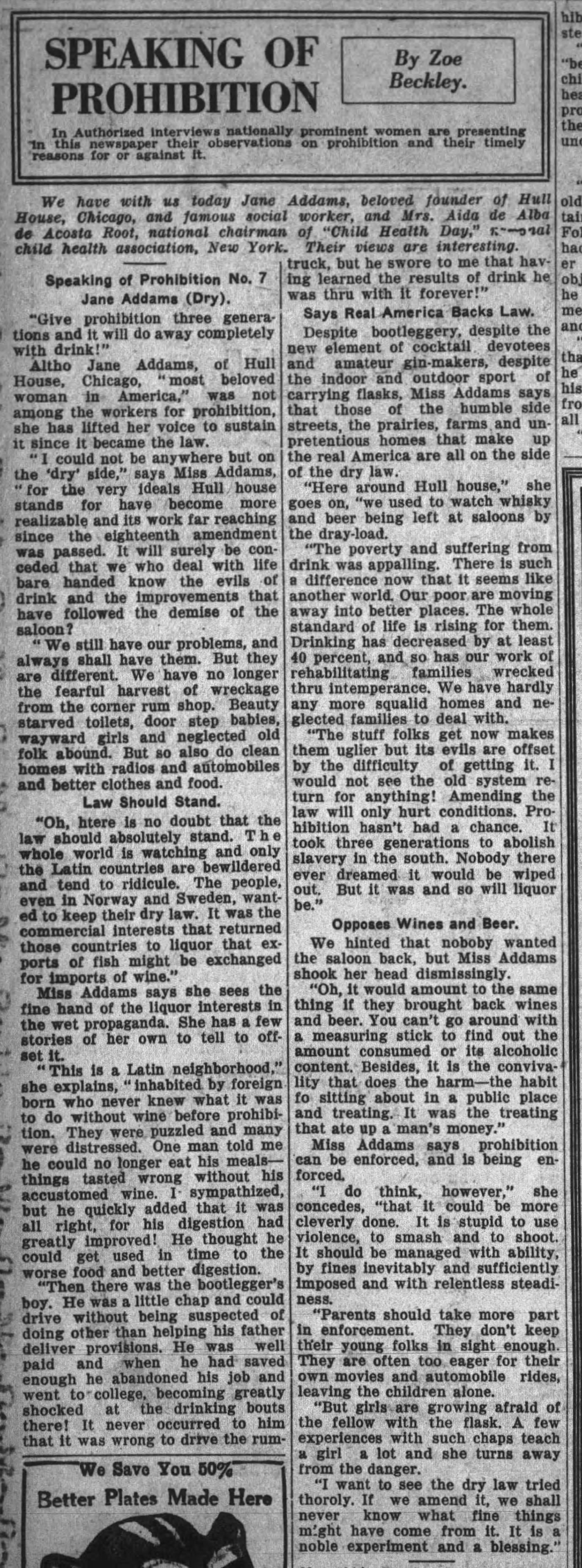
"Give prohibition three generations and it will do away completely with drink!"
[Although] Jane Addams, of Hull House, Chicago, "most beloved woman in America," was not among the workers for prohibition, she has lifted her voice to sustain it since it became the law.
"I could not be anywhere but on the 'dry' side," says Miss Addams, "for the very ideals Hull House stands for have become more realizable and its work far reaching since the eighteenth amendment was passed. It will surely be conceded that we who deal with life bare handed know the evils of drink and the improvements that have followed the demise of the saloon?
"We still have our problems, and always shall have them. But they are different. We have no longer the fearful harvest of wreckage from the corner rum shop. Beauty starved toilets, door step babies, wayward girls and neglected old folk abound. But so also do clean homes with radios and automobiles and better clothes and food.
"Oh, there is no doubt that the law should absolutely stand. The whole world is watching and only the Latin countries are bewildered and tend to ridicule. The people, even in Norway and Sweden, wanted to keep their dry law. It was the commercial interests that returned those countries to liquor that exports of fish might be exchanged for imports of wine."
Miss Addams says she sees the fine hand of the liquor interests in the wet propaganda. She has a few stores of her own to tell to offset it.
"This is a Latin neighborhood," she explains, "inhabited by foreign born who never knew what it was to do without wine before prohibition. They were puzzled and many were distressed. One man told me he could no longer eat his meals -- things tasted wrong without his accustomed wine. I sympathized, but he quickly added that it was all right, for his digestion had greatly improved! He thought he could get used in time to the worse food and better digestion.
"Then there was the bootlegger's boy. He was a little chap and could drive without being suspected of doing other than helping his father deliver provisions. He was well paid and when he had saved enough he abandoned his job and went to college, becoming greatly shocked at the drinking bouts there! It never occurred to him that it was wrong to drive the rum-truck, but he swore to me that having learned the results of drink he was [through] with it forever!"
Despite bootleggery, despite the new element of cocktail devotees and amateur gin-makers, despite the indoor and outdoor sport of carrying flasks, Miss Addams says that those of the humble side streets, the prairies, farms and unpretentious homes that make up the real America are all on the side of the dry law.
"Here around Hull House," she goes on, "we used to watch whisky and beer being left at saloons by the dray-load.
"The poverty and suffering from drink was appalling. There is such a difference now that it seems like another world. Our poor are moving away into better places. The whole standard of life is rising for them. Drinking has decreased by at least 40 percent, and so has our work of rehabilitating families wrecked [through] intemperance. We have hardly any more squalid homes and neglected families to deal with.
"The stuff folks get now makes them uglier but its evils are offset by the difficulty of getting it. I would not see the old system return for anything! Amending the law will only hurt conditions. Prohibition hasn't had a chance. It took three generations to abolish slavery in the south. Nobody there ever dreamed it would be wiped out. But it was and so will liquor be."
We hinted that nobody wanted the saloon back, but Miss Addams shook her head dismissingly.
"Oh, it would amount to the same thing if they brought back wines and beer. You can't go around with a measuring stick to find out the amount consumed or its alcoholic content. Besides, it is the [conviviality] that does the harm -- the habit of sitting about in a public place and treating. It was the treating that ate up a man's money."
Miss Addams says prohibition can be enforced, and is being enforced.
"I do think, however," she concedes, "that it could be more cleverly done. It is stupid to use violence, to smash and to shoot. It should be managed with ability, by fines inevitably and sufficiently imposed and with relentless steadiness.
"Parents should take more part in enforcement. They don't keep their young folks in sight enough. They are often too eager for their own movies and automobile rides, leaving the children alone.
"But girls are growing afraid of the fellow with the flask. A few experiences with such chaps teach a girl a lot and she turns away from the danger.
"I want to see the dry law tried [thoroughly]. If we amend it, we shall never know what fine things might have come from it. It is a noble experiment and a blessing."

Comments