
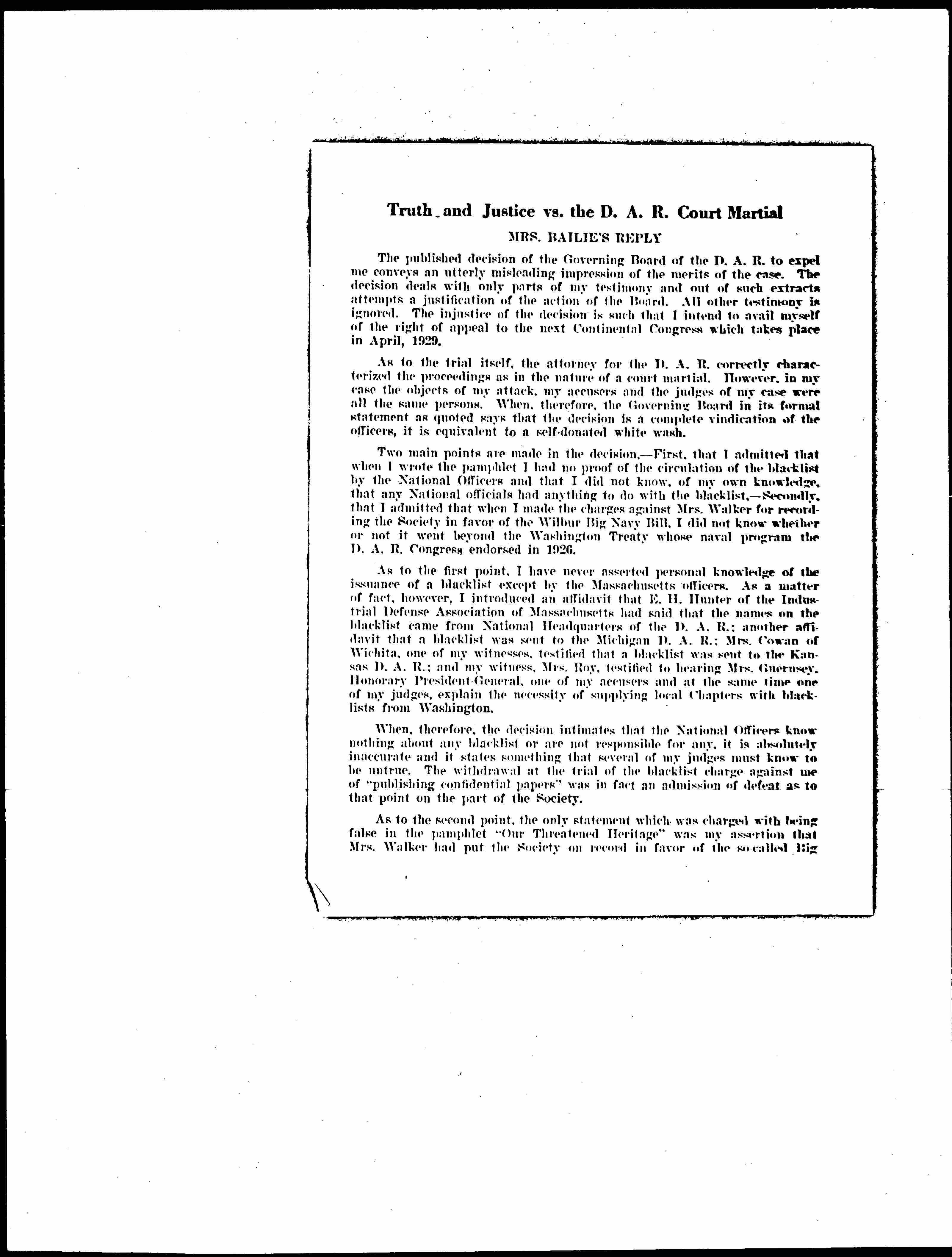
The published decision of the Governing Board of the D.A.R. to expel me conveys an utterly misleading impression of the merits of the case. The decision deals with only parts of my testimony and out of such extracts attempts a justification of the action of the Board. All other testimony is ignored. The injustice of the decision is such that I intend to avail myself of the right of appeal to the next Continental Congress which takes place in April, 1929.
As to the trial itself, the attorney for the D.A.R. correctly characterized the proceedings as in the nature of a court martial. However, in my case the objects of my attack, my accusers and the judges of my case were all the same persons. When, therefore, the Governing Board in its formal statement as quoted says that the decision is a complete vindication of the officers, it is equivalent to a self-donated white wash.
Two main points are made in the decision. -- First, that I admitted that when I wrote the pamphlet I had no proof of the circulation of the blacklist by the National Officers and that I did not know, of my own knowledge, that any National officials had anything to do with the blacklist. -- Secondly, that I admitted that when I made the charges against Mrs. Walker for recording the Society in favor of the Wilbur Big Navy Bill, I did not know whether or not it went beyond the Washington Treaty whose naval program the D.A.R. Congress endorsed in 1926.
As to the first point, I have never asserted personal knowledge of the issuance of a blacklist except by the Massachusetts officers. As a matter of fact, however, I introduced an affidavit that E. H. Hunter of the Industrial Defense Association of Massachusetts had said that the names on the blacklist came from National Headquarters of the D.A.R.; another affidavit that a blacklist was sent to the Michigan D.A.R.; Mrs. Cowan of Wichita, one of my witnesses, testified that a blacklist was sent to the Kansas D.A.R.; and my witness, Mrs. Roy, testified to hearing Mrs. Guernsey, Honorary President-General, one of my accusers and at the same time one of my judges, explain the necessity of supplying local Chapters with blacklists from Washington.
When, therefore, the decision intimates that the National Officers know nothing about any blacklist or are not responsible for any, it is absolutely inaccurate and it states something that several of my judges must know to be untrue. The withdrawal at the trial of the blacklist charge against me of "publishing confidential papers" was in fact an admission of defeat as to that point on the part of the Society.
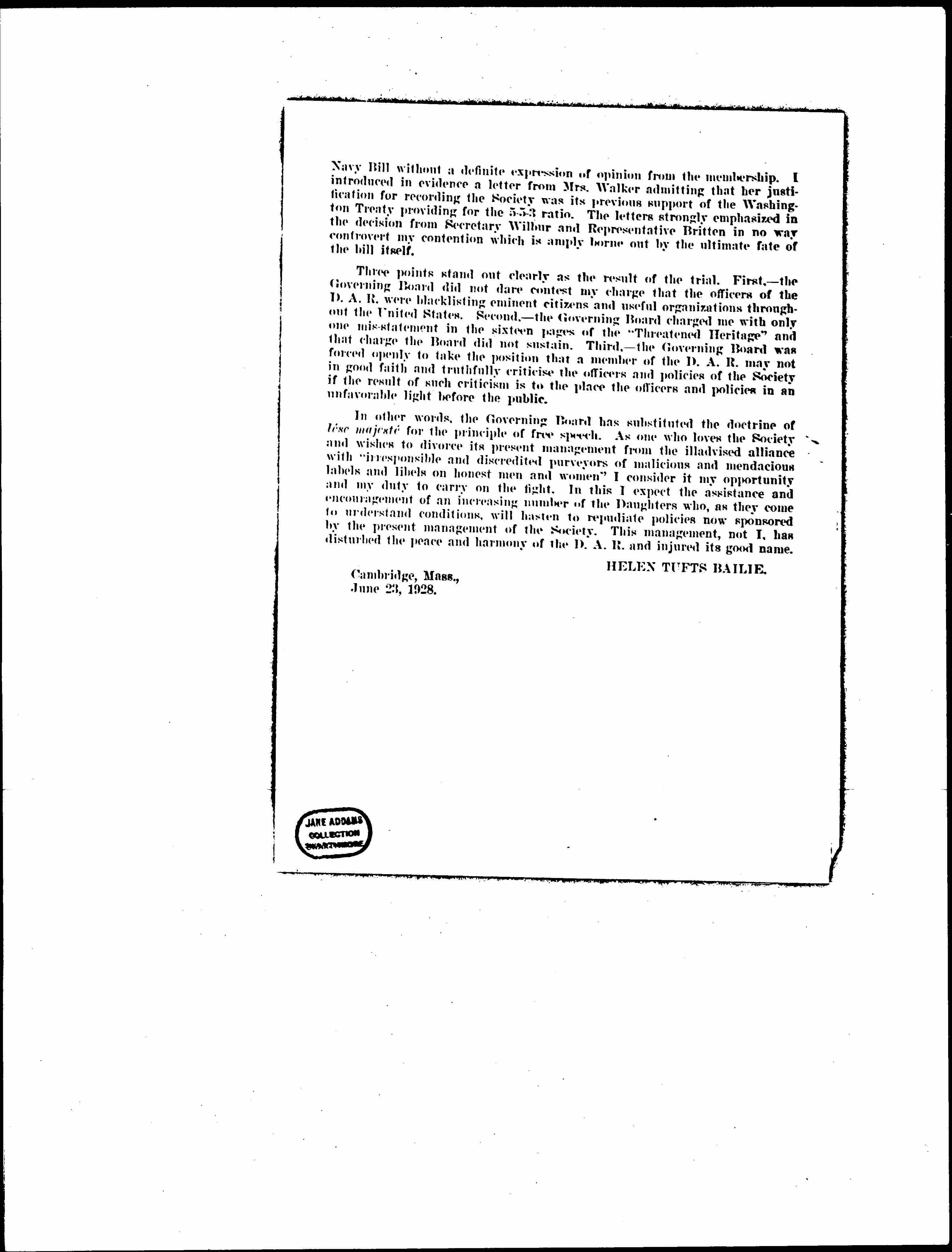
As to the second point, the only statement which was charged with being false in the pamphlet "Our Threatened Heritage" was my assertion that Mrs. Walker had put the Society on record in favor of the so-called Big [page 2] Navy Bill without a definite expression of opinion from the membership. I introduced in evidence a letter from Mrs. Walker admitting that her justification for recording the Society was its previous support of the Washington Treaty providing for the 5-5-3 ratio. The letters strongly emphasized in the decision from Secretary Wilbur and Representative Britten in no way controvert my contention which is amply borne out by the ultimate fate of the bill itself.
Three points stand out clearly as the result of the trial. First, -- the Governing Board did not dare contest my charge that the officers of the D.A.R. were blacklisting eminent citizens and useful organizations throughout the United States. Second, -- the Governing Board charged me with only one [misstatement] in the sixteen pages of the "Threatened Heritage" and that charge the Board did not sustain. Third, -- the Governing Board was forced openly to take the position that a member of the D.A.R. may not in good faith and truthfully [criticize] the officers and policies of the Society if the result of such criticism is to place the officers and policies in an [unfavorable] light before the public.
In other words, the Governing Board has substituted the doctrine of lése majesté for the principle of free speech. As one who loves the Society and wishes to divorce its present management from the [ill-advised] alliance with "irresponsible and discredited purveyors of malicious and mendacious labels and libels on honest men and women" I consider it my opportunity and my duty to carry on the fight. In this I expect the assistance and encouragement of an increasing number of the Daughters who, as they come to understand conditions, will hasten to repudiate policies now sponsored by the present management of the Society. This management, not I, has disturbed the peace and harmony of the D.A.R. and injured its good name.
HELEN TUFTS BAILIE.








Comments