MEMORIAL ON THE OPIUM PROBLEM
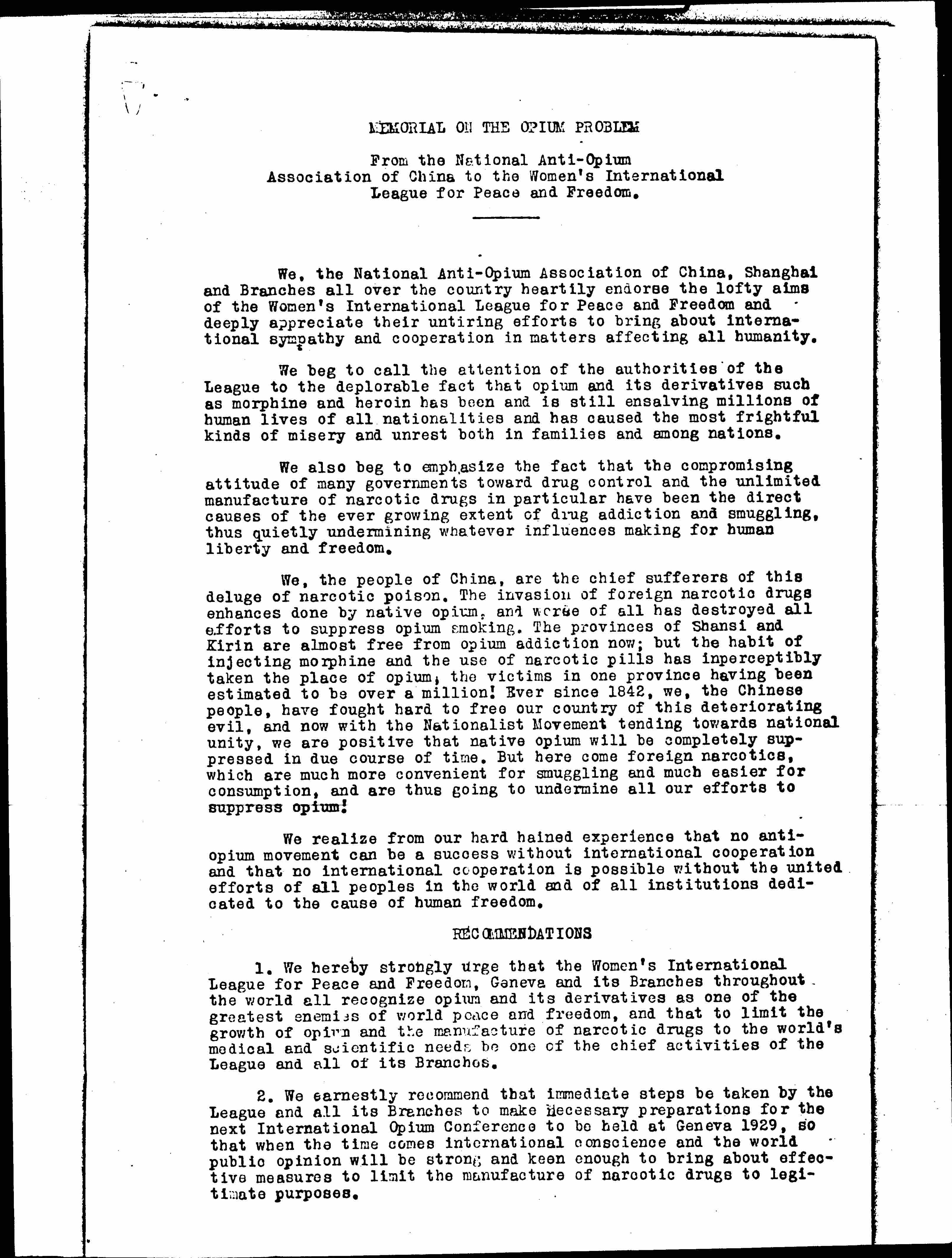
From the National Anti-Opium Association of China to the Women's International League for Peace and Freedom.
We, the National Anti-Opium Association of China, Shanghai and Branches, all over the country heartily endorse the lofty aims of the Women's International League for Peace and Freedom and deeply appreciate their untiring efforts to bring about international sympathy and cooperation in matters affecting all humanity.
We beg to call the attention of the authorities of the League to the deplorable fact that opium and its derivatives such as morphine and heroin has been and is still enslaving millions of human lives of all nationalities and has caused the most frightful kinds of misery and unrest both in families and among nations.
We also beg to emphasize the fact that the compromising attitude of many governments toward drug control and the unlimited manufacture of narcotic drugs in particular have been the direct causes of the ever growing extent of drug addiction and smuggling, thus quietly undermining whatever influences making for human liberty and freedom.
We, the people of China, are the chief sufferers of this deluge of narcotic poison. The invasion of foreign narcotic drugs enhances done by native opium, and worse of all has destroyed all efforts to suppress opium smoking. The provinces of Shansi and Kirin are almost free from opium addiction now; but the habit of injecting morphine and the use of narcotic pills has imperceptibly taken the place of opium, the victims in one province having been estimated to be over a million! Ever since 1842, we, the Chinese people, have fought hard to free our country of this deteriorating evil, and now with the Nationalist Movement tending towards national unity, we are positive that native opium will be completely suppressed in due course of time. But here come foreign narcotics, which are much more convenient for smuggling and much easier for consumption, and are thus going to undermine all our efforts to suppress opium!
We realize from our hard [trained?] experience that no anti-opium movement can be a success without international cooperation and that no international cooperation is possible without the united efforts of all peoples in the world and of all institutions dedicated to the cause of human freedom.
RECOMMENDATIONS
1. We hereby strongly urge that the Women's International League for Peace and Freedom, Geneva and its Branches throughout the world all recognize opium and its derivatives as one of the greatest enemies of world peace and freedom, and that to limit the growth of opium and the manufacture of narcotic drugs to the world's medical and scientific needs be one of the chief activities of the League and all of its Branches.
2. We earnestly recommend that immediate steps be taken by the League and all its Branches to make necessary preparations for the next International Opium Conference to be held at Geneva 1929, so that when the time comes international conscience and the world public opinion will be strong and keen enough to bring about effective measures to limit the manufacture of narcotic drugs to legitimate purposes. [page 2]
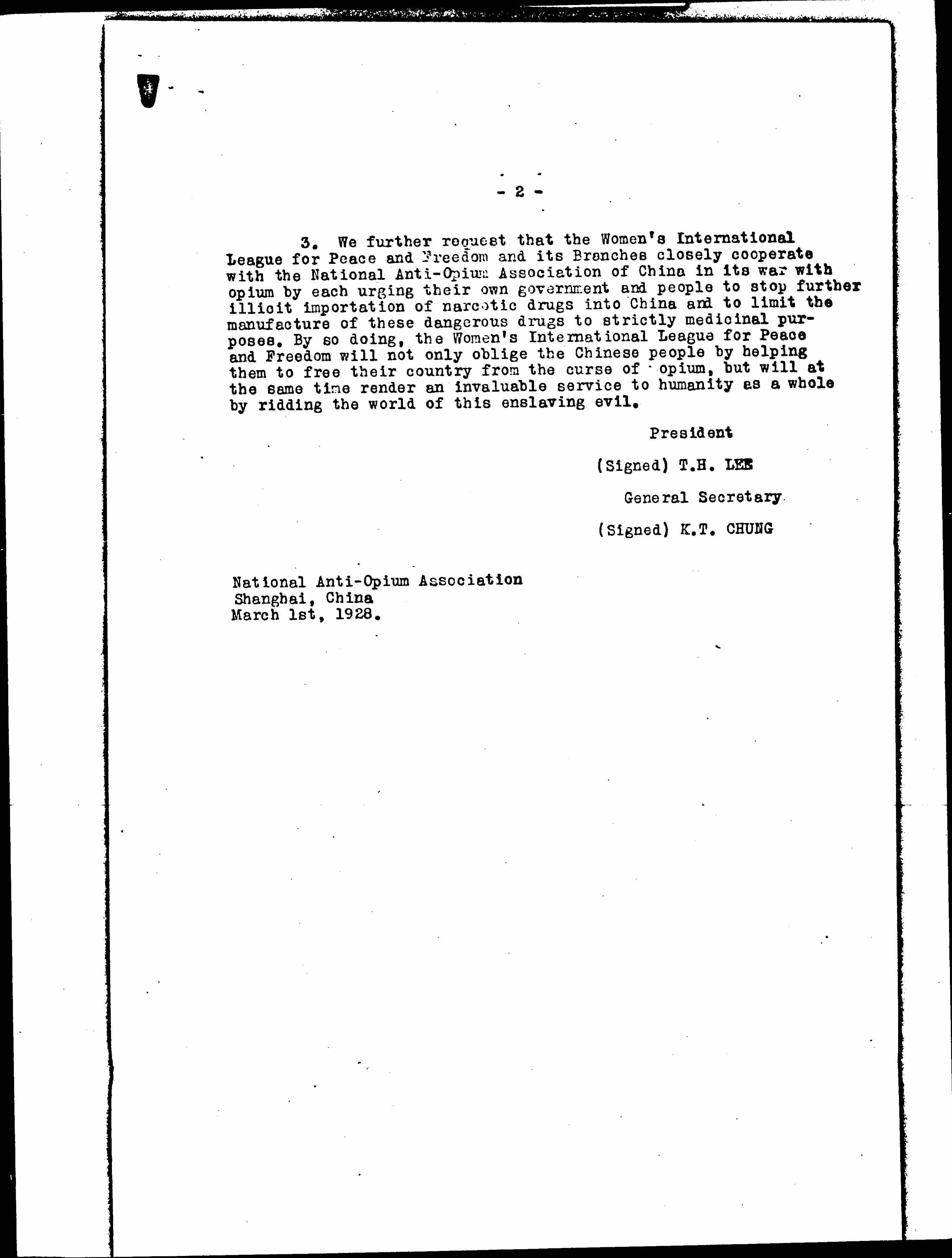
3. We further request that the Women's International League for Peace and Freedom and its Branches closely cooperate with the National Anti-Opium Association of China in its war with opium by each urging their own government and people to stop further illicit importation of narcotic drugs into China and to limit the manufacture of these dangerous drugs to strictly medicinal purposes. By doing so, the Women's International League for Peace and Freedom will not only oblige the Chinese people by helping them to free their country from the curse of opium, but will at the same time render an invaluable service to humanity as a whole by ridding the world of this enslaving evil.


Comments