
KINGSLEY HOUSE
Pittsburgh, Pa., April 2, 1928.
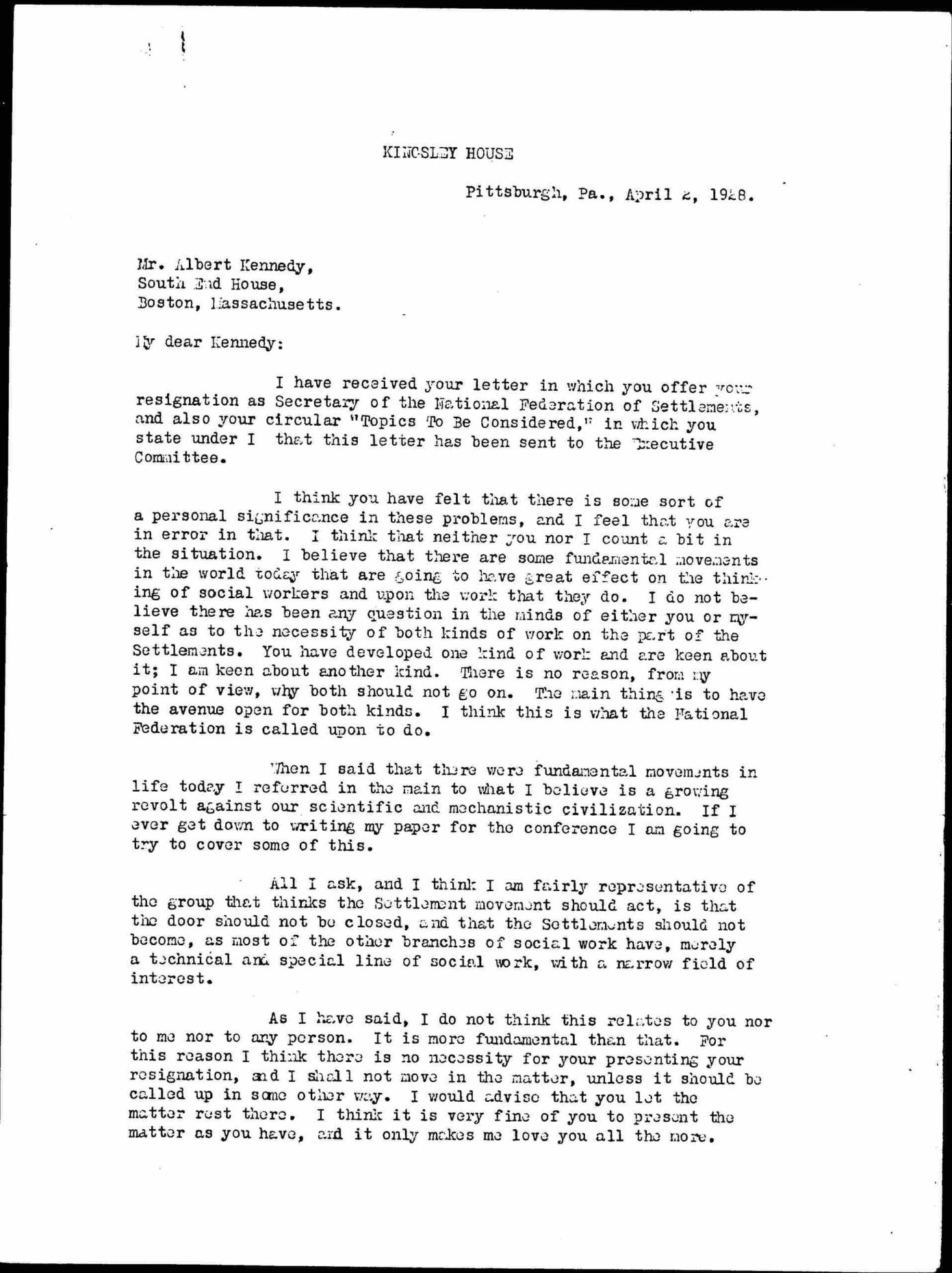
My dear Kennedy:
I have received your letter in which you offer your resignation as Secretary of the National Federation of Settlements, and also your circular "Topics To Be Considered," in which you state under I that this letter has been sent to the Executive Committee.
I think you have felt that there is some sort of a personal significance in these problems, and I feel that you are in error in that. I think that neither you nor I count a bit in the situation. I believe that there are some fundamental movements in the world today that are going to have great effect on the thinking of social workers and upon the work that they do. I do not believe there has been any question in the minds of either you or myself as to the necessity of both kinds of work on the part of the Settlements. You have developed one kind of work and are keen about it; I am keen about another kind. There is no reason, from my point of view, why both should not go on. The main thing is to have the avenue open for both kinds. I think this is what the National Federation is called upon to do.
When I said that there were fundamental movements in life today I referred in the main to what I believe is a growing revolt against our scientific and mechanistic civilization. If I ever get down to writing my paper for the conference I am going to try to cover some of this.
All I ask, and I think I am fairly representative of the group that thinks the Settlement movement should act, is that the door should not be closed, and that the Settlements should not become, as most of the other branches of social work have, merely a technical and special line of social work, with a narrow field of interest.
As I have said, I do not think this relates to you nor to me nor to any person. It is more fundamental than that. For this reason I think there is no necessity for your presenting your resignation, and I shall not move in the matter, unless it should be called up in some other way. I would advise that you let the matter rest there. I think it is very fine of you to present the matter as you have, and it only makes me love you all the more. [page 2]
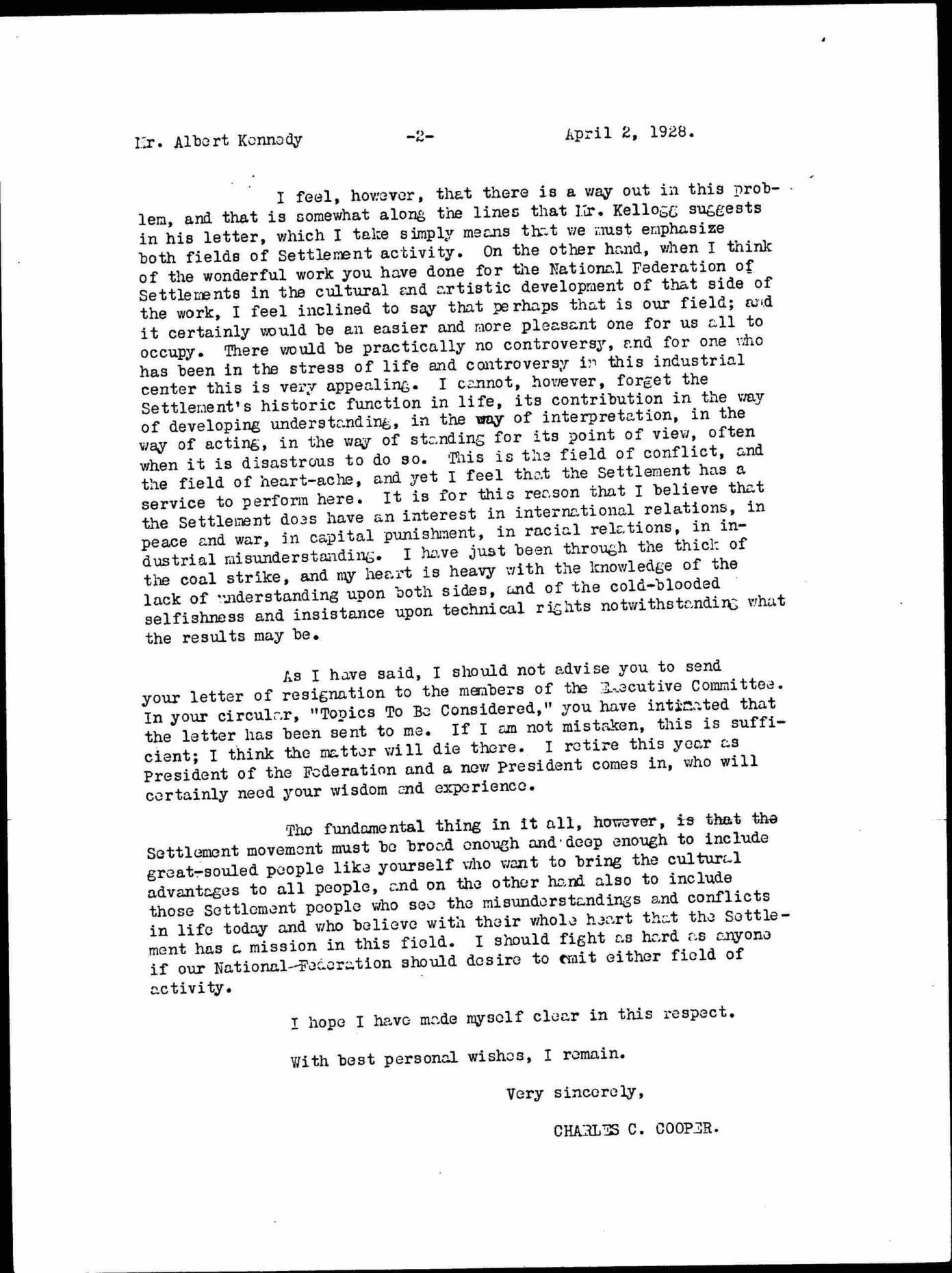
I feel, however, that there is a way out in this problem, and that is somewhat along the lines that Mr. Kellogg suggests in his letter, which I take simply means that we must emphasize both fields of Settlement activity. On the other hand, when I think of the wonderful work you have done for the National Federation of Settlements in the cultural and artistic development of that side of the work, I feel inclined to say that perhaps that is our field; and it certainly would be an easier and more pleasant one for us all to occupy. There would be practically no controversy, and for one who has been in the stress of life and controversy in this industrial center this is very appealing. I cannot, however, forget the Settlement's historic function in life, its contribution in the way of developing understanding, in the way of interpretation, in the way of acting, in the way of standing for its point of view, often when it is disastrous to do so. This is the field of conflict, and the field of heart-ache, and yet I feel that the Settlement has a service to perform here. It is for this reason that I believe that the Settlement does have an interest in international relations, in peace and war, in capital punishment, in racial relations, in industrial misunderstanding. I have just been through the thick of the coal strike, and my heart is heavy with the knowledge of the lack of understanding upon both sides, and of the cold-blooded selfishness and insistence upon technical rights notwithstanding what the results may be.
As I have said, I should not advise you to send your letter of resignation to the members of the Executive Committee. In your circular, "Topics To Be Considered," you have intimated that the letter has been sent to me. If I am not mistaken, this is sufficient; I think the matter will die there. I retire this year as President of the Federation and a new President comes in, who will certainly need your wisdom and experience.
The fundamental thing in it all, however, is that the Settlement movement must be broad enough and deep enough to include great-souled people like yourself who want to bring the cultural advantages to all people, and on the other hand also to include those Settlement people who see the misunderstandings and conflicts in life today and who believe with their whole heart that the Settlement has a mission in this field. I should fight as hard as anyone if our National Federation should desire to omit either field of activity.
I hope I have made myself clear in this respect.
With best personal wishes, I remain.
Very sincerely,
CHARLES C. COOPER



Comments