
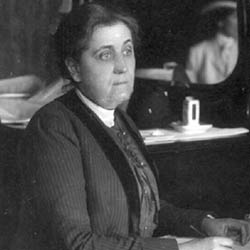
My dear Miss Addams
It was a joy to have you at the Banquet of the International Relations meeting of the National Council of Women.
It made up a little for the terrible mistake of the management of the Council in regard to the W.I.L.P.F. at the time of the meeting of the International Council at Washington in 1925.
I am ending my connection with the National Council after nearly forty years of active service. And I feel dear friend that I should set before you in a letter copies of which I shall send to Mrs Post, Mrs Hull and Dr Parker the reasons why [although] I so seriously disapproved of the action mentioned above I have continued to work for and with the Council after the action taken in regard to our W.I.L.P.F. That action as I at the time indicated to Mrs Moore was a total negative to all the spirit and ideal that had formed the Council. I did not expect to attend the International meeting in 1925 for that reason. But when you asked [Mrs] Post and me to act as fraternal delegates for the International W.I.L. I felt I should do so.
I did not intend to go to the Biennial of the National Council directly following the International meeting in the autumn of 1925. But again I changed my mind because of a violent attack upon the Council published on the front page as a "treasonable body harboring dangerous societies among them the worst the W.I.L.P.F. which the Council had put out but not in season to preserve its patriotism." I thought I saw a plot to capture the Council for the worst [elements] of the "spider web" sort of patriots since in a suggested new official leadership only one person who had been identified with the Council was named and she a president of an ultra patriotic order. I was right in my surmise as I quickly found on reaching the Biennial meeting. It cost a serious effort to rescue the Council Presidency and Dr Parker valiantly came to the rescue and was elected with only a very small majority. Since then by the [generosity] of the American Social Hygiene Assn. whose paid worker she was and is she has done much to put the Council again where it belongs among the international leaders of the world.
You have had ample proof of her appreciation of you and her desire that the sinister influences of a mistaken "patriotism" that is suspicious of all that is progressive shall be more than overcome by a true service to our country that flowers in a real brotherhood of man.
I will not burden you with details of the Questionnaire I sent out as Chairman of the Reorganization Com appointed at the Biennial of the Council in 1925. Suffice it to say that the fruits of that effort undertaken for the purpose of really proving whether or not the Council was needed now that the multitude of other organizations of women were in [the] field were the undertaking of the responsibility of management by the member societies and the removal of all that would seem competitive with those member societies and the installation of the attempt to make the National Council of Women a Clearing House for all women's organizations in our country.
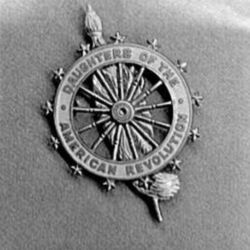
The Committee on Peace and Arbitration was the first to be nationally and internationally appointed and in 1899 the largest meeting of the Council ever held except the testimonial to Mrs Cady Stanton on her 80th Birthday was that held for peace by Mrs Mary Lowe Dickinson as Pres. and participated in by many societies including a large and brilliant delegation of the D.A.R. [page 2]
More than 11,000 names urging support of all movements for international peace were obtained by Mrs Dickinson at that time in a four days poll [taken] at Sherry's.
This is but one of many proofs that peace and arbitration as the Com. was named have been the deepest interests of the Council. The situation developed at the International and national meetings of 1925 however made the position of a Chairman for this country for that Committee a very delicate one and I took the Chairmanship merely to hold it until the Biennial of 1927. Mrs Catt asked six of the strongest member societies of the National Council of Women to go on her Committee on Cause and Cure of War and that fact added a practical embarrassment to any one wishing to use the Chairmanship of the Peace Com. of the Council for a unifying work for peace. I therefore stood in the breach to prevent confusion and save the form of the Com. for a later use.
Mrs George Cadbury of England the able and devoted International Chairman for Peace could not I am sure understand the inactivity of the National Council Com. or the reason why the National Section of the W.I.L.P.F. was given more prominence in my Report than any work of the Council itself.
As the Report of the Com. on Reorganization has been received in such good spirit and used to such good advantage I am relieved of all future responsibility for the Council. This is a great and welcome relief. I find I can be most useful for the larger part of my effort in societies of men and women and shall do no further work in a society of "women only" except the W.I.L.P.F. which I shall be glad to serve as I can and when wanted.
I have known as I did at first that the action I took when undertaking the Chairmanship of the National Section of the W.I.L.P.F. led to grave misunderstanding and could not be quite explained at the time. I am now able to explain my motive and since I am also explaining why I have given so much time and effort to the Council of women after the treatment accorded the W.I.L.P.F. I think it well to explain that action of mine after our government entered the war.
I saw that the easy thing was to make the W.I.L.P.F. an attachment of the Friend's Service Committee and that such a selection of Phila Officers as was probably chiefly desired at the Phila meeting would do just that thing.
I felt that the chief reason for the existence of the Section for the U.S.A. was not to show philanthropic zeal in aiding the victims of war but rather to persistently keep alive the women's peace organization even if no large work could be its portion after we lost our neutral condition and so [keep] it alive as a positive and single minded peace propaganda holding its membership only to that one thing leaving to other appeals the Friend's Service Com. work of which we all felt so proud.
For this as I saw no other person ready for the task I snatched the Chairmanship in an unseemly manner wholly foreign to my usual way of doing and for a purpose so great in my own mind that I was willing to be misunderstood by those I most admired if so be I could keep the W.I.L.P.F. from being supposed to have transformed itself into the philanthropic work which those who defended the war admired.
To do this I found it best for all associated with me professionally to resign from my post as Professor in a Graduate School and become a private in the ranks to just keep the distinctive life of the women's peace movement free on the one side from losing itself in relief work and on the other side from confusing the governmental situation still more by futile appeal to cease fighting. [page 3]
After the armistice was signed those whose consciences were not protected against conscriptions were the Friends whose freedom was won so long [ago] could again speak aloud and there was no need to emphasize the fact that the W.I.L.P.F. was something other than even its most cherished Quaker members.
I have bided my time for making this explanation to see if I could accompany it with a confession of mistake in judgment about the necessity for holding the W.I.L.P.F. in this country clear even of the public mistake of considering it a part of the Friend's Service Committee during the troubled time when all other conscientious objectors were suffering so much. I have even now a clear conviction that whatever one person could do was needed to hold the women's peace movement clear of all entangling alliances even with saints admitted as such by the war leaders themselves and hence not the ones with whom a peace society pure and simple should be confused. I did not expect to be swamped in service during these last two years in the effort to make the National Council of Women more fully the [spiritual] heir of its founders. Now I am free and can write freely to you my dear friend.
I looked upon the W.I.L.P.F. at first and look upon it now as an emergency movement not one for permanent life. The time for its ending is surely not yet but for our country the [work] of men and women in full comradeship must be the leading influence soon if war is to be prevented.
I have said frankly that for the remaining work of the W.I.L.P.F. the National support of the International is the great task not to confuse still further the overlapping peace societies and committees by trying to get local societies of many local members. Hence for those who wish to make the W.I.L.P.F. another locally [membered] national society my method of trying only for National Members and those for large support of the International is not what they believe best. I am quite sure that the increase of peace committees and work as evidenced by the activities in church and social organizations is destined to do the local work and that we should seek consolidation in every community as is now being done under the name of Council to Prevent War rather than to get another set of field workers to get another set of peace society local members and add to the more than one hundred such societies and committees another.
But the one organization of women that at the moment of greatest test of loyalty said peace and said it together in 1915 should have a big support still from the U.S.A. to Geneva.
I say this again as explanation of some things that may seem that to indicate loss of interest in W.I.L.P.F. Far from that. But I am to give much time to the N.Y. Council for the Prevention of War in the hope of getting some one if only a minimum program that all the many societies in our Council may unite upon.
I am unloading all I can [and] as fast as possible to do what in me lies for some unified peace endeavor that shall make our country take its place as a real leader. I rejoiced at the big petition you presented to Pres. Coolidge. I am sorry he is so small he could not appreciate its importance. It is a terrible set-back to have such a big navy program proposed but I hope it may be successfully opposed.
I speak at Mrs Catt's Cause and Cure of War Conference. On the 17th. I am hoping to get her to add to the six women's bodies she has asked to belong and who belong to the Council such other women's organizations as the Council holds which have peace committees and herself lead them. That would be a real help in getting the safe and sane middle-of-the-road people together for active service. I am out for [cooperative] action all around the circle. As I was dead set for distinctive and highly specialized action on behalf of the W.I.L.P.F. when it alone was loyal to the death for peace. [page(s) missing]




Comments