
Opinion on Women's International League for Peace and Freedom's British Section's Questionnaire, May 21, 1927

REEL0018_1783.jpg
REEL0018_1784.jpg
REEL0018_1785.jpg
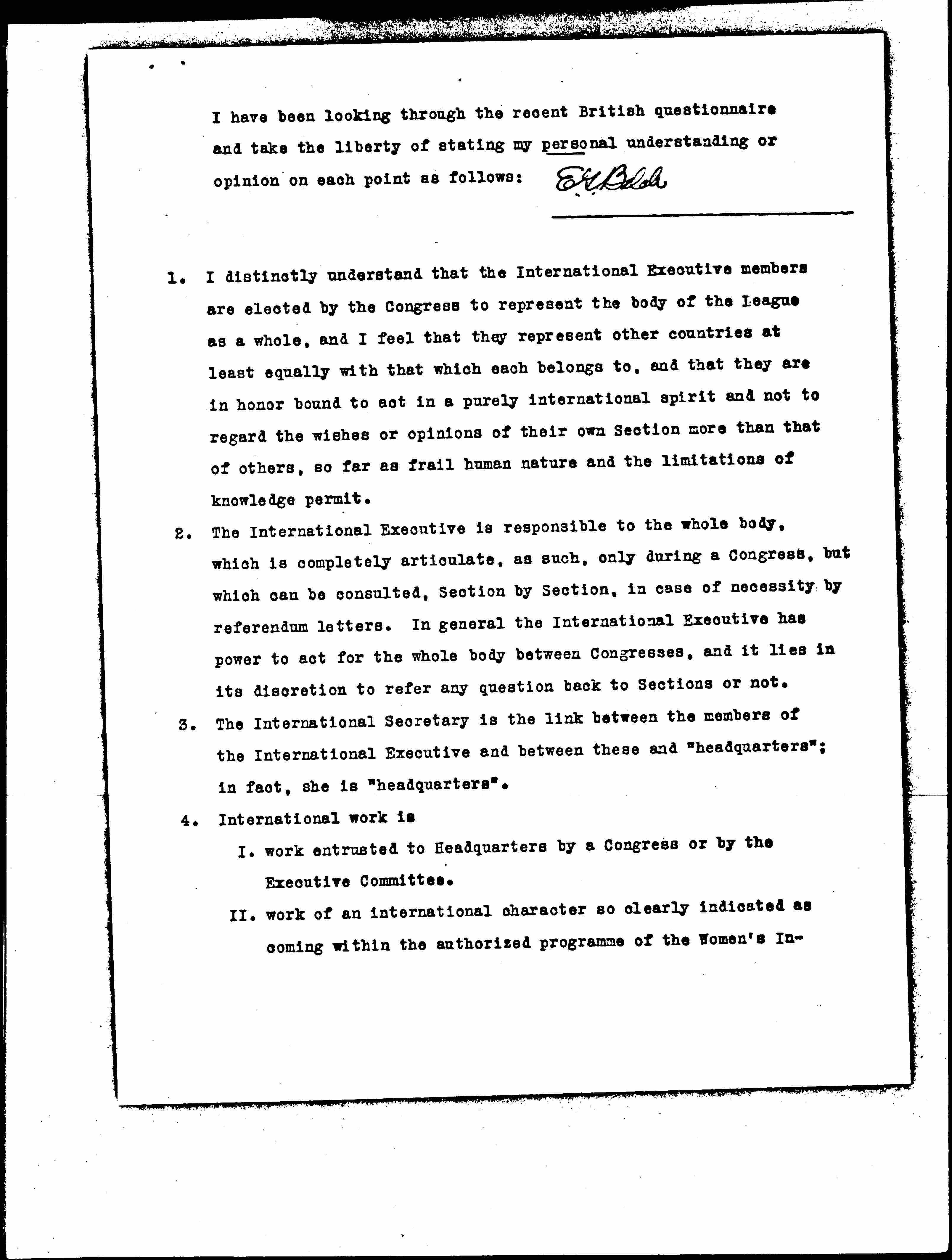
REEL0018_1786.jpg
I have been looking through the recent British questionnaire and take the liberty of stating my personal understanding or opinion on each point as follows: E. G. Balch [signed]

1. I distinctly understand that the International Executive members are elected by the Congress to represent the body of the League as a whole, and I feel that they represent other countries at least equally with that which each belongs to, and that they are in honor bound to act in a purely international spirit and not to regard the wishes or opinions of their own Section more than that of others, so far as frail human nature and the limitations of knowledge permit.

2. The International Executive is responsible to the whole body, which is completely articulate, as such, only during a Congress, but which can be consulted, Section by Section, in case of necessity by referendum letters. In general the International Executive has power to act for the whole body between Congresses, and it lies in its discretion to refer any question back to Sections or not.

3. The International Secretary is the link between the members of the International Executive and between these and "headquarters;" in fact, she is "headquarters."

4. International work is

I. work entrusted to Headquarters by a Congress or by the Executive Committee.

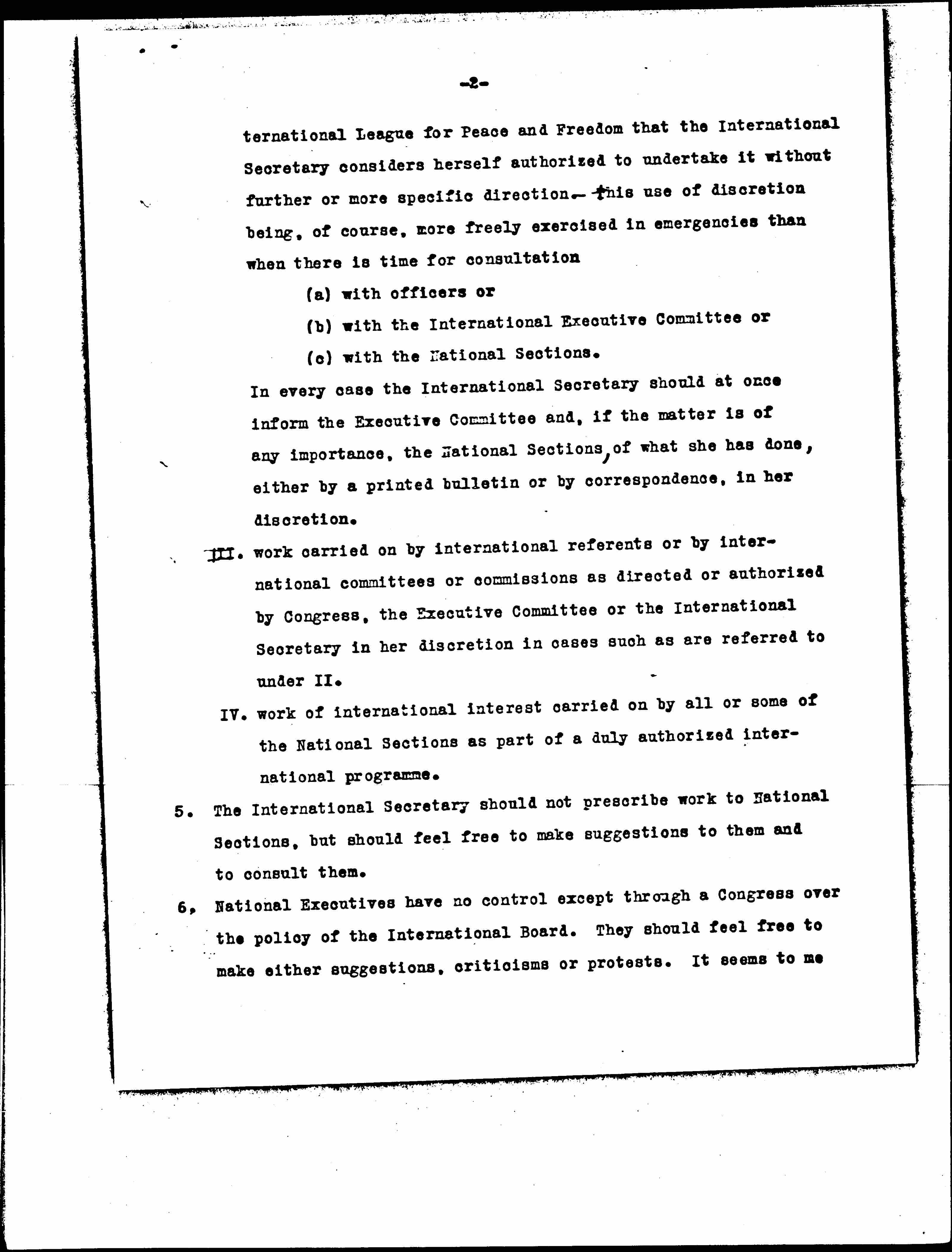
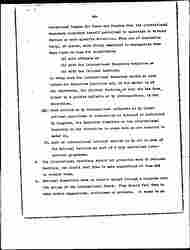
II. work of an international character so clearly indicated as coming within the authorized [program] of the Women's International [page 2] League for Peace and Freedom that the International Secretary considers herself authorized to undertake it without further or more specific direction -- this use of discretion being, of course, more freely exercised in emergencies than when there is time for consultation

(a) with officers or

(b) with the International Executive Committee or

(c) with the National Sections.

In every case the International Secretary should at once inform the Executive Committee and, if the matter is of any importance, the National Sections, of what she has done, either by a printed bulletin or by correspondence, in her discretion.

III. work carried on by international referents or by international committees or commissions as directed or authorized by Congress, the Executive Committee or the International Secretary in her discretion in cases such as are referred to under II.

IV. work of international interest carried on by all or some of the National Sections as part of a duly authorized international [program].

5. The International Secretary should not prescribe work to National Sections, but should feel free to make suggestions to them and to consult them.

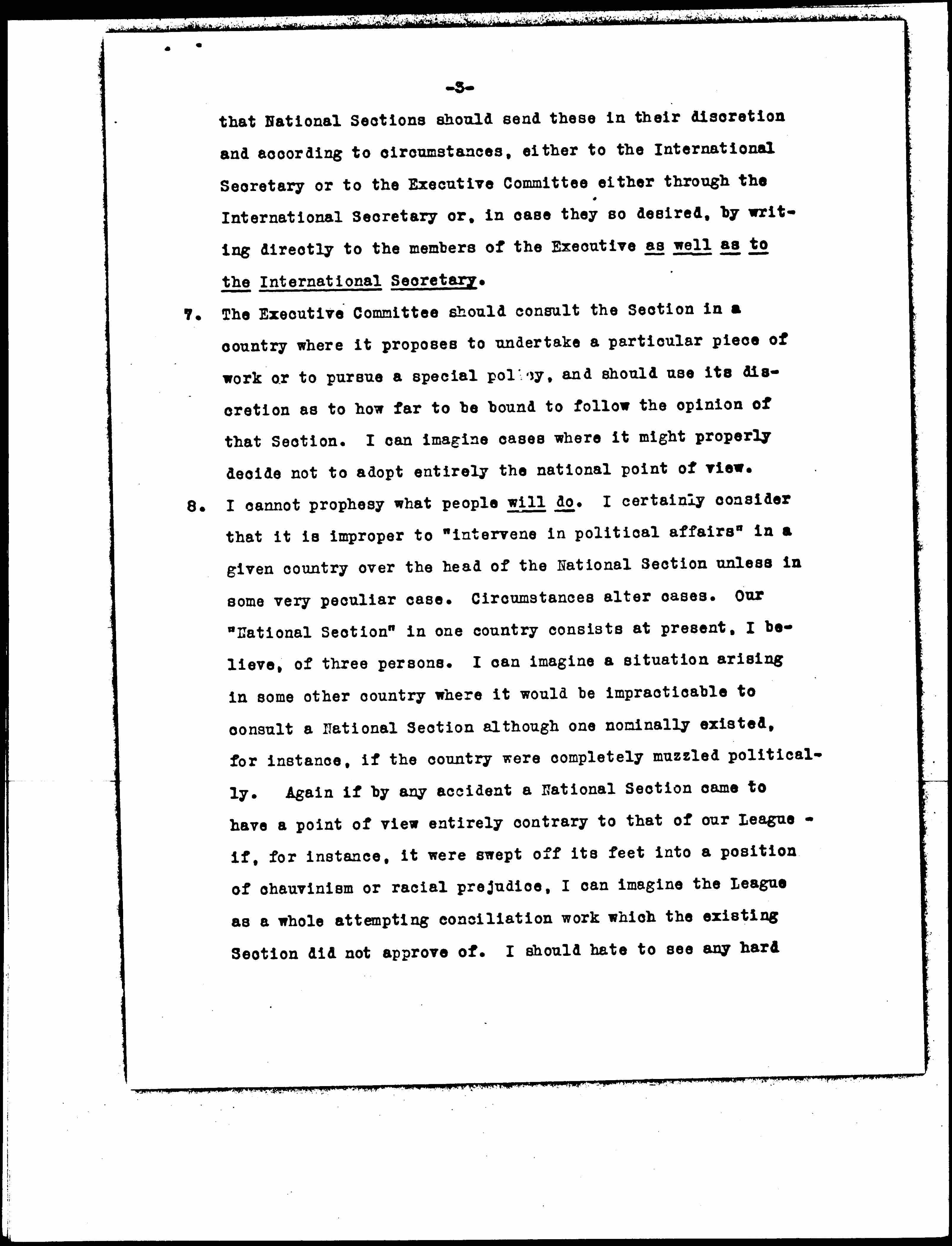
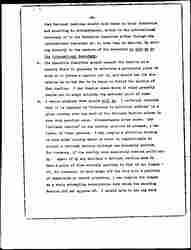
6. National Executives have no control except through a Congress over the policy of the International Board. They should feel free to make either suggestions, criticisms or protests. It seems to me [page 3] that National Sections should send these in their discretion and according to circumstances, either to the International Secretary or to the Executive Committee either through the International Secretary or, in case they so desired, by writing directly to the members of the Executive as well as to the International Secretary.

7. The Executive Committee should consult the Section in a country where it proposes to undertake a particular piece of work or to pursue a special policy, and should use its discretion as to how far to be bound to follow the opinion of that Section. I can imagine cases where it might properly decide not to adopt entirely the national point of view.

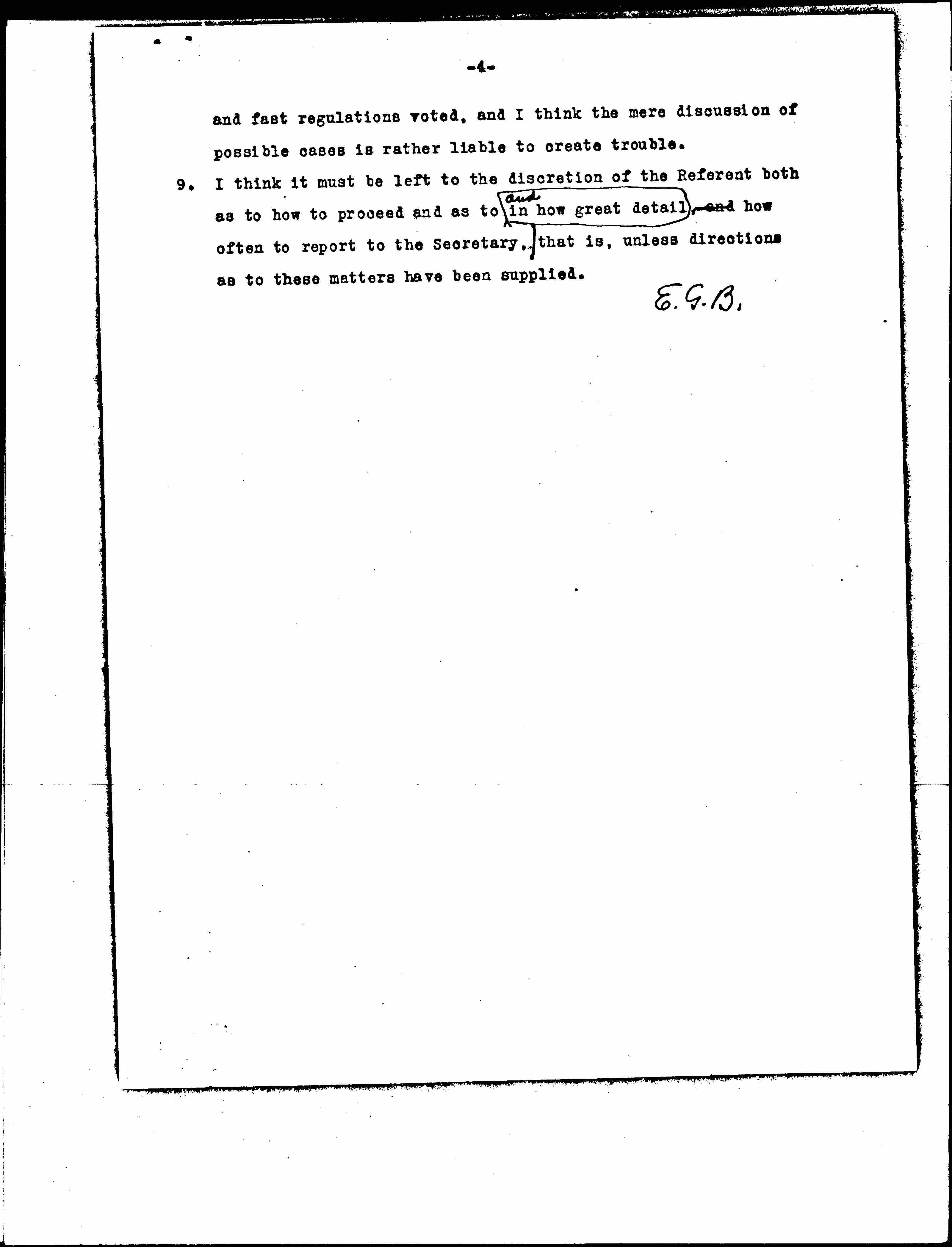
8. I cannot prophesy what people will do. I certainly consider that it is improper to "intervene in political affairs" in a given country over the head of the National Section unless in some very peculiar case. Circumstances alter cases. Our "National Section" in one country consists at present, I believe, of three persons. I can imagine a situation arising in some other country where it would be impracticable to consult a National Section although one nominally existed, for instance, if the country were completely muzzled politically. Again if by any accident a National Section came to have a point of view entirely contrary to that of our League -- if, for instance, it were swept off its feet into a position of chauvinism or racial prejudice, I can imagine the League as a whole attempting conciliation work which the existing Section did not approve of. I should hate to see any hard [page 4] and fast regulations voted, and I think the mere discussion of possible cases is rather liable to create trouble.

9. I think it must be left to the discretion of the Referent both as to how to proceed and as to and how often to report to the Secretary ↑and↓ in how great detail, that is, unless directions as to these matters have been supplied.

E. G. B. [initialed]

Item Relations

Comments

Allowed tags: <p>, <a>, <em>, <strong>, <ul>, <ol>, <li>