Emil Oliver Jorgensen to Jane Addams, May 16, 1927

38310.1.jpg
38310.2.jpg
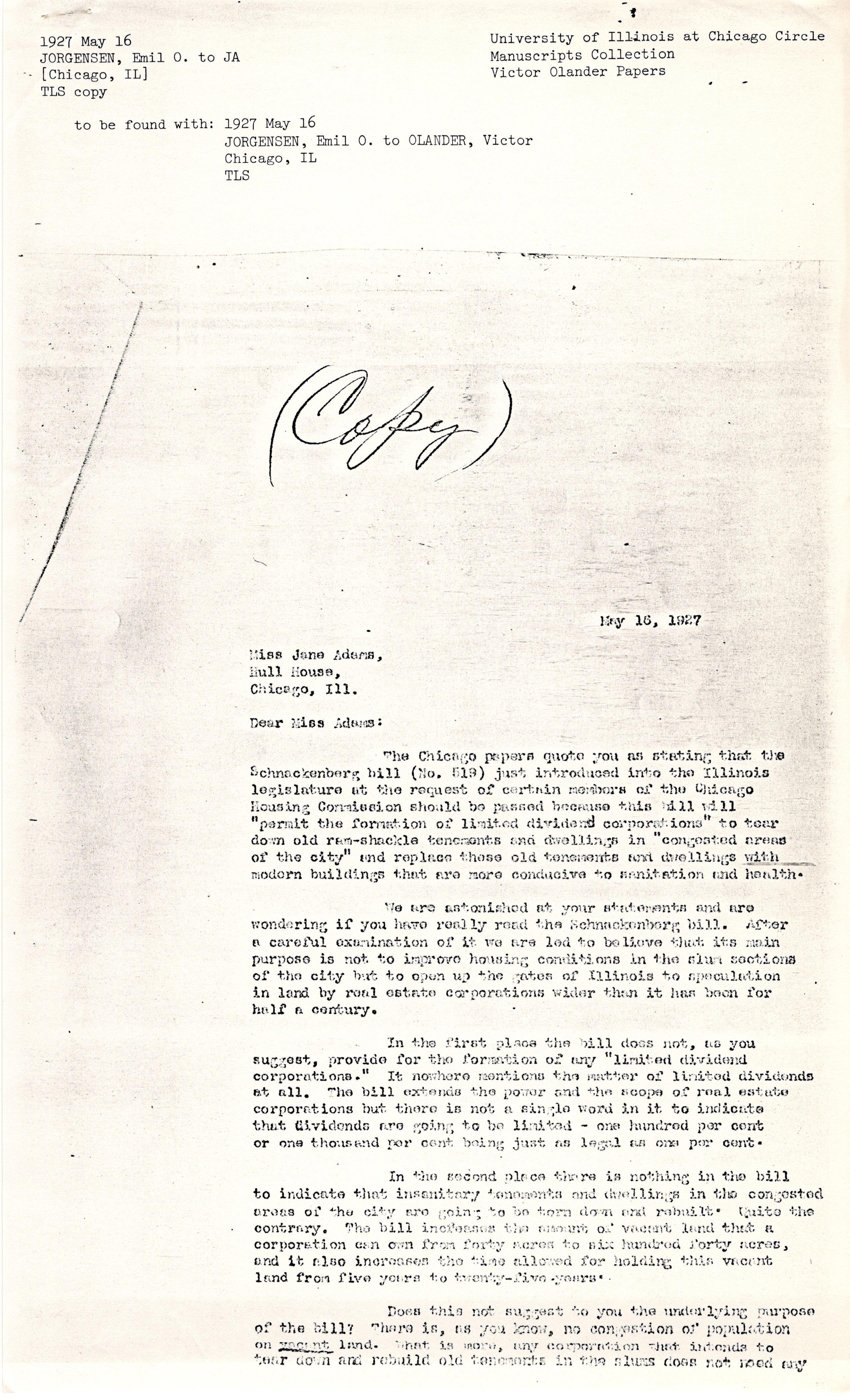
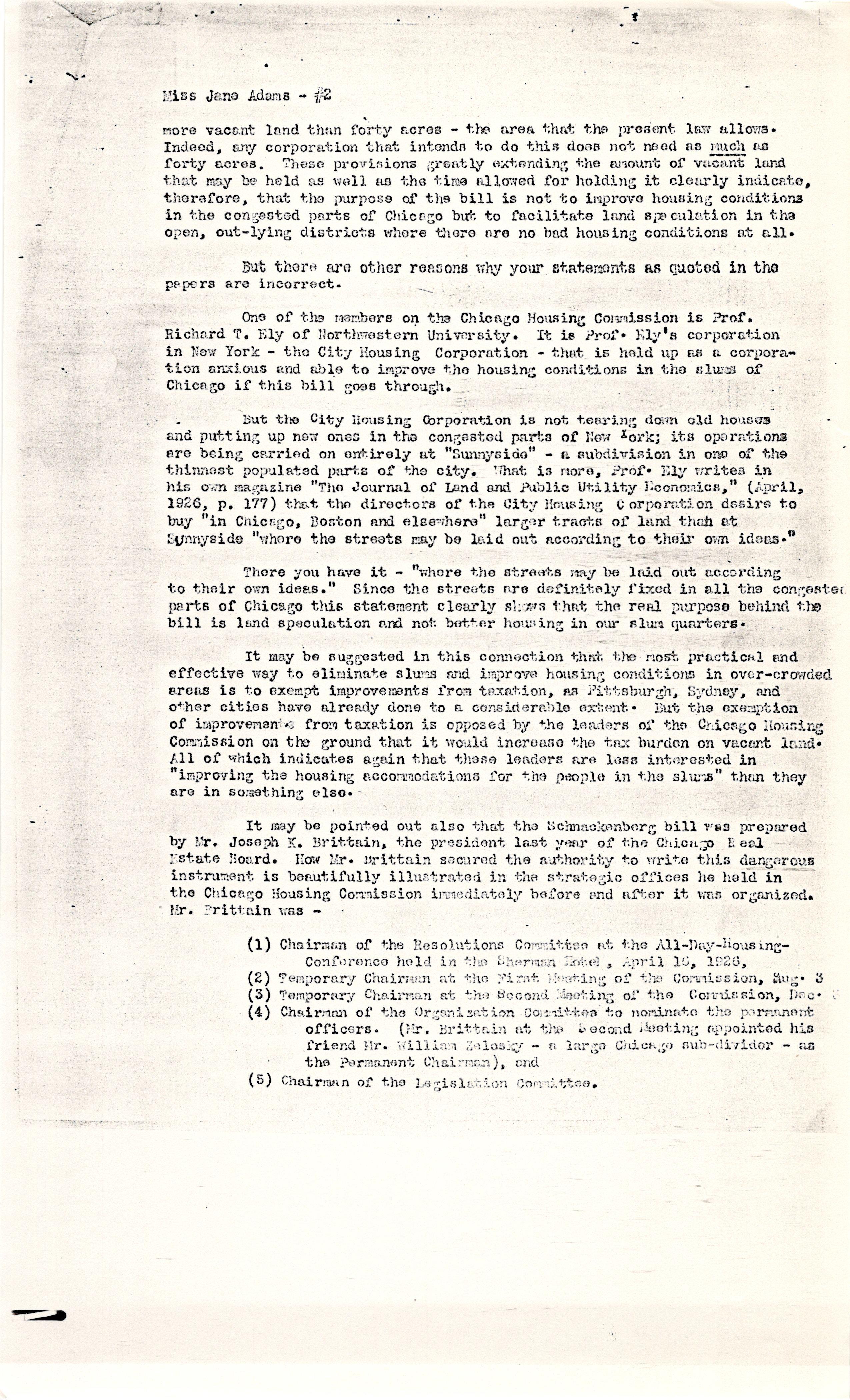
38310.3.jpg

(Copy)

May 16, 1927

Miss Jane [Addams],
Hull House,
Chicago, Ill.

Dear Miss [Addams]:

The Chicago papers quote you as stating that the Schnackenberg bill (No. 519) just introduced into the Illinois legislature at the request of certain members of the Chicago Housing Commission should be passed because this bill will "permit the formation of limited dividend corporations" to tear down old [ramshackle] tenements and dwellings in "congested areas of the city" and replace these old tenements and dwellings with modern buildings that are more conducive to sanitation and health.

We are astonished at your statements and are wondering if you have really read the Schnackenberg bill. After a careful examination of it we are led to believe that its main purpose is not to improve housing conditions in the slum sections of the city but to open up the gates of Illinois to speculation in land by real estate corporations wider than it has been for half a century.

In the first place the bill does not, as you suggest, provide for the formation of any "limited dividend corporations." It nowhere mentions the matter of limited dividends at all. The bill extends the power and the scope of real estate corporations but there is not a single word in it to indicate that dividends are going to be limited -- one hundred [percent] or one thousand [percent] being just as legal as one [percent].

In the second place there is nothing in the bill to indicate that [unsanitary] tenements and dwellings in the congested areas of the city are going to be torn down and rebuilt. Quite the contrary. The bill increases the amount of vacant land that a corporation can own from forty acres to six hundred forty acres, and it also increases the time allowed for holding this vacant land from five years to twenty-five years.

Does this not suggest to you the underlying purpose of the bill? There is, as you know, no congestion of population on vacant land. What is more, any corporation that intends to tear down and rebuild old tenements in the slums does not need any [page 2] more vacant land than forty acres -- the area that the present law allows. Indeed, any corporation that intends to do this does not need as much as forty acres. These provisions greatly extending the amount of vacant land that may be held as well as the time allowed for holding it clearly indicate, therefore, that the purpose of the bill is not to improve housing conditions in the congested parts of Chicago but to facilitate land speculation in the open, [outlying] districts where there are no bad housing conditions at all.

But there are other reasons why your statements as quoted in the papers are incorrect.

One of the members on the Chicago Housing Commission is Prof. Richard T. Ely of Northwestern University. It is Prof. Ely's corporation in New York -- the City Housing Corporation -- that is held up as a corporation anxious and able to improve the housing conditions in the slums of Chicago if this bill goes through.

But the City Housing Corporation is not tearing down old houses and putting up new ones in the congested parts of New York; its operations are being carried on entirely at "Sunnyside" -- a subdivision in one of the thinnest populated parts of the city. What is more, Prof. Ely writes in his own magazine "The Journal of Land and Public Utility Economics," (April, 1926, p. 177) that the directors of the City Housing Corporation desire to buy "in Chicago, Boston and elsewhere" larger tracks of land than at Sunnyside "where the streets may be laid out according to their own ideas."

There you have it -- "where the streets may be laid out according to their own ideas." Since the streets are definitely fixed in all the congested parts of Chicago this statement clearly shows that the real purpose behind the bill is land speculation and not better housing in our slum quarters.

It may be suggested in this connection that the most practical and effective way to eliminate slums and improve housing conditions in [overcrowded] areas is to exempt improvements from taxation, as Pittsburgh, Sydney, and other cities have already done to a considerable extent. But the exemption of improvements from taxation is opposed by the leaders of the Chicago Housing Commission on the ground that it would increase the tax burden on vacant land. All of which indicates that these leaders are less interested in "improving the housing accommodations for the people in the slums" than they are in something else.

It may be pointed out also that the Schnackenberg bill was prepared by Mr. Joseph K. Brittain, the president last year of the Chicago Real Estate Board. Now Mr. Brittain secured the authority to write this dangerous instrument is beautifully illustrated in the strategic offices he held in the Chicago Housing Commission immediately before and after it was organized. Mr. Brittain was --

(1) Chairman of the Resolutions Committee at the All-Day-Housing-Conference held in the Sherman Hotel, April 16, 1926,

(2) Temporary Chairman at the First Meeting of the Commission, Aug. 3

(3) Temporary Chairman at the Second Meeting of the Commission, Dec. 3

(4) Chairman of the Organization Committee to nominate the permanent officers. (Mr. Brittain at the Second Meeting appointed his friend Mr. William Zelosky -- a large Chicago [subdivider] -- as the Permanent Chairman), and

(5) Chairman of the Legislation Committee. [page 3]

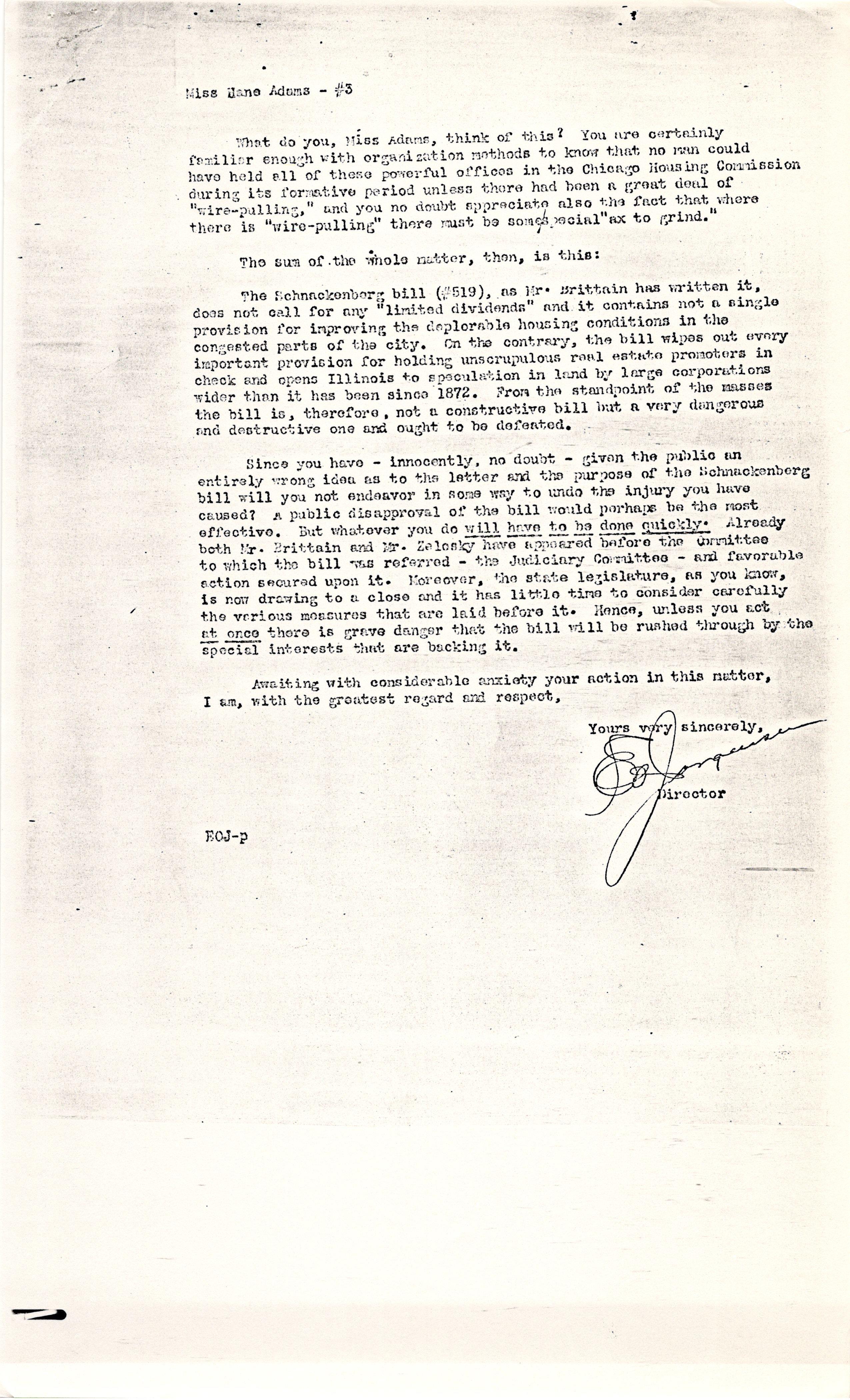
What do you, Miss [Addams], think of this? You are certainly familiar enough with organization methods to know that no man could have held all of these powerful offices in the Chicago Housing Commission during its formative period unless there had been a great deal of "wire-pulling," and you no doubt appreciate also the fact that where there is "wire-pulling" there must be some special "ax to grind."

The sum of the whole matter, then, is this:

The Schnackenberg bill (#519), as Mr. Brittain has written it, does not call for any "limited dividends" and it contains not a single provision for improving the deplorable housing conditions in the congested parts of the city. On the contrary, the bill wipes out every important provision for holding unscrupulous real estate promoters in check and opens Illinois to speculation in land by large corporations wider than it has been since 1872. From the standpoint of the masses the bill is, therefore, not a constructive bill, but a very dangerous and destructive one and ought to be defeated.

Since you have -- innocently, no doubt -- given the public an entirely wrong idea as to the letter and the purpose of the Schnackenberg bill will you not endeavor in some way to undo the injury you have caused? A public disapproval of the bill would perhaps be the most effective. But whatever you do will have to be done quickly. Already both Mr. Brittain and Mr. Zelosky have appeared before the Committee to which the bill was referred -- the Judiciary Committee -- and favorable action secured upon it. Moreover, the state legislature, as you know, is now drawing to a close and it has little time to consider carefully the various measures that are laid before it. Hence, unless you act at once there is grave danger that the bill will be rushed through by the special interests that are backing it.

Awaiting with considerable anxiety your action in this matter, I am, with the greatest regard and respect,

Yours very sincerely,

E. O. Jorgensen [signed]
Director

Item Relations