
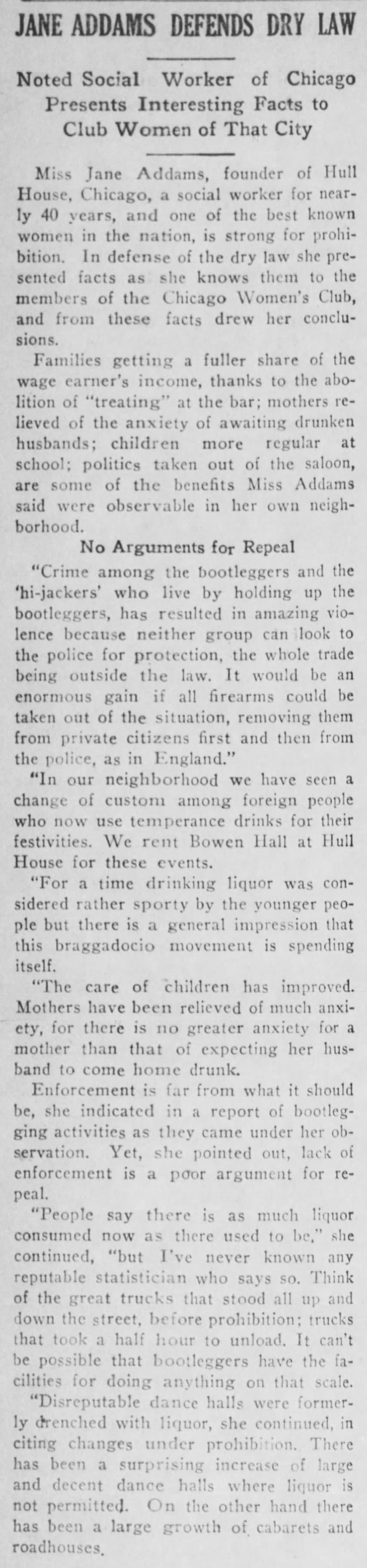
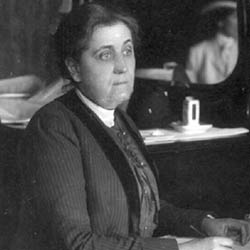
Miss Jane Addams, founder of Hull House, Chicago, a social worker for nearly 40 years, and one of the best known women in the nation, is strong for prohibition. In defense of the dry law she presented facts as she knows them to the members of the Chicago Women's Club, and from these facts drew her conclusions.
Families getting a fuller share of the wage earner's income, thanks to the abolition of "treating" at the bar; mothers relieved of the anxiety of awaiting drunken husbands; children more regular at school; politics taken out of the saloon, are some of the benefits Miss Addams said were observable in her own neighborhood.
"Crime among the bootleggers and the '[hijackers]' who live by holding up the bootleggers, has resulted in amazing violence because neither group can look to the police for protection, the whole trade being outside the law. It would be an enormous gain if all firearms could be taken out of the situation, removing them from private citizens first and then from the police, as in England.
"In our neighborhood we have seen a change of custom among foreign people who now use temperance drinks for their festivities. We rent Bowen Hall at Hull House for these events.
"For a time drinking liquor was considered rather sporty by the younger people but there is a general impression that this braggadocio movement is spending itself.
"The care of children has improved. Mothers have been relieved of much anxiety, for there is no greater anxiety for a mother than that of expecting her husband to come home drunk."
Enforcement is far from what it should be, she indicated in a report of bootlegging activities as they came under her observation. Yet, she pointed out, lack of enforcement is a poor argument for repeal.
"People say there is as much liquor consumed now as there used to be," she continued, "but I've never known any reputable statistician who says so. Think of the great trucks that stood all up and down the street, before prohibition; trucks that took a half hour to unload. It can't be possible that bootleggers have the facilities for doing anything on that scale.
"Disreputable dance halls were formerly drenched with liquor," she continued, in citing changes under prohibition. "There has been a surprising increase of large and decent dance halls where liquor is not permitted. On the other hand there has been a large growth of cabarets and roadhouses."


Comments