

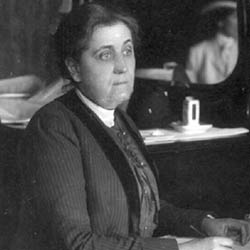
"Quick shooting is bringing a great discredit on the whole prohibition movement. It is my belief that all prohibition officers and agents should disarm," declared Jane Addams, noted settlement worker, in her address on prohibition before an audience of 500 persons at the Y.W.C.A. Friday night. Miss Addams' address was sponsored by the state and local social workers who are meeting in conference here Saturday.
Miss Addams' lecture, largely of interest to social workers and students of sociology, was based on the recent findings of a questionnaire, "Does Prohibition Work?" She discussed the effect year by year of the Volstead Act in Chicago, the city in which she founded Hull House, world famous social center, almost 40 years ago.
She pictured the old saloon days and the advent of prohibition. A great deal of prosperity was obvious in the first two years following prohibition, she said. Men brought home the unopened pay [envelope], more children went to school, students stayed in high school longer, and there was enormous [enrollment] in the colleges of the country.
The social leader told how, in the next two years, bootlegging got under way and distilleries started in the home. Women came into their own, getting enormous prices for the illicit liquor. In the third year this manufacturing left the kitchen and was carried on in small shops, warehouses, and barns, seemingly innocent places of trade, but in fact arsenals of protection against officers of the law and hijackers.
Miss Addams explained how social control has been lessened by the automobile, which she declared an enemy of the prohibition movement and responsible for the breakup of the home. The greatest amount of open drinking is outside the city limits of Chicago in the road houses and restaurants in which the automobile plays an important part as a means of transportation and also makes banditry much easier, she said. She discussed the effect of padlocking and the anti-Volstead Chicago newspapers on the progress of the movement.
She believes dropping the educational program on the general subject of intoxication is one of the most detrimental things this country has done to the progress of prohibition. Exempting prohibition officers from the civil services also has crippled the situation.
There is but 30 [percent] as much liquor manufactured now as before prohibition, Miss Addams stated on authority of experts on prohibition statistics.
The prevalent situation of young men who hold an aristocratic attitude toward drinking, of those who are "in the know as to where to buy their booze," of the social chaps who can mix their cocktails, the speaker touched upon.
"I will not vouch for the men but certainly the girls are very much more afraid of liquor and the men who use it than they were a few years ago," she said.
"If we fall down or take the negative attitude toward prohibition we will disappoint not only ourselves but the peoples of a great many other nations," she said.

Comments