233 results

  • Tags: Religion
  • Item Type: Text

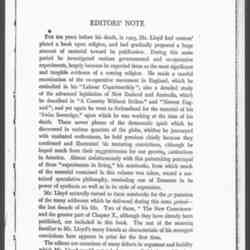
Addams and Withington introduce a posthumous publication of Henry Demarest Lloyd's recent writings on religion.

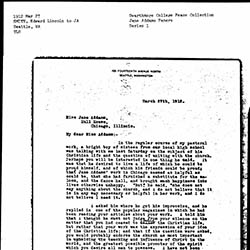
Smith writes Addams about a young man inspired by her work and asks her what role her Christian faith and religious beliefs inform that work.

Menkin writes Addams about writing an article on the Russian government's refusal to honor passports of Catholic or Jewish Americans.

Grece tells Addams that her speech failed to take into account Christian morality.

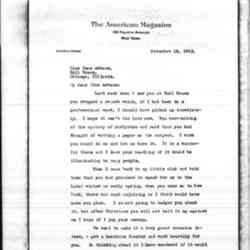
Bok asks Addams to revise an article submitted on religious education, asking her to edit it with an eye toward the appeal of a more general audience.

Bok again asks Addams to write an article about the church and sends his wishes that Twenty Years at Hull-House will have wide circulation.

Bok asks Addams to write an article for The Ladies' Home Journal on the moral and ethical issues currently involving the church.

Starbuck asks Addams for permission to include her work in a new series of books that the american Unitarian Association is compiling to further religious education.

McDougall wishes that she had been able to meet Addams when she visited the Woman's Christian College in Madras.

Swartz sends Addams wishes for recovery after her operation.

Evans admits to Addams that she now supports the need for World War I and is leaving the peace movement.

Frost relates personally to some of the subjects that Addams covers in Twenty Years at Hull House.

Balch tells Addams that she has joined the Society of Friends.

Balch sends Addams her research on Sidney Webb's religious background.

Mann writes about joining the Women's International League for Peace and Freedom, as well as political conditions in England.

This paper focuses on the relationship between ethics, economics, government, and religion.

Bacon praises Addams' book The Spirit of Youth and the City Streets and writes about the progressive activities in which the women of her town are engaged.

Addams sends a copy of her European mailing list to Hyers.

Adler tells Spencer that he is skeptical about Friedrich Foerster's plans for a pacifist school to be funded from outside Germany.

An outline for a book written by Martin on the Fellowship of Faiths.

An announcement of May programs and information about the Fellowship.

Peabody praises Addams's Peace and Bread in Time of War and her views on religion.

Mercer offers his help to the peace movement and emphasizes the importance of a devotion to God to establishing peace.

Article about the resolution for world peace at the National Council of Evangelical Free Churches in Bridlington.

Frohman proposes a law that would allow the presentation of plays on Sunday as long as they have a moral lesson.

Lazareff writes to Blackwell while sailing to Europe about bolshevism, communism, socialis and democracy m in Russia.

A poem asking for peace. It was originally published in the Advocate of Peace from March 1927.

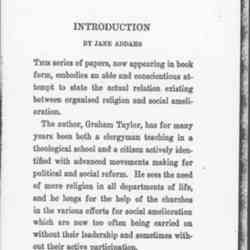
Taylor asks Addams to write an introduction to his book, a collection of essays published in the Survey.

Tuckerman informs Addams of his plans to leave his current church and find a new, more "liberal" church to continue his worship.

Smith tells Addams that despite the attacks in the press, many people support her work at Hull-House.

Barnett sends a notice to the National Federation of Settlements from a message that the late Samuel Barnett once delivered.

Read praises Addams and recalls seeing her speak while a student at Knox College.

Jackson tells Addams his ideas about the cause of crime, blaming in part the message in David Harum, an 1896 novel by Edward Noyes Westcott.

Palmer's poem questions how the world, that can create such beauty, can also breed such hate and violence. Addams comments appear at the bottom.

Kelly wishes to republish Addams article "The Church and the Social Evil," but he wants to verify a citation about St. Augustine first.

Kelly thanks Addams for sending him a book by Justus Hecker, a German physician and writer, and he shares some ideas on Catholicism, his writing, and a book he has been reading.

The Rocky Mountain News praises Hull-House and Jane Addams against criticisms that Hull-House is a "godless" and "Christless" institution.

Tarbell asks Addams to consider writing an article about martyrdom, a topic the two had discussed during Tarbell's last visit to Hull-House.

Also known as The Pageant of Emancipation, April 10, 1929

Addams discusses the progress of women and their importance to society in the western world and in Asia at a regional meeting of the Young Woman's Christian Association.

Also known as The Pageant of Emancipation, August 1929

Addams discusses the process of women's rights on a global scale, praising achievements in government, medicine, art, education, and social work. This talk was given at the University of Chicago chapel and later published.
The Council reports on activities at its meeting in Jerusalem.
Addams tells a reporter that India is failing to deal with its racial and religious problems.

Addams discusses Leo Tolstoy's "What Then Must We Do" in the light of societal changes.

Addams introduces and summarizes the content of Graham Taylor's book, provides some biographical information on Taylor, and praises the work.

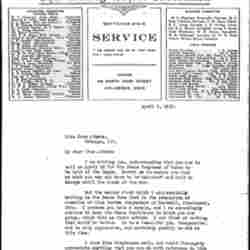
Darling writes Addams about his hopes that the Peace Dove be adopted by the peace conference at The Hague.

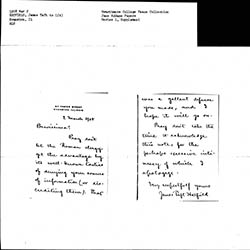
Hatfield offers Addams advice on dealing with claims that Hull-House is a bed of Anti-Catholic activism.

Browse tags for all documents:

Output Formats

Export results to CSV,