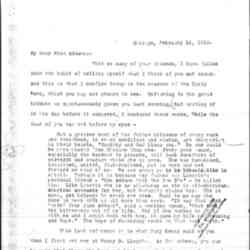
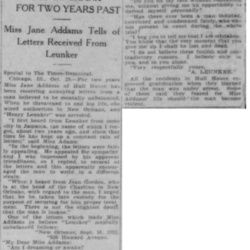
225 results

  • Tags: Public Opinion
  • Item Type: Text

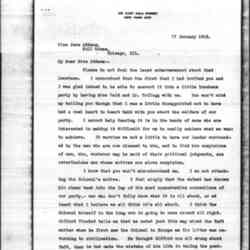
Addams writes Persons about the limitations of a new Illinois law to provide aid for poor parents with children.

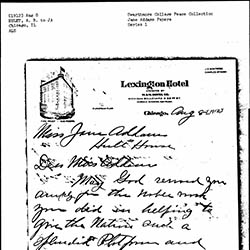
Boyd praises Addams for her McClure's articles on prostitution and boasts about his some of his own work for the common good.

Clarke praises Addams' series of articles in McClure's Magazine and shares the three principles she employs in her work with unmarried mothers.

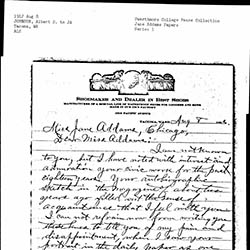
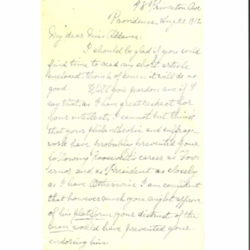
Bush laments that Addams mischaracterized the military's venereal disease problem in her article and offers his opinion on the subject.

Forbes thanks Addams for a copy of her latest book and asks her to return the manuscript she sent.

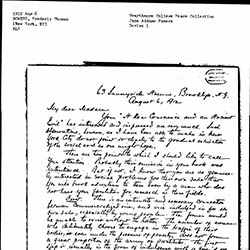
The author eviscerates Roosevelt for seeking a third term as President of the United States and chastises progressives for supporting him.

Gilman's supportive editorial about Theodore Roosevelt and his accomplishments.

Wilkins asks Addams if he can send her his manuscript for her critique.

Upon reading one of her articles in McClure's Magazine, Goldman writes Addams about the evils of flirtation and asks her to look into ways of preventing it.

Willets writes to Addams about what she sees as the negative impact of Addams' book about prostitution.

Bowers praises Addams' latest book, but offers a couple of points of constructive criticism.

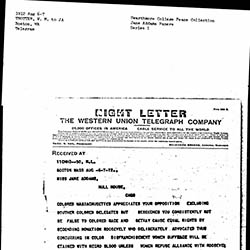
Trotter praises Addams' public opposition to the exclusion of black delegates at the Progressive Party Convention and asks her to consider opposing Theodore Roosevelt.

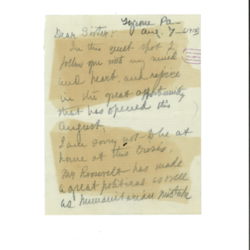
McDowell complains to Addams that Roosevelt made a mistake by courting white Southerners and ignoring the needs of southern African-Americans.

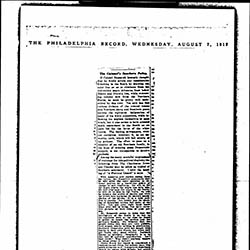
The editorial slams Theodore Roosevelt for drawing a color line in the Progressive Party.

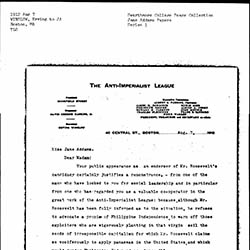
Winslow, on behalf of the Anti-Imperialist League, chastises Addams for supporting the imperialist Roosevelt for President.

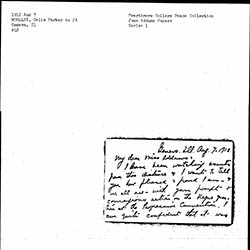
Woolley praises Addams for standing up for African-Americans at the Progressive Party Convention.

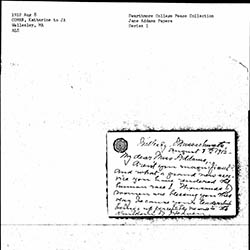
Coman praises Addams for her leadership, likely referring to Addams' work at the Progressive Party Convention.

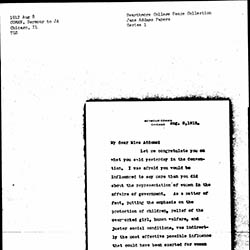
Coman congratulates Addams on her measured handling of the issue of woman suffrage in her speech at the Progressive Party Convention.

Hulet blesses Addams for her work on the Progressive Party Platform.

Johnson, a Socialist, writes Addams of his disappoint that she is supporting Theodore Roosevelt for President on the Progressive Party ticket.

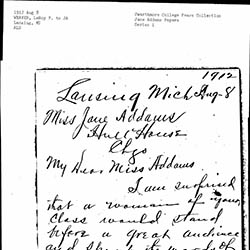
Weaver reprimands Addams for endorsing Theodore Roosevelt for President, whom he feels has greatly wronged President Howard Taft.

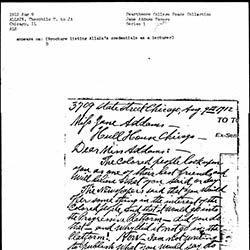
Allain asks Addams why the Progressive Party Platform abandoned African Americans.

Garland congratulates Addams for her speech at the Progressive Party Convention nominating Theodore Roosevelt.

Harvier congratulates Addams on her speech at the Progressive Party Convention.

Gordon refuses Addams' request to help the Progressive Party, because she believes Theodore Roosevelt in not genuine in his support of woman suffrage.

Gregory criticizes Addams for her support of Theodore Roosevelt and the new Progressive Party.

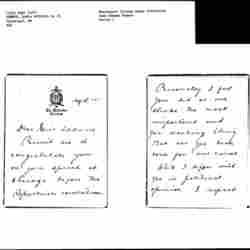
Shauck commends Addams for her speech at the Progressive Party Convention despite the fact that she personally disagrees with Addams' politics.

Peck warns Addams about Theodore Roosevelt and the poor chances of the Progressive Party to elect him president.

Breckinridge notes that Addams will consider the views sent by Hubbard.

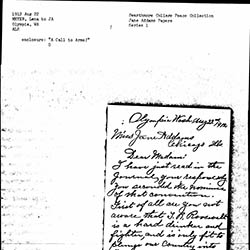
Meyer writes Addams to share her disapproval of Theodore Roosevelt, whom she believes is an immoral man and the wrong candidate for the betterment of the country.

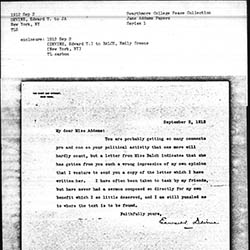
Devine writes Addams to explain a wrong impression regarding his feelings about her involvement in Progressive Party politics.

Devine tells Addams that he revised an editorial and that Taft wanted to appoint her as a member of the Industrial Commission.

Harper writes Addams to explain something erroneous attributed to her in the newspaper, which were critical of Addams. She also criticizes Addams for seconding Roosevelt.

Beals is disappointed that Addams cannot attend their reception because she will be working for the Progressive Party, and believes the Baroness von Suttner should not have publicly criticized Addams for her political beliefs.

Addams discusses elections and the role of partisan politics, arguing that political pragmatism is required for social action.

Addams discusses elections and the role of partisan politics, arguing that political pragmatism is required for social action.

Cozens-Hardy thanks Addams for her strong Progressive Party speech in New York.

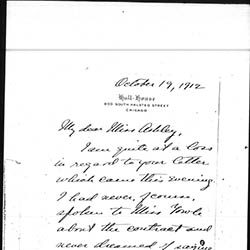
Addams answers Ashley's letter of October 17, claiming that she did not do the things that Ashley alleged.

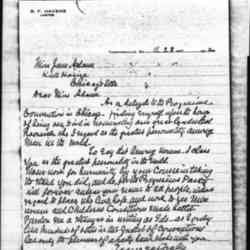
Havens, a delegate to the Progressive Convention in Chicago, praises Addams for her work and shares his great respect for her.

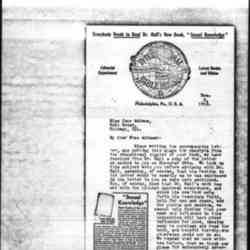
Conrad writes Addams about her introduction to Dr. Hall's book and the positive impact her influence will have upon it.

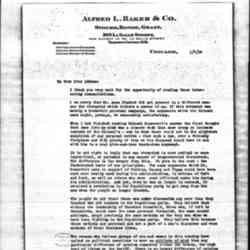
Baker writes Addams about his concerns of the leadership and direction of the Progressive Party, arguing that it may not be that different from the Democratic Party in terms of the character of the leadership.

Kingsbury asks Addams to voice concerns about Theodore Roosevelt's ability to lead the Progressive Party.

Baker returns to Addams some letters she lent him (not found) and suggests that her reputation is the strongest asset for the success of the Progressive movement.

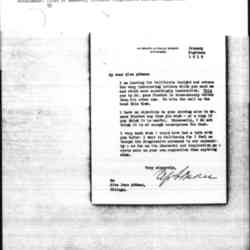
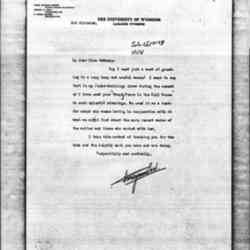
Hebard praises Addams' work and Twenty Years in the Hull House, which she read for her sociology class at the University of Wyoming.

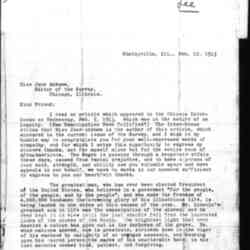
Lee thanks Addams for her statement in the article Has "Has Emancipation Been Nullified," and praises Abraham Lincoln, and discusses slavery and the virtues of liberty.
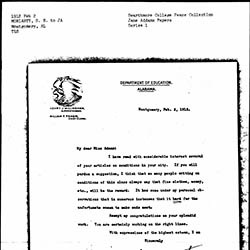
Taylor praises Addams and encloses the text of an article he wrote on her for the Chicago Daily News.
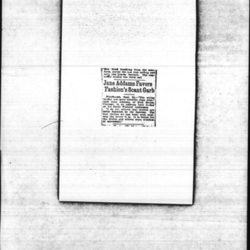
Addams asserts that the changing fashion is not degrading to women, rather freedom of movement in modern clothing is a good for a woman's health.

Browse tags for all documents:

Output Formats

Export results to CSV,