16 results

  • Tags: Philosophy
  • Item Type: Text

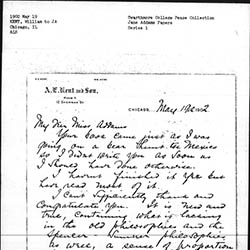
Kent writes Addams to praise her book, Democracy and Social Ethics.

Jones writes to Addams about his experience with simple living and his philosophical realizations.

James writes Addams to praise her book, Democracy and Social Ethics.

Addams argues that if the rulers of European countries lived among their people, they would see that labor and commerce were what made nations, not its military might.

Addams discusses the role that education plays in the life of the workingman. This article is an excerpt from Democracy and Social Ethics.

Addams delivered this commencement address at the University of Chicago on December 20, 1904, the first woman to be a commencement speaker at the college.

Addams and Withington introduce a posthumous publication of Henry Demarest Lloyd's recent writings on religion.

Addams publishes the first chapter of Newer Ideals of Peace, in Charities and the Commons, arguing for a new approach to peace propaganda. She makes a direct appeal to sentiments and opinions to oppose the exploitation of the weak and to reject of blind militarism.
Marot discusses the creation of the American Internationalist, a new publication she hopes to start.

Marot asks Addams about the viability of forming a new journal of modern American philosophers, and seeks Addams' help in raising funds for it.

Wallas asks Addams to meet his brother in law, J. H. Muirhead and advise him on his planned trip to the United States.

Addams criticizes William Durant's theory that people peak early in their lives.

Addams discusses Leo Tolstoy's "What Then Must We Do" in the light of societal changes.

Addams praises the works of Leo Tolstoy and shows how they relate to modern society.

Addams discusses the future of social work and comments on the Southwest.

Browse tags for all documents:

Output Formats

Export results to CSV,