Addams explores lessons learned from the 19th century, and sees the greatest menace for the future as the lack of faith in the people and an over reliance on national pride.
Addams explores lessons learned from the 19th century, and sees the greatest menace for the future as the lack of faith in the people and an over reliance on national pride.
Addams publishes the first chapter of Newer Ideals of Peace, in Charities and the Commons, arguing for a new approach to peace propaganda. She makes a direct appeal to sentiments and opinions to oppose the exploitation of the weak and to reject of blind militarism.
Addams describes the current moral situation of American youth as a result of the current education and religious situations. This speech was also given before the Chicago Sinai congregation.
Addams discusses her childhood, the influence of her father and Lincoln, and her early thoughts on morality and responsibility to the community. This is the first of six articles excerpted from Twenty Years at Hull-House.
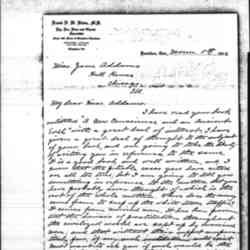
Roosevelt compliments Addams's article in McClure's, which argues that woman's suffrage will lift up women from vice. But he also offers a caution that women's suffrage could fail to impart real change as suffrage failed to impart real change for African Americans in the South.
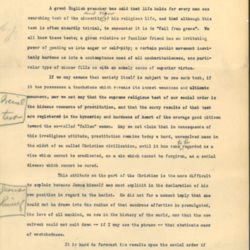
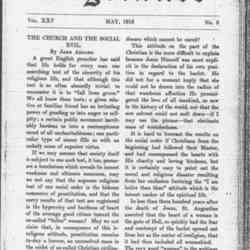
A reprint of Addams' speech to the Congress of Men and the Religion Forward Movement chastises the church for rejection aid to "fallen" women and asks for a return to the teachings of Jesus, who opened his heart to all sinners.
Addams expounds upon the role of religious education in keeping youth from vice and examines the difficult standards to which young women are held. This is the third in a five-part series, which would ultimately be published as A New Conscience and an Ancient Evil later in the year.
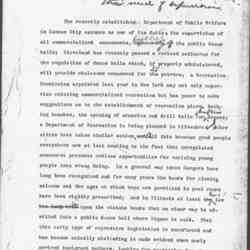
Page proofs of "Chapter V: Social Control," the final article in a five-part series, which would ultimately be published as A New Conscience and an Ancient Evil later in the year.
Addams discusses how social movements can help alleviate vice, providing examples such as crusades against diseases and organized opposition to the white slave trade. This is the final article in a five-part series, which would ultimately be published as A New Conscience and an Ancient Evil later in the year.
Addams' speech to the Congress of Men and the Religion Forward Movement chastises the church for rejection aid to "fallen" women and asks for a return to the teachings of Jesus, who opened his heart to all sinners. The speech was also published inVigilance.
Addams' speech to the Congress of Men and the Religion Forward Movement chastises the church for rejecting aid to "fallen" women. She calls for a return to the teachings of Jesus, who opened his heart to all sinners. The speech was later published in Messages of the Men and Religion Movement and in Vigilance.
A published version of Addams' speech to the Congress of Men and the Religion Forward Movement chastises the church for rejection aid to "fallen" women and asks for a return to the teachings of Jesus, who opened his heart to all sinners. The speech was also published in Messages of the Men and Religion Movement.
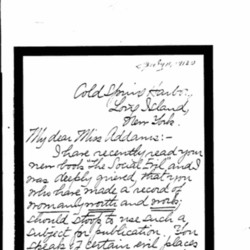
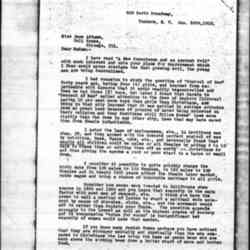
Willets criticizes Addams for writing about prostitution in her latest book, A New Conscience and an Ancient Evil and demands that she cease publishing it to protect morality.
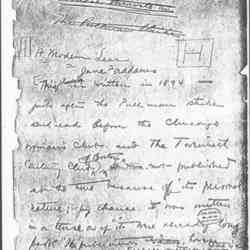
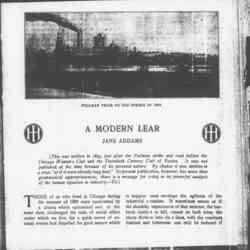
Addams' 1894 talk on the Pullman strike was only published in 1912 in the Survey. She analyzes the strike, drawing comparisons between George Pullman and his workers, and Shakespeare's King Lear and Cordelia.
In 1894, Addams gave a speech to the Chicago Woman's Club and the Twentieth Century Club about the Pullman strike. The speech was not published until 18 years later, in the November 1912 Survey. In it, she draws comparisons between the key players in the strike, particularly George Pullman, and Shakespeare's dysfunctional royal family.
Addams argues for the regulation of public recreation to provide safe venues for women, youth, and communities. This is the seventh article of a monthly, year-long series on economic and social reform in America and how women can affect change.
Addams exposes the double standard applied to women who break society's moral codes and argues for a more charitable view of women and a better understanding of their economic circumstances. A version of this was published in November 1913.
Addams exposes the double standard applied to women who break society's moral codes and argues for a more charitable view of women and a better understanding of their economic circumstances. This is the eleventh article of a monthly, year-long series on economic and social reform in America and a woman's role to affect change.