434 results

  • Tags: Immigrants

Addams describes the positive impact of Prohibition and argues for better enforcement and disarmament in order to improve things.

Addams uses the story of the devil-baby to discuss how the beliefs in fairy tales are still an influencing factor in people's thinking.

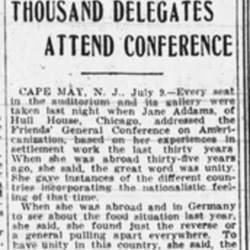
Addams discusses America's changing attitudes towards immigrants. Addams's speech was the annual Ware Lecture of the Unitarian Universalist Association.

Addams gives a lecture on the history and evolution of social reform in the United States and internationally. This was the Ware Lecture delivered at the American Unitarian Association meeting in Boston.

Arguing that white slavery requires an organized movement to defeat it, Addams provides examples from cases in Chicago. This is the first in a five-part series, which would ultimately be published as A New Conscience and an Ancient Evil in 1912.

An excerpt from Addams's remarks at a January 12 City Club Housewarming, focused on Civic Associations' Night, where she discusses how civic associations can be bridges to connect diverse communities.

A summary of Addams' address about Hull-House and its relationship with the neighbors it supports.

Addams' speech at the Chicago Child Welfare Exhibit, on the Hull-House Labor Museum's exhibit.

Addams speaks to the Franklin Street Settlement in Detroit about working in a settlement.

Addams defends both the delinquent and immigrant girl in a speech to the League of Women Voters.

Addams contrasts the way immigrants are treated in the United States in the 1890s and 1920s.

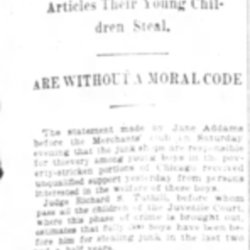
With Maud Booth, Addams addresses the Merchant's Club, appealing for aid in helping criminals and rescuing boys who may become criminals.

Also known as The Church and the Social Problem, September 25, 1901

Addams recalls the different difficulties in creating an inviting and educational space for Italian immigrants.

Addams speaks to the North Broadway Social Settlement about how she runs Hull-House.

Addams' keynote speech at the University Settlement's annual meeting discusses the kind of settlements that build relationships and community.

Sabath cables Addams that Congress passed a bill to place an immigration station in Chicago.

In this address given at the 13th Annual Conference for the Study of the Negro Problems held at Atlanta University, Addams discusses the difficulties immigrants face in Chicago.

Ford tells Addams his view of Eleanor Hinder's resignation from the Pan-Pacific Union.

Kuttner thanks Addams for her stand on peace and discusses the ethnic divisions that the war has brought to America.

Also known as American National Alliance of Czechoslovaks

Also known as American Relief for the German People

Addams argues that American women are behind their European peers with regard to individual rights.

Addams' discussion of the impact of dogmatic nationalism in the light of anti-immigrant sentiment. This paper was given to the American Sociological Society.

Addams discusses the impact of dogmatic nationalism in the light of anti-immigrant sentiment. This paper was given at the American Sociological Society meeting, held in Chicago from December 29-31, 1919.

A draft of Addams' discussion of the impact of dogmatic nationalism in the light of anti-immigrant sentiment. This paper was given at the American Sociological Society meeting, held in Chicago from December 29-31, 1919.

Addams' discussion of the impact of dogmatic nationalism in the light of anti-immigrant sentiment. This paper was given to the American Sociological Society.

Addams discusses the way Americans should view immigrants and European relief efforts.

Edinger asks Addams to help German emigrees who will be settling in Chicago.

An excerpt of Addams' lecture on how settlement houses give people opportunities to practice arts and crafts, an important activity for immigrants afraid of losing their cultural heritage.

Excerpts from Addams' speech on educational opportunities wasted due to discrimination against immigrants.

An editorial supports most of Charles Ferguson's takes on radicalism, but does not support his idea that colleges promote radicalism.

Addams writes about finding a location for her settlement and the early days of settling into the neighborhood and developing the ideas for their work. This is the third of six articles excerpted from Twenty Years at Hull-House.

Addams talks about the settlement as a bulwark against anti-immigrant persecution, using examples of Russian anarchists.

Addams discusses the many programs at Hull-House that appeal to its immigrant neighbors and the additional value that their neighbors bring to the programs.
Output Formats

Export results to CSV,