391 results

  • Tags: Criticism

Kellogg reports on Louis Brandeis's attacks on the Progressive Party.

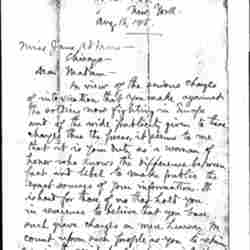
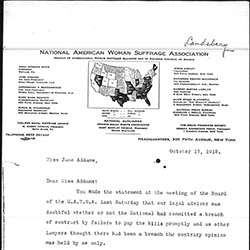
Ashley protests against Addams for making a statement attacking Mary Towle at a board meeting of the National American Woman Suffrage Association.

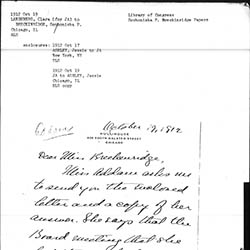
Landsberg, writing for Addams, sends Breckinridge two letters regarding a misunderstanding at a recent meeting of the board of the National American Woman Suffrage Association.

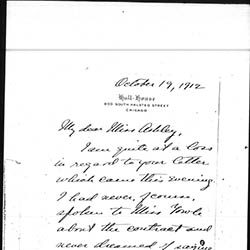
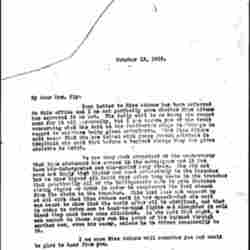
Addams answers Ashley's letter of October 17, claiming that she did not do the things that Ashley alleged.

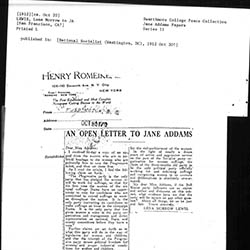
Lewis criticizes Addams and the Progressive Party for claiming to be the only party supporting women's suffrage, as the Socialist Party has supported the suffrage movement since its founding in 1901.

Also known as The Army Gets Busy, November 2, 1912

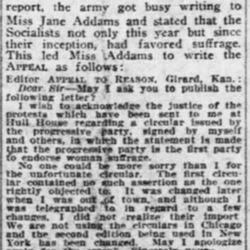
Addams apologizes for inaccurate information about the Socialist Party's endorsement of woman suffrage, which the Progressive Party circulated. The editor of the Appeal to Reason comments both before and after the published version of her letter.

Pelham responds to Bennett's harsh critique of the Hull-House Players.

Hibben provides a detailed explanation for his resignation from the Progressive National Service, citing the dysfunction and inadequacies of the Chief of Service, Frances Kellor.

Armstrong expresses his beliefs about the peace movement and the causes of the current war.

Catt apologizes to Addams because she did not know that there was another conference planned in Washington, D.C and it has caused confusion.

Ayres urges Addams to reconsider her stance on the inclusion of the suffrage plank in the Woman's Peace Party platform.

Plumptre, on behalf of the National Committee of Women's Patriotic Service, criticizes Addams about her views on peace and informs her about an open letter published in Canada.

Lynch praises Addams' Carnegie Hall speech and hopes that they can organize a peace conference before she returns to Chicago.

Wald describes the efforts she and others are making to defend Addams against attacks regarding her Carnegie Hall speech.

Rogers criticizes Addams' charges about intoxicated soldiers and asks her to make her sources public.

Evans sends an appeal to Massachusetts newspapers asking for support for Addams's contention that soldiers in Europe were given alcohol before bayonet charges.

Schwimmer complains about attacks on her. This letter is a draft that may not have been sent.

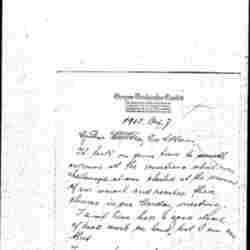
Hyers replies to Ely's letter to Addams asking for more detail about her comments on the use of stimulants in trench warfare.

Addams discusses her statement on soldiers using stimulants before engaging in battle and the reaction that followed. Addams likely made the statement a few days before the article was published.

News report of Powys' speech before women pacifists that insulted them as "cowards, fools and knaves"

Catt explains her reasons for not accepting Addams' invitation to be a representative on the International Council for Permanent Peace.

Spencer expresses her concerns and voices her suspicions to Addams in regards to the Henry Ford peace plan.

Jacobs updates Addams on issues coming up with the International Committee of Women for Permanent Peace, financial concerns and personality issues.

Atkins criticizes Addams' peace efforts as shallow and coercive.

Bradford thanks Addams for sending her The Women at the Hague, and praises the book.

Schwimmer reports problems with Aletta Jacobs and other pacifists that endanger the success of Ford Peace Ship expedition and hopes that Addams can intervene.

Redfield thanks Kent for the information on the International Congress of Women he sent.

Heskett believes that the war is a symbol of the end of time, based off his understanding of certain Bible passages.

Glücklich expresses her surprise at the small amount of American delegates in Sweden, and asks Addams if the others would be able to hurry.

De Wolf refuses to fund Hull-House's camp program because of his disapproval of Hull-House's support for workers and unions and calls for it to divorce itself from politics, labor issues, and religion.

Addams tells Kellogg about letters she has received about the peace movement.

Bowen responds to de Wolf's criticism of Hull-House with a defense of the motives of the residents and its action during labor strikes.

Addams has some edits for Schütze's pamphlet and asks Thomas to have her wait before publishing it. Addams will be traveling in October for a series of meetings.

Addams criticizes a study to be supported by the Woman's Peace Party and wants do discuss it at a meeting of the Executive Committee.

Jacobs and Manus criticize Addams for overstepping her role as president of the International Committee of Women for Permanent Peace.

Unknown writers comment on Jacobs's issues with Addams and notes Headquarters' neglect in doing its duty, thus forcing Addams to take action.

Addams asks Balch's advice on responding to Aletta Jacobs's angry letter of December 16, 1916.

Lochner expresses to Addams the stress that he has been under and discusses his views on the European allies of the United States

Sherman tells Addams that he believes a referendum vote for peace would not do any good, even though he sees war as a last resort.

Denison expresses her opposition to Addams's request to demand a referendum from President Wilson because of the current political climate in the U.S. and the need to build defense against Germany.

Vermilye criticizes Addams's request for a referendum and explains that there are some times when war is necessary to protect the nation.

Thacher argues that Barrett's recent speech was unfair in his criticism of Addams and based upon a misinterpretation of a 1915 speech.

Atkinson criticizes Addams's continued work for peace, claiming that the time has come to support the war effort.

The Tribune reports on Orrin Carter disagreement with Addams during her speech In Evanston.

Hopkins urges Addams to cease speaking against the war.

Moore hopes Addams won't be discouraged by press reaction to her speech.

Schwartz informs Addams about the Charles Kimball estate bequest to Hull-House and condemns Orrin Carter's criticism of Addams.

Strong praises Addams' address in Evanston.

Christie accuses Addams of being overly emotional and disagrees with her statements about German-Americans and the entry of the United States in World War I.
Riddle sends Addams a hostile article and offers information about the author.
Output Formats

Export results to CSV,