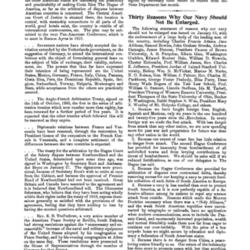
Addams gave this speech at a public meeting held by the Society for the Promotion of Industrial Education, at Cooper Union, along with Henry Pritchett, Frank Vanderlip, Frederick Fish, Nicholas Murray Butler, Frank P. Sargent, and others. Addams' appeal, unlike the other speakers, identified with the plight of working people and argued that industrial education would better their lives.
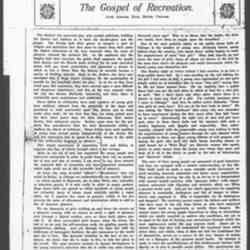
Addams' lectures at the founding meeting of the National Society for the Promotion of Industrial Education on November 16, 1906, at Cooper Union, commenting on the need for practical education that works in the modern world. The speech was published in January 1907.
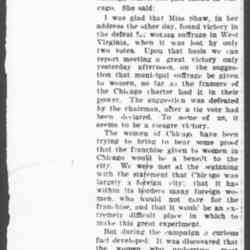
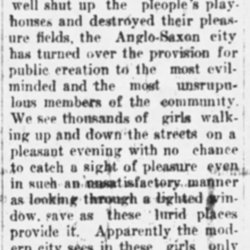
A newspaper report and excerpts from Addams' February 17 speech at the National Suffrage Convention, after the defeat of municipal suffrage for women in Chicago.
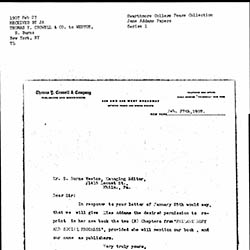
Crowell grants Addams permission to reprint her two chapters from Philanthropy and Social Progress in her new book as long as she includes proper citation.
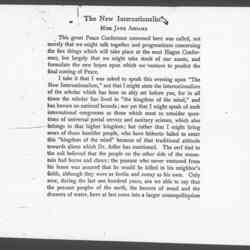
Addams' second speech at the National Arbitration and Peace Congress, given at the University Session. The speech discusses changes in society that make the ground fruitful for peace movements. The speech was published in the conference proceedings.
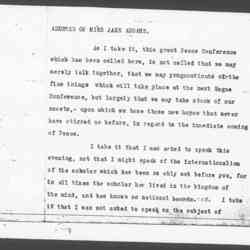
A stenographic transcription of Addams' second speech at the National Arbitration and Peace Congress, given at the University Session in which she argues that the moment for peace activism is here and can best be led from America.
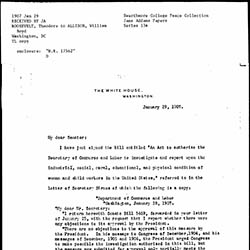
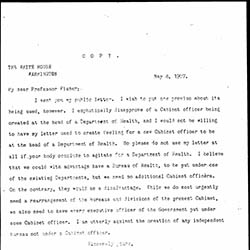
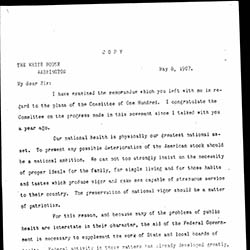
Roosevelt writes Fisher about his opposition to creating a new cabinet position for a department of health, arguing instead for placing it under the guise of an existing cabinet position.
Addams recalls stories from her childhood meetings with Civil War Colonel John A. Davis, as part of a dedication of a guest chamber at the Abraham Lincoln Center settlement in his honor. The speech was published in a pamphlet on the event.
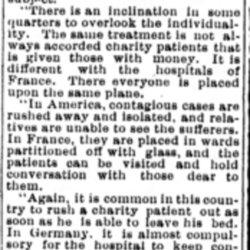
Addams's speech to the American Hospital Association meeting, held in Chicago on September 17, 1907 was later published in the organization's journal. In her talk Addams discusses prejudice against the poor in hospitals and their reluctance to seek care from hospitals.
Addams' speech to the American Hospital Association meeting, held in Chicago on September 17, 1907 was published in the organization's journal. In her talk Addams discussed the prejudices against the poor in hospitals and their reluctance to use them.
Addams introduces a discussion about the purposed of social settlements at the Abraham Lincoln Centre. The event celebrated the twenty-fifth anniversary of Jenkin Lloyd Jones' pastorate.
Addams discusses the benefits of suffrage and how the vote will benefit immigrant women living in tenement houses. This lecture was made before the Ethical Culture Society at New Century Hall in Philadelphia on March 14, 1908 and published later.
An excerpt from Addams' March 22 speech at Faneuil Hall to the Boston Equal Suffrage Association and the Women's Trade Union League on the changes in women's work brought about by factory work.
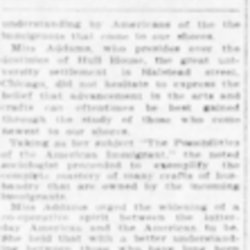
Addams discusses the association in the public eye between settlements and immigrants and when immigrants are involved in high profile crimes, settlements are accused of supporting anarchism. Addams defends the role of the settlement as the bridge between immigrant communities and the American public, holding that it does not change in times of crisis.
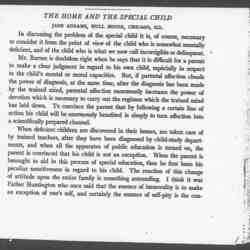
Speaking to the National Education Association meeting, Addams discusses her thoughts on educating mentally, morally or physically "deficient" children.
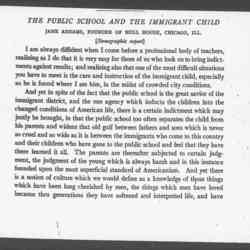
In this address, given to the Annual Meeting of the National Education Association in 1908, Addams speaks of the importance of education within the immigrant community and the role of teachers as bridges between the families of students and American society.
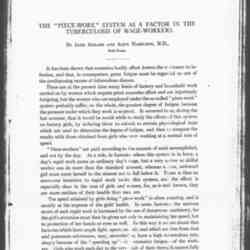
At the Sixth International Congress on Tuberculosis in Washington, D.C., Addams and Hamilton discuss "Economic Aspects of Tuberculosis" and why people living in poverty are more susceptible to the disease.
Addams is one of the signers of a leaflet, arguing against the enlargement of the U.S. Navy. Shortened versions of this leaflet were also published in newspapers.
Addams argues for the establishment of a federal bureau for the protection of children, especially regarding the issues of child labor and education. This is a published version of Addams's speech to the National Child Labor Committee meeting in January 1909.
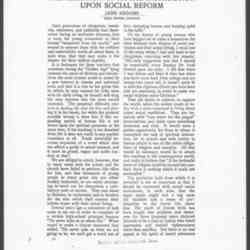
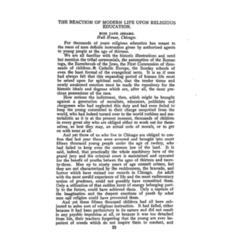
Addams describes the current moral situation of American youth as a result of the current education and religious situations. This speech was also given before the Chicago Sinai congregation.
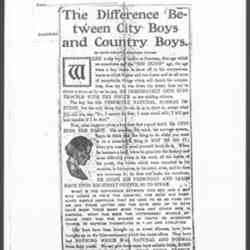
Addams argues that young boys need an outlet for their pent-up energy and adventurousness, and that without an outlet, like a playground, they are susceptible to petty crime.
Addams pays tribute to Theodore Parker at a Memorial Banquet in Chicago, where she praised his anti-slavery work and support of black suffrage, blamed his generation for not extending suffrage to women, and surmised that Parker would have ultimately supported the franchise for women had he lived longer.
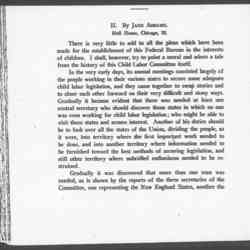
Addams' lecture on March 12 at the National Child Labor Committee Conference in Birmingham, Alabama, in which she discusses child labor legislation in Illinois.