3349 results

  • Title starts with "S"

Jones requests that Addams dine with him in Toledo within the next month.

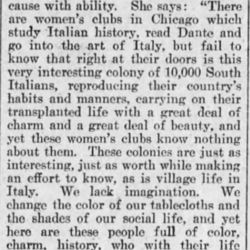
Addams summarizes the life and background of Italian immigrants living in Chicago.

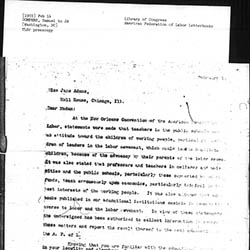
Gompers writes regarding the American education system and its attitude towards children and labor. He requests that Addams send him any information relevant to the issue.

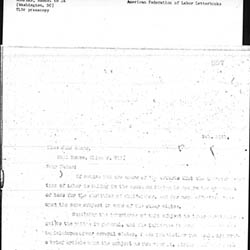
Gompers requests and article about child labor for the American Federationist, in order to gain public attention and sympathy.

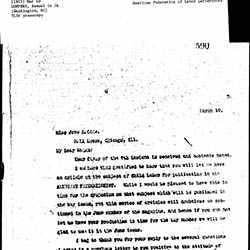
Gompers thanks Addams for writing an article on child labor to be published in the American Federationist.

Addams comments about child labor, pointing out the difference between the educational opportunities child workers had a generation ago versus those working in factories in 1903.

Newspaper account of Addams' statement on raising of women's clubs funds to support child care for widows attending school.

Jones responds that he will attend the Henry Lloyd Memorial.

Addams discusses which widows can be granted scholarships for their children.

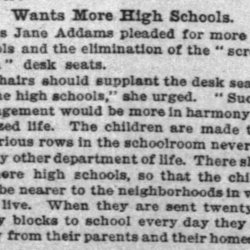
Addams argues for more high schools with better furnishings.

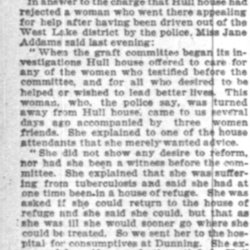
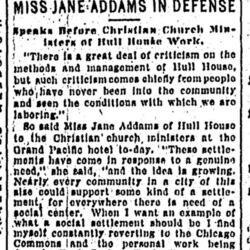
Addams denies an accusation that Hull-House turned away a woman appealing for help.

The Chicago Daily Tribune, summarizes Addams' talk to the Chicago Bureau of Charities on the morality of charity.

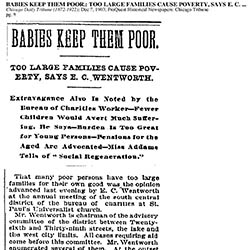
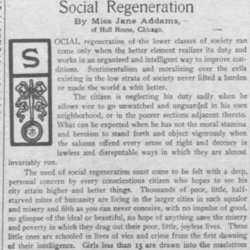
Addams argues the lower class can only be raised up if everyone in the community takes a interest in their plight. The article appeared in multiple newspapers.

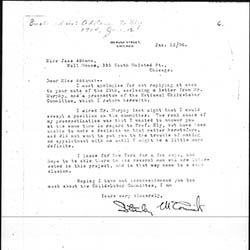
McCormick agrees to join the National Child-Labor Committee and explains that he has not made a decision yet about Richard T. Ely's request.

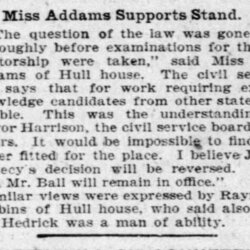
Addams discusses the procedure for hiring civil servants in the light of Charles B. Ball's appointment of sanitary inspector.

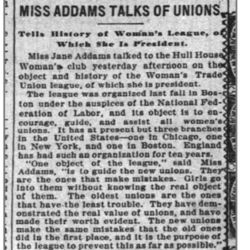
A newspaper report that includes an excerpt from Addams' talk to the Hull-House Woman's Club on the object and history of the Women's Trade Union League.

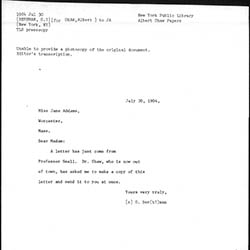
Berhman sends Addams a letter from Professor Small upon the request of Albert Shaw.

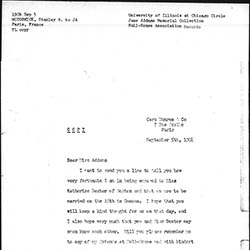
McCormick writes Addams to announce his engagement to Katharine Dexter.

Linn recounts his travels in Wyoming with companions.

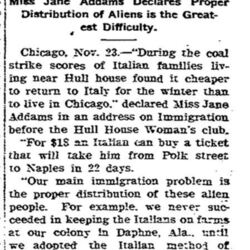
Addams argues that immigrants needs to be dispersed throughout the country to be successful.

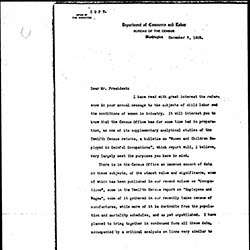
North discusses the availability of data on woman and child labor held by the Census Bureau and their efforts to compile it.

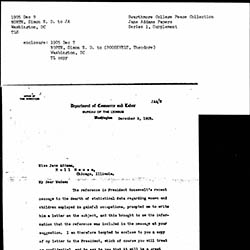
North wrote to Addams about Theodore Roosevelt's complaint that there was insufficient data on women and children's employment, and asks for her help with a plan.

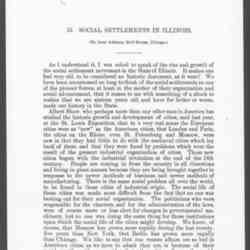
Addams discusses the history of social settlements in Illinois at a meeting of the Illinois State Historical Society, discussing the neighborhoods, settlement foundings, child labor, African Americans, and other similar charitable organizations.

Breckinridge returns some materials about the lobbying for an investigation of working conditions for women and discusses the status of the work.

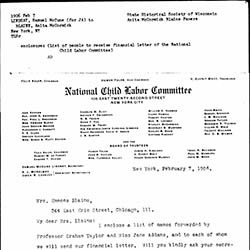
Lindsay encloses a list of names sent by Addams and Graham Taylor which should be used with the funding request from the National Child Labor Committee.

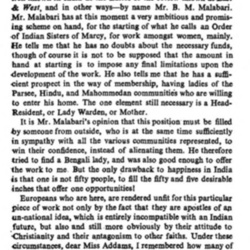
Nivedita asks Addams to find a head resident for a new settlement in India.

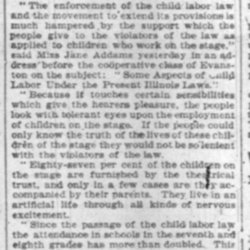
Addams presents reasons to oppose the employment of young children in the theater.

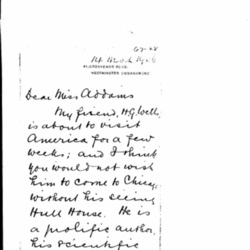
Webb informs Addams that H. G. Wells is to visit America and he wants Wells to visit Hull-House.

Breckinridge expresses her gratitude to Addams for writing her piece in the March Ladies' Home Journal and how it inspired her.

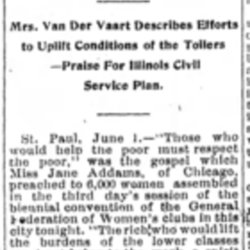
Also known as Address at the General Federation of Women's Clubs Convention, June 1, 1906 (excerpt)

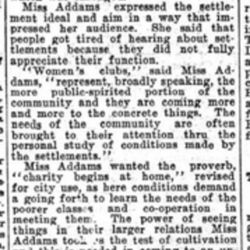
Addams discusses the role that settlements play in improving the conditions of the poor. Only the portion of the article with Addams remarks has been included.

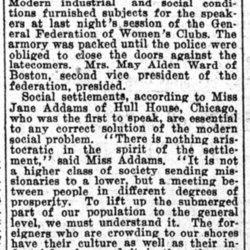
Also known as Address at the General Federation of Women's Clubs Convention, June 1, 1906 (excerpt)

Addams discusses the role of class relations in the settlement movement. Only Addams' portion of the article was included.

Addams reports that when Lindsey was not nominated for re-election by either party, the women of Denver elected him as an independent.

For a pamphlet published by the Peace Association of Friends, Addams argues against having rifle practice in public schools.

Gompers writes Addams to decline an invitation to participate in a conference.

George H. Mead's address to the Board of Education, discussing education as a social process.

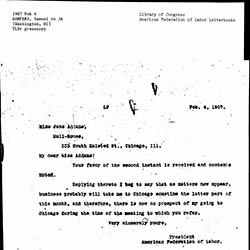
Gompers writes Addams that he will not be attending a meeting with her in Chicago and will come at a different date.

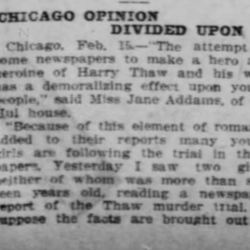
Addams chastises newspapers for glamorizing the story of Harry Thaw, an heir to a railroad fortune who killed his wife's lover.

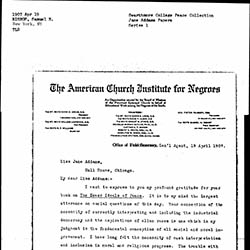
Bishop praises Addams on Newer Ideals of Peace, especially the arguments about religion and democracy.

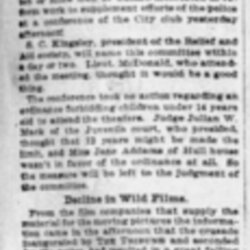
Addams supports the idea of regulating theaters aimed at juvenile audiences, but not banning children from attending.

Addams' testimonial to the educational value of Carl Laemmle's movies, which are shown in Hull-House.

Addams argues for the creation of entertainments for urban dwellers for recreation and relaxation. This is an excerpt of  Addams' speech, Public Recreation and Social Morality.

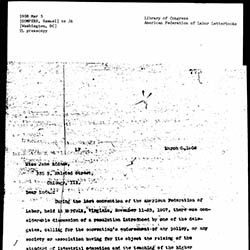
Gompers reports to Addams that the Executive Council of the American Federation of Labor has agreed to endorse the raising of industrial education and the teaching of improved techniques.

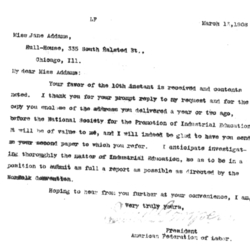
Gompers thanks Addams for sending him a copy of her address at a meeting of the National Society for the Promotion of Industrial Education in Chicago.

Breckinridge suggests that Addams meet with Oscar Strauss, and Cyrus Adler.

Addams discusses traditional women's roles and how they correspond to a greater need for the involvement of woman in politics.
Output Formats

Export results to CSV,