66 results

  • Subject is exactly "women, political culture"

Addams discusses the impact of woman suffrage on India, Burma, Japan, and China.

Addams discusses the impact of woman suffrage on India, Burma, Japan, and China.

Bass asks Addams to recognize some of the women who worked in Cook County on the State Educational Committee.

Post tells Balch about the problems of obtaining passports to Europe.

Post relates to Addams her conversation with William Jennings Bryan about the Woman's Peace Party's letter to the President and plans for a Congress after peace is achieved in Europe.

Post relays the information about the fundraising needs of the Woman's Peace Party and sends charter members leaflets for them to use.

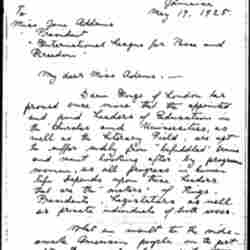
Addams argues that American women are behind their European peers with regard to individual rights.

Spencer writes Addams about the Woman's Peace Party and the recent conference in Washington.

Haldeman-Julius updates Addams on her daughter, explains recent appeals to remove her husband from the draft, and discusses their publishing company.

Martin asks Karsten to thank Addams for her political endorsement and hopes she will help campaign in Nevada.

Ford asks Addams' advice on how to include women in the new Indiana constitution.

"A Woman from Los Angeles" congratulates Addams's call for a disarmament plank at the Republican convention.

Also known as Bryn Mawr Commencement Address, June 6, 1912

In this commencement address, Addams discusses the changes in perception of women's intelligence and argues that the time is ripe for women's intelligence to hold sway. The speech was later published in the Bryn Mawr Alumnae Quarterly.

Catt asks Addams for information so that she can publish a defense of peace activists vilified by the Daughters of the American Revolution.

Breshkovsky thanks Starr for her friendship and discusses her difficulties in communicating her ideas.

Addams discusses the value of the vote at the General Federation of Women's Clubs convention.

A report detailing the Daughters of the American Revolution's effort to stop dissent.

Hubbart wants Addams to advise her on how to be of better use to the peace movement.

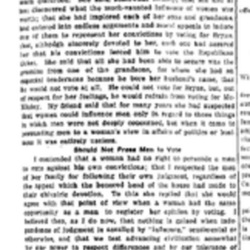
Fleischer applauds Addams' involvement with the Progressive Party, arguing that politics is a logical extension of social work.

Balch brings to the attention of Addams that Polish women have been denied a say in their League of Nations and urges all sections of the Women's International League for Peace and Freedom to fight for recognition of their voting rights.

Balch asks Addams about whether the Women's International League for Peace and Freedom should advertise about their efforts in European women's journals.

Hobhouse writes to Addams on her position with the British Committee for the International Women's Congress and personal matters of health and travel.

Johnson examines the emotional aspects of the presidential election and how politicians use emotion to win votes.

Taussig asks Addams to release a statement that clarifies the Women's International League for Peace and Freedom's position on endorsing candidates.

The paper reports on discussions of milk shortage and child welfare in Germany held at the Paris Peace Conference.

Abbott writes Case about pictures of children and Case's father.

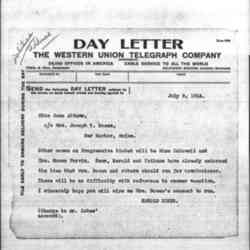
Ickes informs Addams that McDowell and Purvin are running on the Progressive ticket, and to ask her to wire him Bowen's consent to run as well.

Blatch asks Addams to support efforts to erect monuments to woman suffrage leaders in Washington, DC.

Addams argues for woman suffrage, demonstrating the limits of influence that women can have on political affairs without the vote.

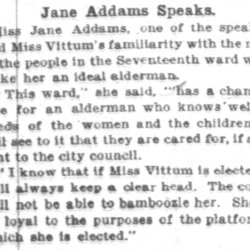
Addams endorses Harriet Vittum, who campaigned for the Board of Aldermans in the Seventeenth ward of Chicago.

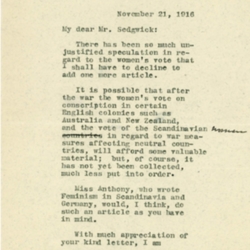
Addams writes to Sedgwick explaining her reluctance to write an article on women's vote at the moment.

Addams writes to Sheehy Skeffington about representation, particularly for women and Ireland, within the International Committee of Women for Permanent Peace.

Addams agrees to join Blatch's work to place busts of suffrage leaders in Washington, DC.

Addams tells Travis that the Daughters of the American Revolution's condemnation of the Women's International League for Peace and Freedom is not the work of the national organization, but only of some local chapters.

Addams writes Wald about her preference for Julia Lathrop to become the head of the United States Children's Bureau.

Addams writes Allender regarding appointments for the Woman's Peace Party.

Addams and seventy other prominent club women write President Coolidge asking for better enforcement of prohibition laws.

Jennison invites Addams to speak at a Michigan meeting in support of Robert La Follette's presidential campaign and to help get the Women's International League for Peace and Freedom's Detroit Branch going again.

A draft of Addams' article about the challenges facing college women who want to contribute to society.

Addams discusses the challenges facing college women who want to contribute to society.

The National Progressive Party plans for the involvement of women after a conference.

The Association of Collegiate Alumnae proposed various ways in which women may be included in the war effort and maintain ranks alongside men, primarily as nurses but as other medical specialists as well.

Schwimmer updates Addams about attacks on her by the Jewish media and seeks help taking Norman Hapgood to task.

Addams informs Pennybacker of her selection as a member of the Cooperating Council in the Woman's Peace Party and expresses her hope that she will serve as a representative.

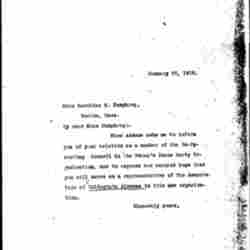
Addams informs Humphrey of her selection as a member of the Co-Operating Council in the Woman's Peace Party and expresses her hope that she will serve as a representative.

Addams informs Robins of her selection as a member of the Cooperating Council in the Woman's Peace Party and expresses her hope that she will serve as a representative.

Addams informs McDowell of her selection as a member of the Cooperating Council in the Woman's Peace Party and expresses her hope that she will serve as a representative.

Sheba tells Addams about her religious beliefs that the current leaders of religion are corrupt and inept.

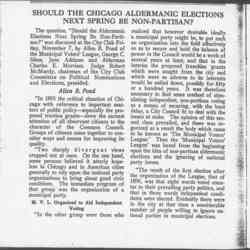
In this published version of a speech given to the Chicago City Club on November 7, Addams discusses party politics, the viability of independent parties, and the possibilities of women's role in municipal elections in Illinois.
Output Formats

Export results to CSV,