66 results

  • Subject is exactly "pacifism"

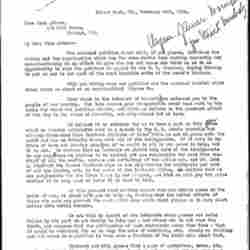
Addams reports on the Progressive Party Convention, discussing how items were added to its platform, particularly labor and military planks, and her dismay about the conventions unjust treatment of African-Americans. This is one of a series of articles she prepared as part of the Progressive Party campaign in 1912.

Addams describes her experiences at the Progressive Party Convention, discussing how items were added to its platform, particularly labor and military planks, and its appeal to labor and women.

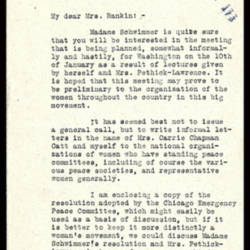
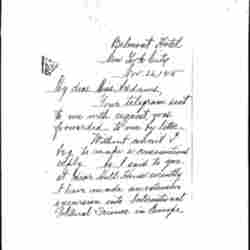
Addams discusses plans for gathering a group of women peace activists to work on a resolution or proposal. (Enclosures not found.)

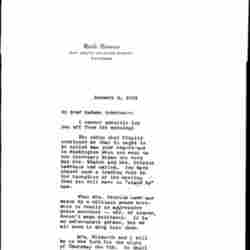
Addams insists that Schwimmer continue to support the peace conference despite her disagreement with Lawrence's call for a militant peace movement.

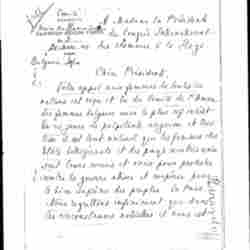
Karavelova responds to Addams' request for representatives to the International Congress of Women.

Addams reports that the International Congress of Women believes that the sinking of the Lusitania must bring neutral nations to work to end World War One.

Stone informs Addams that she unfortunately will not be able to contact the president directly, and although she believes a convention of the Neutral Powers would be futile, she would be happy to assist the Woman's Peace Party.

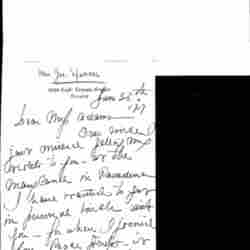
Miller writes as a representative to the Organization of American Women for Strict Neutrality, encouraging Addams to read about the organization itself and to take a look at her enclosed petition.

A fragmented document written by Addams, possibly a draft of a speech she would later give. In it, Addams argues how nationalistic ideas are beginning to cloud peoples judgement about the war.

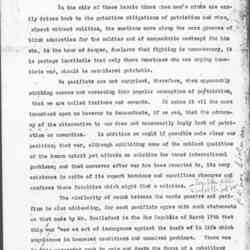
Addams argues how ideas about nationalism and patriotism are beginning to cloud people's judgement about the war.

Addams argues how ideas about nationalism and patriotism are beginning to cloud peoples judgment about the war.

Werkheiser tells Addams about the lack of value placed on human life and proposes a solution.

McLaughlin tells Addams about her new book Efficiency vs. War and of her support for the peace movement.

Addams argues how ideas about nationalism and patriotism are beginning to cloud peoples judgement about the war. This speech was given before the Chicago Woman's Club.

Addams discusses the challenges pacifists face now that the United States has entered World War I, and discusses how nationalism and patriotism are used to support war. Addams gave a lecture version of this article on June 10 at the Evanston Congregational Church.

Zueblin argues that Prussian militarism is the real enemy and that the war pits militarism against democracy

Jones writes Addams a rambling letter about his views on pacifism.

Kerr's editorial in the Cleveland News attacks Addams' for her views on peace, calling her naive.

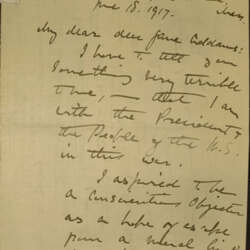
Evans admits to Addams that she now supports the need for World War I and is leaving the peace movement.

Henderson describes pro-World War I propaganda and tells Addams that he now supports peace.

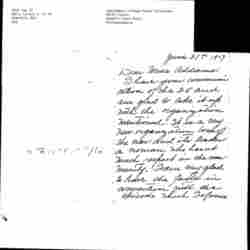
Holt takes up communication with a society of women from Detroit for Addams.

Sihler tells Addams he added her name to a list of subscribers to a potential publication about Germany.

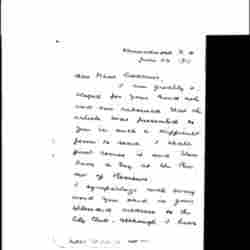
White tells Addams about how she was inspired by Addams' articles. White then discusses how she disagrees with a recent policy adopted by the Woman's Party.

Waugh is grateful for Addams's stance in her writings and lets her know that her views are shared by many whose voices are stifled.

Addams refuses to write an introduction for Lloyd's brother to Edward M. ("Colonel") House.

Addams discusses the the Russian Revolution and Russian Civil War using Tolstoy's theories, and argues that Russia represents an effort to end rather than start wars.

Addams discusses the the Russian Revolution and Russian Civil War using Tolstoy's theories, and argues that Russia represents an effort to end rather than start wars.

Weyl thanks Addams for her critique of his book The End of War (1918).

Balch provides Harwood with a sense of the Women's International League for Peace and Freedom's mission and immediate goals.

Jordan writes to Addams about Alfred Fried's work.

Baber writes Addams about the political situation in Mexico and her opposition to the celebration of Memorial Day.

Balch encloses a message regarding pacifists in France.

Balch asks Addams for advice on peace strike regarding the wording of the Women's International League for Peace and Freedom's creeds and objective statements.

Swanwick offers Addams advice regarding the Irish Civil War and the American Commission on Conditions in Ireland.

Adler tells Spencer that he is skeptical about Friedrich Foerster's plans for a pacifist school to be funded from outside Germany.

La Follette sends a report to Addams and suggests that it contains a plan for women's work against militarism.

Also known as Peace and Bread: Personal Reactions During the War, January 28, 1922

Addams discusses United States foreign policy and pacifism during World War One.

Arthur Kellogg suggests that Paul Kellogg send a copy of a letter from Agnes Hills to Addams.

Kennedy thanks Addams for her Survey articles and muses on how pacifists were treated during the World War Ir.

Also known as Emily Greene Balch to Women's International League for Peace and Freedom's Executive Committee, Consultative Members, and Secretaries of National Sections, March 1922

Balch writes to the Women's International League for Peace and Freedom Executive Committee postponing the meeting and requesting feedback on several issues.

Heymann reports on a questionnaire about passive resistance and seeks information from other Women's International League for Peace and Freedom branches.

Bennett argues that successful passive resistance campaigns must rely on sound education, financial planing, and public opinion, drawing on the Irish case.

Farwell thanks Addams for sending Peace and Bread in Time of War and remarks that in one hundred years society will accept pacifism as the logical way.
Thomas praises Addams's Peace and Bread in Time of War and updates her on Helen Culver's health.
Vernet writes to the No More War organizers in the hopes of joining the movement and securing support for an anti-war league.

Cumberson thanks Addams for Peace and Bread in Time of War. 

A review of Peace and Bread in Time of War.

Spencer tells Addams of her husband's death and her optimism for peace in the world.

Balch answers Puck's letter to Addams suggesting caution against working for mobilization against war.
Output Formats

Export results to CSV,