66 results

  • Subject is exactly "pacifism"

Runham sends Balch an article about the Tolstoy Commune that he could nit fit in War Resisters International's bulletin.

Balch asks Cousins for information on the conference of women of Asia.

Burton proposes an international peace ship called the World Citizen.

Lathrop asks Addams whether they should see if Henry Ford was willing to change his views on pacifists.

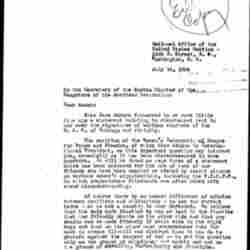
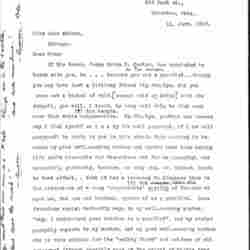
Balch defends Addams against accusations made by the Daughters of the American Revolution and other organizations.

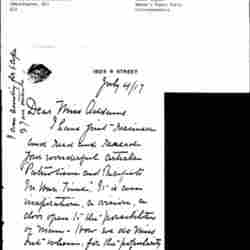
Kennedy congratulates Addams on the Civic Dinner and discusses settlement projects

Widegren tells Addams that the Swedes are having difficulty accepting the Women's International League for Peace and Freedom's pacifist platform passed at the International Congress of Women.

Blake asks Dempsey to have students broadcast a peace message on May 18.

Rochester reviews Marcelle Capy's L'Amour Roi.

The branch seeks to reopen debate over the Women's International League for Peace and Freedom's purpose at the next International Conference due to hostility to it from other organizations.

Winsor tells Addams that she cannot support the Women's International League for Peace and Freedom because they will not come out cleanly for non-resistance.

Addams tells Courtney of her concern over the Women's International League for Peace and Freedom's language which has to walk a fine line to maintain all its members.

Courtney tells Addams that some Women's International League for Peace and Freedom members oppose the pacifist doctrines sent out after the Washington meeting and asks that they be formally ratified at the next international congress.

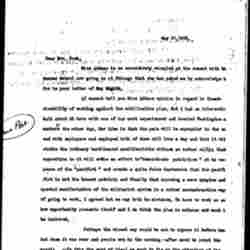
Balch tells the Kaskia Chapter that Women's International League for Peace and Freedom's position ion disarmament has been misrepresented and hopes that even if they disagree, they are both working for the nation's best interests.

Balch answers Puck's letter to Addams suggesting caution against working for mobilization against war.

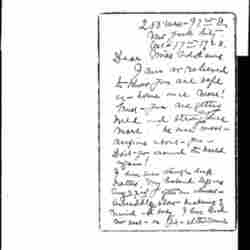
Spencer tells Addams of her husband's death and her optimism for peace in the world.

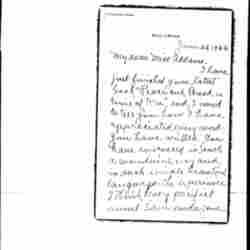
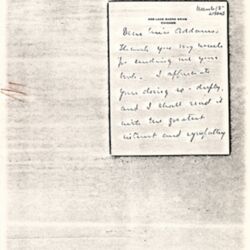
Cumberson thanks Addams for Peace and Bread in Time of War. 

A review of Peace and Bread in Time of War.

Farwell thanks Addams for sending Peace and Bread in Time of War and remarks that in one hundred years society will accept pacifism as the logical way.

Bennett argues that successful passive resistance campaigns must rely on sound education, financial planing, and public opinion, drawing on the Irish case.

Vernet writes to the No More War organizers in the hopes of joining the movement and securing support for an anti-war league.

Heymann reports on a questionnaire about passive resistance and seeks information from other Women's International League for Peace and Freedom branches.

Also known as Emily Greene Balch to Women's International League for Peace and Freedom's Executive Committee, Consultative Members, and Secretaries of National Sections, March 1922

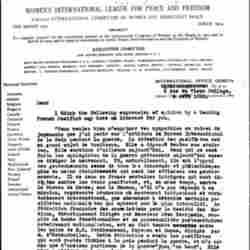
Balch writes to the Women's International League for Peace and Freedom Executive Committee postponing the meeting and requesting feedback on several issues.

Thomas praises Addams's Peace and Bread in Time of War and updates her on Helen Culver's health.

Arthur Kellogg suggests that Paul Kellogg send a copy of a letter from Agnes Hills to Addams.

Kennedy thanks Addams for her Survey articles and muses on how pacifists were treated during the World War Ir.

La Follette sends a report to Addams and suggests that it contains a plan for women's work against militarism.

Adler tells Spencer that he is skeptical about Friedrich Foerster's plans for a pacifist school to be funded from outside Germany.

Swanwick offers Addams advice regarding the Irish Civil War and the American Commission on Conditions in Ireland.

Balch encloses a message regarding pacifists in France.

Balch asks Addams for advice on peace strike regarding the wording of the Women's International League for Peace and Freedom's creeds and objective statements.

Baber writes Addams about the political situation in Mexico and her opposition to the celebration of Memorial Day.

Jordan writes to Addams about Alfred Fried's work.

Also known as Peace and Bread: Personal Reactions During the War, January 28, 1922

Addams discusses United States foreign policy and pacifism during World War One.

Balch provides Harwood with a sense of the Women's International League for Peace and Freedom's mission and immediate goals.

Weyl thanks Addams for her critique of his book The End of War (1918).

Addams refuses to write an introduction for Lloyd's brother to Edward M. ("Colonel") House.

Waugh is grateful for Addams's stance in her writings and lets her know that her views are shared by many whose voices are stifled.

Evans admits to Addams that she now supports the need for World War I and is leaving the peace movement.

Kerr's editorial in the Cleveland News attacks Addams' for her views on peace, calling her naive.

Jones writes Addams a rambling letter about his views on pacifism.

White tells Addams about how she was inspired by Addams' articles. White then discusses how she disagrees with a recent policy adopted by the Woman's Party.
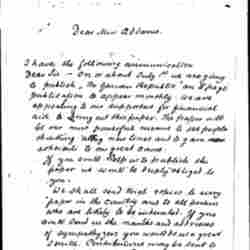
Sihler tells Addams he added her name to a list of subscribers to a potential publication about Germany.
Holt takes up communication with a society of women from Detroit for Addams.
Henderson describes pro-World War I propaganda and tells Addams that he now supports peace.

Werkheiser tells Addams about the lack of value placed on human life and proposes a solution.

Zueblin argues that Prussian militarism is the real enemy and that the war pits militarism against democracy
Output Formats

Export results to CSV,