68 results

  • Subject is exactly "immigration reform"

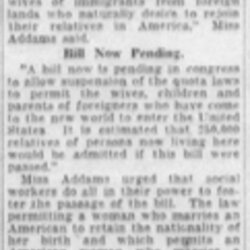
Addams exhorts social workers to support a bill suspending immigration quota to allow family members of residents to join them.

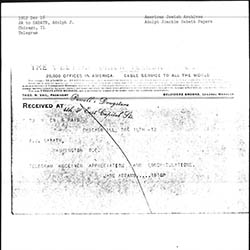
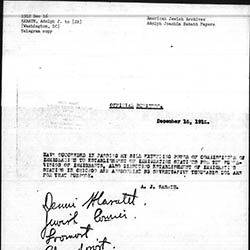
Sabath cables Addams that Congress passed a bill to place an immigration station in Chicago.

Excerpts from Addams' speech on educational opportunities wasted due to discrimination against immigrants.

Addams discusses the perils that face immigrant women and the need for protections.

Addams decries the deportation of immigrants due to the Immigration Act of 1924. This speech was given at the National Conference of Social Work.

Woods tells Speer that he considers the Japanese Exclusion Act a disaster for the United States.

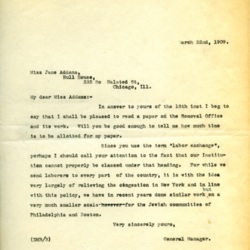
Bressler accepts Addams' invitation to give a paper at a conference.

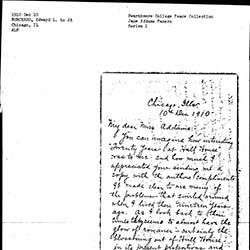
Burchard thanks Addams sending a copy of Twenty Years at Hull House and looks back at his time living there with nostalgia.

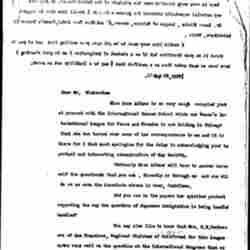
Balch tells Wickersham that Addams is busy with the peace activiries and sends him other contacts and notes Addams's statement on Japanese immigration.

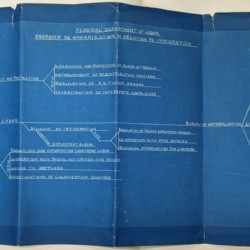
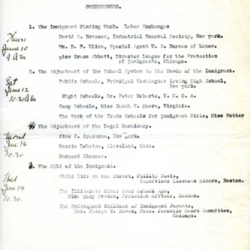
The Department of Labor proposes a reorganization of work for immigrants.

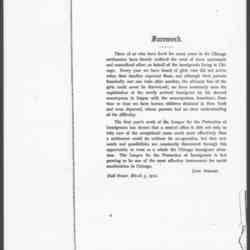
As a foreword to the report on the Immigrants Protective League, Addams explains the difficulties immigrants face and the importance of the League's work to assist them.

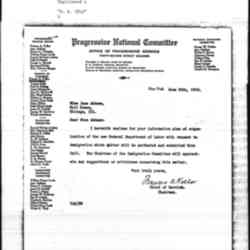
Kellor sends Addams a plan of organization for the new Federal Department of Labor for comment.

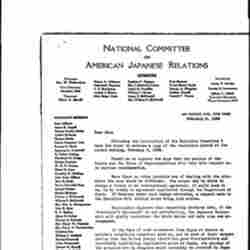
Wickersham tells Addams about the Committee's resolution on the "Gentleman's Agreement" and their hope to foster better relations between the United States and Japan.

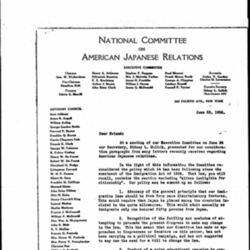
Wickersham asks Addams' opinion on keeping the Committee's goals the same.

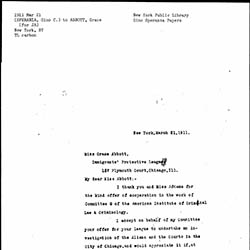
Speranza thanks Abbott and Jane Addams for their work on behalf of the American Institute of Criminal Law & Criminology in its investigation of the courts.

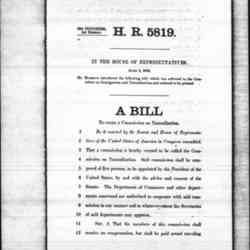
A House bill, introduced by Victor Murdock, to create a Commission on Naturalization.

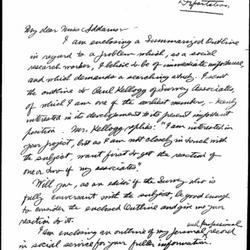
Winkler asks Addams to read and react to her proposed research on immigration.

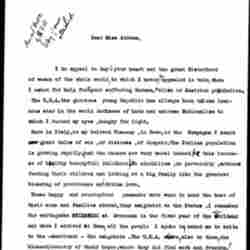
Von Trueberg asks Addams for help in lobbying Congress to admit more immigrants from Italy, Germany and Austria.

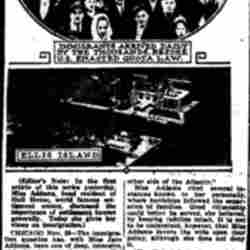
Addams discusses how the recent immigrant quota laws have created hardships for immigrants and the American economy, and have created false ideas about immigrants and social problems.

Addams reviews the research and papers of her colleagues on the topics of immigration, employment, and education at the National Charities and Correction meeting.

Addams tells Cipriani that she opposes the restriction of immigration and believes the current laws are unfair.

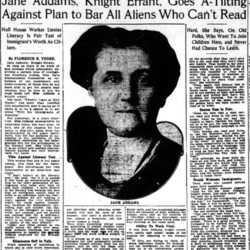
Addams is interviewed about her stance on literacy testing for immigrants, before she lobbied on Capitol Hill for the issue.

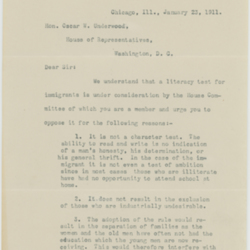
Addams and Abbott write Underwood to oppose a Congressional bill to require literacy tests for immigrants.

Addams congratulates Sabath on the passage of a bill to establish an immigration station in Chicago.

Addams sends Woods an article by David Starr Jordan on the Japanese immigration question.

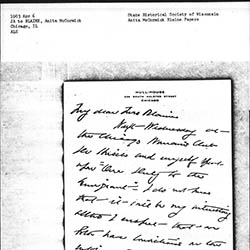
Addams tells Blaine that she is speaking with Dr. Hirsch about "Our Duty to the Immigrant " at the next meeting of the Chicago Women's Club.

Addams asks Coolidge to veto efforts to limit Japanese immigration to the United States.

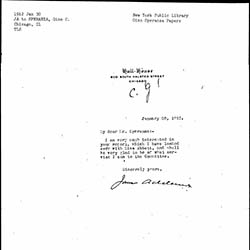
Addams expresses her eagerness to help Speranza with the Committee on Crime and Immigration.

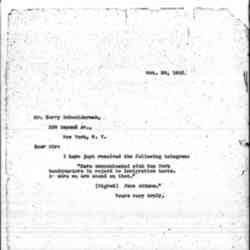
Also known as Julius Rosenwald to Henry Schneiderman October 30, 1912

Rosenwald sends Schneiderman a transcript of a telegram from Jane Addams related to literacy tests for immigrants

Addams writes Wald about the importance of the Ostrow case to the Jewish immigrant community and makes plans to meet with Cyrus Adler and Oscar Straus in Washington.

Addams tells Lewis about Jeannette Rankin's interest in working with Women's International League for Peace and Freedom.

Addams advises Doty about holding the Women's International League for Peace and Freedom's United States Section's meeting in Chicago, and discusses Japanese-American relations.

Addams provides Straus with information on the Committee on Immigrants program coming up at the Conference of Charities and Correction.

Addams sends Kellogg a letter from Countess Treuberg regarding possible publication in the Survey.

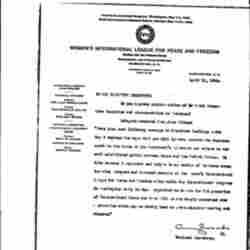
Addams sends a statement to the Women's International League for Peace and Freedom that includes her telegram to Calvin Coolidge regarding the pending immigration law.

Addams expresses praise to the President for vetoing an immigration bill.

Addams, Bowen, and Breckinridge invite an unknown person to Hull-House for a meeting of professors and the League for the Protection of Immigrants.

Berwald takes issue with the Tribune's stance that only true Americans have ancestors who spoke English. He also expresses his anti-war beliefs.

Rosenwald asks Addams for the Progressive leaders to offer statements on literacy tests for immigrants.

Addams notes that American foreign policy is criticized outside the country for failing to join the World Court and League of Nations.

Smith thanks Kohn for the candies she sent to her and to Jane Addams aboard ship for their journey to Egypt and offers some details of their sea voyage.

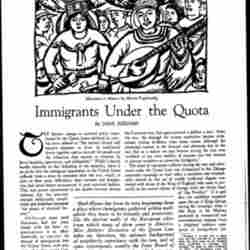
Addams offers a counter narrative to the idea that the U.S. government should limit immigration, arguing that immigrants provide benefits to society and are deserving of protections under the law. This is the fifth article of a monthly, year-long series on economic and social reform in America and a woman's role to affect change.

Draft program Addams sends to David Bressler for the Conference of Charities and Correction.

Holmes argues that Rosika Schwimmer ought not be barred from citizenship because her pacifism makes her unwilling to bear arms in defense of the country.

Kellogg tells Addams about the 16th Conference of the National Federation of Settlements, held in Boston.

Addams provides an argument against literacy tests for immigrants, proposed by the Burnett Bill recently pased by the U.S. House of Representatives.

Addams delivered this commencement address at the University of Chicago on December 20, 1904, the first woman to be a commencement speaker at the college.
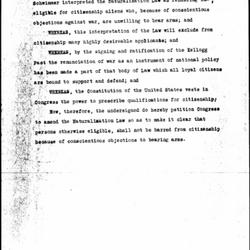
A petition asking Congress to amend the naturalization law to make it clear that conscientious objectors are not barred from citizenship.
Output Formats

Export results to CSV,