63 results

  • Subject is exactly "World War I"

An issue of Unity that features articles on the settlement of international disputes, labor in Italy and Germany, and book reviews.

Addams gave this speech at the Woman's Constructive Peace Conference in Washington, D.C., on the reasons why women need to become more active in politics and the peace movement.

Addams, comparing the act of human sacrifice to what is going on in the early stages of World War One, points out how pointless both acts are.

Plumptre, on behalf of the National Committee of Women's Patriotic Service, criticizes Addams about her views on peace and informs her about an open letter published in Canada.

Baller congratulates Addams on being selected to be one of the Chicago Delegates, provides religious views on the war, and blesses Addams on her journey to The Hague.

Catt explains the international issues that she has encountered in trying to organize an international peace meeting.

Nash sends a message to Addams with a song enclosed and a request.

In this speech, Addams tells the alumnae of the University of Michigan at the Chicago College club, how they can help with the food shortage crisis by conserving food and understanding the production of food.

Jordan has little hope for the meetings that United States officials are having in Europe.

Karsten sends Leach copies of a letter regarding the Congress After the War.

Hobhouse discusses ideas of peace with Addams and about her hopes for The Hague conference.

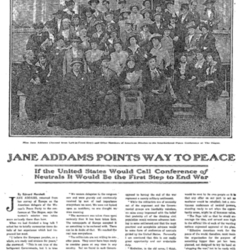
Addams urges for citizens of neutral nations to work actively for peace.

White informs Addams about the meetings that have been arranged. Schwimmer has been an issue because the American peace movement has been labeled as "militant".

Graham discusses the state of World War I and muses about the United States entering the fight.

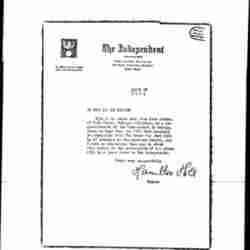
Holt writes a letter "to whom it may concern" about Addams being a representative for The Independent.

Addams talks with New York Times reporter Edward Marshall about World War I and the efforts of the International Council of Women to start peace negotiations.

Addams argues that international peace is not a failed idea, and even though World War I is in the early stages of fighting it is not too late to stop war from continuing.

Addams argues that international peace is not a failed idea, and even though World War One is in the early stages of fighting it is not to late to stop war from continuing. Bryan also claims that peace is possible with mediation.

Addams forwards Carrie Catt's plan for a peace conference.

Addams promises to send Wales more folders with argumentative content. Addams also responds to a suggestion offered by Wales in previous correspondence and has enclosed a poem from a soldier.

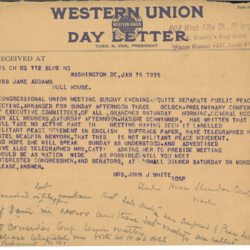
Addams forwards Carrie Catt's idea for a women's peace meeting.

Addams sends Wald a letter from Bryan, in which he says that President Wilson supports peace in his heart, but that is impossible.

Addams asks Reinsch to write an article on the influence of colonial policies on the war for a peace issue of The Survey.

Addams enclosed a poem from a soldier fighting in World War I and offers it for use to Kellogg. Addams further explains her reasons and hesitations in providing reviews of nine books Kellogg had sent her.

Addams describes her travels to Europe.

Addams reports that the International Congress of Women believes that the sinking of the Lusitania must bring neutral nations to work to end World War One.

Style asks Addams how she could help the peace movement and thanks her for trying to end the war.

Blauvelt and Ogle detail The Kenton County Equal Franchise Association's political and philosophical stance on peace.

Glasier describes her time at home while the war wages on and she hopes for peace.

Glasier explains that she has been turning to religion to fight for peace during the First World War.

Glasier tells Evans of her trip in South Wales, and her thoughts on achieving peace in Belgium.

Wald invites Balch to a round-table discussion on peace.

Armstrong expresses his beliefs about the peace movement and the causes of the current war.

Boardman writes to Addams about the work the Red Cross is doing during the war, and hopes that nations would stop fighting each other.

Craigie discusses her activities in Washington for peace and suffrage, especially focusing on Japan.

Page sends a translation of a letter to Addams that she thinks will interest Addams.

The Countess of Selborne sends Addams a poem written by her son.

Selborne talks about the war and what the warring nations see as minimal terms for peace. She also talks about how woman suffrage is a secondary and less important issue to these governments.

Pringsheim argues that trade practices of the United States in the early years of World War I have not been neutral.

Addams urges the belligerent nations at war to call a ceasefire in honor of Christmas.

A fragmented document written by Addams, possibly a draft of a speech she would later give. In it, Addams argues how nationalistic ideas are beginning to cloud peoples judgement about the war.

Addams argues how ideas about nationalism and patriotism are beginning to cloud peoples judgment about the war.

Kellogg discusses the war and the latest draft of a statement Addams has written for the newspapers.

A pamphlet containing a petition from the Swiss Peace Society to the Swiss Federal Council, and the reply. The texts were translated into multiple languages.

The petition requests that university and college faculties support the United States in ending World War I. The petition will later be sent to President Wilson.

This petition draft urges Wilson to help end the war by peaceful means.

Lynch writes about the travels of Battin, and some of his accomplishments in traveling abroad to various branches of the World Alliance for Promoting International Friendship through the Churches.
Output Formats

Export results to CSV,