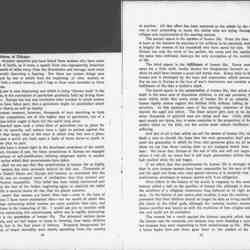
Addams reflects on her career at the National Federation of Settlement Conference. The speech was given on June 19, 1929 and published in Neighborhood in July.
In this speech, Addams tells the alumnae of the University of Michigan at the Chicago College club, how they can help with the food shortage crisis by conserving food and understanding the production of food.
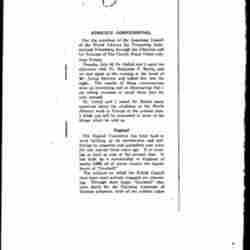
Lynch writes about the travels of Battin, and some of his accomplishments in traveling abroad to various branches of the World Alliance for Promoting International Friendship through the Churches.
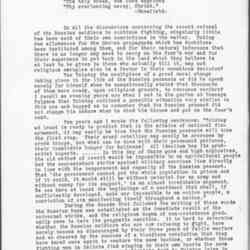
A fragmented document written by Addams, possibly a draft of a speech she would later give. In it, Addams argues how nationalistic ideas are beginning to cloud peoples judgement about the war.
Schwimmer complains to Addams about the collapse of the Peace Ship and Neutral Conference for Continuous Mediation and her difficulties with the Fords and others.
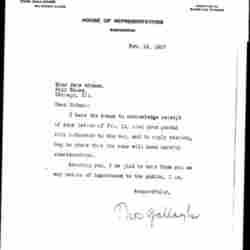
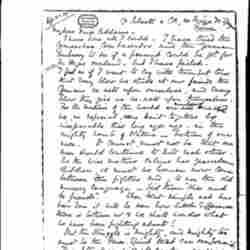
Addams promises to send Wales more folders with argumentative content. Addams also responds to a suggestion offered by Wales in previous correspondence and has enclosed a poem from a soldier.
Addams enclosed a poem from a soldier fighting in World War I and offers it for use to Kellogg. Addams further explains her reasons and hesitations in providing reviews of nine books Kellogg had sent her.
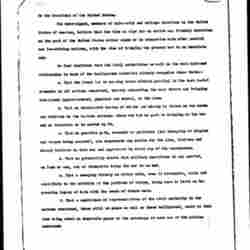
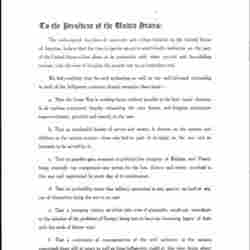
The petition requests that university and college faculties support the United States in ending World War I. The petition will later be sent to President Wilson.
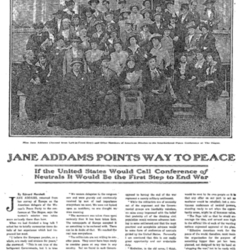
Addams talks with New York Times reporter Edward Marshall about World War I and the efforts of the International Council of Women to start peace negotiations.
Selborne talks about the war and what the warring nations see as minimal terms for peace. She also talks about how woman suffrage is a secondary and less important issue to these governments.
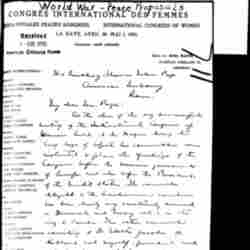
Addams reports that the International Congress of Women believes that the sinking of the Lusitania must bring neutral nations to work to end World War One.
An interview with Addams, by Marshall, right before she leaves for the The Hague peace conference. In this interview Addams discusses the importance of the conference and of women's peace movements.
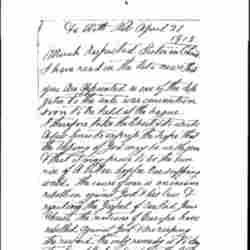
Baller congratulates Addams on being selected to be one of the Chicago Delegates, provides religious views on the war, and blesses Addams on her journey to The Hague.
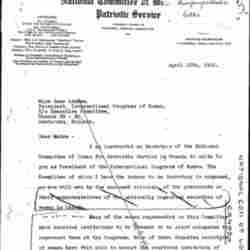
Plumptre, on behalf of the National Committee of Women's Patriotic Service, criticizes Addams about her views on peace and informs her about an open letter published in Canada.
Addams, Kellogg, and Wald argue the many reasons why World War One is destroying society, and detail how it is robbing a generation of its people and future. They also argue that the global community has the power to stop this war and prevent other wars.
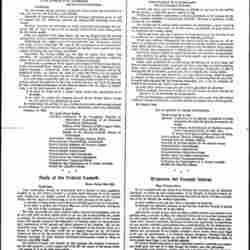
A pamphlet containing a petition from the Swiss Peace Society to the Swiss Federal Council, and the reply. The texts were translated into multiple languages.
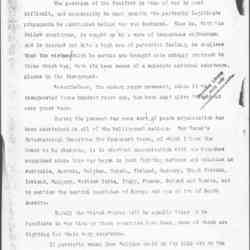
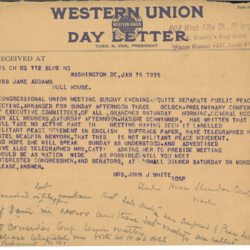
White informs Addams about the meetings that have been arranged. Schwimmer has been an issue because the American peace movement has been labeled as "militant".
Addams gave this speech at the Woman's Constructive Peace Conference in Washington, D.C., on the reasons why women need to become more active in politics and the peace movement.