151 results

  • Subject is exactly "World War I, opposition to"

Henderson describes pro-World War I propaganda and tells Addams that he now supports peace.

Claytor asks for information about the Woman's Peace Party as the women in her area do not wish to lose husbands and sons.

A quote attacking the role of intellectuals in World War I.

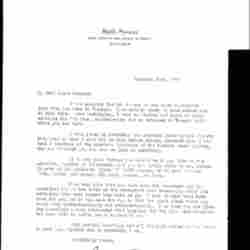
Mercer offers his help to the peace movement and emphasizes the importance of a devotion to God to establishing peace.

Van Buskirk volunteers to assist the peace movement in any way he can.

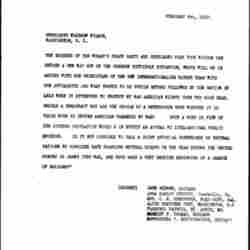
Nasmyth sends a reply to Wilson's recent speech explaining the need for disarmament to perpetuate national safety rather than an increase in war preparation. He offers a list of proposals to ensure peace which focus on strengthening international relations.

In discussing two German Americans attempt suicide to avoid the draft and fighting against their native country of Germany, Viereck's argues for alternate ways for German-Americans to serve their country.

Sinclair suggests that Addams call a conference of women to voice disapproval of the war.

Thomas updates Addams on lobbying efforts and her upcoming travels.

Thomas asks Addams if a plan of action should be spread among Woman's Peace Party branches and chairmen regarding referendums on the war.

Webber writes to Addams about her opposition to the war and hopes that the United States will not enter.

Dudley commiserates with Addams about the United States entering World War I and how peace groups are reacting.

Burrows plans to come to see Addams talk at Kingsway Hall and discusses the peace movement in England.

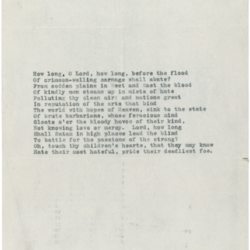
Palmer's poem questions how the world, that can create such beauty, can also breed such hate and violence. Addams comments appear at the bottom.

Palmer's poem questions how the world, that can create such beauty, can also breed such hate and violence.

Palmer's poem questions how the world, that can create such beauty, can also breed such hate and violence.

An extended interview with a Chicago Tribune reporter on Addams's efforts for peace and the work of the International Congress of Women.

Addams gives an interview summarizing the diplomatic work done by the International Congress of Women delegates and heads of state. The comments are similar to reports of a talk she gave that night at the home of Lady Kate Courtney, in London.

Cook is concerned about Wilson's preparedness plan.

Zevin writes Addams soliciting a brief statement regarding the disenfranchisement Jewish people are facing in Europe and the United States during World War I.

Oppenheim hopes the Addams will be willing to write an article for Seven Arts.

The New York Times criticizes the efforts of Addams and the International Congress of Women.

The leaders of the different branches of the Woman's Peace Party contribute towards a letter stating why the President should call for a referendum vote on whether or not America should go to war.

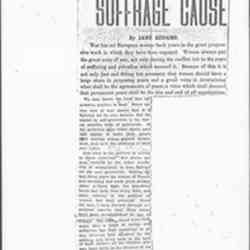
Addams argues the point that women need the right to vote in all national affairs to force the issue of peace, and to help prevent future wars from happening.

Addams hopes to see Lindsey soon and commiserates about the difficulty of finding a way to help on the home front.

Addams describes the services a Conference of Neutral Nations would provide and why it is necessary at this time.

Addams regrets not being able to attend the meeting of the Emergency Peace Federation, but fully supports their purpose and efforts.

Addams asks Denison to write a telegram to Woodrow Wilson urging him to join a conference of neutral nations.

Addams asks Harper to telegraph President Wilson to support a conference of neutral nations to find a just settlement to the war.

Addams asks Baker to include amendments for conscientious objectors in the pending Selective Draft bill.

Addams speculates regarding small European neutral countries making statements on the war.

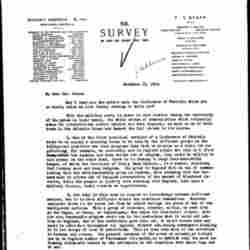
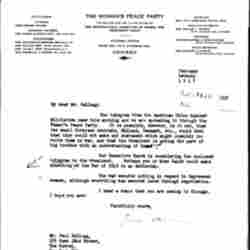
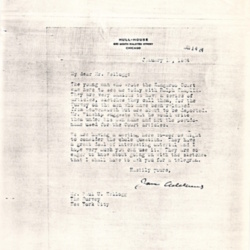
Addams tells Kellogg about meetings with Albert Winship and Ralph Chaplin about articles for the Survey on prisoner releases from Leavenworth.

Addams tells Baldwin that she telegrammed Newton Baker and suggests that he and Lillian Wald so do so too.

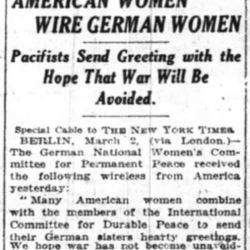
Addams telegrams the German section of the International Women's Committee for Permanent Peace that American women send greetings and hope that war will not come.

Addams lists several points of concern against the war and the issue of "preparedness" to Fisher.

Addams asks members of the Woman's Peace Party National Executive Board to use their influence to try to prevent the United States from being drawn into war.
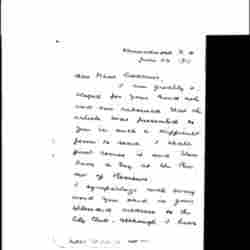
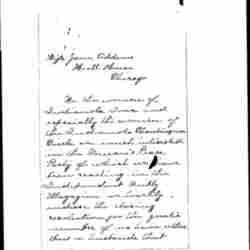
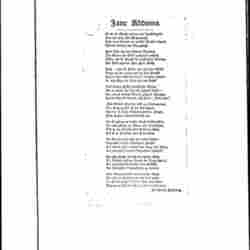
A Müller poem used to describe Jane Addams

Dickie supports Addams' views on food shortages for women and children during war.

Fiske asks Addams to create a petition for the women of America to oppose entry into World War I.

Moore provides Addams data on number of men who claimed a draft exemption as a way to gauge support for the war.

Halsey regrets not getting to speak with Addams but appreciates her address and agrees with her views on politics.

Wales discusses peace propaganda, including Continuous Mediation pamphlets and the film Throw Down Your Arms.

Sihler praises Addams for her stance on peace and discusses her opposition to war.
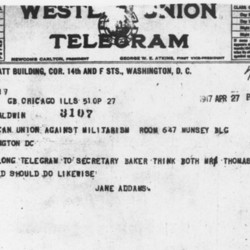
Leckie offers to head the publicity section of the Woman's Peace Party and cites her credentials.

Overman writes to Kent to thank him for the information on women in the peace movement.

Letters written by a German soldier, published in Jus Suffragi, detail the moral dilemma faced by troops at the front.

Lochner invites Addams's ideas on forming a Commission to investigate the ways to avoid war.
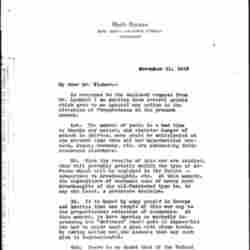
Mead suggests some revisions on the Woman's Peace Party statement and urges it be sent out immediately.
Mead discusses her recent meeting with Norman Angell, efforts to broker a peace conference, and her concerns that peace efforts will fail.

Mead discusses plans for the Woman's Peace Party's statement on peace negotiations and tactics to avoid being seen as too revolutionary.
Output Formats

Export results to CSV,