151 results

  • Subject is exactly "World War I, opposition to"

Palmer's poem questions how the world, that can create such beauty, can also breed such hate and violence. Addams comments appear at the bottom.

Zevin writes Addams soliciting a brief statement regarding the disenfranchisement Jewish people are facing in Europe and the United States during World War I.

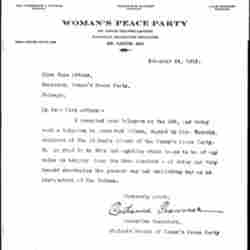
Catt writes Addams about international relations and the future of the Woman's Peace Party.

Leckie offers to head the publicity section of the Woman's Peace Party and cites her credentials.

Claytor asks for information about the Woman's Peace Party as the women in her area do not wish to lose husbands and sons.

Goldman discusses his attempts to end World War I by writing the governments of England, Germany, and Japan.

Hobhouse apologizes to Addams for not being able to attend the International Congress of Women at The Hague, but she will continue to advocate for peace in Italy.

Addams argues the point that women need the right to vote in all national affairs to force the issue of peace, and to help prevent future wars from happening.

Addams gives a recount of what is happening so far at the Hague Conference.

Addams retells the events of the day, April 29th, at the The Hague Convention. Issues Addams details include peace and arbitration for ending World War I.

Addams reports on a resolution calling for arbitration passed by the International Congress of Women.

Addams discusses the events of the International Congress of Women, including presentations by Schwimmer, Augsburg, and Pethick-Lawrence.

Addams and Lochner retell the events of the International Congress of Women.

Burrows plans to come to see Addams talk at Kingsway Hall and discusses the peace movement in England.

Legien tells Bohm about German workers' support for efforts to end the war.

Addams reports that the Executive Committee of the Woman's Peace Party decided against signing Gittings' petition for an arms embargo.

The International Congress of Women asks Denmark to join in a conference of neutral nations to help bring an end to World War I.

Delegates of the International Congress of Women ask the prime minister of Denmark to join a conference of neutral nations.

Addams gives an interview summarizing the diplomatic work done by the International Congress of Women delegates and heads of state. The comments are similar to reports of a talk she gave that night at the home of Lady Kate Courtney, in London.

Letters written by a German soldier, published in Jus Suffragi, detail the moral dilemma faced by troops at the front.

The New York Times criticizes the efforts of Addams and the International Congress of Women.

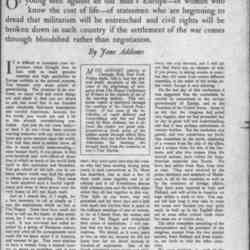
Also known as Revolt Against War, July 9, 1915

Addams's speech on her return from Europe detailed the work of the International Congress of Women and her ideas on peace.

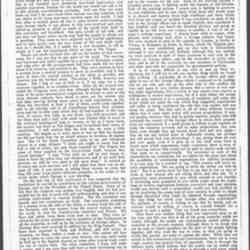
A published version of Addams's Carnegie Hall speech, held July 9, on her return from Europe. In it Adams detailed the work of the International Congress of Women and her ideas on peace.

Addams reports the efforts of the International Congress of Women, the delegations to heads of European countries, and her views on peace. The speech was given at Carnegie Hall on July 9 and published on July 31, 1915.

Jordan asks Addams to sign and promote a petition to President Wilson to encourage him to work to ending World War I.

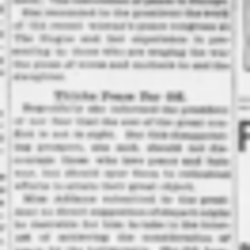
An extended interview with a Chicago Tribune reporter on Addams's efforts for peace and the work of the International Congress of Women.

Addams discusses her work with the International Congress of Women, the delegations to European leaders, and her views on the need for peace. The event was held at the Chicago Auditorium and attended by both peace activists and the general public, and chaired by Charles L. Hutchinson.

Merkel plans to organize men to help promote peace and asks Addams' support for the German University. League.

Palmer's poem questions how the world, that can create such beauty, can also breed such hate and violence.

Palmer's poem questions how the world, that can create such beauty, can also breed such hate and violence.

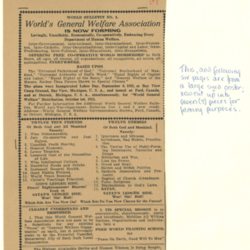
The poster contains various bulletins and petitions with an anti-war ethos.

Kellogg asks Addams for information regarding paying the printer for the International Committee of Women's Manifesto and discusses publicity efforts.

Wales discusses peace propaganda, including Continuous Mediation pamphlets and the film Throw Down Your Arms.

Addams lists several points of concern against the war and the issue of "preparedness" to Fisher.

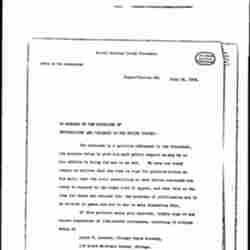
Addams describes the services a Conference of Neutral Nations would provide and why it is necessary at this time.

Addams asks Denison to write a telegram to Woodrow Wilson urging him to join a conference of neutral nations.

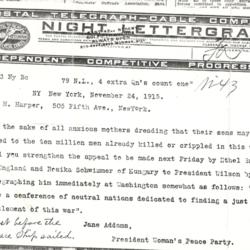
Addams asks Harper to telegraph President Wilson to support a conference of neutral nations to find a just settlement to the war.

Cranmer acknowledges Addams' recent telegram and has written Wilson urging neutrality on behalf of the St. Louis branch of the Women's Peace Party.

Nasmyth sends a reply to Wilson's recent speech explaining the need for disarmament to perpetuate national safety rather than an increase in war preparation. He offers a list of proposals to ensure peace which focus on strengthening international relations.

Hull informs Addams that although he supports her cause, he cannot take part in Henry Ford's peace plan. He asks if she would be willing to invite the current president of Swarthmore College in his place.

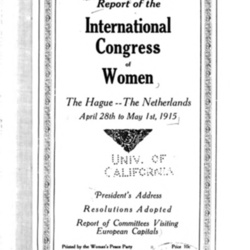
The International Congress of Women's report of activities including Jane Addams's address, resolutions, and a report of the work done by the delegations to European capitals.

Parsons is troubled over the growing sentiment towards war and asks Addams to speak to those in power.

Villard suggests points that Addams might argue in her testimony before the Senate Military Affairs committee, highlighting the political and costs drawbacks of militarization.

Addams testifies before the House Military Affairs Committee against indulging in military preparedness.

Hyers sends Dusenbury anti-preparedness literature and notes that the force behind the movement is financial.

Hyers responds for Addams, telling Pfannebecker that it would be extremely difficult to help the peace movement by contacting relatives in Germany and urging them to protest to their government.
Parsons sends Addams materials arguing for peace and asks for her support of a Senate resolution (enclosed) to empower a Neutral Nations Conference.

Cook is concerned about Wilson's preparedness plan.

Overman writes to Kent to thank him for the information on women in the peace movement.
Laddey offers to collaborate on peace work with Addams.
Output Formats

Export results to CSV,